

Before you even think about draping that hood over your shoulders, it’s worth taking a moment to understand what you’re actually wearing. This isn’t just another piece of your graduation outfit; it's a visual transcript of your academic journey, packed with centuries of tradition.
Every color, fabric, and inch of its length tells a story about your degree, your field of study, and the university you’re so proud to represent. Knowing what it all means turns wearing your hood from a simple requirement into a genuine point of pride.
The whole tradition is steeped in academic history. The academic hood first popped up at the University of Cambridge way back in 1284, originally serving a practical purpose—keeping scholars and clerics warm in drafty stone halls. The tradition made its way to America in the 1750s with King's College (now Columbia University). By 1895, a group of 15 prestigious U.S. universities got together to form the Intercollegiate Commission, establishing the Intercollegiate Code of Academic Costume that most schools still follow today.
Anatomy of an Academic Hood
At first glance, all hoods might look the same. But look a little closer, and you'll see a detailed system of colors, fabrics, and lengths that tells a graduate's story. Understanding these parts will help you wear your hood correctly and appreciate the regalia of everyone around you.
To make sense of it all, here's a quick breakdown of the key components you'll find on an academic hood.
| Component | What It Represents |
|---|---|
| Velvet Trim | The color of the velvet signifies your specific field of study or academic discipline. |
| Satin Lining | The colors inside the hood represent the official colors of your university. |
| Shell | The main black fabric of the hood, designed to match your graduation gown. |
| Length | The size of the hood indicates your academic level (bachelor's, master's, or doctoral). |
Let's dive a little deeper into what each of these components really means.
Here are the primary parts of your academic hood:
- Velvet Trim: This is the most important color on your hood. The rich velvet border signifies your specific field of study. Dark blue, for example, represents Philosophy (Ph.D.), while golden yellow stands for Science.
- Satin Lining: The silk or satin material on the inside is all about school pride. It showcases the official colors of the university that granted your degree. When you wear the hood correctly, you'll flip these colors out to put them on full display.
- Shell: This is simply the main fabric of the hood. It’s almost always black to match your gown.
- Length: The size of the hood isn't just for show; it directly indicates your academic level. A bachelor's hood is the shortest, a master's is a bit longer, and the doctoral hood is the longest and most impressive of them all.
Your academic hood is a symbolic garment that visually communicates your academic achievements. Every color and every inch of its length tells a part of your unique educational story, connecting you to a legacy of scholars who came before you.
What Your Hood Says About You
Think of your hood as your personal academic banner. Take a deluxe master's graduation hood, for instance. It’s precisely three and a half feet long, which immediately sets it apart from the four-foot doctoral hood. Its three-inch-wide velvet trim tells everyone your field—maybe white for Arts, Letters, and Humanities, or drab for Commerce and Business.
And that brilliant flash of color from the satin lining? That’s a proud declaration of where you earned your degree. Once you understand these details, you’re not just carrying a piece of fabric. You’re wearing a testament to your hard work, dedication, and incredible achievement.
The Practical Guide to Draping Your Hood Perfectly
Putting on an academic hood for the first time can feel a little like trying to solve a puzzle. Let's be honest, it’s a uniquely shaped garment, and getting that elegant drape doesn't just happen by accident. But with a few simple tricks I've picked up over the years, you can learn how to wear your hood so it sits perfectly, showcasing your achievements with some real polish and confidence.
First things first, make sure your graduation gown is already on. Unfold your academic hood and drape it over your non-dominant arm with the velvet side facing up. Getting it into this position from the start makes it so much easier to handle before you place it over your head.
Now, with your free hand, grab the hood and lift it over your head. The goal is to let it drape down your back, with the pointed "V" shape of the velvet trim resting flat and centered right on your chest, just below your collarbones. It should feel balanced, not like it's being pulled to one side.
Securing the Hood in Place
Once the hood is over your head, this next part is absolutely crucial for keeping it stable through the whole ceremony. If you look at the front point of that velvet "V," you'll find a small fabric loop or cord. That little thing is your anchor.
- For Gowns with a Button: Many academic gowns have a small button sewn onto the inside, right near the zipper. Just loop the cord around this button. Easy.
- For Gowns Without a Button: If your gown doesn't have a button, no problem. You can secure the cord to a button on your shirt or blouse underneath.
- No Button Option: And if you aren't wearing a buttoned shirt, a small, discreet safety pin is your best friend. Use it to fasten the loop directly to the fabric of your gown from the inside.
This one simple action prevents the hood from sliding backward and ensures the velvet "V" stays comfortably in place instead of riding up against your throat. Trust me on this one.
Securing the front cord is the single most important step for comfort and stability. It anchors the entire garment, allowing the back to drape correctly without constant adjustments.
Revealing Your University Colors
The real artistry of wearing an academic hood happens on the back. This is where you get to display your university's official colors, which are hidden within the satin lining.
To get started, reach behind you and find the velvet trim at the base of the hood. Gently flip that velvet edge outward, turning it "inside out" all along the back. This simple move will cause the colorful satin lining to roll out and become visible.
You don't need to be aggressive with it. A small turn is all it takes to create a beautiful, colorful panel that contrasts sharply with the black shell of the hood. The widest part of this color display should be at the very bottom, creating a really striking visual. It's always a good idea to have a friend or a faculty marshal check the back for you to make sure it’s even and fully displayed.
This diagram breaks down the key components that come together to create that final, polished look.
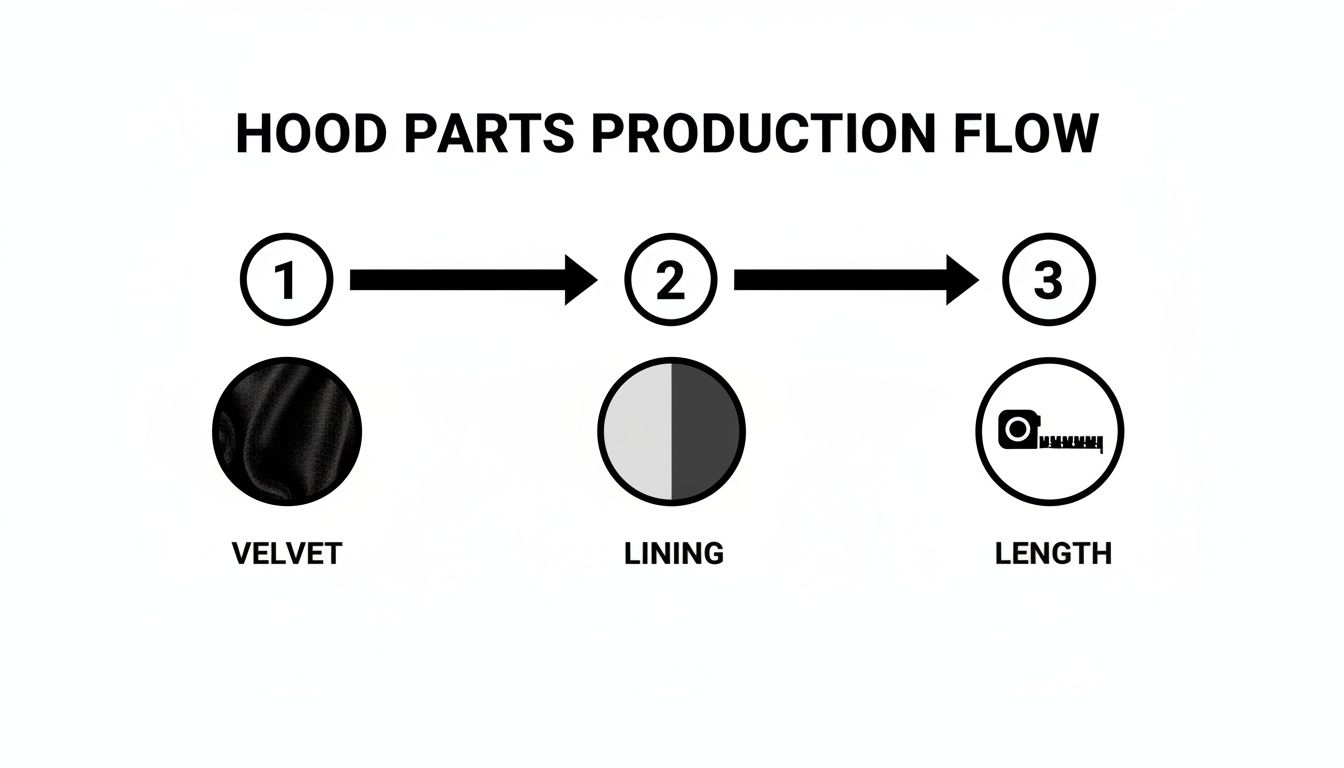
It shows exactly how the velvet, lining, and specific length combine to form your complete academic hood.
Final Adjustments for a Polished Look
With the colors revealed, take a second to make any final tweaks. The hood should lie flat and smooth against your back. If it looks bunched up, just give it a gentle pull downward from the base. Double-check that the velvet trim is symmetrical and not twisted.
For those really serious about achieving the perfect look, mastering the art of using adjustable sewing mannequins for garment draping and fitting can offer some advanced techniques. While it's definitely not necessary for graduation day, understanding these principles can build a lot of confidence.
Take a moment to look in a mirror or ask a friend to snap a picture so you can see how it looks from all angles. A well-draped hood not only looks distinguished but also feels way more comfortable, allowing you to focus on your big achievement.
And a final tip: after the ceremony, preserve your regalia by storing it properly. A breathable garment bag is an excellent choice for keeping your hood and gown in pristine condition for years to come.
Decoding the Colors and Lengths of Academic Hoods
Your academic hood is so much more than a piece of graduation attire. Think of it as a visual resume, speaking a symbolic language of colors, fabrics, and measurements that tells your entire academic story. Every single element is intentional, designed to communicate your degree level, field of study, and alma mater in a single glance. Understanding this system doesn't just guarantee you get the right regalia—it deepens your appreciation for the ceremony itself.
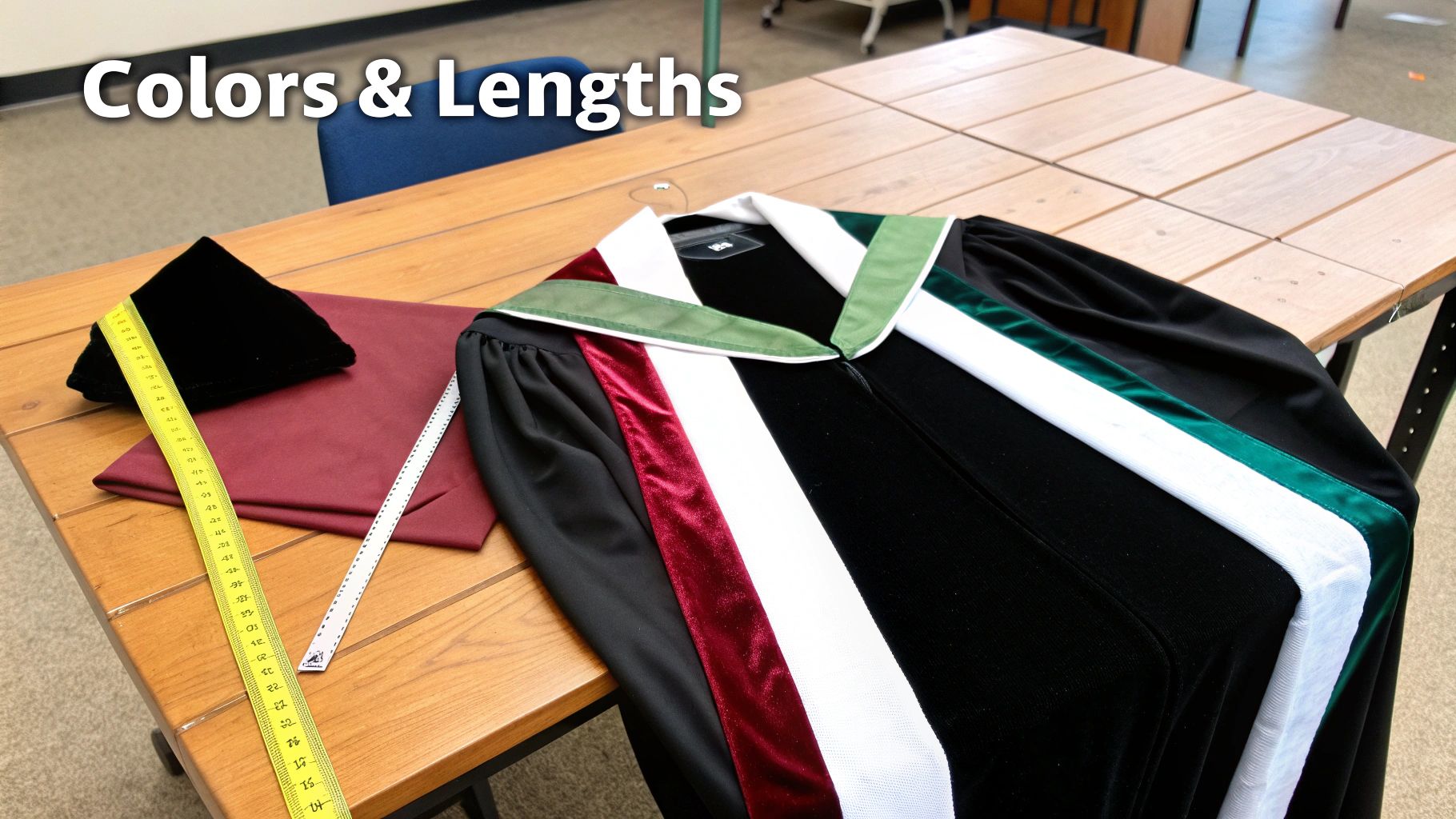
The consistency you see in academic regalia across the United States is no accident. It’s all governed by the Intercollegiate Code of Academic Costume, a set of guidelines that brings a shared language to the tradition. This code dictates the precise details that make each hood unique yet universally understood.
The Significance of Hood Length
The most immediate giveaway of your academic achievement is the length of your hood. It’s a simple but clear visual cue that instantly distinguishes one degree level from another.
- Bachelor's Degree: Traditionally, bachelor’s degree recipients in the U.S. don't wear a hood, though some schools have their own customs. If one is used, it’s the shortest at three feet.
- Master's Degree: The master's hood measures a distinct three and a half feet long, marking a significant step up in academic accomplishment.
- Doctoral Degree: As the longest and most distinguished, the doctoral hood extends to a full four feet. Its impressive length signifies the highest level of academic attainment.
These measurements aren't just estimates; they are prescribed standards. First standardized in the 1895 Intercollegiate Code, these precise lengths and colors are what make the system work. A master's hood is exactly 42 inches long with a three-inch velvet trim, while a doctoral hood is 48 inches with a five-inch trim—dimensions followed by an estimated 90% of over 4,000 U.S. colleges.
The Velvet Trim: Your Field of Study
The rich velvet trim bordering your hood is arguably its most personal element. The color of this velvet band corresponds directly to the academic discipline in which you earned your degree. This system allows anyone familiar with the code to identify a graduate's field of study from across a crowded room.
You might see a graduate with a golden yellow trim, instantly signaling they studied one of the Sciences. Someone sporting a light blue trim earned their degree in Education. This visual language is incredibly specific and covers a huge array of disciplines.
The color of your hood's velvet trim is a proud declaration of your specific academic discipline. It connects you to a community of scholars in your field and tells the story of your intellectual journey.
Here are some of the most common velvet colors you'll see at a graduation ceremony and what they represent:
| Velvet Color | Academic Field Represented |
|---|---|
| Dark Blue | Philosophy (Ph.D.) |
| Light Blue | Education |
| Golden Yellow | Science |
| Drab (Tan) | Business, Commerce, Accountancy |
| White | Arts, Letters, Humanities |
| Brown | Fine Arts |
| Green | Medicine |
| Lilac | Dentistry |
| Orange | Engineering |
This color-coding is a core part of the academic tradition. For instance, data shows that roughly 25% of U.S. doctorates awarded each year feature orange for engineering, while white for math accounts for another 15%. For a complete visual reference, be sure to check our official size, color, and fabric charts to find the exact color for your degree.
The Satin Lining: Your University Pride
Finally, we get to the vibrant, colorful satin lining on the inside of the hood. This part is all about institutional pride. These are the official colors of the university or college granting your degree. Once you learn how to wear the hood correctly, this lining gets turned out, allowing the colors to be displayed prominently on your back for everyone to see.
A graduate from the University of California, Berkeley, for example, will have a hood lined in brilliant blue and gold. Someone from Harvard University will display crimson. This element is a powerful and celebratory nod to the institution that guided your academic journey, making your hood a complete and meaningful symbol of your success.
Navigating Your Hooding Ceremony With Confidence
The hooding ceremony is so much more than a formality. For master’s and doctoral candidates, it's a profound rite of passage—the moment a mentor or faculty member formally bestows your academic hood, publicly recognizing years of intense work.
Understanding the choreography of this event will let you soak in the moment without any last-minute stress. Unlike undergraduate ceremonies, you’ll likely carry your hood until your name is called.
The proper way to do this is to drape it neatly over your left arm, velvet side out. This keeps it looking sharp and leaves your right hand free for handshakes.
The Graduate and the Hooder: A Coordinated Moment
The ceremony is a quick, coordinated dance between you and your hooder—who is often your dissertation advisor, dean, or another chosen mentor. A quick chat beforehand can make the whole thing feel seamless and memorable.
When your name is called, your main job is to walk calmly to the stage, hood on your arm. Once you hit your mark, you’ll turn to face the audience, and your hooder will be right behind you, ready to do their part.
For a smooth handoff:
- Pass the Hood Gracefully: Just hand the hood from your arm to your hooder. They’ve done this before and know exactly how to unfold it for draping.
- Stand Still: Keep your back straight and shoulders relaxed. Some people find it helps to bend their knees or lean forward slightly, giving the hooder a bit more room to work.
- Trust Your Hooder: They’ve got this. Let them handle the placement and any final adjustments. Once the hood is settled, they’ll likely give it a final tug to make sure it’s sitting perfectly.
A hooding ceremony is a symbolic transition from student to peer. The act of facing forward while your mentor places the hood over your shoulders is a powerful sign of respect for the tradition and the faculty who guided you.
After you’re hooded, you’ll turn to your hooder, shake their hand, and then continue across the stage for congratulations from university officials before heading back to your seat. The whole thing is over in a flash, but its significance lasts a lifetime.
Key Points of Ceremony Etiquette
Knowing a few simple points of etiquette will help you feel completely at ease. To confidently navigate this important moment, understanding the full scope of preparations for your graduation ceremony can also be beneficial, ensuring every detail of your day is picture-perfect.
The actual hooding is a two-person job with very distinct roles. The table below breaks down exactly what you and your hooder will be doing in that key moment.
Hooding Ceremony Roles Explained
| Role | Key Actions |
|---|---|
| The Graduate | Carries the hood over their left arm, walks to the stage, turns to face the audience, and stands still while being hooded. |
| The Hooder (Faculty/Mentor) | Stands behind the graduate, takes the hood, unfolds it, and gently places it over the graduate's head and onto their shoulders. |
Beyond the mechanics, remember to be gracious. A simple "thank you" to your hooder and a smile for the other officials on stage shows appreciation for their part in your journey. The goal is to move through the ceremony with the quiet confidence that reflects the dignity of your achievement.
Common Hood Mistakes and How to Fix Them Fast
Even with the best preparation, academic regalia can have a mind of its own on graduation day. A slipping hood or a bunched-up neckline is the last thing you want to be fussing with during one of life's biggest moments.
Fortunately, just about every common mishap has a quick and easy fix. Think of this as your day-of troubleshooting guide to make sure you look polished and feel comfortable from the processional to the final photo.

The number one complaint I hear from graduates is the hood sliding off their shoulders. This usually happens because it isn't properly anchored, causing it to slip backward throughout the long ceremony. A constantly shifting hood is not only annoying but can also ruin the look of your regalia in every single photo.
Another classic issue is the front "V" of the hood riding up and digging into your neck. This is a tell-tale sign that the weight of the hood isn't distributed correctly, pulling the entire garment backward and creating that uncomfortable choking feeling.
Quick Fixes for a Perfect Fit
To prevent these problems, your first line of defense is that small loop on the inside point of the velvet "V." It's designed to attach to a button on your shirt or gown, and using it correctly solves over 90% of common hood issues. Seriously, don't skip this step.
But if you're still having trouble, here are a couple of on-the-spot solutions that work every time:
-
The Slipping Hood Solution: If the attachment loop just isn't cutting it, a well-placed safety pin is your best friend. From inside your gown, discreetly pin the hood’s shell fabric to the gown at the top of each shoulder. This creates two extra anchor points that will stop it from sliding around.
-
The Choking V-Neck Fix: If the front feels too tight, it means the back is pulling down too hard. After securing the front loop, make sure the hood is draped widely across your shoulders, not just hanging from your neck. A small adjustment—spreading the fabric wider—often redistributes the weight and instantly relieves the pressure.
Polishing Your Appearance in Seconds
Perfecting your look goes beyond just keeping the hood in place. The final appearance is all in the details, and two specific issues can detract from an otherwise flawless presentation.
The first is when the colorful satin lining—the part representing your university—refuses to stay visible. The second is when the velvet trim, which signifies your field of study, gets twisted or tucked under.
A well-adjusted hood should feel balanced and secure, not like something you have to constantly fuss with. Taking a minute for a quick fix before the ceremony begins will save you from a day of distracting adjustments.
To solve these visual mishaps, just do a quick check with a friend before lining up for the processional.
Is your velvet trim hidden? Easy fix. Just run your fingers along the edge of the hood draping down your back. Gently pull the velvet trim out so it lays flat and creates a clean, defining border for your university colors.
Are your university colors not showing? Reach behind you to the base of the hood and give the satin lining a gentle outward flip. This simple turn is all it takes to expose the colors. If it won't stay put, a tiny piece of double-sided fabric tape can discreetly hold the lining in place, ensuring your school pride is on full display. With these quick fixes, you'll know exactly how to wear the academic hood with total confidence.
Got Questions About Your Academic Hood? We've Got Answers.
Even after you've got the basics down, a few practical questions always seem to pop up right before commencement. These are the last-minute details that can make all the difference in how comfortable and confident you feel on your big day. We’ve pulled together the most common queries we hear and laid out clear, direct answers so you have nothing to worry about.
Navigating academic traditions can sometimes feel like learning a whole new language, but once you get the logic behind it, everything clicks into place. These questions cover everything from what to do if you're a multi-degree graduate to how to keep your hood looking perfect long after the ceremony ends.
I Have Multiple Degrees. Which Hood Should I Wear?
This is a fantastic question and a common point of confusion for accomplished scholars. Academic protocol is actually quite clear on this: you should only wear one hood at a time, and it has to be the one that represents the degree you are currently being awarded. The ceremony is all about celebrating this specific, new achievement.
For example, if you're walking across the stage to receive your doctorate but you already have a master's degree, you'll wear the doctoral hood. Wearing the hood for the degree being conferred keeps the focus squarely on the milestone of the moment and maintains the formality of the event.
How Do I Care For My Hood After Graduation?
Your academic hood is a huge keepsake, a tangible piece of all your hard work. To keep it looking its best, don't just fold it up and toss it in a box. That beautiful velvet trim can get crushed easily, and you'll end up with permanent creases.
Instead, a little care goes a long way. Here’s what we recommend:
- Hang it right. Always use a wide, padded hanger. A flimsy wire hanger will cause the fabric to stretch or create sharp lines over time, while a padded one supports the hood's natural shape.
- Steam, don't iron. If you spot any wrinkles, never iron your hood directly. The intense heat can scorch the velvet and even melt the satin lining. A garment steamer on a low setting is your best friend here. Just hold it several inches away from the fabric to gently release the wrinkles.
- Store it for the long haul. For long-term storage, a breathable garment bag is the best investment you can make. It protects the hood from dust, fading, and moths while still allowing the fabric to breathe. Tuck it away in a cool, dark closet, and it will be ready for any future academic events.
Are There Adjustments for Different Body Types?
Absolutely. While the method for wearing the hood is pretty standard, small tweaks are often needed to get that perfect, flattering fit for every body type. The goal is always a smooth, elegant drape, but that might look a little different on everyone.
For graduates with broader shoulders, the key is to drape the hood widely so it sits comfortably across the shoulders, rather than letting it bunch up around the neck. This helps distribute the weight evenly and prevents it from looking cramped.
On the other hand, if you have narrower shoulders, the hood might want to slip off. In this case, using that front attachment cord is a must. If it still feels a little insecure, don't be afraid to use a small, discreet safety pin on the inside of each shoulder to anchor the hood to your gown. A faculty marshal can always help you with this before the ceremony begins.
My University Didn't Issue a Bachelor's Hood. Can I Wear One Anyway?
This is an important point of academic etiquette. In the United States, it’s a long-standing tradition that the vast majority of institutions do not award hoods for bachelor's degrees. The academic hood is almost exclusively reserved for graduate-level achievements—that means master's and doctoral degrees.
If your university doesn't include a hood as part of its official regalia for bachelor's candidates, you shouldn't wear one. Academic regalia is specific to the degree-granting institution and its own established customs. Adding unapproved items is a break from your school's protocol. The best course of action is always to follow the guidelines your school provides. For more specific questions about your school's policies, you can usually find answers on their commencement website or by checking out a comprehensive resource like our Graduation Cap and Gown FAQs page.
At Graduation Cap and Gown, we understand that every detail matters on your special day. From ensuring the perfect fit to providing regalia that honors your achievements, we are here to help you celebrate with confidence. Explore our complete collection of high-quality caps, gowns, and academic hoods at https://www.graduationcapandgown.com.