

At first glance, graduation cords and stoles might seem to serve the same purpose, but they tell very different stories. Cords are like medals earned for a specific skill or high honor, while stoles are sashes that reflect a broader chapter of your academic journey or personal identity. Both transform a simple cap and gown into a personal testament to your hard work.
How We Approach This Guide (Our Regalia Expertise)
This guide reflects an editorial perspective built on reviewing university commencement policies, published academic costume traditions, and the requirements of recognized honor societies — not generic color charts copied around the internet. When evaluating regalia guidance, it is best to consult the sources that govern these traditions: university commencement policy pages, academic costume references, and the published requirements of organizations like Phi Beta Kappa.
One principle shapes every recommendation here: your school's own rules always beat general conventions. There is no national standard for cord colors or stole eligibility, so if a university defines summa cum laude with white cords while most schools use gold, that university wins. Whenever general guidance and an institution's official commencement guidelines conflict, defer to the institution — and we encourage you to do the same before ordering anything.
Decoding Your Graduation Regalia

As commencement gets closer, the little details of what you'll wear start to feel a lot more important. Beyond the classic cap and gown, cords and stoles are the key accessories that let you show off your unique accomplishments. Each piece has a distinct purpose, allowing you to visually represent academic excellence, club memberships, cultural heritage, and personal milestones.
Understanding the difference is the first step toward putting together a graduation look that feels both meaningful and appropriate for the ceremony. This guide will clear up the roles of each accessory, helping you confidently pick the right items to celebrate everything you've achieved.
Cords and Stoles: An Essential Comparison
While you wear both over your shoulders, their appearance and what they symbolize are completely different. Think of it this way: if your gown is the canvas, graduation stoles and cords are the vibrant colors you use to paint your academic story.
- Honor Cords are the thin, twisted ropes, often with tassels at the end. They typically represent specific academic honors, like hitting a certain GPA for Cum Laude, Magna Cum Laude, or Summa Cum Laude status.
- Graduation Stoles are the wider, sash-like garments worn around your neck. They can signify a much broader range of achievements or affiliations, including your field of study, participation in Greek life, or your cultural identity.
The table below offers a quick comparison to help you easily tell the difference between these two essential graduation items.
Graduation Cords vs Stoles At a Glance
Here’s a quick breakdown to help you distinguish between these two key pieces of graduation regalia at a single glance.
| Attribute | Honor Cords | Graduation Stoles |
|---|---|---|
| Appearance | Thin, twisted ropes with tassels at each end. | Wide, flat sashes made of cloth, often satin. |
| Primary Meaning | Signifies specific academic achievements or honor society membership. | Represents broader affiliations, cultural identity, or field of study. |
| How It's Worn | Draped around the neck with cords hanging down the front. | Worn over the shoulders, hanging evenly down the front of the gown. |
| Common Examples | Gold cord for Summa Cum Laude, red and blue cord for a specific honor society. | Kente stole for African heritage, a stole with Greek letters for a fraternity. |
Ultimately, both cords and stoles serve to make your graduation day more personal, turning the traditional gown into a unique reflection of your individual journey and hard-won successes.
The Full Inventory of Cord Types
If you're trying to account for every cord you might see on stage, here's the complete lineup:
- Latin honors cords: Earned by GPA for cum laude, magna cum laude, and summa cum laude. These are the cords most schools award automatically through the registrar.
- Honor society cords: Awarded by organizations such as Phi Beta Kappa, the National Honor Society, or discipline-specific societies like Psi Chi. Membership, not just GPA, qualifies you.
- Club and organization cords: Student government, volunteer groups, band, athletics, and academic clubs often order custom cords for their members.
- Military and service cords: Some ROTC programs, veteran groups, and service organizations may use dedicated cord colors to mark service commitments, though practices vary by institution.
- Double cords: A double honor cord is two individual cords joined at a center knot — schools use them either to signal a double honor or because two colors represent one achievement.
Who Gets to Wear a Stole?
Stoles follow different logic than cords. Because cords are mostly GPA-driven, they're earned by the numbers; stoles are earned by belonging, identity, or program completion. The graduates you'll typically see wearing stoles include:
- Members of cultural organizations and heritage groups, wearing Kente, Serape, or international stoles.
- Greek life members displaying their fraternity or sorority letters.
- Participants in first-generation student programs, which distribute stoles to mark a milestone that honors the whole family.
- Faculty and program honors recipients, including honor program graduates and departmental award winners.
Eligibility for wearing a stole is generally determined by your institution's specific commencement policies, so checking your university's official commencement guidelines is the best way to confirm who gets to wear a stole at graduation.
The tradition of draping ceremonial regalia over academic dress is centuries old — academic costume itself traces back to medieval European universities, where scholars commonly wore long gowns reflecting the clothing of clergy and educated professionals (history of academic regalia). Modern stoles carry that same logic: they represent a community, not just a number.
The Symbolism Behind Each Color and Style
Walk into any graduation ceremony, and you'll see that the simple academic gown is transformed into a vibrant display of achievement and identity. Every colorful cord or stole (a word often misspelled as "graduation chords," by the way) tells a unique story. This rich language of color goes far beyond just decoration; it’s a visual resume of a student's hard work, affiliations, and personal journey.
The most recognized colors almost always have traditional academic meanings. Take gold honor cords, for example. They are widely understood to represent the highest levels of academic achievement. You'll see them on students graduating Summa Cum Laude, a clear sign that their GPA was at the very top of their class. This tradition makes gold a quintessential color for scholarly excellence — though "universally" deserves a caveat, because the color system itself has never been nationally standardized. Traditional color associations exist within academic costume guidelines, but individual institutions remain free to assign their own meanings.
Other colors carry their own specific weight. Silver often denotes Magna Cum Laude, while white or bronze can represent Cum Laude. Red is frequently associated with leadership roles, community service, or passion-driven fields like journalism and public health. This established system creates a quick visual language for recognizing top performers.
Decoding Common Cord and Stole Colors
While some color meanings are widespread, many schools create their own unique systems to recognize specific achievements or departments. This is why you might see such a variety of shades and combinations at a single ceremony. Still, several colors have generally accepted associations across most schools and honor societies.
- Royal Blue often represents philosophy, political science, or service.
- Light Blue is commonly linked to the field of education.
- Green typically signifies medicine, pharmacy, or physical science.
- Pink is associated with music and fine arts.
This color-coding helps create a sense of community within academic disciplines, allowing graduates to proudly represent their field of study as they walk across the stage. For more information, see an honor cord color guide that explains these associations in greater detail.
To help you get a quick handle on what you might see at a ceremony, here's a reference table breaking down some of the most common color meanings.
Common Cord and Stole Color Meanings
This table serves as a quick reference for the traditional academic and honor society meanings tied to various colors you'll see on graduation day.
| Color | Common Academic Meaning | Associated Fields or Honors |
|---|---|---|
| Gold | High Academic Honors | Summa Cum Laude, Magna Cum Laude, National Honor Society |
| Silver | Distinguished Achievement | Magna Cum Laude, Oratory, Physics, Community Service |
| White | Arts and Humanities | Cum Laude, Letters, English, History, Sociology |
| Red | Public Service & Passion | Journalism, Public Health, Music, Theology, Leadership |
| Royal Blue | Philosophy & Government | Political Science, Foreign Service, Philosophy, Service |
| Light Blue | Education | Teaching, School Administration, Educational Leadership |
| Green | Medicine & Life Sciences | Medicine, Pharmacy, Environmental Science, Agriculture |
| Purple | Law & Dignity | Law, Theology, Architecture, Urban Planning |
| Orange | Engineering | All engineering disciplines, Civil, Mechanical, Electrical |
| Pink | Fine Arts & Music | Music, Art History, Performing Arts |
Keep in mind, this is a general guide. The true meaning of any color is always determined by the graduating institution itself.
How Universities Define Honors with Colors
Institutions often tailor their use of cords and stoles to reflect their specific honor systems. The exact requirements for earning Latin honors—and the colors that represent them—can vary significantly from one school to another.
One clear example is how specific colors denote precise academic achievements. At Skidmore College, red cords are awarded to all graduates earning Latin honors, including cum laude for a GPA of 3.650–3.749, magna cum laude for 3.750–3.899, and summa cum laude for 3.900–4.000.
A second example makes the point even sharper. Millersville University reserves white cords for cum laude, silver for magna cum laude, and gold for summa cum laude — nearly a full inversion of the "gold means highest honors" convention — and adds purple for University Honors College recognition (academic symbolism at Millersville). What signifies a top honor at one school might represent a different achievement somewhere else, which is exactly why we recommend checking your university's official commencement guidelines before you buy anything.
Beyond Academics: Stoles of Identity and Culture
While cords often focus on academic merit, stoles provide a much broader canvas for graduates to express their personal stories. They are powerful symbols of identity, heritage, and belonging, allowing students to celebrate the entire journey that brought them to graduation day.
Designs like the Kente stole are absolutely packed with meaning, representing African heritage, pride, and a connection to cultural roots. Similarly, Serape stoles celebrate Hispanic and Latinx identity, bringing vibrant cultural patterns to the ceremony.
Another profoundly meaningful option is the first-generation stole. Wearing one is a powerful statement, honoring not just the graduate's hard work but also the sacrifices and support of their entire family. These stoles recognize the monumental achievement of being the first in a family to earn a college degree.
International students can also showcase their home country's pride by wearing a graduation stole with their national flag. This allows them to represent their origins and the global nature of their academic community on this important day.
How to Wear Your Regalia with Confidence
Your graduation day is the grand finale celebrating years of hard work, and your academic regalia is the official uniform for the occasion. Wearing it correctly is more than just about looking polished for photos—it's about feeling confident and honoring your achievements as you take that memorable walk across the stage. Getting your cords and stoles perfectly arranged is the final touch.
This guide will walk you through layering your regalia, piece by piece. We’ll cover everything from the gown and hood to the right way to display multiple honors, so you can focus on your big moment without worrying about a slipping stole or a tangle of cords.
The Foundation: Your Gown and Hood
Before you even think about your honors, start with your gown. Make sure it's steamed or ironed on a low setting to get rid of any wrinkles from the packaging. The zipper goes in the front, and the fabric should fall naturally.
For master's and doctoral candidates, the academic hood comes next.
Drape the hood over your head so the velvet portion faces outward, with the V-point centered at your throat. The rest of the hood should drape down your back. The colors inside the hood—representing your university and field of study—should be visible. Many hoods have a small loop to secure to a shirt button or a pin to attach it to the gown, which really helps keep it from shifting around.
Layering Your Stoles and Cords
Once the gown and hood are in place, it’s time for your stoles. If you just have one, it’s simple: drape it around your neck so it hangs evenly down both sides in the front. The edges of the stole should lie flat and smooth against your gown.
If you’re wearing more than one stole, like a Kente stole and a first-generation stole, you’ve got two main options:
- Layering: Place the stole that feels most significant to you right on top of the other. Just make sure both are visible and hang symmetrically. This is usually the cleanest look.
- Side-by-Side: Position them next to each other, slightly overlapping at the back of your neck. This approach can look a bit busy, so layering is often the preferred method.
After the stoles come the honor cords. Group all of your grad cords and stoles together and drape them around your neck, right on top of the stoles. Let them hang down the front with the knot resting at the back of your neck. Fiddle with them a bit so they fall neatly on either side of your stole, with the tassels hanging freely.
A common worry is keeping your stole from slipping off during the ceremony. A simple trick is to use small safety pins to discreetly fasten the stole to your gown at the top of your shoulders. Pinning from the inside will keep them completely hidden.
This image shows how different academic honors, often represented by cords and stoles, build upon one another.

This visual guide demonstrates how each honor level, from Cum Laude to Summa Cum Laude, represents a higher tier of academic achievement, often distinguished by different colored cords or medals.
How Many Cords and Stoles Should You Wear?
There's no universal cap — you wear what you earned, and nothing you didn't. That said, here's how the numbers usually shake out:
- Typical graduate: one to two cords plus zero to one stole.
- High-achievement graduates: three to four cords (Latin honors, an honor society, a club, a service organization) and one or two stoles.
- Practical limit: once you're past roughly four cords or three stoles, the regalia starts reading as clutter in photos, and cords can tangle with each other on stage.
A common combination for many graduates is a single GPA cord paired with one cultural or program stole — a balance where every piece stays visible. If you're stacking more than that, layer stoles rather than wearing them side-by-side, and group your cords so the tassels hang freely.
Regalia Tips for Every Graduate Level
While the basic principles are the same, there are subtle differences in regalia depending on your academic level. Following these guidelines will ensure your attire is spot-on for your specific ceremony.
- High School: Graduates usually wear a cap, gown, and tassel. Cords from groups like the National Honor Society or stoles for student government are common, but the overall look is simpler than collegiate regalia.
- Bachelor's Degree: This includes the cap, gown, tassel, and any earned cords and stoles. The gown has traditional pointed sleeves.
- Master's Degree: Graduates wear a cap, gown, tassel, and an academic hood. The gown for a master's degree features unique oblong sleeves. All cords and stoles are always worn over the hood.
For more detailed instructions and visuals on arranging every single piece of your academic attire, you can learn more about how to wear graduation regalia in our dedicated guide. Taking a few minutes to get everything right beforehand will make all the difference on graduation day.
Showcasing Your Identity with Custom Stoles
Your graduation day is a celebration of your entire journey, and your regalia should tell that story. While honor cords often represent your GPA, custom graduation stoles give you a much broader canvas to show everyone who you are. They are powerful symbols of heritage, personal identity, and the communities that got you here, turning your gown into a statement about where you come from and where you're going.
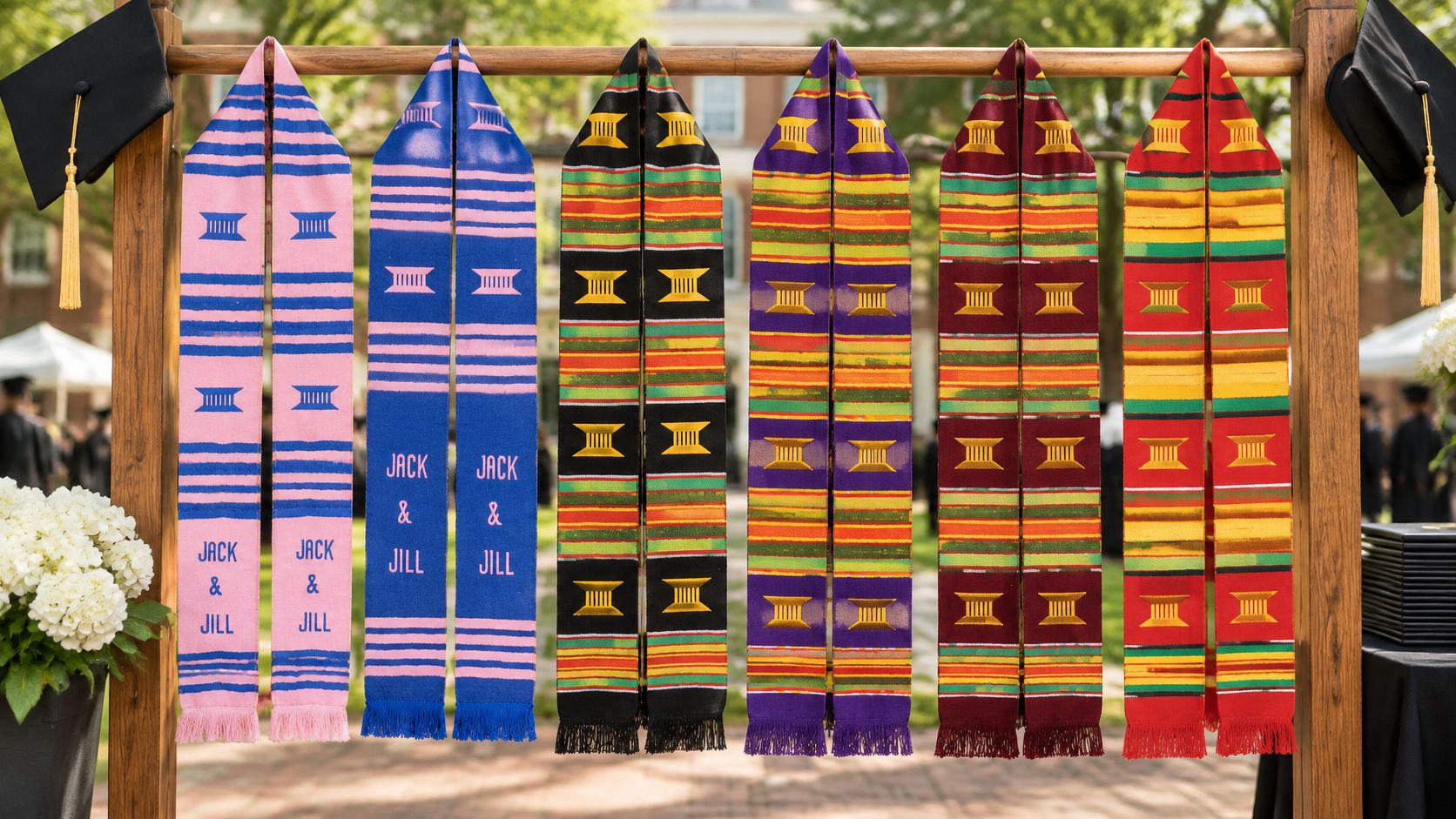
This is your chance to shine a spotlight on the cultural roots and affiliations that shaped you. From Greek life and student clubs to your international background or family milestones, a stole represents the people who had your back.
Celebrating Heritage with Cultural Stoles
Cultural stoles are easily some of the most striking and meaningful pieces of regalia you'll see at commencement. They are vibrant, proud declarations of connection to one's heritage.
For example, the Kente stole is a powerful emblem of African heritage, woven with intricate patterns where every color and design carries a specific meaning tied to history and values. Wearing a Kente stole is a beautiful way to honor your ancestral roots and celebrate Black excellence.
In the same way, the colorful Serape stole is an unmistakable representation of Hispanic and Latinx pride. Its bright, striped patterns bring a proud, festive energy to the ceremony, celebrating a rich and vibrant cultural identity.
The ability to wear items of cultural significance is a valued part of modern commencements. Many universities explicitly permit students to wear traditional tribal regalia and other cultural adornments alongside their academic cords and stoles.
This growing acceptance highlights just how important it is for graduates to express their full selves on their big day.
Honoring the Journey with Personal Stoles
Beyond cultural identity, stoles can honor the personal milestones that defined your path. One of the most powerful examples is the First-Generation stole.
Wearing this stole is a profound statement. It signifies the incredible achievement of being the first in your family to graduate from college, honoring not just your own hard work but the dreams and sacrifices of everyone who came before you. It’s a symbol of breaking barriers and building a new legacy.
Other stoles can represent:
- Greek Life: Displaying the letters of your fraternity or sorority with a Greek Stole.
- Student Organizations: Showing your involvement in clubs, government, or volunteer groups.
- International Background: Featuring the flag of your home country to celebrate your global perspective.
If you're looking for more inspiration, you can explore the many different types of graduation stoles that graduates use to tell their unique stories.
Creating Your Own Personalized Stole
The best way to make your regalia yours is with a custom-designed stole. This turns your graduation outfit into a one-of-a-kind keepsake that perfectly captures your story.
You can design and personalize custom graduation stoles online to reflect your specific achievements or affiliations. Once you have an idea of what you want, you can email your order details, and a mockup of your custom stole can be created for you to review.
A Guide for Coordinators Placing Bulk Orders
Taking charge of graduation regalia for an entire class is a massive responsibility. For academic advisors, department heads, and graduation coordinators, ordering cords and stoles in bulk requires some careful planning to make sure commencement day goes off without a hitch. This guide is your playbook for handling group orders like a pro, ensuring every student gets what they need to celebrate their hard-won achievements.
First things first: you need a solid headcount. A great starting point is to look at last year's order numbers, but be sure to adjust for any changes in class size or the number of honor societies and student groups taking part this year. It's always a smart move to order a small surplus—think 5-10% extra—to cover any last-minute additions or unexpected replacements. That little buffer can save you from the stress of a rush order right before the big day.
Strategic Timing for Your Order
If there’s one secret to a stress-free ordering experience, it's this: place your bulk order early. Getting ahead of the game is the single best way to avoid headaches. The market for graduation regalia is seasonal.
Demand spikes hard in the spring: Google Trends data shows interest in graduation stoles reaching a peak score of 95 in late May, compared to a peak of 36 for related searches like tassels. That creates a high-stakes rush you definitely want to avoid. For a spring 2027 commencement, the practical deadline is ordering by fall or early winter 2026. Planning well ahead of the peak season helps ensure better inventory availability and avoids potential shipping delays.
Planning your purchase months ahead of time doesn't just ensure every color and style is in stock; it also helps manage your department's budget effectively.
Of course, ordering regalia is just one piece of the puzzle. An Event Coordinator Checklist Template can be a lifesaver for managing all the other moving parts of a graduation ceremony, from venue logistics to the final program.
We Make Bulk Ordering Simple
Our goal is to make group orders as straightforward as possible for schools and institutions. We've designed a process that saves you time and gives you total confidence in your purchase.
To streamline everything, we offer dedicated resources for group purchases. You can use our simple bulk order forms to organize your institution’s needs with total clarity. These forms help you lay out all the specifics—quantities, colors, and any custom details—making the whole process a breeze. We’re here to be a reliable partner in making your commencement a success.
Your Top Questions About Cords and Stoles
As the big day gets closer, the small details start to matter. You're probably wondering about the different cords and stoles you've earned, how to wear them, and where to even get them. It's completely normal to have questions—after all, you want everything to be perfect.
Think of this as your graduation day cheat sheet. We’ve pulled together the most common questions from students and coordinators to give you quick, clear answers so you can walk across that stage feeling confident and looking sharp.
How Many Cords Should I Have for Graduation?
There's no universal number — you wear exactly the cords you earned. Most graduates end up with one to four: typically a Latin honors cord, an honor society cord, and one or two club or service cords. The main constraint is your school's policy, not a national rule. A few institutions limit total adornments or specify how cords must be arranged, so a quick check of your commencement guidelines (or a call to the registrar) settles it. If you're between cords because you're unsure whether an achievement "counts," ask the organization awarding it — they'll know whether cords were ordered for your class.
Do Colleges Look at Graduation Cords?
The cords themselves don't factor into college admissions — by the time you're wearing them, you've already been admitted and graduated. But the achievements behind them absolutely do. A cum laude GPA, honor society membership, documented volunteer hours, and leadership roles are all things applications and resumes ask about directly. The cord is the ceremony-day symbol; the accomplishment is what has actual weight. According to university registrars and honor society guidelines, the underlying academic record is what holds institutional value. If you're a current student aiming to earn cords before graduation, treat the cords as a scoreboard, not the goal: join the honor society, keep the GPA, log the service hours, and the regalia follows.
Can I Wear Multiple Cords and Stoles at My Graduation?
Yes, absolutely! If you've earned multiple honors, you get to show them all off. It's totally normal to see grads wearing a mix of cords and stoles that represent everything from their GPA to club memberships and cultural pride.
The whole trick is to arrange them neatly so your regalia looks balanced and respectful. Group your cords together and drape them around your neck, and if you have more than one stole, you can layer them one on top of the other.
It's always a smart move to quickly check your school's official commencement guidelines. Most universities love seeing you celebrate all your hard work, but a few might have specific rules about how many adornments you can wear.
For example, it's pretty common to see someone with a gold cord for academic honors, a leadership stole from student government, and a beautiful cultural stole like a Kente or Serape design. When you layer them right, each piece is visible, painting a full picture of your unique journey.
What Is the Difference Between an Honor Cord and a Regular Cord?
Physically, there's no difference at all; it's the same twisted rope with tassels on the end. The distinction comes down to the meaning behind the cord and how you earned it.
An "honor cord" is an official award given by your school or a recognized honor society (like Phi Beta Kappa) to recognize a specific academic achievement. These are usually tied to GPA milestones like Cum Laude, Magna Cum Laude, and Summa Cum Laude.
A "regular cord," on the other hand, might be worn to show you were part of a student group, a fraternity or sorority, or a volunteer organization. While it still represents a huge part of your college life, it doesn't carry that official academic weight. Our shop offers a full spectrum of graduation cord colors perfect for both official honors and student group recognition.
How Do I Keep My Stole from Falling Off During the Ceremony?
A slipping stole is a classic graduation day worry, but don't sweat it. There are a few simple tricks to make sure your stole stays perfectly in place from the first procession to the final tassel turn.
The easiest and most reliable fix is to use a couple of small safety pins. You can discreetly pin the stole to your gown right at the top of your shoulders. If you pin it from the inside of your gown, the pins will be completely invisible.
Here are a few other pro tips to keep your stole secure:
- Try Fashion Tape: Double-sided fashion tape works wonders for holding fabric in place without leaving any holes.
- Center It Up: Before things get started, take a second to make sure your stole is centered and hangs evenly on both sides. A balanced stole is less likely to wander.
- Give It a Quick Press: Ironing your stole on a low-heat setting beforehand (check the care label first!) helps it lie flat and stay put.
Where Can I Buy Official Cords and Stoles for My University?
That's a great question, and the answer really depends on what you're looking for. For any regalia that has your university's official crest or a specific, trademarked design on it, your campus bookstore is almost always the one and only place to get it.
But for a whole range of other essential items, you have more flexible options. This includes things like:
- GPA-Based Honor Cords: Standard colors, like gold for Summa Cum Laude, are widely available.
- Cultural and Identity Stoles: Items like Kente, Serape, First-Generation, and international flag stoles can be found at specialized suppliers.
- Honor Society Cords: Some national honor societies allow their members to obtain official colored cords through approved channels.
We offer a wide selection of cords and stoles to match your school's requirements for these types of honors. It's a reliable way to complete your look and proudly display every single one of your achievements.
At Graduation Cap and Gown, we're here to help you celebrate your academic milestones with confidence and style. Explore our extensive collection of regalia, from custom stoles to honor cords. Find everything you need for a memorable commencement at Graduation Cap and Gown.