

Graduation cords are so much more than just colorful ropes you wear over your gown. They’re a visual language, a shorthand that tells the story of your unique academic journey and personal wins. These symbols broadcast everything from top-tier academic honors and honor society memberships to leadership roles and cultural heritage.
What Graduation Cords Symbolize on Your Big Day
Look out across a sea of graduates on commencement day, and you'll see a vibrant tapestry of colors. Those cords are what turn a standard cap and gown into a personal narrative of hard work, dedication, and accomplishment.
Think of them as a wearable resume. They instantly communicate a graduate's specific successes to friends, family, and faculty without a single word. Each cord is a testament to the late-night study sessions, the leadership you showed in student organizations, or the pride you take in your cultural identity. Knowing what these symbols mean makes the whole ceremony richer, letting you appreciate not just your own journey but the diverse achievements of your peers.
A Language of Achievement
The tradition of wearing cords is rooted deep in academic history, designed as a way to publicly recognize excellence. While your diploma confirms you’ve earned the degree, the cords fill in the details of your story. They answer questions like:
- Did you crush it with a high GPA? A gold cord often signals just that.
- Were you a member of a prestigious honor society? You’ll likely wear that society's specific colors.
- Did you serve in student government or rack up serious volunteer hours? A royal blue cord could represent that commitment.
- Are you a first-generation graduate or a veteran? There are cords to honor that distinction, too.
This visual language adds a ton of depth and meaning to the ceremony, celebrating the unique path each and every student walked to get there.
The whole point of graduation cords is to offer a distinct, visible form of recognition for accomplishments that go beyond the standard curriculum. They are a proud display of a graduate's individual story.
Setting the Stage for Your Ceremony
As you get ready for commencement, learning about the different cords for graduation helps you figure out all the honors you’re eligible to wear. It also preps you to understand the rich story of accomplishments on display all around you during the ceremony. Whether you're a high school senior, a college graduate, or earning an advanced degree, these cords are a powerful way to showcase your success.
Ready to find the perfect symbol of all your hard work? You can explore our full collection of high-quality graduation cords to make sure you have everything you need to celebrate your big day in style.
Decoding the Colors of Graduation Cords
When you look out at a graduation ceremony, the vibrant splash of colors isn't just for show. It's a rich visual language where every hue tells a story. Each cord color is a specific symbol, acting like a decoder ring for the accomplishments, fields of study, and special honors earned by the graduating class. Once you learn to read this color code, you start to see the incredible depth of achievement on display.
Brilliant gold is probably the most universally recognized color. You'll see graduates wearing gold cords to signify the highest levels of academic achievement, like summa cum laude, magna cum laude, or cum laude distinctions. It’s a powerful, instant symbol of intellectual dedication and success.
Other colors carry serious weight, too. Royal blue, for example, often points to leadership roles or excellence in the social sciences, while a crisp white cord might signify a degree in the humanities or arts. This system of color-coding turns a simple black gown into a detailed narrative of a student's entire journey.
Common Colors and Their Academic Fields
Many schools follow a standardized color scheme, often based on guidelines from the American Council on Education, to represent specific fields of study. This creates a sense of unity and shared tradition that connects graduates from different universities.
For instance, you'll frequently see education graduates wearing light blue cords, while those in engineering proudly display orange. Nursing graduates are often recognized with apricot, and students who studied the arts may wear white or pink. These specific colors connect a graduate not just to their own school, but to a long line of scholars in their chosen discipline.
This diagram breaks down how graduation cords symbolize different facets of a student's journey, from academic achievement to personal identity.
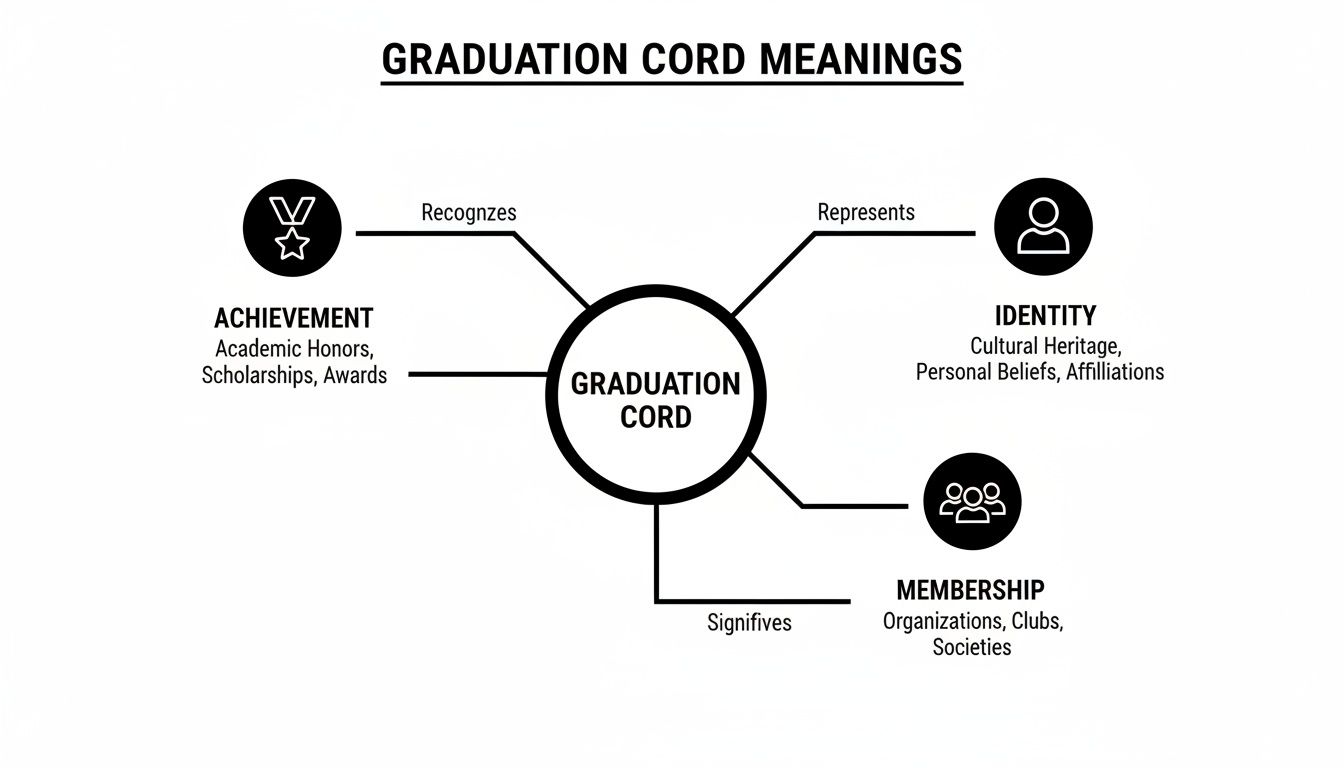
As you can see, a single cord can represent membership in a group, personal identity, or a major academic achievement, making it a powerful, multi-layered symbol.
The growing importance of these symbols is undeniable. The global market for graduation cords and stoles has surged, with stoles alone accounting for $325 million while serving tens of thousands of graduates each year. This highlights how cords for graduation have shifted from simple tokens to essential parts of the academic uniform. There are over 50 distinct colors tied to achievements—gold for Latin honors (often a GPA of 3.65+), purple for law, and multi-colored cords for societies like Alpha Kappa Delta in sociology.
Your Quick Reference Guide to Cord Colors
To help you quickly decipher the meanings behind the regalia, we’ve put together a handy reference table. Use this guide to understand what your own cords represent or to recognize the accomplishments of your fellow graduates as they walk across the stage. For a more exhaustive list, be sure to check out our complete Honor Cord Color Guide and Meanings article.
Remember, while many colors have traditional meanings, individual schools or honor societies can assign their own specific symbolism. It's always a good idea to double-check your institution's guidelines.
The table below covers some of the most common color associations you'll see at both high school and university ceremonies.
Common Graduation Cord Color Meanings
This table is a quick reference for the most common cord colors and what they typically represent at graduation ceremonies.
| Cord Color | Common Meaning / Field of Study | Example Honor Society / Group |
|---|---|---|
| Gold | High academic honors (Summa Cum Laude, Valedictorian) | National Honor Society |
| Royal Blue | Leadership, Social Sciences, Community Service | Student Government Association |
| Silver | Oratory, Veterinary Science, Engineering | Lambda Pi Eta (Communication) |
| Red | Journalism, Public Health, Courage and Strength | Society of Professional Journalists |
| White | Arts, Humanities, English, Purity | Sigma Tau Delta (English) |
| Green | Medicine, Environmental Studies, Science | Beta Beta Beta (Biology) |
| Purple | Law, Dentistry, Architecture, Royalty | Phi Alpha Delta (Law) |
| Light Blue | Education | Kappa Delta Pi (Education) |
| Orange | Engineering, Computational Sciences | Tau Beta Pi (Engineering) |
| Pink | Music, Performing Arts | Tri-M Music Honor Society |
| Maroon | Forestry, Theology, Confidence | |
| Black | Business, Accounting, Economics | Beta Gamma Sigma (Business) |
Whether you're wearing a single, double, or even a triple-braided cord, each strand helps tell the unique story of your academic career. They are tangible symbols of your dedication, ready to be worn with pride.
Understanding Different Types of Honor Cords
While the colors of graduation cords are packed with meaning, it’s just as important to know that not all cords celebrate the same thing. They fall into a few distinct categories, with each one honoring a different part of a student’s journey. Think of them like a collection of badges—each one earned in a unique way, but all contributing to the full story of your success.
Knowing the difference ensures you’re wearing every honor you've rightfully earned. It helps you build a complete picture of your regalia, showcasing your dedication both inside and outside the classroom. Let's break down the four main types of cords for graduation.
Academic Honor Cords
This is the classic, most widely recognized category. Academic honor cords are awarded by the school itself to celebrate outstanding scholarly performance, almost always tied to a graduate's final Grade Point Average (GPA).
They are the ultimate symbol of academic excellence. The most common distinctions you'll see are the Latin honors:
- Cum Laude: Meaning "with praise," this is typically for students who have earned a solid high GPA.
- Magna Cum Laude: This translates to "with great praise" and recognizes an even higher level of academic achievement.
- Summa Cum Laude: The highest honor, meaning "with greatest praise," is reserved for students at the absolute top of their graduating class.
Gold is the traditional color for these cords, symbolizing wisdom and success. However, some schools mix it up, using silver or a combination of their school colors to signify these prestigious achievements.
Honor Society Cords
Beyond GPA-based awards, many cords represent membership in a specific honor society. These organizations recognize students who not only excel in a particular field of study but also demonstrate exceptional character, leadership, and service.
Joining an honor society is a big deal, and the cord is the public acknowledgment of that membership. For instance, high school members of the National Honor Society often wear gold cords, while a university student inducted into Phi Beta Kappa (the oldest arts and sciences honor society) would wear a pink and blue cord. Each society has its own signature colors, creating a vibrant mix at any ceremony.
These cords are a testament to specialized excellence. They show that a graduate not only performed well academically but also met the high standards of a nationally recognized organization.
Cords of Recognition
Not every achievement happens in a lecture hall. Cords of recognition celebrate a student's contributions to the campus community and beyond. These cords acknowledge the skills, leadership, and time put into extracurricular activities.
This category is incredibly broad and can cover participation in:
- Student Government: Often represented by royal blue cords to signify leadership and civic duty.
- Volunteer Service: Cords may be awarded to students who complete a significant number of community service hours.
- Athletics: Student-athletes might receive cords in their school colors to honor their commitment.
- Specific Clubs: Academic or special interest clubs, from the debate team to the engineering club, may offer cords to their members.
These cords paint a picture of a well-rounded educational experience, proving that a graduate's impact stretched far beyond their coursework.
Cultural and Identity Cords
Finally, a growing number of schools offer cords that celebrate a student's heritage, identity, or unique personal journey. These cords are a powerful statement of pride and resilience, acknowledging the diverse backgrounds that make the academic community so rich. You can discover more about the different categories in our article covering the various types of graduation cords.
Examples of these include:
- First-Generation Cords: Honoring students who are the first in their family to graduate from college.
- Military Service Cords: A red, white, and blue cord is often worn by active-duty military members or veterans.
- Cultural Heritage Cords: Kente cloth stoles or cords with the colors of a national flag can represent a graduate's cultural background.
These cords are deeply personal and add a powerful layer to the graduation ceremony, celebrating the individual behind the degree.
How to Properly Wear Your Graduation Cords
You've put in the years of hard work to earn those cords, and now it's time to wear them with the pride they deserve. On graduation day, a polished look is everything. It’s that final touch that helps you feel confident as you walk across the stage, and wearing your regalia correctly ensures your honors are displayed with the respect they’ve earned.

The basic idea is simple: the cords drape over your shoulders. Start by finding the middle of the cord, which is almost always marked by a small, tied knot. This central knot is the key to getting a perfectly balanced look.
Place that center knot right at the nape of your neck, so it rests against the back of your graduation gown. The two sides of the cord should then hang evenly down the front. The tassels at each end will fall at roughly the same height, creating a clean, symmetrical look that really polishes your entire outfit.
Step-by-Step Instructions for a Polished Look
To make sure your cords look fantastic, just follow these quick and easy steps. This works perfectly whether you're wearing a single cord or a whole collection of them.
- Find the Center: Hold the cord up and locate the central knot. That’s your anchor point.
- Drape from the Back: Place the knot at the back of your neck, letting the two sides fall forward over your shoulders.
- Adjust for Symmetry: Take a quick look in a mirror to make sure both sides are hanging at the same length. The tassels should line up nicely.
- Secure if Necessary: Most cords hang perfectly on their own, but if you're worried about them shifting, a small safety pin is your best friend. Just pin the knot to the back of your gown from the inside so the pin stays hidden.
Managing Multiple Graduation Cords
Wearing multiple cords for graduation is a fantastic way to showcase all of your accomplishments. The goal is to arrange them so they look distinguished, not like a tangled mess. It’s all about simple, clean layering.
Place the first cord around your neck just like you would a single one. Then, simply lay the next cord on top of it, followed by the third, and so on. Let each one nestle neatly behind the one before it at the back of your neck.
When you're arranging multiple cords, make sure they lie flat against your gown instead of twisting over each other. This keeps the distinct colors of each honor visible and creates a clean, layered effect that properly showcases every single one of your achievements.
By layering your cords this way, you create a beautiful cascade of color that tells the full story of your academic journey. For a complete guide on how all the pieces of your outfit come together, check out our article on how to wear graduation regalia. Following this simple etiquette ensures your cords enhance your appearance, reflecting the dignity of your accomplishments on your special day.
A Practical Checklist for Ordering Your Cords
Knowing what your graduation cords mean is the first step, but the next is making sure you actually have the right ones in hand for the big day. The ordering process can feel a little overwhelming at first, but with a solid game plan, it's actually pretty straightforward. This checklist will walk you through everything, from confirming what you're allowed to wear to placing your order with total confidence.
Think of ordering your regalia like studying for a final exam—a little bit of prep goes a long way. If you tackle these steps early, you can skip the last-minute panic and make sure every detail is perfect for your walk across the stage.
Confirm Your School's Requirements
Before you even think about adding cords for graduation to your shopping cart, your very first move should be to check with your school. Every college and high school has its own rulebook for academic regalia. You need to confirm your eligibility for any honors and find out the exact colors you're supposed to wear.
Start by heading to your school's official commencement website or getting in touch with the registrar's office. They are the final authority and will have a definitive list of approved cords for academic honors, honor societies, and other recognized groups. This one simple check can save you from ordering the wrong color or a cord for an honor you haven't officially been awarded yet.
Find the Perfect Color and Style Match
Once you know what you need, it's time to find the perfect match. A slight difference in the shade of gold or blue can stand out, so getting it right is key. Tools like our Find Your University feature are built to take the guesswork out of the equation. Just select your school, and you’ll see the exact regalia colors and styles approved for your ceremony.
You'll also need to pick the right style of cord. Think about the visual statement you want to make with these common options:
- Single Cords: The classic choice, representing one specific honor.
- Double Cords: Two cords tied together, often used to signify dual honors or membership in a specific society.
- Triple Cords: A really substantial option with three intertwined strands, perfect for high honors or showing off braided school colors.
Plan Your Timeline to Avoid Rush Fees
Timing is everything. Graduation season is an incredibly busy time for regalia suppliers, and waiting until the last minute is a recipe for rush shipping fees—or worse, your cords not showing up on time. Our advice? Order your cords at least three to four weeks before your graduation date.
This buffer gives you some breathing room and peace of mind, covering any potential shipping hiccups. Graduation honor cords have become a vital symbol of achievement in ceremonies worldwide, with gold cords often being the most prestigious. Retailers stock extensive inventories, especially of popular colors, to meet the surge in both bulk and last-minute orders, frequently shipping overnight to ensure these important milestones are celebrated correctly. To discover more about this trend, you can read about the role of cords in modern ceremonies.
Pro Tip: If you're ordering for a whole group, start even earlier. Bulk orders for student organizations or academic departments will almost always need a little more lead time for processing and coordination.
Take Advantage of Bulk Orders and Guarantees
Are you in charge of ordering for a whole club, department, or honor society? A bulk order is easily the most efficient and budget-friendly way to go. Placing a single large order simplifies all the logistics and often unlocks better pricing, making it much easier for everyone in your group to get their official cords without any hassle.
As you're getting ready to buy, look for retailers that really stand behind their products. A lowest price guarantee makes sure you’re getting the best deal, while fast and reliable shipping options give you flexibility. With secure ordering and a clear return policy, you can be confident that your investment is protected.
This straightforward approach turns ordering your graduation cords from just another task into an exciting step toward your celebration. Ready to get started? You can browse our full collection of graduation cords and place your order today, knowing you’ll have the perfect symbols of your achievement for your walk across the stage.
Preserving and Displaying Your Graduation Cords
Your graduation cords are way more than just an accessory for one day—they’re cherished keepsakes that represent years of dedication and hard work. Once the ceremony is over, these symbols of your achievement deserve a place of honor. Taking care of them the right way ensures they stay a vibrant reminder of your success for years to come.

The first step is a little bit of care. Before you pack them away, give your cords a gentle hand cleaning if they need it, using a bit of mild soap and water on any spots. Let them air dry completely to avoid any mildew. From there, proper storage is what will keep those colors bright and prevent a tangled mess down the road.
Proper Cleaning and Storage Techniques
To keep your cords for graduation in pristine condition, definitely avoid harsh chemicals or throwing them in the washing machine. That’s a surefire way to damage the delicate fibers and tassels. Once they’re clean and dry, the best move is to either lay them flat or coil them loosely in a breathable storage box.
Steer clear of direct sunlight, as too much exposure will cause those vibrant colors to fade over time. A cool, dry spot like a closet shelf or a dedicated memory box is the perfect environment to keep them safe.
Here's a simple but effective trick: wrap your cords in acid-free tissue paper before putting them away. This small step adds an extra layer of protection against dust, moisture, and discoloration, preserving their original look and feel.
Creative Ways to Display Your Achievements
Your cords tell the story of your academic journey, and putting them on display is a fantastic way to keep that story alive. Instead of tucking them away in a box, think about turning them into a piece of decor that celebrates everything you’ve accomplished. This transforms them from a simple memento into a daily source of pride and inspiration.
Here are a few popular and great-looking display ideas:
- Create a Custom Shadow Box: This is a classic and really elegant option. Arrange your cords next to your tassel, graduation medal, and a photo from the ceremony. Pairing them with a high-quality diploma frame creates a professional and complete display of your academic legacy.
- Design a Memory Board: Grab a corkboard or a fabric-covered board and pin your cords in a cool, decorative pattern. You can also add other keepsakes like tickets from graduation, congratulatory cards, and pins from student clubs for a more dynamic look.
- Frame Them with Your Diploma: Some frames are designed with extra space specifically to showcase medals and cords. This all-in-one approach keeps your most important academic achievements together in a single, protected display.
By thoughtfully preserving and displaying your graduation cords, you honor the effort they represent and turn them into a lasting tribute to your success. To explore more ways to personalize your regalia, you might be interested in our guide on adding tassel charms for graduation, another great way to commemorate your journey.
Got Questions About Graduation Cords? We Have Answers.
As your big day gets closer, it's natural for questions about regalia to pop up. To help you feel completely confident, we’ve put together answers to some of the most common things graduates wonder about their cords. Think of this as your quick guide to clearing up any confusion so you can focus on celebrating.
We've designed each answer to be straightforward and helpful, tackling everything from how many cords you can rock to the difference between a cord and a stole.
How Many Cords Can I Wear for Graduation?
Most schools are happy to see you wear multiple cords to show off the full range of your achievements. While there’s usually no strict limit, it’s always a good idea to double-check your school’s specific commencement guidelines, just in case. The main thing is to arrange them neatly so you look polished, not cluttered.
The trick is to layer them around your neck so they hang evenly on both sides of your gown. This makes sure all the different colors are visible. Proudly wearing all the cords for graduation you’ve earned—for your major, honor societies, and leadership roles—is the perfect way to tell the complete story of your academic journey.
Do I Get to Keep My Graduation Cords?
Yes, absolutely! Unlike the gown, which is often a rental, your honor cords are a personal award you’ve earned. They’re meant to be a lasting memento of your dedication and success.
This is exactly why so many graduates display their cords in a shadow box or custom frame next to their diploma and tassel. We design our cords to be high-quality, durable keepsakes you can cherish for years as a reminder of all your hard work.
Your cords are a tangible piece of your academic history. They are purchased honors that belong to you as a permanent symbol of your specific achievements.
What Is the Difference Between a Cord and a Stole?
While both cords and stoles signify special honors, they're two distinct pieces of academic regalia. Knowing the difference helps you put together your full graduation look.
Here's a quick breakdown:
- A Cord: This is a thin, twisted rope with tassels on each end that you drape around your neck. Cords usually represent a specific honor, like a high GPA (a gold cord for cum laude) or membership in an academic society.
- A Stole: Also known as a sash, a stole is a much wider, scarf-like piece of cloth worn over your shoulders. Stoles often represent broader affiliations, like participation in Greek life, celebrating cultural identity, or completing a study abroad program.
It’s very common—and perfectly fine—for graduates to wear both cords and stoles to recognize all their different accomplishments.
Can I Buy My Own Cords for Graduation?
This really depends on the honor the cord represents. For official, university-wide distinctions like summa cum laude, the school’s administration or registrar's office will typically provide the cords directly to eligible students. The same goes for honor societies or clubs; the faculty advisor usually coordinates distribution.
However, if you're eligible for an honor but the cords aren't provided, or if you just need a replacement, you can definitely purchase your own. We offer a huge selection of colors to match thousands of institutions and organizations. Just be sure to confirm your eligibility and the right color before you place an order.
At Graduation Cap and Gown, we know how important it is to celebrate every single one of your achievements. From high school honors to doctoral distinctions, we provide top-quality regalia to make your commencement unforgettable. Explore our complete collection of graduation cords and other accessories to find the perfect symbols of your success.