

You have chosen your cap and gown, and commencement is approaching. As your name is called, the stole across your gown can show what your degree represents. A custom graduation stole may honor your heritage, recognize a student organization, mark a first-generation milestone, or celebrate an achievement earned through years of work.
Start with meaning, then confirm the practical details. Your design needs readable lettering, accurate sizing, an approval process that fits your school's rules, and enough production time for reviewing proofs and receiving the finished stole. A proof works like a final blueprint: check every word, color, and placement before production begins.
Academic regalia connects today's ceremony with a tradition rooted in medieval European universities. The United States later formalized modern academic costume through the Intercollegiate Code for Academic Costume in 1895. Stoles continue to adapt, linking that long-standing ceremony with personal identity and group recognition.
First Steps Stole Styles and School Rules
Before choosing fonts, colors, or embroidery, decide what your stole needs to communicate and confirm that your university permits it. A stole is more than a decorative strip of fabric. It can represent an honor society, cultural heritage, student organization, military service, or a major personal milestone. University guidance also shows that stoles may be optional accessories rather than required parts of academic dress, so permission can depend entirely on the ceremony and institution.
Graduation Cap and Gown offers several directions for that first decision. A Kente graduation stole can express cultural heritage through its distinctive woven pattern. A First Generation stole can recognize the significance of becoming the first in your family to earn a degree. A Greek stole can display affiliation with a fraternity or sorority. Students may also consider flag, international, honor, and organization-focused styles. For an overview of the differences, review the guide to types of graduation stoles.

Check the ceremony policy before designing
Search your university website for “commencement regalia,” “graduation dress code,” or “regalia guidelines.” If the information isn't clear, contact the registrar, commencement office, or student involvement office and ask specifically about custom stoles. Don't assume that permission to wear an honor cord also means permission to wear a personalized stole.
Use this checklist:
- Approval source: Find out which office approves organization stoles or personal designs.
- Design limits: Ask whether names, logos, Greek letters, cultural symbols, or text are allowed.
- Color rules: Confirm whether certain colors are reserved for institutional honors.
- Size requirements: Check the permitted length and width.
- Deadline: Learn when applications, artwork, or vendor approvals are due.
- Layering: Ask whether multiple stoles, cords, medals, or sashes may be worn together.
The details can be strict. Kansas State University allows cords and stoles only for officially recognized organizations and requires university approval, with applications due by October 1 for fall commencement or March 1 for spring commencement. (Kansas State University regalia guidelines) LIFE University permits only approved stoles and limits them to 62 inches in length by 5 inches wide. (LIFE University academic dress requirements) The University of Arkansas reserves cardinal and white stole colors for specific university honors. (University of Arkansas commencement regalia information)
Practical rule: Treat your school's commencement policy as part of the design brief. A beautiful stole only helps if you're allowed to wear it on stage.
Building Your Base Fabric and Color Choices
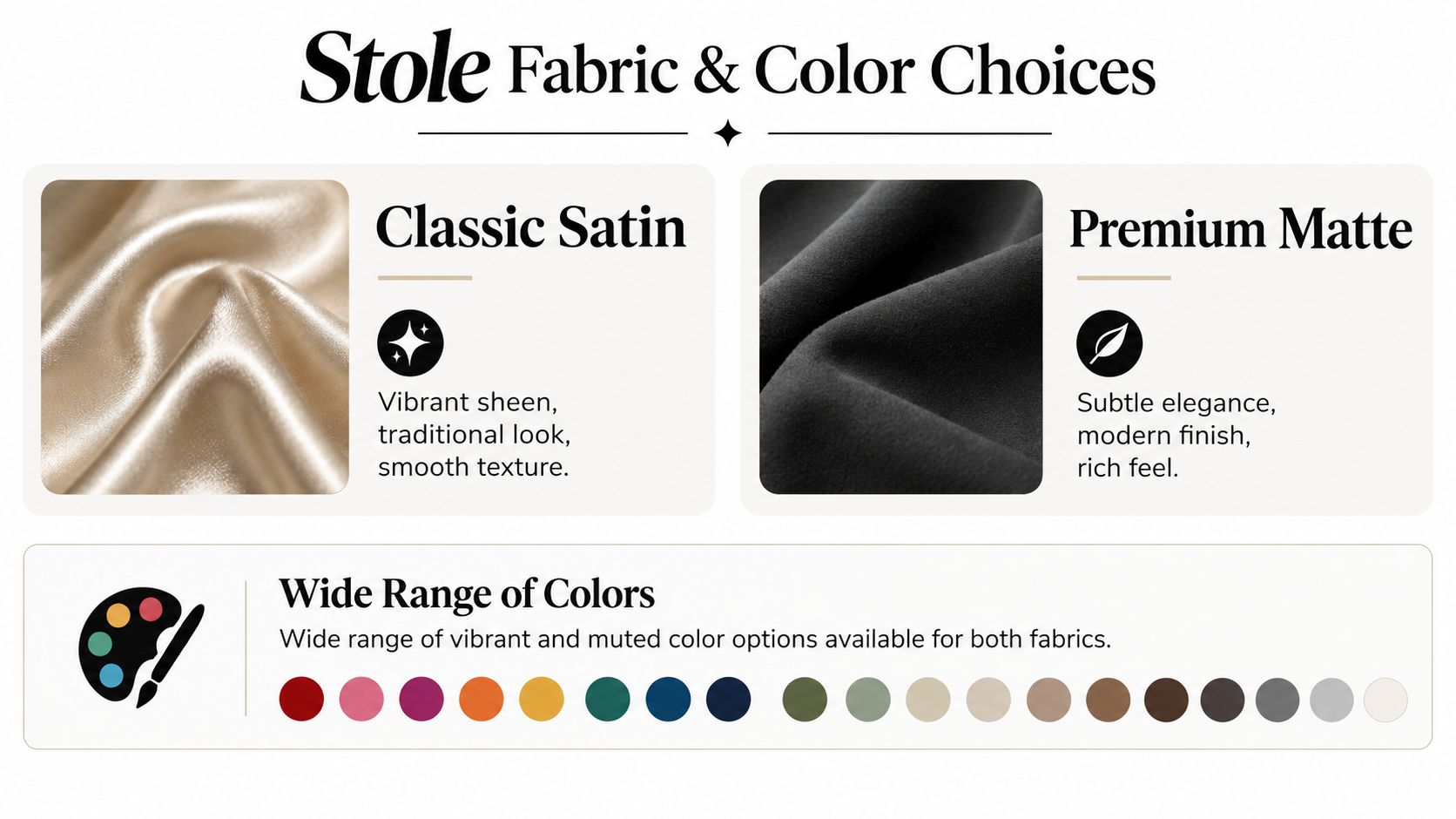
Once your school's requirements are clear, choose the foundation of your stole. Fabric affects how the piece reflects light, while color determines whether the design coordinates with your gown and communicates the intended affiliation. Two common directions are Classic Satin and Premium Matte.
Classic Satin has a smooth surface with a noticeable sheen. It creates a traditional, formal appearance and can catch light during professional portraits. Premium Matte has a quieter finish and a softer visual presence. It may suit graduates who prefer a modern look or want embroidered lettering to remain the main focus instead of competing with surface reflection.
Compare the finish with your ceremony setting
Think about where your photos will be taken. A satin stole can add visual energy in formal portraits, especially when the base color is rich and the design uses contrasting thread. A matte stole offers a more restrained appearance and can make a detailed emblem or clean line of text feel especially intentional.
Neither finish is automatically right for every graduate. If your design includes a bold Kente pattern, a cultural flag, or several colors, the pattern may already provide enough visual interest. If your design is mostly one color with a name, degree, or organization, the fabric finish can help establish the mood.
Color requires equal care. Seattle Colleges explains that stole colors and patterns may represent achievement, program membership, cultural identity, or affinity. Its examples include white for international students, gold for Phi Theta Kappa, multicolor patterns for ethnic, cultural, or tribal affinity, and flag-based designs for heritage or identification with a country. (Seattle Colleges academic regalia guidance)
Match school colors without guessing
Start with your university's official color references rather than relying on a memory of the campus bookstore sweatshirt. Graduation Cap and Gown's size, color, and fabric charts help you compare available options before you finalize the order. The Find Your University feature can also simplify the search by helping you identify coordinated regalia colors for your institution.
Use your school's color direction as a foundation, then add personal elements carefully. A student organization name, heritage pattern, or degree identifier should be easy to distinguish from the base fabric. If your school reserves a particular shade for honors, don't use it just because it matches your preferred palette. Color can be attractive and symbolic, but ceremony rules take priority.
Telling Your Story With Personalization
Stand at the ceremony entrance in your gown, and your stole will be seen before you reach your seat. A clear design helps guests understand what the day represents to you. Start by listing the two or three ideas you most want people to notice, such as your organization, cultural identity, degree, family milestone, or a meaningful phrase. Use those priorities to guide every later choice.
A custom stole commonly has two visible panels, so treat them like two pages of the same short story. One side might show Greek letters or an organization crest, while the other carries your name, degree, or graduation year. Another graduate may pair a cultural symbol with a first-generation message. Leave some space around each element. A panel does not need to hold every achievement to feel personal.
Choose the right application method
Embroidery gives text, initials, Greek letters, and simple marks a raised finish. It suits a traditional academic look, especially when the thread contrasts clearly with the fabric. Select a font with enough weight and spacing to remain readable from a distance.
Patches work well for larger logos, crests, or artwork containing several visual parts. They create a defined area for an emblem and may retain details that small embroidered lettering cannot show clearly. Request a proof before production so you can review the patch's scale, placement, and colors.
The artwork file also affects the result. A clean, high-resolution logo is easier to adapt than one with blurred edges or an unwanted background. If you are comparing decoration methods for other apparel projects, Wear X Apparel DTF solutions provides context on direct-to-film decoration workflows.

Design for the stage, not only the screen
A layout that looks refined on a phone may become hard to read among many graduates. Keep the main wording brief, use strong contrast, and avoid stacking several small lines in one area. Guidance on customizing graduation stoles recommends simpler arrangements for clear viewing on stage and in photographs. (Guidance on customizing graduation stoles)
Check three points before approving the artwork:
- Can someone read the main message quickly?
- Does each panel have one clear visual priority?
- Will the design remain balanced over the gown?
The proof turns those questions into specific checks. Review spelling, font, colors, logo size, and panel placement before production begins. A mockup may also show how the design fits the available space. Ask for revisions if lettering feels cramped or the logo overwhelms the panel. Approval workflows and revision options vary by supplier and order type, so confirm the process before you submit final approval.
Read every word in the proof, including organization names and degree abbreviations. Once production starts, corrections may no longer be possible. Treat approval with the same care as the final wording on a diploma, and check your university's rules before authorizing the order.
Finalizing Your Order Sizing Timelines and Groups
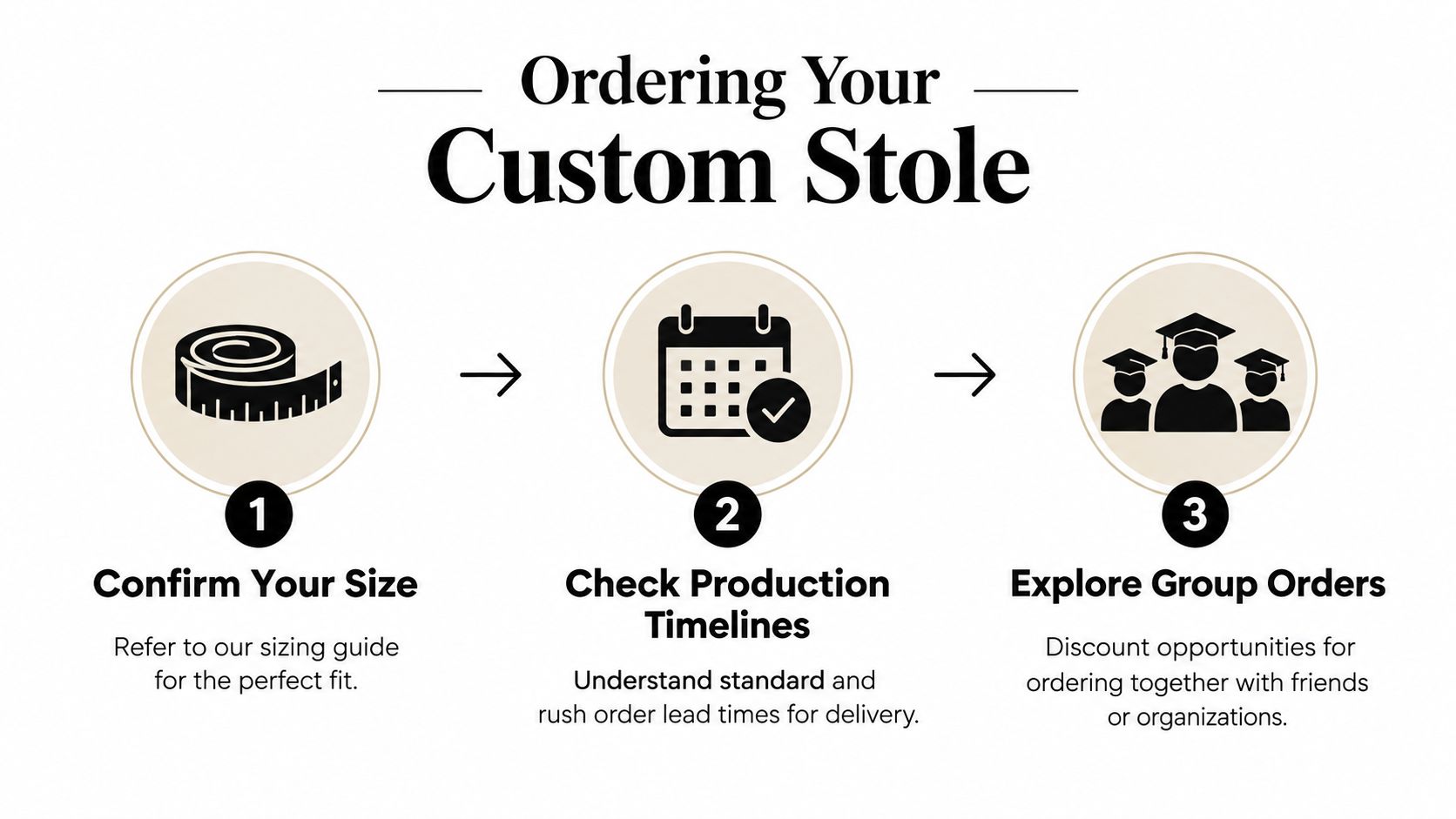
A polished design can still cause problems if the stole fits poorly, arrives late, or includes the wrong quantity. Before placing the order, coordinate three practical details: how it will sit over the gown, when it must arrive, and who is responsible for the final information. This preparation keeps a group order from stalling while production is already in progress.
For an individual order, start with the supplier's sizing information and consider how the stole will fall over your gown. It should look balanced from the front and allow comfortable movement. Check your university's permitted dimensions as well, since institutional rules may differ from a supplier's standard options. A product page can describe what is available, but your school determines what you may wear at the ceremony.
Build the delivery plan around approval
Production commonly begins after artwork approval, rather than when you first send an inquiry. Revisions, university review, and missing artwork can all delay that starting point. Ask the supplier for the estimated production window, shipping options, and the final date for approving your proof.
Supplier timelines differ. One custom stole provider lists a 12-piece minimum order, free mockups, and standard production of two weeks after approval. Another describes custom stoles taking about three weeks, with possible additional fees for text or logos. Treat these details as supplier-specific examples, not guarantees for every order.
Deadline check: Work backward from the ceremony date. Reserve time for university approval, proof revisions, production, shipping, and a final inspection when the package arrives.
A written schedule works like a checklist at the airport. Each stage must be complete before the next one can begin. If your university requires a design review, ask who submits it and whether the supplier will wait for that approval before producing the stoles.
Organize a group order without confusion
Clubs, departments, cultural organizations, and Greek groups should choose one coordinator to collect details. Use a shared list containing each participant's name spelling, requested size if applicable, design choice, and approval status. Keep one master artwork file so the group reviews and receives the same approved version.
Ask about minimum quantities, quote requirements, artwork fees, and whether individual names can be added to a shared design. Confirm how the supplier handles changes after the quote and proof are issued. For an organization or larger student group, review the wholesale graduation stoles collection to compare group-order options.
Before submitting payment, confirm:
- Final quantity: Match the cart or quote with the participant list.
- Approved proof: Ensure the organizer has reviewed the exact version being produced.
- Delivery address: Choose a location where someone can receive the package.
- Deadline communication: Provide the ceremony date and ask whether the proposed schedule is achievable.
Keep the confirmation, approved proof, and participant list together. That small record makes it easier to resolve a spelling, quantity, or delivery question before the ceremony.
Preserving Your Achievement Stole Care and Keepsakes
Your stole may be worn for one ceremony, but its meaning can last much longer. Handle it gently from the moment it arrives, especially if the fabric includes embroidery, patches, metallic details, or a delicate cultural pattern.
Before the ceremony, keep the stole on a hanger or lay it flat in a clean, dry place. Avoid placing heavy items on top of it, because pressure can create creases in the fabric or flatten raised decoration. If wrinkles appear, follow the supplier's care instructions and use gentle methods. Don't apply high heat directly to embroidery or patches, and don't experiment with harsh cleaning products on a keepsake you want to preserve.
Clean and store it with care
After commencement, inspect the stole for makeup, outdoor dust, food, or moisture. Spot-clean only when the care label permits it, using a soft cloth and mild treatment. For a formal garment or a difficult stain, a professional cleaner can advise on the safest approach. Graduates in Singapore who need specialized garment care can review Singapore dry cleaning solutions before choosing a service.
For storage, avoid folding the stole tightly around sharp creases. A breathable garment bag or acid-free tissue can help protect the fabric from dust and unnecessary friction. Store it away from direct sunlight, heat, and damp areas so its colors remain stable.
Turn the stole into a display piece
A shadow box creates a practical way to preserve the stole alongside your cap, tassel, honor cords, or ceremony photograph. Fold or arrange the stole so the most meaningful embroidery and symbols remain visible, then use a frame deep enough to avoid compressing the decoration. A diploma display can also place the stole within a larger record of your academic milestone. For layout inspiration, see the guide to a cap and gown shadow box.
If you're still deciding what to purchase, check the retailer's policy before ordering. Non-custom items may have different return conditions from personalized products, since a custom item is made to the buyer's specifications. Save your order confirmation, proof approval, and care information with your graduation records.
Wear Your Story with Pride
At commencement, your stole should feel familiar in the best way. The colors, words, and symbols you selected can help you recognize the organizations, family members, heritage, and persistence that shaped your degree.
Give the finished design room to matter. A clear phrase may be easier to read and remember than several crowded lines of text. A Kente pattern, flag, Greek symbol, or first-generation message can connect your ceremony attire with the people and experiences behind your achievement.
Before the ceremony, keep your order records together. Save the approved proof, sizing details, care instructions, and school guidance with your graduation documents. If a question arises about what you may wear, those records make it easier to check the decision you approved and the requirements you followed.
The stole can remain meaningful after the photographs are taken. Display it with your cap, tassel, cords, or ceremony photograph, or store it with other academic keepsakes. Years later, those details can bring back the effort behind the accomplishment, not only the day you crossed the stage.
Graduation Cap and Gown offers custom graduation stoles alongside Kente, First Generation, Greek, flag, honor, and international regalia options. Its tools support comparisons of size, color, and fabric choices. Visit Graduation Cap and Gown to select a base, prepare your design, and order a stole that reflects your achievement.