

Walk into any graduation ceremony, and the sea of colorful ropes draped over students' gowns can be a little puzzling at first. But the meaning behind those graduation rope colors is actually pretty straightforward.
These ropes, officially known as honor cords, are a visual testament to a student's hard work, academic excellence, and deep involvement in their school community. Think of them as a wearable résumé, a proud display of everything from a stellar GPA to membership in a specific honor society or club. Understanding the graduation rope color meaning for each cord you see adds a rich layer of appreciation for the graduates' journeys.
Decoding the Colors of Commencement
At any graduation ceremony, the vibrant display of honor cords adds a rich layer of symbolism to the traditional cap and gown. Each colored rope tells the unique story of a graduate's journey, recognizing specific achievements that go far beyond the diploma itself. These aren't just decorative touches; they're a proud, public acknowledgment of dedication and success.
But where did this tradition even come from? The practice of using specific colors in academic regalia isn't some new trend. It actually traces back to the late 19th century when American universities began to standardize their commencement attire. In 1895, the Academic Costume Code was established, assigning specific colors to different fields of study—like golden yellow for the sciences and purple for law. You can explore a bit more about this history and the story behind commencement colors on The Newshouse.
What Do the Ropes Represent?
While some colors have meanings that are almost universal, many are specific to the institution. Once you get the hang of the basics, you can start to read the stories woven into the regalia. The graduation rope color meaning can signify:
- Academic Excellence: Gold cords are the most widely recognized symbol of all, almost always reserved for graduates achieving Latin honors like summa cum laude, magna cum laude, and cum laude. It’s the universal sign of top-tier academic performance. A gold honor cord is a prestigious mark of distinction.
- Field of Study: Many departments award cords to their graduates as a point of pride. For instance, you might see orange cords for engineering, light blue for education, or green for environmental studies.
- Honor Societies: Prestigious national honor societies like Phi Beta Kappa or Sigma Theta Tau have their own distinct color combinations, allowing their members to stand out in the crowd.
- Leadership and Service: Cords can also represent significant contributions outside the classroom, such as holding a leadership role in student government or dedicating extensive time to volunteer work in the community.
The graduation rope, or honor cord, is more than an accessory; it's a narrative woven in color, celebrating a graduate's unique path of accomplishment, dedication, and personal growth throughout their academic career.
To help you get a quick handle on what you'll see, here’s a simple table breaking down some of the most common cord colors and their typical associations.
Quick Guide to Common Graduation Cord Colors
| Cord Color | Common Meaning | Often Associated With |
|---|---|---|
| Gold | High academic achievement, excellence | Latin Honors (cum laude, etc.), National Honor Society, Top GPA |
| Red | Passion-driven fields, communication | Journalism, Music, Public Health, Theology, Language Societies |
| Blue (Light) | Education, teaching, mentorship | Degrees in Education, Future Teachers and Administrators |
| Blue (Royal/Navy) | Leadership, justice, social sciences | Political Science, Justice Studies, Community Service |
| Green | Life sciences, health, nature | Medicine, Environmental Science, Agriculture, Nursing |
| Silver | Oratory, science, service | Public Speaking, Physics, Volunteerism, Technical Fields |
| Purple | Law, arts, humanities | Juris Doctor (Law), Architecture, Theology, Fine Arts |
| White | Arts, humanities, purity of thought | Arts & Letters, English, History, Sociology |
This table is a great starting point, but remember, schools often have their own unique traditions, so the exact meaning can vary.
This guide will walk you through everything, from the most common colors to navigating your own school's specific traditions. To get a head start, you can learn more about the diverse types of graduation cords available and what they signify. Whether you're earning your own cords or cheering on a graduate, you'll soon be able to read the stories told by every rope on display.
A Spectrum of Success: The Meaning Behind Each Color
Each graduation rope, or honor cord, holds its own unique story, acting as a vibrant badge of honor for specific accomplishments. While traditions can definitely vary from one school to another, certain colors carry widely recognized meanings that help paint a picture of a graduate's academic and extracurricular journey.
Once you understand the story behind each cord, the sea of regalia transforms from a simple display into a rich tapestry of achievement. Let's break down the symbolism behind the most common colors you'll see on commencement day.
The Gold Standard: Academic Excellence
Across pretty much every university and high school, the gold honor cord is the universal symbol for high academic achievement. Just like a gold medal in the Olympics, this color is reserved for students who have shown exceptional intellectual horsepower.
It's most often tied to Latin honors. A recent analysis revealed that approximately 12% of U.S. bachelor's degree recipients earned these distinctions, making the gold cord a mark of true academic dedication. If you see a graduate wearing a gold honor cord, you're looking at someone who has likely achieved one of the following:
- Summa Cum Laude: "With highest praise," typically for GPAs of 3.9 or above.
- Magna Cum Laude: "With great praise," usually for GPAs between 3.7 and 3.89.
- Cum Laude: "With praise," often for GPAs in the 3.5 to 3.69 range.
Blue Hues: Leadership and Knowledge
Blue cords come in various shades, each with its own distinct meaning. Royal blue is frequently tied to leadership, philosophy, and the social sciences. It signals a graduate's contribution to the campus community or their deep engagement with fields that explore human society and thought. You can find high-quality royal blue honor cords to represent these achievements.
On the other hand, a lighter sky blue cord is almost always linked to the field of education. This color represents the clear and open communication essential for teaching and mentorship. It's worn with pride by future educators who are preparing to shape the next generation of learners.
The spectrum of blue honor cords perfectly illustrates how a single color family can represent a wide range of achievements—from leading a student organization to committing to a future in the classroom.
Red, Green, and Beyond: Specialized Fields
Beyond the common gold and blue, a whole rainbow of colors represents specific fields of study and unique accomplishments. The story behind each graduation rope color meaning gives you deeper insight into a student's chosen path. For a complete overview, check out our comprehensive honor cord color guide and meanings to see the full list of associations.
Red cords often signify courage, passion, and creativity. You'll commonly see them on graduates in fields like journalism, music, public health, and communications—disciplines that require a bold voice and a dedicated spirit.
Meanwhile, green cords are deeply connected to the natural world. They are typically worn by graduates in environmental science, agriculture, and medicine. This color symbolizes growth, health, and a commitment to sustainability and well-being.
This infographic breaks down how honor cords are typically categorized, showing the relationship between academic, major-specific, and organizational awards.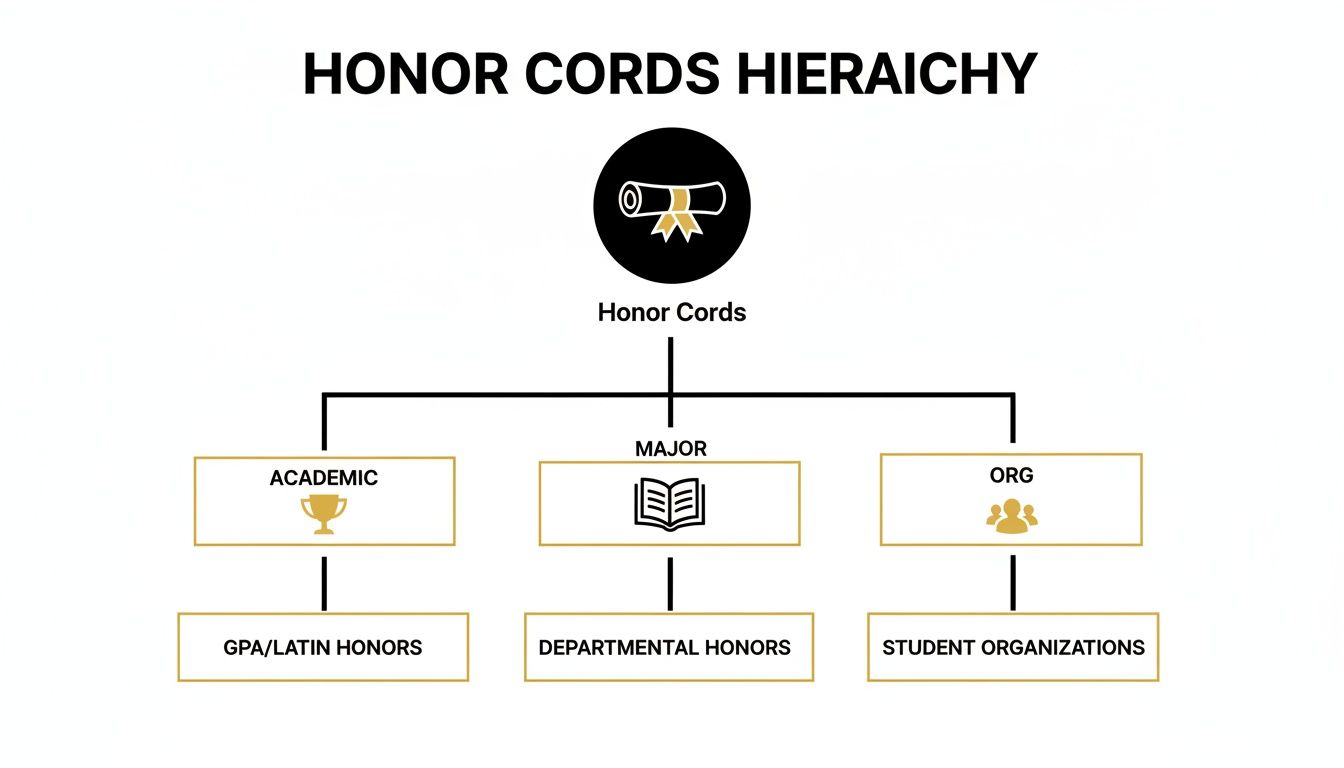
The visual hierarchy makes it clear that a student can earn cords from multiple categories, reflecting a well-rounded and successful academic career.
Other Notable Cord Colors
The symbolism doesn't stop there. Many other colors are used to denote specific areas of study or personal qualities, adding even more depth to the regalia.
- Silver: Often represents eloquence, kindness, or technical fields like physics and veterinary science. Find your silver honor cord here.
- Purple: Tied to ambition and creativity, it's frequently seen in law, architecture, and the fine arts. Browse purple honor cords.
- White: Symbolizes purity of thought and is common for graduates in arts, humanities, English, and history. Check out our white honor cords.
- Orange: Represents an energetic and creative spirit, closely associated with the demanding field of engineering.
These color distinctions help celebrate the diverse talents and disciplines that make up any graduating class, turning the ceremony into a vibrant display of individual journeys.
Cords Beyond GPA: Departmental and Society Honors

While the classic gold cord for a high GPA is the one everyone recognizes, it really only tells part of the story. Many graduates walk across the stage wearing cords that celebrate totally different kinds of success, reflecting their specific fields of study, leadership roles, and membership in prestigious organizations.
These cords paint a much fuller picture of a student's academic journey, showcasing dedication that goes far beyond test scores and final grades. Understanding this broader graduation rope color meaning helps you appreciate the incredible diversity of accomplishments within any graduating class.
Departmental Cords: Representing Your Major
Many academic departments present their graduates with specific colored cords to signify their field of study. It’s a tradition that creates a real sense of community and pride among students who have survived the same rigorous program. Think of it as a uniform for your intellectual team.
For instance, a bright orange cord immediately identifies an engineering major, representing the creativity and energy poured into that field. In the same way, a graduate with a light blue cord has likely dedicated their studies to education, getting ready for a career shaping young minds. These departmental honors are a powerful visual shorthand for a student's chosen path.
Here are some common examples of departmental cord colors:
- Orange: A vibrant color often reserved for graduates from the College of Engineering.
- Light Blue: The standard color representing the field of Education and teaching.
- Green: Typically worn by graduates in Environmental Studies, Agriculture, or certain medical fields.
- Purple: Frequently associated with Law, Architecture, and sometimes the Humanities.
- Red: Used to signify studies in Journalism, Communications, or Public Health.
Honor Societies and Their Distinctive Colors
Beyond your major, many cords represent membership in national and international honor societies. These organizations invite students based on a combination of high academic standing, leadership, and character, making their cord a mark of distinction recognized across the country.
These societies often use unique, multi-colored braided cords to represent their identity. The prestigious Phi Kappa Phi honor society, for example, uses a blue, gold, and white braided cord, making their members instantly recognizable at any ceremony. You can explore more about the different types of graduation cords and their specific affiliations to better understand these symbols.
A graduate wearing multiple cords—one for their GPA, another for their major, and a third for an honor society—is displaying a complete narrative of their college career. Each rope signifies a different chapter of their hard work and success.
A single graduate might wear a gold cord for achieving magna cum laude honors, a green cord for their degree in environmental science, and a silver cord for community service. This layering of cords doesn’t just add color to their gown; it adds depth to their story, showcasing a well-rounded and accomplished individual ready for whatever comes next.
Making Sense of Your School's Cord Traditions
While many graduation cord colors have widely accepted meanings, here’s the one thing that trips people up: they are not universally standardized. Think of all the color associations we’ve talked about as a great starting point, but your university’s official rules are the final word.
This lack of a single, nationwide standard is why a green cord might mean community service at one school and an environmental science degree at another. Every institution builds its own traditions, assigning meanings that tie back to its unique history, values, and academic programs. This makes the ceremony more personal for their community, but it does mean you have to do a little homework.
Finding Your School’s Specific Rules
To make sure you’re wearing the right regalia and getting credit for all the honors you’ve earned, you’ve got to confirm your school’s specific guidelines. Don't worry, this process is usually pretty straightforward. The key is just knowing where to look.
The most important step you can take before graduation is verifying your school's official regalia policy. A quick check will clear up any confusion and make sure you're celebrating your achievements with the right honor cords.
Taking a few minutes to verify this empowers you to buy the right items with total confidence. It guarantees that the story your cords tell on commencement day is the right one—one that lines up perfectly with your school's respected traditions.
Your Step-by-Step Confirmation Guide
Finding the official rules for your school's honor cords is probably easier than you think. Just follow these simple steps to get the answers you need.
-
Check the University Registrar's Website: This is almost always the central hub for all things commencement. Look for a "Graduation" or "Commencement" section, which usually has a detailed FAQ covering academic regalia, including the specific honor cord colors and who is eligible for them.
-
Consult Your Student Handbook: Your student handbook or the academic catalog is another goldmine of information. These documents typically outline all the requirements for academic honors and list the corresponding regalia the school officially recognizes.
-
Contact Your Department Advisor: If you think you've earned a departmental cord (like one for your major), your academic advisor or the department's main office is your best bet. They can confirm the color for you and tell you exactly how to get your hands on it.
-
Reach Out to Student Affairs: The Office of Student Affairs or Student Life is usually in charge of honors related to leadership, volunteer hours, and student organizations. If you're part of a club or group that awards a cord, they can give you all the details you need.
How to Wear Your Graduation Cords Correctly

You've put in the years of hard work to earn those honor cords. Now it’s time to wear them with the pride and polish they deserve. Getting it right is simple, but it makes a huge difference in looking put-together for the ceremony and all those photos.
First things first, find the center of your cord. The easiest way is to hold both tassels together and let the rope fold naturally at its midpoint. That center point is your guide for getting everything to hang just right.
Once you’ve found the middle, drape the cord over your head so it rests on the back of your neck, tucked neatly under your gown's collar. It should feel secure but not tight, with the two sides hanging down the front of your gown.
Achieving a Polished Look
The goal here is simple: you want the tassels at each end to hang at the exact same length. Take a second to adjust the cord on your neck until they’re perfectly even. It’s a small detail, but it creates a clean, symmetrical look that really stands out.
A properly worn honor cord is a sign of respect for your achievements and the academic institution. Taking a moment to adjust it correctly ensures your regalia looks intentional and dignified.
For graduates with a whole collection of cords, the process is similar—it just requires a bit more finesse to keep things tidy. You can learn more about mastering your entire commencement look in our detailed guide on how to wear graduation regalia, which has extra tips for stoles and other accessories.
Tips for Wearing Multiple Cords
If you've earned several honors (congratulations!), you'll want to arrange them thoughtfully to avoid a tangled or cluttered appearance. A neat presentation makes sure each of your distinct accomplishments gets its moment.
Just follow these simple steps for a flawless arrangement:
- Group Them First: Before placing them over your head, hold all your cords together by their midpoints.
- Drape as a Unit: Place the entire group of cords around your neck at once, making sure they lay flat against each other.
- Adjust for Evenness: Gently arrange the individual cords so they aren't twisted and the tassels hang neatly side-by-side. Make any final tweaks so all the tassels are at an equal length.
By following these straightforward tips, you can be confident your honor cords will perfectly complement your cap and gown. It’s the final touch that ensures your appearance reflects the dedication behind every honor you’ve earned.
Frequently Asked Questions About Graduation Rope Colors
As commencement gets closer, a few practical questions about regalia always seem to come up. Understanding the ins and outs of graduation ropes can feel a little confusing, but getting these details straight ensures you’re ready for the big day. Let’s clear up the most common points of confusion with some quick, straightforward answers.
Once you have these answers, you'll be set to wear your honors with confidence and focus on what really matters—celebrating your incredible journey.
Can I Wear More Than One Graduation Rope?
Yes, absolutely! If you've earned multiple honors, you get to show them all off. It's very common for graduates to wear several cords at once, representing everything from their GPA and major to memberships in different honor societies. It's a colorful and immediate way to display the full range of your accomplishments.
To wear them correctly, just drape the midpoint of each cord behind your neck so the tassels hang evenly down the front of your gown. If you have a few, layer them neatly so they don't get tangled. That said, it's always a good idea to double-check your school's specific guidelines, as some institutions might have rules on the number or types of cords you can wear.
What Is the Difference Between a Graduation Rope and a Stole?
Both signify accomplishment, but they are very different pieces of your graduation outfit.
A graduation rope, or honor cord, is a thin, twisted rope with tassels on each end. Think of it as a specific badge of honor. Cords usually represent a distinct academic achievement, like graduating with Latin honors or being a member of a prestigious honor society.
A stole, on the other hand, is a much wider, sash-like piece of cloth that drapes over your shoulders. Stoles often signify a broader affiliation or service, such as involvement in a club, a cultural organization, a specific program, or a leadership role like student government. It’s perfectly acceptable—and very common—for students to wear both to showcase the full story of their time at school.
Do I Have to Buy Honor Cords from My School?
Often, you don't. While some universities or specific honor societies require you to purchase regalia directly through them to ensure consistency, many give you the freedom to buy from an outside vendor. This can sometimes be a more affordable or convenient option, especially if you're in a last-minute pinch.
The most important step is to first confirm your school's exact requirements for color, thickness, and style. Sourcing your cords from a reputable supplier ensures you get high-quality, regulation-compliant regalia for your ceremony.
What Do Double or Triple Braided Graduation Ropes Mean?
When you see a cord with two or three colors braided together, it almost always signifies something very specific. These interwoven braided honor cords typically represent a particular honor society, an interdisciplinary academic award, or a special university-wide distinction that involves multiple areas of achievement.
For example, a cord that braids your school's two main colors might be given for a unique leadership award or a multi-departmental honor. The meaning is all in that specific color combination, which you can always verify with the organization that awarded it to you.
No matter which honors you have earned, Graduation Cap and Gown has the largest selection of high-quality honor cords to help you celebrate. Find the perfect match for your achievements and wear your success with pride by visiting https://www.graduationcapandgown.com.