

Think of a graduation stole as the final, personalized chapter of your academic journey, worn proudly for all to see. It’s far more than just another piece of fabric required for the ceremony; it’s a canvas for your accomplishments and a declaration of who you are. The meaning of a graduation stole is deeply personal and symbolic.
While the cap and gown represent the collective experience of graduation, the stole is where your individual story shines through.
What Does a Graduation Stole Really Mean?

This single piece of regalia can communicate a wealth of information at a glance. In a sea of identical black robes, the stole is a visual resume, showcasing everything from academic honors and club leadership to cultural heritage and personal milestones. The graduation stole meaning is tied to showcasing these achievements.
It’s what distinguishes members of an honor society, celebrates a student's participation in Greek life, or signifies the incredible achievement of being the first in a family to graduate. The stole turns a uniform into a personal statement.
Common Stole Representations
A stole can signify many different things, but most fall into a few key categories. Once you understand them, you can start to decode the stories you see at every commencement ceremony.
- Academic Honors: Recognizing achievements like summa cum laude, magna cum laude, or membership in a prestigious honor society. These are often represented by specific honor stoles.
- Organizational Membership: Displaying affiliation with fraternities, sororities, student government, or other campus clubs.
- Cultural Identity: Honoring a graduate’s heritage with designs like a Kente cloth stole for African heritage or a Serape stole for Latino culture.
- Personal Milestones: Commemorating significant experiences, such as studying abroad, completing a specific program, or being a student-athlete.
While the stole is a powerful symbol of the graduate's journey, many families also commemorate the milestone with special jewelry gifts for graduates.
To help you visualize the most common types of stoles you'll see on graduation day, here is a quick summary of what they usually represent.
Graduation Stoles at a Glance: Common Types and Meanings
| Stole Type | Primary Meaning |
|---|---|
| Academic Honor Stole | Represents high scholastic achievement, such as GPA-based Latin honors. |
| Organization Stole | Signifies membership and leadership in a specific group or club. |
| Cultural Stole | Celebrates personal heritage, ethnic background, or national identity. |
| Custom Stole | Showcases unique accomplishments, personal messages, or creative designs. |
Ultimately, the stole is a wearable testament to the unique path each graduate took to get to their big day. It’s a story told in color and fabric, worn with pride.
That graduation stole you'll soon be wearing is more than just a piece of fabric for your big day; it’s a direct link to a tradition nearly a thousand years old. Its story doesn't start in a university bookstore, but in the soaring cathedrals of medieval Europe, where its ancestor, the stola, was a common sight.
This original garment was a long, narrow scarf worn by clergy to signify their rank, authority, and devotion. As the first great universities like Oxford and Cambridge started popping up in the 12th and 13th centuries, this religious attire was naturally adopted by the scholarly class. After all, the earliest academics were often clerics themselves, so the stola made a seamless jump from a symbol of religious service to one of intellectual dedication. You can get more great insights into this evolution over at GraduationMall.com.
That small leap was a huge moment in academic history. The stole became a visual cue that set scholars apart, identifying them as members of a learned community committed to chasing down knowledge. It was one of the very first pieces of what we now recognize as academic regalia.
From Clergy Robes to Academic Regalia
As universities grew, so did the need to give scholars their own distinct visual identity. While early academics shared clothing traditions with the church, they started adding unique touches to signal their specific roles.
By the 1400s, professors and students began wearing mortarboards, which helped separate their academic status from that of priests. Regalia even became mandatory daily wear on campus, cementing its place as the official uniform of higher learning. The stole was right at the center of it all, evolving from a simple scarf into a more decorated and meaningful garment.
The adoption of specific academic dress wasn't just about looking the part; it was a practical way to create a standardized, recognizable system of honor. This system let you understand a scholar's achievements and field of study at a glance—a practice that is very much alive today.
Over the next few centuries, this system became more formalized. Different colors and emblems were introduced to represent various faculties and levels of academic achievement, laying the groundwork for the complex language of regalia we see at modern commencement ceremonies.
The Intercollegiate Code and Modern Standardization
The next major leap in the stole’s journey came much later, in the late 19th century, with the establishment of the Intercollegiate Code of Academic Costume in the United States. Before this code, regalia was a bit of a free-for-all, varying wildly between institutions and creating plenty of confusion.
The code created a unified system for American colleges and universities, standardizing the colors, shapes, and styles of gowns, hoods, and stoles. For instance, it assigned specific colors to different fields of study—a tradition that remains strong today. This move transformed the stole into a universally understood symbol of merit, connecting every single graduate to a rich, centuries-old history of celebrating knowledge.
How to Read the Colors and Symbols on a Stole
Think of a graduation stole as a wearable resume. Every color, symbol, and piece of embroidery is part of a visual language that tells the story of a graduate's unique journey. Once you know how to read the code, you can glance at their regalia and get a real sense of their accomplishments. The meaning of graduation stole colors is particularly important.
This system, largely standardized by the American Council on Education's (ACE) Intercollegiate Code of Academic Costume, turns a simple piece of fabric into a rich tapestry of meaning. It’s a silent, colorful announcement of expertise and affiliation.
Unlocking the Meaning of Academic Colors
The first thing you’ll notice is the stole's primary color, which usually represents the graduate’s field of study. While some schools stick to their own institutional colors, many follow a standardized system that assigns a specific hue to each academic discipline. This creates a vibrant, meaningful display across the entire graduating class.
Here are some of the most common colors you’ll see and what they mean:
- Golden Yellow: This bright, classic color is reserved for the sciences, covering everything from mathematics and physics to chemistry.
- White: Representing the arts and humanities, white is worn by graduates in fields like literature, history, and languages. To learn more, check out our detailed guide on the symbolism behind white graduation stoles.
- Drab (Beige): This distinct color is designated for the world of commerce and business, including degrees in accounting and finance.
- Light Blue: Reserved for the field of education, this color honors the commitment of future teachers, principals, and administrators.
- Green: Various shades of green represent the medical fields. Sage green is for physical sciences, while a distinct olive green is for pharmacy.
This system traces its roots back centuries, evolving from clerical vestments worn by early university scholars into the modern academic regalia we see today.

The visualization shows how a symbol once tied to religious authority was adopted by medieval academics and eventually transformed into the personalized emblem of achievement worn by modern graduates.
To help you decode the academic rainbow at your next commencement, here’s a quick reference guide to the official colors assigned to different fields of study.
Common Academic Field Colors for Stoles and Hoods
| Field of Study | Associated Color | Meaning/Symbolism |
|---|---|---|
| Agriculture | Maize | Represents the color of corn, a symbol of cultivation and harvest. |
| Arts, Letters, Humanities | White | Symbolizes the purity and clarity of creative and humanistic thought. |
| Business/Commerce | Drab (Beige) | A traditional color associated with finance and the materiality of commerce. |
| Education | Light Blue | Represents patience and the lifelong quest for knowledge. |
| Engineering | Orange | A strong, energetic color reflecting the constructive nature of engineering. |
| Fine Arts | Brown | An earthy tone representing the raw materials of artistic creation. |
| Law | Purple | Historically tied to royalty and justice, signifying dignity and authority. |
| Medicine | Green | Linked to healing and life, likely tracing back to medicinal herbs. |
| Music | Pink | A vibrant color chosen to represent the creativity and passion of musical arts. |
| Nursing | Apricot | A warm, compassionate color reflecting the caring role of the profession. |
| Philosophy | Dark Blue | Signifies wisdom and truth, as philosophy is the foundation of all scholarship. |
| Science | Golden Yellow | Represents the "light" of discovery and the intellectual wealth from research. |
This shared color language is what allows you to instantly recognize a future doctor, engineer, or teacher in a crowd of graduates.
Decoding Emblems and Insignia
Beyond the base color, the symbols embroidered on a stole add another layer of personal and academic meaning. These emblems get into the specifics, highlighting a graduate's affiliations, honors, and unique experiences. This is what makes each stole truly one-of-a-kind.
Some of the most common symbols you might encounter include:
- Greek Letters: These are the most recognizable emblems for fraternities and sororities, like ΑΦΑ (Alpha Phi Alpha) or ΔΣΘ (Delta Sigma Theta).
- Honor Society Keys and Crests: Organizations like Phi Beta Kappa often use a golden key emblem, while others have intricate crests representing their core values.
- University Seals: Many graduates proudly display their university's official seal, showing deep pride in their alma mater.
- Class Year: The graduation year (e.g., "Class of 2025") is a straightforward and popular way to mark the milestone.
Celebrating Your Identity with Cultural Stoles
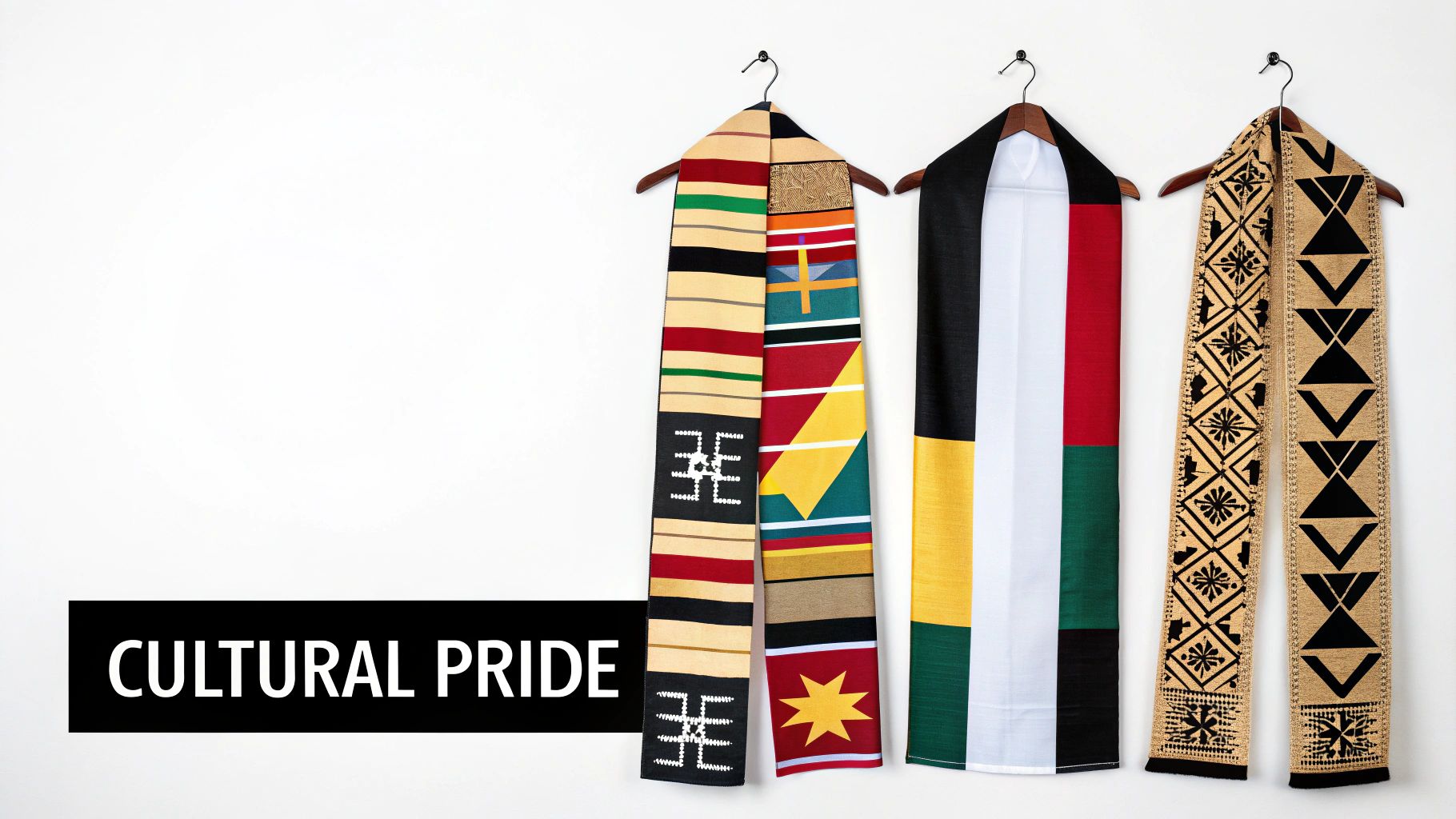
While academic colors celebrate what you’ve learned, a cultural stole celebrates who you are. Graduation ceremonies are embracing these powerful symbols of personal identity and heritage more than ever, and for good reason. A cultural stole transforms your regalia from a uniform into a profound declaration of your unique story.
These aren't just accessories. They are deeply personal statements that honor your family, your community, and the specific journey that brought you to this milestone. Wearing your history with pride creates a vibrant, meaningful display of diversity at commencement. The cultural graduation stole meaning is about celebrating this heritage.
Kente Stoles: A Symbol of Heritage
The Kente stole is probably the most iconic cultural garment you'll see on graduation day. Originating with the Asante people of Ghana, this vibrant, handwoven cloth is absolutely packed with meaning. Every single pattern and color in Kente cloth tells a story, representing big concepts like wisdom, bravery, and community.
For many African American graduates, wearing a Kente stole is a powerful way to connect with their African heritage and honor the resilience of their ancestors. It’s a visual tribute to a legacy of strength and achievement. You can explore a variety of authentic designs in our dedicated Kente Stole collection.
Serape Stoles and Celebrating Latino Culture
In the same way, the colorful Serape stole is a vibrant celebration of Latino culture. Known for its bright, striped patterns, the Serape is a traditional Mexican garment that has become a powerful symbol of pride and identity for graduates of Hispanic and Latino descent.
Wearing a Serape stole is a way to honor one's roots, family, and the rich cultural tapestry of Latin America. It adds a beautiful and meaningful splash of color to the ceremony, representing a community's collective success.
Cultural stoles have evolved into powerful symbols of personal identity, academic honors, and cultural pride, worn by millions worldwide each year. This is especially true as college enrollment and graduation rates for diverse populations continue to rise, making these celebrations more representative than ever. Find out more about this trend and its historical context on GraduationSource.com.
Stoles of a First Generation Graduate
One of the most meaningful stoles a graduate can wear is the First Generation stole. This garment signifies a monumental achievement—not just for the student, but for their entire family. It represents the breaking of barriers and the realization of a dream that often spans generations.
The "First Gen" message is a proud declaration that honors the sacrifices of parents and grandparents who may not have had the same opportunities. It symbolizes a new chapter in a family's history, inspiring future generations to pursue their own educational goals. It's a true testament to perseverance, hard work, and the power of being the first.
Stoles, Cords, and Sashes: What Is the Difference?
Walking into a graduation ceremony can feel like trying to learn a new language. You see all these different accessories draped over the gowns, and each one signifies a unique story of achievement. While they all add a splash of color to the traditional robe, stoles, honor cords, and sashes each have their own distinct job to do.
Think of it like this: your graduation stole is the main billboard of your academic career. It’s that broad, scarf-like piece of fabric that hangs around your neck and tells your biggest story—your field of study, your cultural identity, or your membership in a major organization. Its wide surface is the perfect canvas for detailed embroidery, logos, and vibrant colors that paint the big picture of your journey.
The Specific Role of Honor Cords
Now, if the stole is the billboard, then honor cords are the fine print—the specific, individual honors you’ve racked up along the way. These are the thin, twisted ropes, often with tassels at the end, that you see layered over the gown. Each one is like a distinct medal recognizing a specific accomplishment or affiliation.
A graduate might wear a double cord of gold and maroon for earning a high GPA, a single blue cord for their membership in the Psychology Club, and another for their role in student government. Each cord adds another layer to their academic narrative.
These cords are almost always color-coded to represent specific societies, grade point averages, or other unique honors. If you’re trying to decode all the different strands, you can explore our complete honor cord color guide and their meanings. While a stole tells the overarching story, the cords fill in the proud details of your success.
When Is a Sash Worn?
Finally, we have the sash. While you’ll sometimes hear people use the term interchangeably with "stole," in a formal academic setting, a sash plays a very different role. It’s typically a much wider piece of fabric worn over one shoulder and across the body, pageant-style, not draped around the neck.
Because they’re so prominent, sashes are usually reserved for singular, high-profile honors that set a person apart from everyone else. You'll typically see them worn for titles like:
- Valedictorian or Salutatorian: Highlighting the top academic achievers in the entire graduating class.
- Homecoming or Prom Royalty: Often seen in high school ceremonies.
- Grand Marshal: A title given to a distinguished faculty member or student chosen to lead a procession.
A sash is meant to signify a unique and distinguished role. By understanding these key differences, you can put together the perfect combination of regalia that proudly and accurately tells the full story of your academic journey.
How to Wear and Preserve Your Graduation Stole
On your big day, the last thing you want to be fussing with is your regalia. Wearing your stole correctly isn’t just about looking polished and confident in photos; it’s about respecting the tradition it represents. Luckily, a few simple steps will make sure your symbol of achievement is perfectly placed.
First things first, put your graduation gown on. Then, just drape the stole around the back of your neck, almost like you’re putting on a scarf. The two ends should hang down your front, parallel to each other. Take a second to adjust them until they’re the same length, lying flat and smooth against your gown.
To keep it from slipping or shifting around while you walk, sit, and collect that hard-earned diploma, a small safety pin is your best friend. Pin it to your gown from underneath, right at the back of your neck where no one will see it. That simple trick will keep it secure all day. For other accessories, like the academic hood, you can find more tips in our guide on how to wear the academic hood properly.
Caring for Your Stole as a Keepsake
Your stole is so much more than an accessory for a single day. It’s a lifelong keepsake that symbolizes years of hard work, and preserving it correctly means you’ll have that treasured memento for decades to come.
If your stole is wrinkled from its packaging before the ceremony, you’ll want to iron it on a low heat setting. Always—and this is important—place a thin cloth, like a pillowcase or press cloth, between the iron and the stole. This protects the delicate fabric and any embroidery from direct heat. Never let a hot iron touch the material directly.
After graduation, proper storage is what makes all the difference. Try to avoid folding it in a way that creates sharp, permanent creases. Instead, hang it on a padded hanger or store it flat in a cool, dry place away from direct sunlight, which will cause the vibrant colors to fade over time.
For the best long-term protection, think about using a garment bag. This will shield it from dust, moisture, and pests, keeping it in pristine condition. With just these few simple steps, your graduation stole will remain a beautiful, tangible reminder of your incredible accomplishment.
Got Questions About Graduation Stoles?
As your big day gets closer, it's totally normal for questions about regalia to pop up. You’ve put in the work, and now you want to make sure you get the details right. Understanding the traditions behind your stole helps make commencement feel even more meaningful.
We’ve pulled together some of the most common questions students have about their stoles. Let's get you some clear, straightforward answers so you can walk across that stage with confidence.
Can I Wear More Than One Graduation Stole?
This is a great question, and the answer comes down to one thing: your school's rules. Many universities are perfectly fine with graduates wearing multiple stoles. It’s a fantastic way to represent all your different achievements—maybe one for your academic honors and another for a cultural organization you were a part of.
However, some schools are a bit stricter. The last thing you want is a surprise on graduation day, so always check your university's official graduation handbook or get in touch with the registrar's office. A quick check will give you the final word.
Is There a Difference Between High School and College Stoles?
They might look similar, but there’s a real difference in what they represent. While the core graduation stole meaning—celebrating a major achievement—is the same, the specifics usually change.
College stoles are often more formalized. They tend to follow the official Intercollegiate Code for academic colors and represent a huge range of accomplishments, from Greek life and departmental honors to advanced degrees.
High school stoles, on the other hand, typically recognize achievements like being valedictorian, a class officer, or membership in groups like the National Honor Society. The tradition of graduation regalia is rooted in post-Civil War America, where it was strictly reserved for commencements to set them apart from British customs. Today, personalization has become a huge part of the ceremony, with 90% of U.S. colleges following the voluntary Intercollegiate Codes for their regalia. You can read more about the history of graduation stoles on TheSashCompany.com.
Of course, once you’ve figured out your stole, the next step is the celebration itself! If you're looking for some creative graduation party ideas, we've got you covered there, too.
At Graduation Cap and Gown, we have a huge collection of custom, cultural, and academic stoles to help you tell your unique story. Find the perfect symbol of your achievement today at https://www.graduationcapandgown.com.