

You're halfway through commencement when you reach up to move your tassel from right to left. The tassel shifts, the graduation tassel year charm swings loose, and suddenly the ceremony's most visible keepsake feels one tug away from falling onto the floor. A quick attachment check before leaving home can prevent that distraction.
A year charm is a small metal date attachment fitted to a graduation tassel. It can identify the graduating cohort, personalize otherwise standardized regalia, and become a lasting memento after the ceremony. The important questions aren't only which date to buy, but whether the charm suits your degree level, where it should attach, and how to preserve it after commencement.
Understanding Tassel Charms and Ceremony Etiquette
The tassel carries more meaning than its size suggests. Historical accounts trace academic tassels to the 14th century, when European universities used them to represent different levels of academic achievement, while the mortarboard tradition developed from medieval European universities of the 12th and 13th centuries. In modern ceremonies, moving the tassel from the right side to the left commonly signals that a candidate has completed a degree. (Graduation tassel history and symbolism)
That movement is a ceremony convention, not the original purpose of the dated charm. The custom of turning the tassel likely began in the 20th century and became widely popular only in the last 50 years, making it relatively recent compared with cap-and-gown traditions. At many high school ceremonies, graduates begin with the tassel on the right and move it left after receiving diplomas. (Tassel placement and graduation traditions)
Is a year charm appropriate for every graduate?
For high school seniors, a visible year-date charm is generally a familiar and expected personalization. Historical accounts also describe class-coded tassel placement at Goucher College, where students wore tassels on different cap corners by class year and seniors turned theirs together at the ceremony's conclusion. That history helps explain why today's date drops feel natural for a graduating cohort.
For bachelor's, master's, and doctoral graduates, the answer is less uniform. A dated charm is usually an optional keepsake, not a universal requirement of academic regalia. Bachelor's and graduate tassels often appear without a prominent year charm, while some institutions, departments, student groups, or families choose to add one. Doctoral candidates should be especially attentive to university instructions because doctoral regalia may follow stricter visual conventions.
Practical rule: Treat the year charm as a context-specific memento unless your school or ceremony coordinator says it's part of the official tassel.
Before ordering, check the commencement handbook or ask the regalia office. If the charm is allowed, it can give your cap a personal timestamp without changing the traditional right-to-left movement. For readers pairing the keepsake with a card or family celebration, these meaningful graduation message ideas can help connect the small accessory to the larger milestone. For additional background, see this guide to tassel charms and graduation traditions.
Choosing the Right Charm for Your Degree Level
A charm can suit one tassel and overwhelm another. Choose it by degree level, tassel construction, and ceremony rules rather than appearance alone. For undergraduate and graduate regalia, a modest stamped-metal date charm generally fits a conventional rayon or cotton tassel. Doctoral regalia often has a fuller bullion tassel, so a heavy attachment can pull at the head, disrupt the drape, or look out of place with formal doctoral dress.
| Degree Level | Standard Tassel Length | Recommended Charm Style |
|---|---|---|
| High school | 9 inches | Visible year-date drop or modest personalized charm |
| Undergraduate | 9 inches | Standard stamped-metal year charm, if permitted |
| Master's | 9 inches | Compact stamped-metal charm with restrained finish |
| Doctoral | 10 inches | Small, lightweight charm only if institutional policy allows |
Length is a proportion guide, not an etiquette rule. For bachelor's and master's graduates, a standard date drop is usually an unobtrusive keepsake when the school permits it. Doctoral candidates should confirm the policy before ordering, since doctoral regalia may follow stricter visual conventions. The university's approved tassel color and shape take priority at every degree level.
Match finish, hardware, and school colors
Year-date charms are available in gold and silver, allowing the finish to coordinate with tassel hardware, school colors, honor cords, stole, or other regalia details. (Gold and silver tassel year dates) Matching every metallic detail is optional, but one consistent finish usually photographs more cleanly than a combination that looks accidental.
Gold has a traditional, celebratory appearance. Silver can look quieter and pair well with cool-toned school colors. Check the tassel description before buying a separate charm. Some standard tassels are 15.5 inches total length and already include a gold two-digit year date, making an extra drop unnecessary unless it marks a personal milestone. (Tassel specifications and included year dates)
For a long-term keepsake, choose a compact charm with a finish that will not clash with the tassel's existing hardware. Keep the packaging or a small labeled storage bag after the ceremony, so the date charm can be preserved separately without crushing the tassel.
How to Attach and Secure Your Year Charm
A charm that looks secure in your hands can still catch on the cap, cords, or gown during the processional. Attach it to the tassel's cinched top band, metal loop, or existing ring at the tassel head, never to the loose fabric strands. The band and loop carry the hardware. Individual strands can fray, slide, or stretch when the charm swings. Follow this guide to attaching charms to graduation tassels before assembling a group of tassels.
Use the right hardware
A lobster clasp suits on-site assembly because its small lever opens quickly and clips onto the tassel's top loop. It also lets you test the connection without forcing a metal ring apart. Year charms are made as add-ons for tassel bands, so replacing the full tassel is usually unnecessary. (Year-date drops for tassel bands)
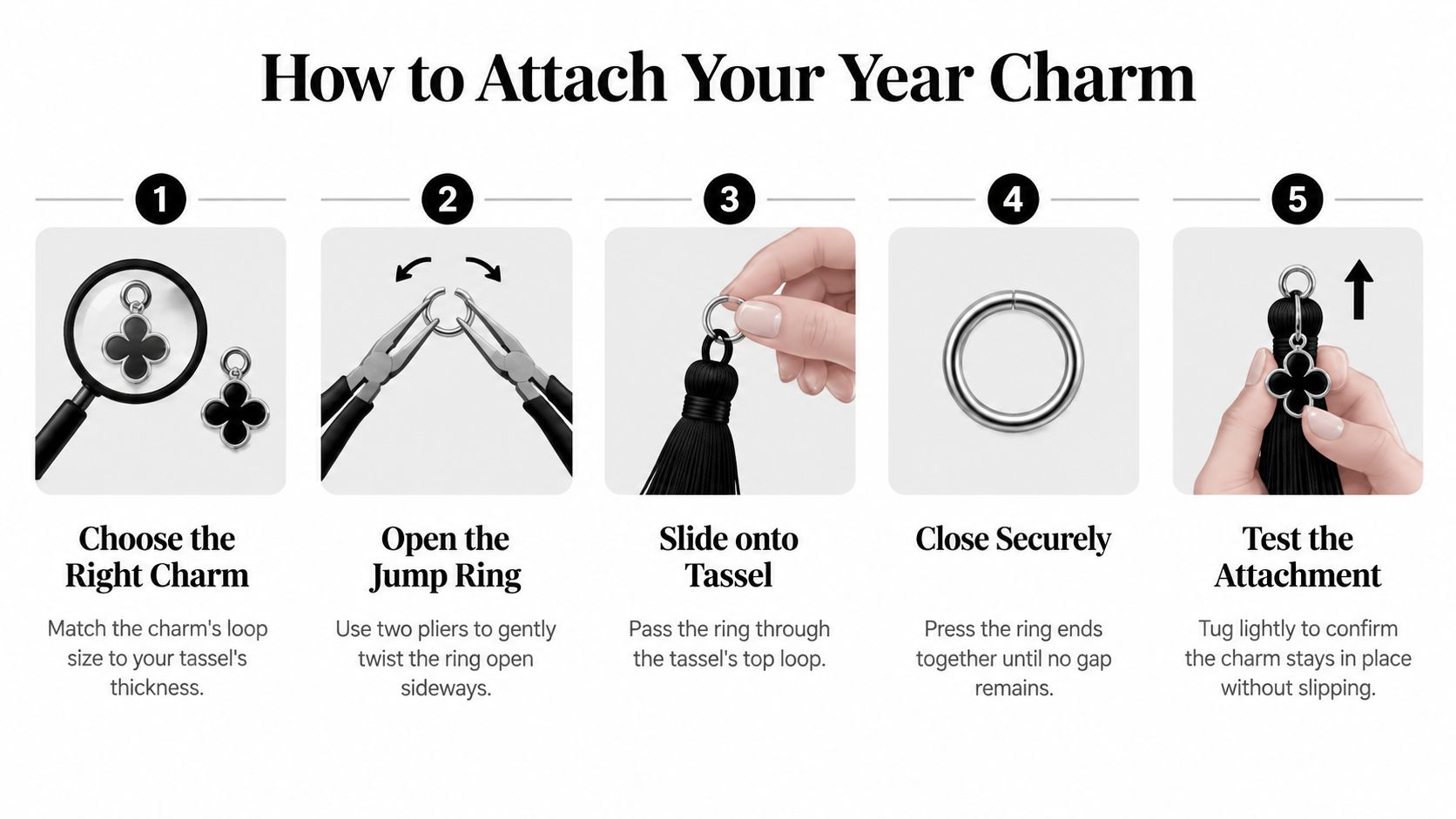
A jump ring requires more care. Use two pairs of small jewelry pliers, grip opposite sides, and twist one side forward while moving the other backward. Do not pull the ends straight apart. That motion spreads the ring into a clamshell shape, weakens the metal, and makes a complete closure harder.
Five attachment steps
- Inspect the pieces. Confirm the year, check that the charm loop fits the available hardware, and look for damage around the tassel's top loop or band.
- Choose the attachment point. Locate the cinched band or metal loop where the strands gather. Keep the charm clear of individual threads.
- Open the ring correctly. Twist the jump ring sideways with pliers, or use the lobster clasp lever. Open it only far enough to pass through the top loop.
- Add and close. Slide the charm onto the loop and bring the ring ends together until no visible gap remains. Position the year so it faces outward when the tassel hangs from the cap.
- Test before packing. Give the charm a light tug and move the tassel as it may move during the ceremony. Correct any slipping, spinning into the strands, or visible gap before distribution.
Review this guide on how to put a tassel on a graduation cap for cap placement and the ceremony movement from right to left.
Here's a visual demonstration to review after installation:
For a large order, assemble one sample first. Check the clasp, attachment point, and outward-facing date, then repeat the process only after the sample passes inspection. This catches fit problems while they are still easy to correct.
Exploring Customization and Material Options
A graduation tassel year charm can mark more than the class year. It may represent a field of study, family milestone, initials, or student organization. Each choice affects the charm's weight, finish, readability, and suitability for a ceremony. Select the design with the tassel's hardware and future storage in mind, not only its appearance in a product photo.

Material and finish choices
Zinc-alloy metal is common for year charms because it provides a durable base for a small accessory and supports gold-tone or silver-tone finishes. The finish changes the appearance, while the attachment format can remain the same. Confirm that the coating is even and that the edges are smooth enough to avoid catching tassel fibers.
A stamped date with a clean face is usually easiest to read during the ceremony and in photographs. Engraved initials or a name create a more personal keepsake. Enamel can introduce school colors or identify a major, but extra color and text can make a small charm visually crowded. Keep the message short enough to remain legible beside the hanging strands.
The Graduation Year Date Drop collection provides a dated option for shoppers who want personalization without ordering a fully custom design. (Browse year date drops for tassels)
A charm intended for long-term keeping should also have a finish that is easy to clean and a surface that will not quickly show scratches. Store it separately if its edges or hardware could rub against the tassel or other memorabilia.
Custom orders need production discipline
Group orders require a proofing process. Confirm the quantity, graduating year, lettering, finish, attachment method, and tassel compatibility before approving production. Custom suppliers may require minimum runs of 200 pieces and approximately 12 weeks of production lead time, while larger quantities may reduce unit cost. (Custom graduation tassel production planning)
That timeline makes stock year drops simpler for individual purchases or late orders. A custom signet can better express a department or cohort, but one incorrect date or inconsistent finish can affect the entire distribution. Request one sample when the order allows it, inspect how it hangs, and confirm that the attachment does not strain the tassel's top loop.
Individual buyers should check the loop size, clasp style, metal finish, and compatibility with the tassel already owned. A heavier charm may look substantial online but can pull the tassel off balance during photographs or movement. Choose a readable design that remains secure and worth preserving after commencement.
Care, Storage, and Troubleshooting Common Issues
After commencement, remove the charm before storing the tassel if the clasp could snag the strands or other keepsakes. Work over a clean table, hold the tassel near its top band, and open the lobster clasp or jump ring gradually. Never pull the charm away by the threads, because the strands aren't designed to carry that force.
Solve small hardware problems early
A lobster clasp that won't snap shut usually has debris, a bent lever, or a misaligned receiving loop. Clean the area with a dry soft cloth, check whether the clasp closes fully without the charm attached, and replace the hardware if it remains unreliable. Don't force a defective clasp onto the tassel and assume the surrounding threads will hold it.
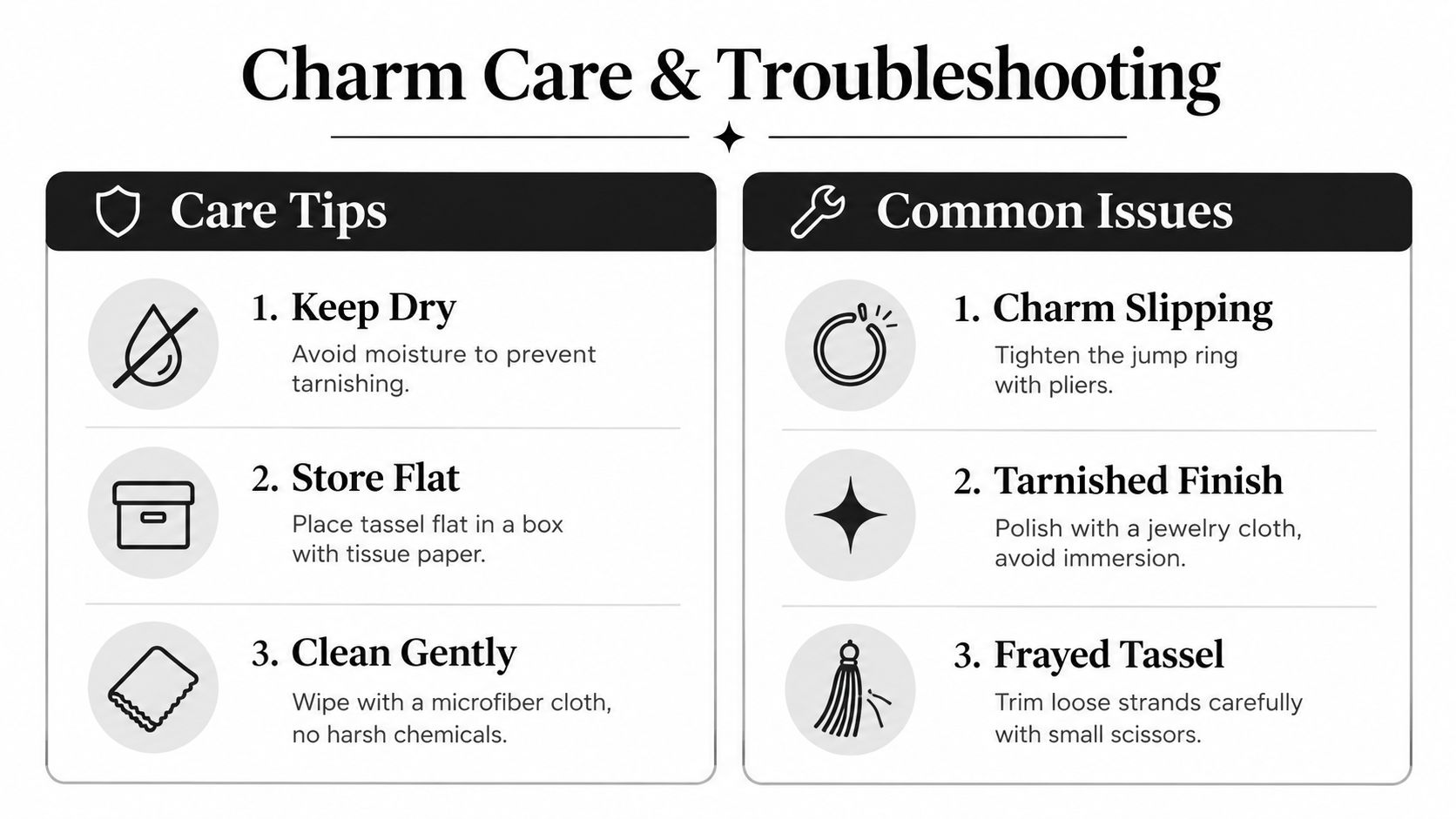
A jump ring that has opened out of shape should be realigned with small pliers. Bring the ends together by twisting rather than squeezing the ring flat. If the metal has cracked or remains visibly weak, replace the ring instead of trusting it for display or future use.
Protect the finish and the fibers
Keep the charm dry and wipe it with a microfiber or jewelry cloth. Avoid harsh chemicals, abrasive cleaners, and immersion in liquid, especially when the charm has enamel, plating, or engraved details. Guidance on how to keep jewelry shining longer is also useful for the metal component, although the tassel fibers need gentler handling than most jewelry.
For long-term storage, place the tassel flat in a clean box with acid-free tissue paper if available. Keep the charm separated from anything that could scratch its face, and avoid compressing the strands under heavy items. A shadow box or memory frame can display the tassel while protecting it from dust and repeated handling.
Storage rule: Preserve the tassel and charm as separate materials. The metal needs protection from moisture and abrasion, while the fibers need room to remain smooth and uncrushed.
If the tassel has a few loose strands, trim only the stray ends with small scissors. Don't cut into the cinched band or attempt to reshape the entire tassel. A clean, dry, flat storage arrangement gives the charm a better chance of remaining readable and attached when you revisit it years later.
Final Buying Considerations and Ceremony Rules
The safest purchase starts with your school's ceremony policy. Some schools require identical regalia and restrict dangling charms or other tassel modifications. Ask the commencement office whether a graduation tassel year charm is customary, optional, or prohibited for your degree level before ordering.
Check the charm against the tassel you will wear. Confirm the date, finish, clasp, and attachment point. A low-cost accessory can still create a ceremony-day problem if the year is wrong, the metal does not fit the loop, or the clasp catches on the strands. Current-year drops may be sold for as little as $1.12 per unit, and one retailer lists an MSRP of $1.40 for a 2024 year-date drop, showing that these are generally accessible accessories rather than major regalia components. (Year-date drop pricing)
Bulk coordinators should approve design files, quantities, the proofed date, and the hanging point before distribution. Custom production's 200-piece minimum and approximately 12-week lead time, covered earlier, make last-minute ordering risky. Build in time to inspect a sample, verify that the charm sits correctly, and resolve attachment problems before graduates receive their tassels.
Review the graduation ceremony order of events, especially the timing of tassel movement, diploma presentation, photographs, and the cap toss. If you are selecting a milestone gift as well, ECI Jewelers' 2026 graduation watch guide offers another keepsake option to compare with a charm.
Graduation Cap and Gown offers graduation year date drops, tassels, and academic regalia for high school, undergraduate, master's, and doctoral ceremonies. Visit Graduation Cap and Gown to match your tassel, confirm the charm style, and order accessories before commencement day.