

Three weeks before commencement, a coordinator opens the delivery and finds the wrong shade of blue. Then the roster changes, the supplier reports a backorder, and the team discovers that several tassels don't fit the caps already packed for distribution. With families arriving and graduates lined up, there's no practical time left to fix a preventable purchasing error.
Ordering graduation tassels bulk requires more than finding a low unit price. Schools and departments must control color compliance, attachment specifications, customization, quantity, delivery timing, receiving inspection, and ceremony-day distribution. The safest order is the one that arrives early, matches the institution's approved standards, and includes enough stock to handle ordinary changes without triggering an emergency reorder.
Why Bulk Tassel Planning Matters for Your Ceremony
A graduation tassel is small, but a bulk order creates a large operational dependency. Every graduate needs the correct accessory, and the tassel must work with the cap, degree level, academic discipline, or school policy. If one part of that chain fails, staff end up solving a purchasing problem in front of graduates and families.
Academic regalia standards developed through formal codification. American universities formed an intercollegiate commission that produced the Intercollegiate Code in 1895, followed by revisions in 1932 and 1959, and those standards still underpin much modern regalia practice (University of South Carolina Aiken history of regalia). The framework typically treats bachelor's and master's tassels as black, doctoral tassels as old gold, and the tassel as moving to the left after the degree is conferred. Many institutions also assign colors by academic field.
That means a buyer can't treat tassels as generic accessories. A university may need separate quantities for degree levels, colleges, or disciplines. A school district may use one approved school color, while a college commencement requires several field-specific shades. The order sheet must reflect the ceremony policy, not the total number of graduates.
Practical rule: Treat every color, attachment style, and charm configuration as a separate stock-keeping unit. A correct total with incorrect variants is still a failed order.
The same discipline should apply to the rest of commencement preparation. Use the high school graduation checklist to coordinate tassels with cap-and-gown fittings, roster confirmation, accessories, and distribution dates. For teams handling garments and accessories in controlled environments, the Material Handling USA gowning guide offers useful context on organized apparel handling and contamination-conscious storage practices.
The hidden cost of weak planning isn't limited to replacement units. Staff may need to separate mismatched colors, explain exceptions to graduates, repackage incomplete sets, or pay for rushed transportation. A reliable bulk program removes those decisions before ceremony week.
Tassel Types Materials and Standard Sizes
Start with the cap attachment, then specify the fiber, finish, hardware, and dimensions. Buyers who skip this sequence often receive tassels that look acceptable in a product image but don't attach securely to the institution's mortarboards.
Select the attachment before the appearance
Traditional graduation tassels generally use a loop that fits over the button at the center of a mortarboard. A clip-on or removable design can suit caps without a built-in fastener or programs that want to distribute tassels separately from the caps. Confirm the cap construction with the regalia provider before approving a bulk purchase.
Standard graduation tassels are commonly manufactured at about 8 inches, with a 6-inch loop, according to Graduation Outlet's standard tassel specifications. That dimension should be treated as a starting specification, not an assumption. Ask for a sample and verify that the loop clears the cap button while the hanging strands sit at the intended position.
Compare fibers and hardware
Bulk graduation tassels are commonly specified as 100% polyester. One supplier describes its tassels as 65-thread-count polyester with a gold-plated copper clasp, details that buyers can use when comparing construction rather than relying on appearance alone (Graduation Snow bulk tassel product details).
Polyester is a practical choice for high-volume programs because it supports consistent dye matching and tolerates repeated handling, packing, and shipping. Rayon can provide a smoother, more reflective finish, while cotton generally produces a more matte appearance. The right choice depends on whether the priority is uniformity and handling durability, a particular visual finish, or a keepsake feel.
| Material | Appearance | Durability | Cost | Best For |
|---|---|---|---|---|
| Polyester | Consistent, polished finish | Strong for routine handling and shipping | Usually economical | Large school and university orders |
| Rayon | Softer, silk-like sheen | Requires more careful handling | Often higher | Keepsake-focused ceremonies |
| Cotton | Matte, natural texture | Can need careful storage | Varies by specification | Institutions seeking a subdued finish |
| Synthetic blend | Finish depends on the blend | Depends on fiber composition | Varies | Programs balancing appearance and budget |
Approve a written specification
Your purchase order should state the material, color reference, length, loop style, clasp, charm treatment, packaging, and sample approval requirement. Don't accept “standard tassel” as a sufficient description. It leaves too much room for substitutions, especially when an order contains several colors or custom elements.
Matching School Colors and Academic Discipline Codes
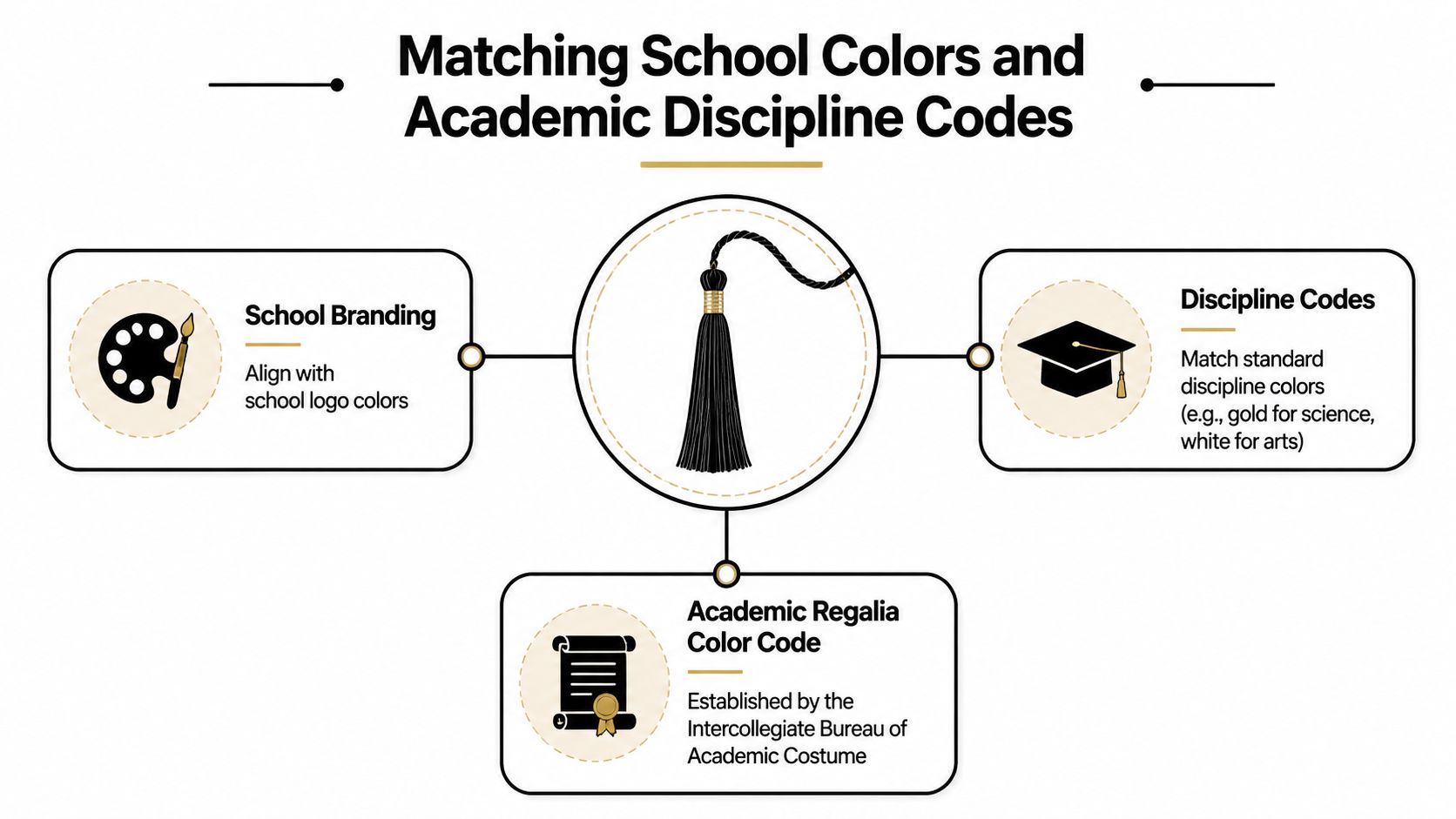
Color selection is where many bulk orders become noncompliant. A tassel can match the school logo and still be wrong for a particular academic discipline, or it can follow a discipline code while clashing with a high school's ceremony policy. The registrar, commencement office, and supplier should work from one approved color schedule.
The historical framework behind U.S. academic dress assigns meaning to colors. Examples include white for arts and humanities, light blue for education, orange for engineering, apricot for nursing, and gold or yellow for science and computer-related fields (California Graduation guidance on academic regalia). University policies may use additional discipline shades. For example, Hunter College lists white for Arts and Sciences, light blue for Education, apricot for Nursing, and olive green for Pharmacy (Hunter College academic regalia guidance).
Build a color authority
Use the institution's current commencement policy as the controlling document. Don't let a supplier's generic chart override the registrar's requirements. If a university has changed a college assignment or uses a local convention, that policy governs the order.
Create a simple approval record with:
- Degree level: Separate bachelor's, master's, and doctoral requirements where applicable.
- Academic unit: List each school, college, department, or program receiving a distinct shade.
- Color reference: Record a fabric swatch, approved physical sample, or institutional color reference.
- Quantity by variant: Never combine all colors into one total.
- Placement instruction: Document whether candidates begin on the right and move left, or whether the institution uses a different ceremony practice.
TAMIU's academic-regalia guidance identifies the tassel as a reflection of the candidate's major field and places it on the left after graduation (Texas A&M International University commencement guidance). The graduation tassel colors meaning guide can help staff explain color symbolism, but the institution's official policy should remain the final authority.
Never approve from a screen alone
Digital previews can shift with monitors, lighting, compression, and camera settings. Request a physical sample or fabric swatch for every color that matters. Inspect it under the lighting used at gown fitting and during stage rehearsal, then keep the approved sample with the purchase file and receiving team.
If the order includes school branding and discipline colors, decide which requirement takes priority before production. Don't ask the supplier to “make it close.” Give the supplier a documented hierarchy and require written confirmation of each variant.
Customization Options for Year Drops and Charms
Customization turns a standard tassel into a keepsake, but every extra component adds another point of failure. The most useful question isn't whether a charm looks attractive. It's whether the personalization improves the graduate experience enough to justify additional approval, assembly, inspection, and delivery work.
Choose the simplest customization that serves the ceremony
A stamped metal year drop is usually the easiest option to manage. It uses a defined numeral design and can be attached to the tassel before shipment or supplied separately. Enamel-filled charms create more visual distinction but require tighter approval of color, finish, and attachment. A school logo medallion delivers the strongest branding effect, yet custom artwork and tooling make it the least forgiving choice for a compressed schedule.
Use embroidery selectively for honor society or special recognition tassels. Embroidery can distinguish a group, but it also introduces another production specification and may require a separate assembly process. If the tassel will be handed out in a crowded fitting line, a pre-attached charm reduces volunteer work. Loose charms can be more flexible, but they demand clear labeling and a controlled attachment station.
The supplier also shows why buyers must ask about minimums before approving artwork. One tassel supplier lists 200 pieces as the minimum quantity for custom tassels (The Honor Cord Company tassel requirements). A custom design that works for a large graduating class may not be economical for a small department.
| Customization Type | Cost Per Unit (500+ pcs) | Cost Per Unit (100–499 pcs) | Added Lead Time | Best For |
|---|---|---|---|---|
| Stamped metal year drop | Request a written quote | Request a written quote | Confirm with supplier | Standard class-year keepsakes |
| Enamel date charm | Request a written quote | Request a written quote | Confirm artwork and production timing | Programs prioritizing visual personalization |
| School logo medallion | Request a written quote | Request a written quote | Confirm tooling and production timing | Institutions with approved branding |
| Embroidered recognition detail | Request a written quote | Request a written quote | Confirm stitching and assembly timing | Honor societies and defined groups |
The table intentionally avoids unsupported price assumptions. Supplier quotes can vary by metal, finish, attachment method, artwork, packaging, and shipping destination.
Protect the date and the artwork
Submit numerals, logos, and color references in writing. Require a proof before production, and assign one person to approve it. Multiple informal approvals create confusion, especially when a year drop, school seal, or abbreviation changes during email revisions.
For a practical comparison of year drops and other add-ons, consult tassel charms for graduation. Keep the final choice conservative if the ceremony date is close. A plain, correct year charm is better than a custom piece that arrives after the caps have been distributed.
Order Quantities Lead Times and Budget Planning
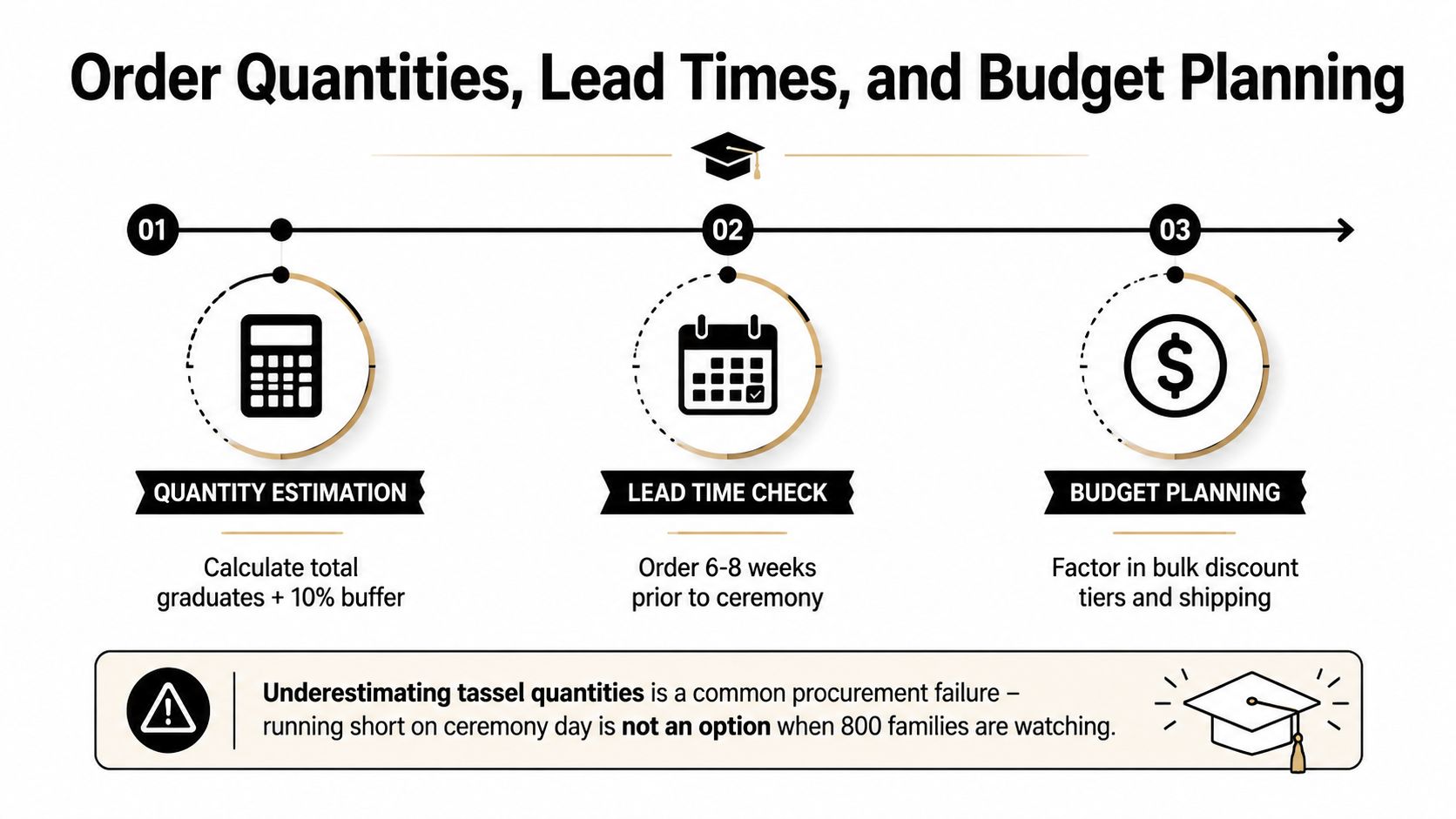
Quantity planning should begin with the final roster, not the first enrollment estimate. Separate graduates by tassel variant, then calculate each variant independently. A large total can hide a shortage in one small department.
Calculate each variant
Use this working formula:
Required units for each variant = confirmed graduates assigned to that variant + planned buffer + replacement stock.
The correct buffer depends on roster stability, ceremony size, supplier reliability, and the difficulty of obtaining replacements. Planning notes often recommend a 7% to 10% buffer for groups under 500 graduates, while larger institutions may use 4% to 5% because the overall roster variance is narrower. These planning percentages are operational recommendations, not universal rules. Apply them to each color or program rather than only to the grand total.
For example, a department with a small assigned color may need a meaningful reserve even when the entire university order is large. Keep the reserve visible in the purchase record so staff don't distribute it accidentally during normal fitting.
Work backward from the ceremony
Lead times differ sharply by supplier and customization level. Vendor pages describe custom programs with minimums as low as 12 pieces and production of about 2 weeks, while other suppliers require 100 pieces and quote 6 to 8 weeks, or as much as 12 weeks for custom tassels (Custom Grad Tassel bulk ordering guidance). Don't use the shortest advertised lead time as your plan. Ask whether it covers proof approval, production, quality review, transit, customs, and replacement handling.
Use this reverse schedule:
- Ceremony date: Set the delivery deadline before the event, not on the event date.
- Receiving and inspection: Reserve time to count, sort, and test samples.
- Production and proofing: Add the supplier's stated production period after artwork approval.
- Quote and specification: Allow time for color confirmation, sample review, and purchase authorization.
- Roster freeze: Establish a date for the final count, then preserve a reserve for late additions.
Compare total risk, not just unit price
Standalone graduation tassels can range from about $1.05 to $7.99, while cap-and-tassel sets can range from $2.56 to $18.29, depending on features such as charms and closures (Accio graduation tassel market coverage). Those ranges show why a quote needs a complete specification before comparison.
Review these budget lines separately:
- Product price: Include the exact color, material, attachment, and charm.
- Shipping: Ask about standard, expedited, and international delivery options.
- Duties and taxes: Confirm responsibility for customs charges when ordering internationally.
- Reorder exposure: Price the cost of a small replacement shipment before placing the main order.
- Variant splits: Check whether multiple color SKUs reduce the quantity tier for each one.
The lowest quote isn't automatically the lowest-risk purchase. A cheaper item can create more labor, more sorting, and more delivery exposure if the supplier cannot reproduce the approved shade or meet the required date.
Storage Assembly and Distribution on Ceremony Day
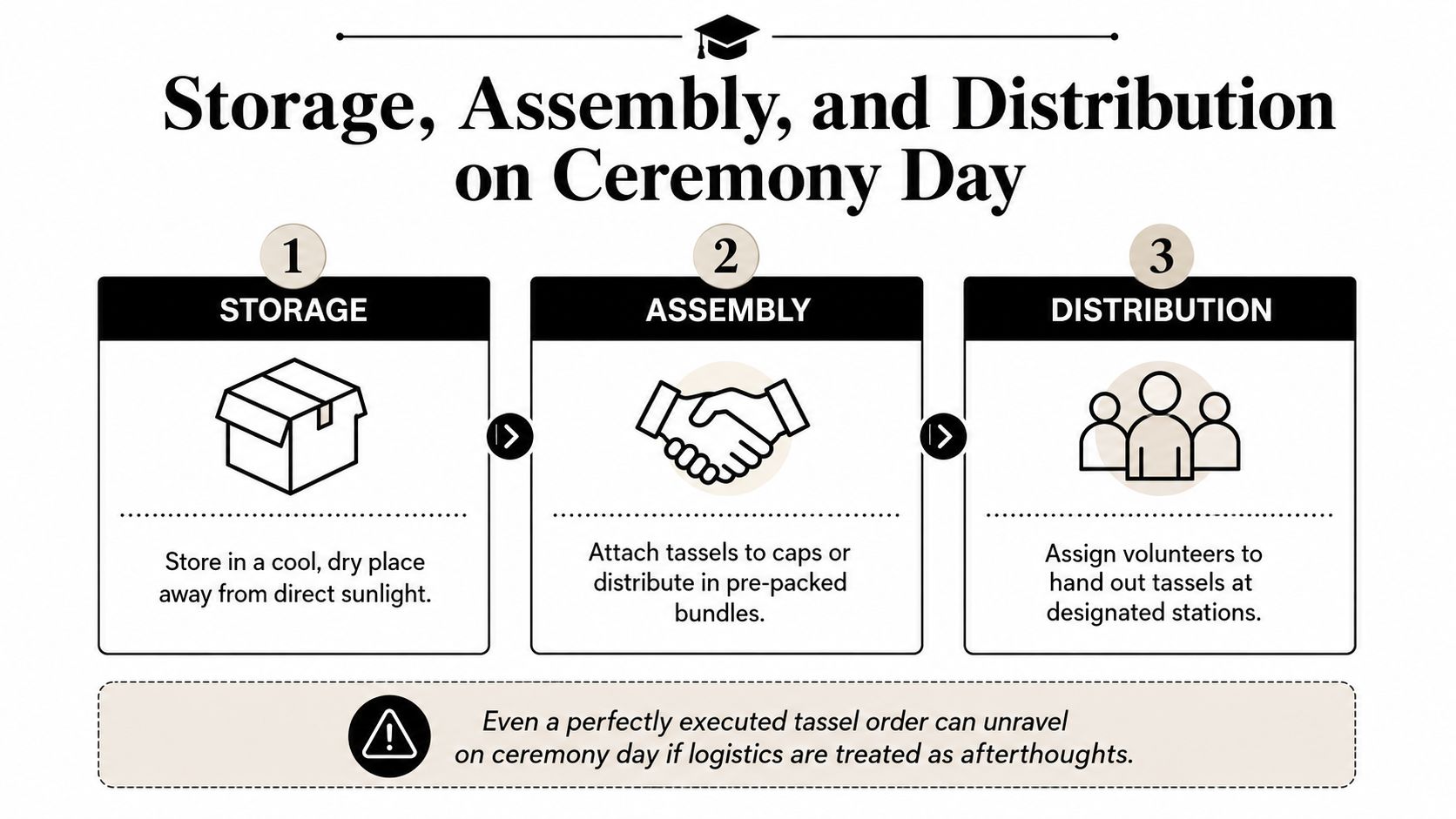
A correct shipment can still fail at the venue. Tassels arrive in boxes, not in graduate-ready order, so the receiving team needs a physical workflow that protects the inventory from tangling, mislabeling, and accidental distribution.
Store by variant, not by arrival carton
Move the shipment into a cool, dry storage area away from direct sunlight. Keep cartons off damp floors, avoid compressing the hanging strands, and retain the supplier labels until the count and inspection are complete. Polyester is generally suited to repeated handling, while any fiber that absorbs moisture can tangle or lose its intended presentation if stored carelessly.
At least two weeks before the ceremony, sort stock into clearly labeled bins by color, academic unit, degree level, and charm configuration. Record the number placed in each bin. Store buffer inventory separately and mark it for authorized use only.
Standardize assembly
If year drops or charms arrive loose, create one workstation with the approved sample, attachment tools, labels, and a completed example. Give volunteers one task at a time, then have a second person inspect the finished attachment. That separation prevents a fast assembler from passing a loose charm or incorrect variant into the distribution stock.
Choose the distribution model based on your existing fitting process:
- Individual cap bags: Pack each graduate's cap and tassel together. This reduces line decisions but requires accurate roster assembly.
- Alphabetical pickup: Organize labeled bundles by last name. This works when graduates collect regalia at a controlled station.
- Fitting-session handoff: Give the tassel to the graduate while staff verify the cap and program. This offers a useful final human check.
For attachment instructions, share the guide on how to put a tassel on a graduation cap with staff and volunteers. On ceremony day, stage spare tassels in every approved color, extra loops and clasps, scissors, labels, and a printed color chart. Assign one person to approve substitutions so volunteers don't improvise.
Procurement Checklist and Quality Verification
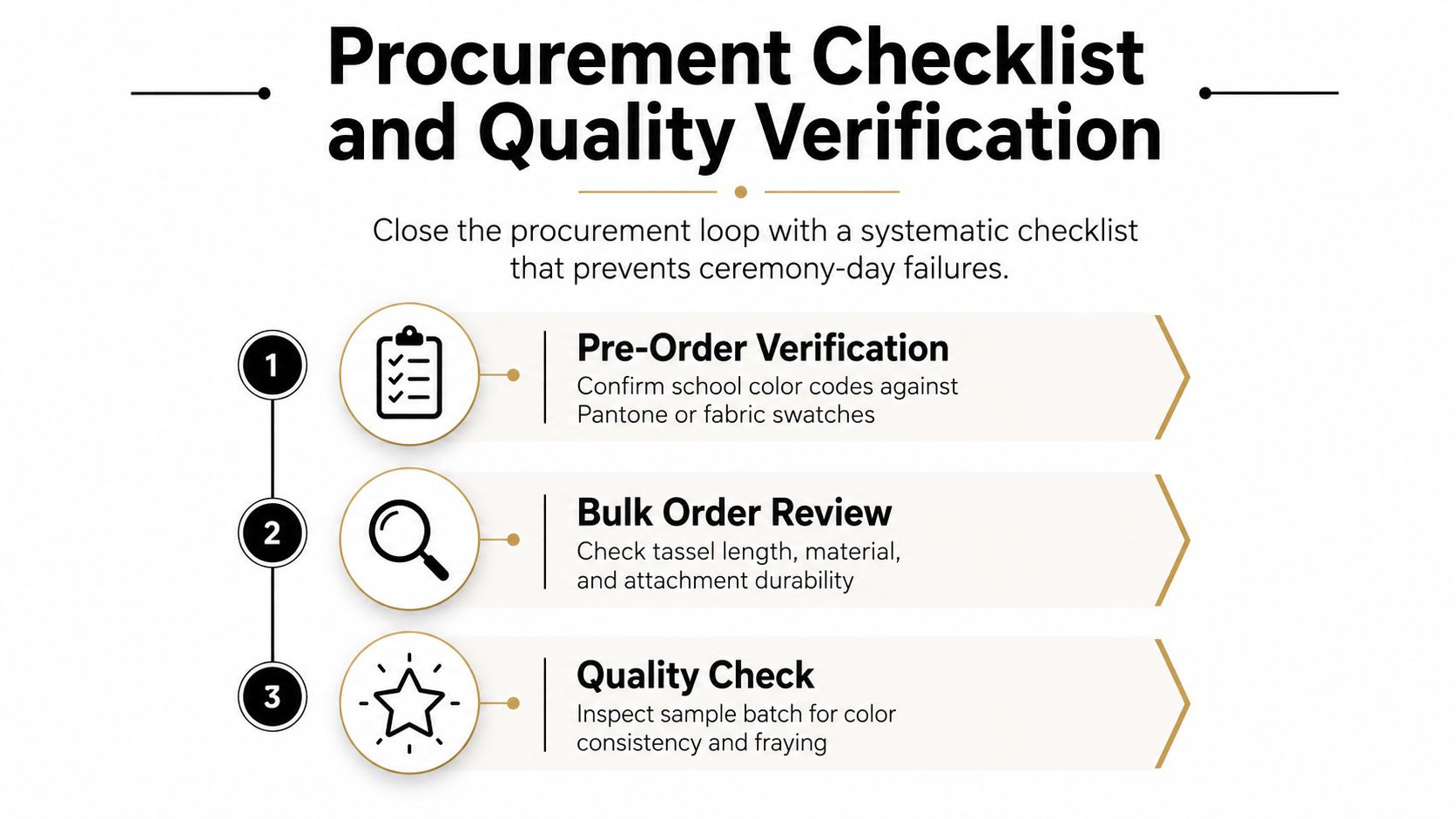
A bulk tassel order isn't complete when the cartons arrive. It's complete when the right units have passed inspection, reached the right bins, and can be replaced quickly if a graduate loses or damages one.
Before placing the order
Confirm the institution's color policy against a physical swatch or approved sample. Record the color name, reference, discipline, degree level, and quantity as separate fields. Check every year numeral and logo proof character by character, then confirm the cap button and loop compatibility.
The purchase file should include:
- Roster source: The person and date responsible for the final count.
- Variant schedule: A line for each color, degree level, and customization.
- Reserve quantity: Buffer and replacement stock shown separately.
- Delivery requirement: The date the shipment must arrive for inspection.
- Approval record: The sample, proof, and written supplier confirmation.
Inspect immediately upon delivery
Count every carton against the packing list before distributing anything. Open representative units from each color and customization batch, then check:
- Strand condition: Look for fraying, loose fibers, tangles, or uneven trimming.
- Color consistency: Compare units with the approved sample under natural and artificial light.
- Loop and clasp: Test the attachment on the actual mortarboard button.
- Charm security: Pull gently on the attachment and inspect the ring, clasp, or connection point.
- Packaging labels: Confirm that color and program labels match the inventory record.
Photograph defects and isolate affected units. Notify the supplier promptly, because replacement terms vary and a buyer who waits until the final fitting has little time or bargaining power.
Finish the week before commencement
Keep the registrar or commencement lead responsible for the reserve stock. Stage backup units with the distribution team, post the color chart at every station, and name one point person for emergency substitutions. The final check should confirm that each bin is labeled, each variant is reconciled, and staff know which units they may issue.
Graduation Cap and Gown offers individual tassels and quantity-based ordering options, along with special-order choices such as key chain and jumbo tassels. Visit Graduation Cap and Gown to compare tassel variants, year date drops, school colors, and related regalia before you finalize your procurement schedule. Build the order around an approved sample, variant-level counts, and a delivery date that leaves time for inspection.