

Think of earning your high school diploma like building a house. You can’t just throw up the walls and call it a day; you need a solid foundation first. High school graduation requirements are that foundation—a specific set of academic benchmarks designed to make sure every student has the essential knowledge for whatever comes next.
What Are High School Graduation Requirements Anyway

It’s about way more than just showing up for four years. Graduating high school is a structured journey that involves earning a set number of credits, passing mandatory courses, and sometimes, clearing state-level exams.
The Building Blocks of a Diploma
At the heart of it all are credits. Think of them as the literal building blocks of your education. You earn one by successfully passing a class for a specific amount of time, which is usually a full school year.
This isn’t just a loose suggestion, either. In the United States, graduation requirements have evolved to really zero in on college and career readiness. Today, at least 46 states plus the District of Columbia have set minimum credit requirements.
To give you a general idea of what that looks like, here’s a quick summary of the usual breakdown for a standard high school diploma.
Typical High School Graduation Requirements At a Glance
| Core Subject Area | Typical Credits or Years Required | Common Course Examples |
|---|---|---|
| English/Language Arts | 4 credits | English I-IV, American Literature, Creative Writing |
| Mathematics | 3-4 credits | Algebra I, Geometry, Algebra II, Pre-Calculus |
| Science | 3-4 credits | Biology, Chemistry, Physics, Earth Science |
| Social Studies/History | 3-4 credits | U.S. History, World History, Government, Economics |
| Physical Education & Health | 1-2 credits | P.E., Health & Wellness, First Aid |
| Fine Arts or Performing Arts | 1-2 credits | Art, Music, Theater, Dance |
| Foreign Language | 2 credits (often for college prep) | Spanish, French, German, American Sign Language |
| Electives | 3-6 credits | Varies widely (e.g., computer science, marketing, psychology) |
This structure ensures students complete core subjects like English, math, science, and social studies, with most diplomas requiring around 22 credits on average nationwide.
The whole point is to create a well-rounded educational experience. These requirements guarantee that every single graduate, no matter their future plans, has a baseline of critical thinking, communication, and problem-solving skills.
Ultimately, this system is designed to provide a consistent standard of achievement. It verifies that a diploma isn't just a certificate for showing up, but a genuine measure of academic accomplishment.
More Than Just a Checklist
Getting a handle on your school’s specific requirements is the first real step toward a successful high school career. These rules shape your academic path, dictating which classes you take and when. They are the roadmap that guides you from freshman orientation to that incredible moment you walk across the stage in your cap and gown.
This guide will walk you through every piece of the puzzle, from the universal expectations to the local rules that will shape your unique journey. We'll show you how to navigate this path so you can celebrate your achievement with confidence, knowing you’ve built a strong future.
For more advice on getting ready for this huge milestone, you can explore other helpful graduation planning articles on our blog. This clarity helps you make smart choices, avoid last-minute surprises, and ultimately, wear your graduation regalia with pride.
Mastering the Core Credit Curriculum
While the total number of credits varies from state to state, the heart of all high school graduation requirements is the core academic curriculum. Think of subjects like English, Math, Science, and Social Studies as the structural pillars of your entire education. They aren't just arbitrary hurdles to jump over; each one is there to build fundamental skills you'll use for the rest of your life, no matter what career you pursue.
When you successfully complete these courses, you're proving you have the critical thinking, communication, and analytical skills needed for college and the workforce. Instead of just looking at the numbers, it's way more helpful to understand the why behind each requirement. That perspective transforms your class schedule from a simple checklist into a clear roadmap for personal and academic growth.

The Logic Behind Core Subject Progression
Schools don't just ask you to take four years of math; they map out a specific sequence for a reason. This progression is designed to build your knowledge layer by layer, with each course setting you up for what comes next. It’s like learning to cook—you have to master basic chopping skills before you can even think about tackling a complex recipe.
-
Mathematics: A common path is Algebra I, then Geometry, followed by Algebra II. This sequence isn't random. Algebra I teaches you the language of variables and equations, which you then apply in a spatial way in Geometry. Algebra II takes those foundational concepts and blows them up into more complex problem-solving, which is exactly what you need for advanced math like Pre-Calculus.
-
Science: You’ll often start with a life science like Biology, which explores living organisms and ecosystems. From there, you move to a physical science like Chemistry or Physics, which explains the very matter and energy that govern those systems. This approach gives you a holistic view of the natural world, from microscopic cells to cosmic forces.
Understanding this logical flow helps you see the bigger picture. Each class isn't just an isolated island of knowledge but part of an interconnected journey.
English and Social Studies: The Skills of Citizenship
While math and science build your analytical brain, English and social studies are all about understanding the world and your place in it. They teach you how to think critically, communicate effectively, and step into the world as an informed citizen.
Four years of English isn't just about reading classic novels. It's a deep dive into analyzing arguments, constructing persuasive essays, and seeing the world from different perspectives. In the same way, social studies courses like U.S. History, World History, and Government provide the essential context for modern society. They explain how past events shape our present and give you the tools to participate in civic life.
These core requirements are not just about memorizing facts and formulas. They are about developing a well-rounded mind capable of tackling complex challenges in a rapidly changing world. Rigorous standards have been shown to help students rise to the occasion and better prepare them for their future.
Electives: Where Passion Meets Purpose
Beyond the core curriculum lies the exciting world of electives. These are the courses that let you explore your own unique interests and passions. Whether it's coding, digital art, psychology, or a skilled trade, electives are your chance to customize your high school experience and make it your own.
These choices are way more than just fun breaks from your required subjects. They offer a sneak peek into potential career paths and help you develop specialized skills. Taking several courses in one area, like fine arts or computer science, can show a deep, focused interest to colleges and future employers.
Better yet, excelling in these areas can lead to special recognition at graduation. Students who dedicate themselves to a particular field often earn unique accolades. This achievement can be celebrated with accessories like honor cords or custom graduation stoles that showcase their unique talents as they walk across the stage. These vibrant symbols turn a personal passion into a visible point of pride on graduation day.
Why Your Zip Code Changes Your Graduation Plan
One of the biggest myths about graduating high school is that the rules are the same for everyone. They’re not even close. While the federal government offers guidance, it doesn't set a national standard for high school graduation requirements. That power belongs to each state—and often, each local school district—to draw its own unique map to the finish line.
Think of it like different roadmaps all pointing to the same city. Every route gets you there, but the specific turns, landmarks, and even the speed limits change depending on the path you take. This means a student in Texas might have a completely different academic journey than a student in New York, even if they both walk away with a high school diploma. Getting a handle on your specific, local requirements is the first and most important step.
State-Level Differences in Diploma Tracks
To see just how much the rules can change, let's look at a couple of different approaches. States have the power to design diploma programs that reflect their own educational priorities and workforce needs, which creates a huge variety of graduation plans across the country.
A state like Texas, for example, runs on the Foundation High School Program. Students need to complete 22 credits for a basic diploma, but they're also pushed to choose an "endorsement," which is basically a high school version of a college major. These specialized tracks require four extra credits and focus on areas like STEM, Business & Industry, or Arts & Humanities. It’s a structure designed to get students thinking about career paths early on.
In sharp contrast, other states might offer a more generalized set of requirements. Their goal is to ensure a strong, broad foundation in core subjects without forcing students to specialize so soon. This flexibility gives students more room to explore different interests through electives before they have to commit to a post-graduation plan.
The Role of Standardized Exit Exams
Another major fork in the road is standardized testing. Your zip code is the single biggest factor in determining whether you'll need to pass a series of comprehensive exams to graduate. These tests, often called "exit exams," are meant to measure a student's mastery of core subjects.
For many students, the path to a diploma includes not just passing classes, but also clearing state-mandated exams. These assessments act as a final quality check, ensuring that every graduate meets a consistent academic standard set by the state.
New York is a prime example of this. Students there must pass several rigorous Regents Exams in subjects like English, math, science, and history to earn their diploma. Failing to pass the required exams can stop a student from graduating, even if they have perfect grades in their classes.
But plenty of other states have moved away from this model entirely. States like Georgia and Kentucky, for instance, do not require students to pass a specific graduation test. In those places, as long as you complete the required coursework and earn the necessary credits, you get your diploma. This patchwork of testing policies makes it absolutely critical to know exactly what your state demands.
Finding Your Local Graduation Roadmap
So, where do you find the specific rules for your school? Your two best resources are your state's Department of Education website and your high school counselor. These are the official sources that will give you the most accurate and up-to-date information.
By understanding these local differences from the start, you can map out your four years of high school with confidence. It also helps you aim for special state-level honors, which are often celebrated with unique graduation accessories. Earning these distinctions is a huge point of pride, celebrated with custom graduation medals that recognize your hard work and academic excellence on graduation day.
Going Beyond Credits to Earn Your Diploma
Earning your diploma today often involves more than just passing your classes. Think of it like a video game: completing your courses is like beating the main levels, but to truly win, you often have to defeat a few "boss battles" or finish some side quests along the way. Many states have added these extra milestones to their high school graduation requirements to make sure you're truly ready for college and a career.
These additional tasks might feel like extra hurdles, but they're really opportunities. They push you to apply what you've learned in practical ways, build new skills, and make your diploma a much more accurate reflection of your unique talents and hard work.
Common Milestones Beyond Coursework
While the specifics can change quite a bit from state to state (and even district to district), a few common non-credit tasks have become a standard part of the graduation journey. They're designed to test skills that don't always show up on a report card, like critical thinking, long-term planning, and community engagement.
Here are a few you're likely to run into:
- State-Mandated Assessments: Like we've mentioned, many states require you to pass comprehensive exams in core subjects. These act as a final quality check to ensure every single graduate meets a baseline standard of academic proficiency.
- Senior Projects or Portfolios: Some schools require a big, culminating senior project. This could be anything from a deep research paper to a community-based project or a portfolio showcasing your best work from all four years, demonstrating just how much you've grown.
- Community Service Hours: A growing number of districts now mandate a certain number of volunteer hours. This requirement is all about fostering civic responsibility and connecting you with your local community in a meaningful way.
These tasks add another layer to your high school experience, pushing you beyond textbook learning and into real-world application.
Earning Special Diploma Endorsements and Seals
Beyond the baseline requirements, many states offer special recognitions called diploma endorsements or seals. These are official acknowledgments added right onto your diploma that signal you have advanced skills or specialized knowledge in a particular area. Earning one is like getting a special certification that tells colleges and employers you've gone the extra mile.
These endorsements are becoming an increasingly popular way to reward student achievement. A perfect example is the State Seal of Biliteracy, a powerful distinction that recognizes fluency in two or more languages. Innovative programs like this are on the rise; in the 2023-24 school year, a record-breaking 14.7% of California graduates—that's 64,261 students—earned this gold-sealed distinction. This trend reflects a broader U.S. movement to integrate non-course requirements that promote global readiness and make a diploma more valuable. You can read more about these statewide educational trends and their impact on students.
Earning an endorsement isn't just about adding a line to your resume. It's a chance to showcase a deep passion and a high level of skill, turning your diploma from a certificate of completion into a testament to your unique abilities.
Recognitions like these are often celebrated with special regalia during the graduation ceremony. Different achievements are frequently signified by different colored ropes worn over the gown. Check out our honor cord color guide and their meanings to learn more about these symbols of accomplishment.
Similarly, achieving the Seal of Biliteracy is a perfect opportunity to celebrate your cultural heritage. You can proudly wear a custom Flag or Kente stole to honor your background and your incredible linguistic achievement as you walk across the stage. These extras aren’t just hurdles; they are powerful ways to personalize your graduation moment.
Navigating Special Circumstances and Flexible Paths
Not everyone’s journey to graduation follows a straight line. Life happens—families move, students face learning challenges, or sometimes a class just doesn’t click. The good news is that the education system has built-in flexibility to accommodate these detours.
These alternative pathways are there to make sure every student has a fair shot at earning their diploma and celebrating that milestone moment. Think of it like a GPS with multiple routes. If the main highway is blocked, there are other roads you can take to reach the same destination. Whether you're a transfer student, need extra support, or want to get a head start, there's likely a plan designed for you.
For Students Transferring Schools
Moving to a new school district or state can feel like starting over, especially when it comes to credits. The first thing your new school will do is evaluate your transcript to see how your old classes line up with their high school graduation requirements.
While core credits in subjects like English and math usually transfer pretty smoothly, electives or state-specific courses might not. The key is to be proactive. Get all your paperwork to the school counselor quickly and work with them to map out a clear plan to fill any gaps.
Support for Students with IEPs
For students with unique learning challenges, an Individualized Education Program (IEP) or a 504 plan is an incredibly powerful tool. These are legally binding documents that spell out the specific accommodations, modifications, and support services a student needs to thrive. This could be anything from extended time on tests to modified assignments.
Understanding how to advocate for these needs is a crucial step toward earning a diploma. You can explore how to approach special education advocacy, including IEPs and 504 plans, to make sure the right support system is in place.
When it comes to graduation, these plans might define a different diploma track. Some states offer options that modify the standard credit or testing requirements while still providing a valid high school diploma, ensuring every student has an achievable path forward.
These flexible pathways have a real impact on a national scale. This kind of support helps more students cross the finish line, contributing to a stronger, better-educated population.
Options for Early Graduation and Credit Recovery
What if you're on the opposite end of the spectrum and want to graduate early? Many schools offer accelerated paths for ambitious learners. This usually means taking a heavier course load, hitting summer school, or earning dual credits at a local college. It takes meticulous planning from day one, but it’s a fantastic option for highly motivated students.
On the flip side, if you've hit a roadblock and failed a required class, credit recovery programs are your safety net. These programs let you make up the credit without falling behind schedule. Common options include:
- Summer School: A condensed version of the course taken over the summer break.
- Online Courses: Self-paced digital classes that offer a ton of flexibility.
- After-School Programs: Specialized instruction or tutoring to help you master the material.
These programs are proof that one stumble doesn't have to derail your entire high school career. This supportive approach is clearly working, as seen in rising graduation rates nationwide. The National Center for Education Statistics reports the average public high school graduation rate reached 87% in 2021-22, a big jump from a decade ago, with real progress among underserved groups. This success, even in states with tough standards, shows that providing clear pathways helps students succeed. For example, California's completion rate for university-required A-G courses rose to 51.9% in 2023-24, impacting 227,463 graduates. You can discover more insights about these graduation rate trends and see the data for yourself.
Your Four-Year High School Graduation Checklist
Staring at a long list of credits, tests, and requirements can feel like trying to solve a puzzle with no picture on the box. But if you break it down year by year, that overwhelming puzzle turns into a clear, manageable journey. Think of this as your personal roadmap to hitting all your high school graduation requirements with confidence, from your first day as a freshman to the moment you toss your cap in the air.
Freshman Year: Building Your Foundation
Your first year is all about getting the lay of the land and building a strong foundation for everything that comes next. This is the time to really understand your school’s specific rules and sketch out a four-year plan to make sure you hit every single target. Don’t wait—start strong from day one.
- Meet Your Counselor: Get a meeting on the books to go over your school's graduation requirements. This is your chance to map out a tentative four-year course plan and get your questions answered.
- Focus on Core Classes: Your grades in foundational subjects like English I and Algebra I really matter. They set the stage for success in more advanced classes later on.
- Explore Extracurriculars: Join a club, try out for a team, or get involved in an activity that sounds interesting. This is the best way to discover new passions and build a well-rounded high school experience.
Sophomore Year: Exploration and Preparation
With one year under your belt, sophomore year is the perfect time to start exploring your interests more deeply and thinking about life after high school. Now's the time to prep for those key standardized tests and start fine-tuning your academic path.
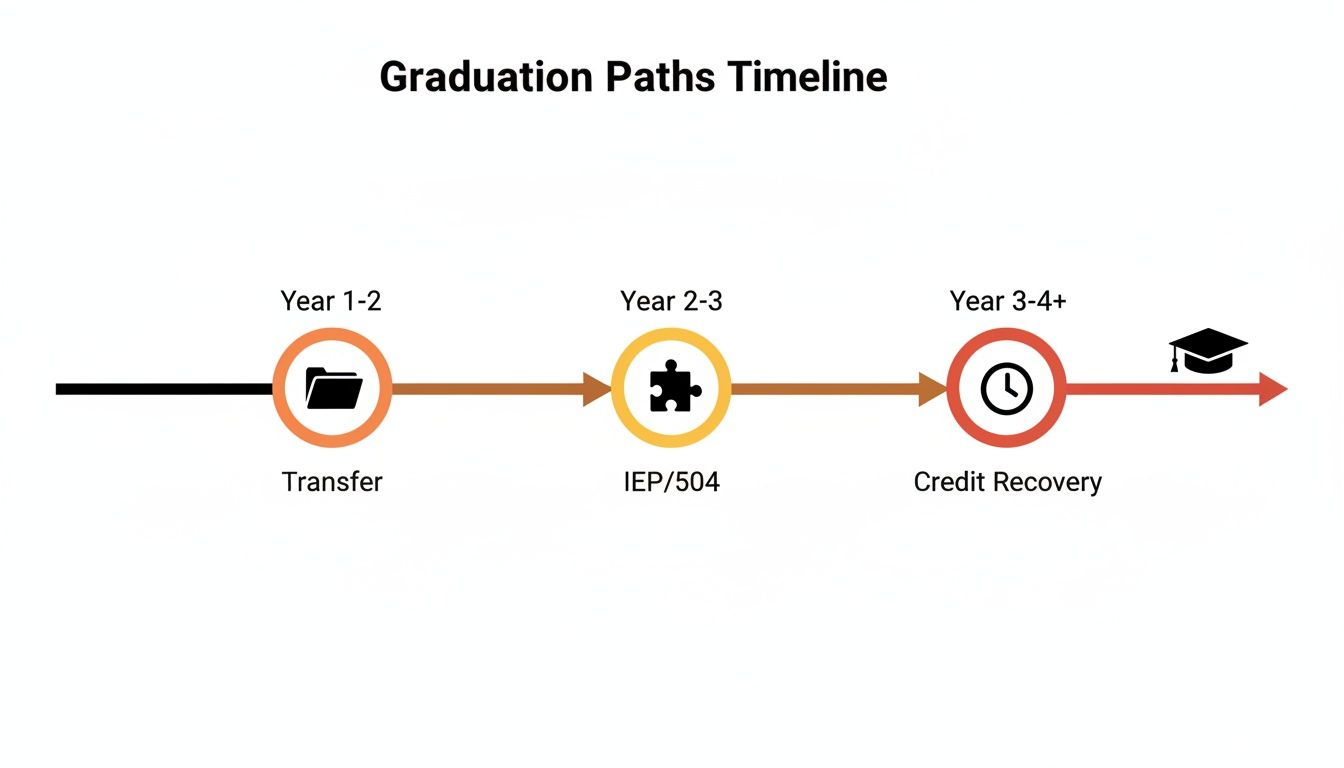
The road to graduation isn't always a straight line. As the timeline above shows, things like transferring schools, having an IEP, or needing to do some credit recovery can change a student’s four-year plan.
- Take the PSAT: Use this as a low-stakes practice run for the SAT. It’s a great way to see where you stand academically without the pressure.
- Choose Electives Wisely: Start picking electives that line up with potential career interests or college majors you might be considering.
- Track Your Credits: Pop in for a quick chat with your counselor to double-check that you're on track with all your credits.
Junior Year: The Strategic Push
Junior year is often the most demanding one academically. It’s crunch time. This is when you need to solidify your GPA, tackle the major standardized tests, and make sure your courses align with your goals after graduation. Stay focused—this year has a huge impact on your future options.
This is the year to really dial in. Your grades, test scores, and course selections from junior year will play a significant role in your college applications and scholarship opportunities.
As you start thinking about higher education, it's a good idea to get familiar with what makes a great application. Looking at some examples of personal statements for college and scholarships can be a huge help.
Senior Year: The Final Stretch
You’re almost there! Senior year is all about finalizing your plans, triple-checking that you’ve met every last requirement, and, of course, celebrating everything you’ve accomplished. It’s time to send off those applications and get ready for the big day.
- Apply for Graduation: Follow your school’s process to officially apply for graduation. This is your final chance to make sure all your credits and requirements are in order.
- Finalize Post-High School Plans: Submit your college applications, fill out financial aid forms, apply for scholarships, or take whatever final steps are needed for your chosen career path.
- Order Your Regalia: This is the fun part! Get your cap and gown ordered so you’re ready for the ceremony. If you're wondering about the price tag, it's smart to look into how much a cap and gown costs ahead of time.
To help pull all of this together, here is a simplified table you can use as a quick reference throughout your high school journey.
Year by Year High School Graduation Planning Guide
| High School Year | Key Focus Areas | Action Items |
|---|---|---|
| Freshman | Foundation & Planning | Meet with your counselor, map out a 4-year plan, and focus on core class grades. |
| Sophomore | Exploration & Testing | Take the PSAT, choose strategic electives, and do a credit check-in. |
| Junior | Strategy & Performance | Focus on GPA, take the SAT/ACT, and begin college/career research. |
| Senior | Finalization & Application | Apply for graduation, submit all applications, and order your cap and gown. |
Keeping this timeline in mind will help turn a four-year marathon into a series of manageable sprints, ensuring you cross the finish line with everything you need for the next chapter.
Your Top Graduation Questions, Answered
That final push to graduation can bring up some very specific, very urgent questions. Don't worry, that's completely normal. Getting quick, clear answers is the best way to keep the stress down and stay on track. Let's tackle some of the most common hurdles students and parents run into on the way to the finish line.
What Happens If I Fail a Required Class?
First, take a deep breath. Failing a class you need to graduate isn't the end of the road, but it does mean you haven't earned that credit... yet. Schools have systems for this. You'll likely have credit recovery options like retaking the class, hitting summer school, or even finishing up with an approved online course. Your first move? Talk to your school counselor immediately. They'll help you build a plan to get it done.
Can I Graduate From High School Early?
Yes, you absolutely can, but it takes serious planning right from the start. Graduating early means you have to pack all of your state and local credit requirements into a shorter timeframe. This usually involves taking a heavier course load each semester or using summer classes to get ahead. If this is your goal, you need to be working closely with your counselor from freshman year to map out an accelerated plan and get the school's official sign-off.
Graduating early is an ambitious goal, and it definitely shows maturity and focus to colleges. Just make sure you're not simply rushing through the material to get it done. A well-planned early graduation path is far more impressive.
Do Honors or AP Classes Count as Extra Credit?
This is a common point of confusion. Honors and Advanced Placement (AP) classes generally don't count as extra credits toward your final graduation total. Think of it this way: a year-long AP English class is still worth one English credit, not one-and-a-half.
Where they do give you a major boost is in your GPA. These tougher classes are weighted more heavily, which can significantly raise your academic standing. Taking them sends a clear signal to colleges that you're ready for serious academic work and can even help you earn special recognitions, like an honors diploma.
For more answers about the big day itself—from ordering your cap and gown to understanding the ceremony details—our comprehensive graduation FAQs page has you covered.
At Graduation Cap and Gown, we know that earning your diploma is a monumental achievement. We're here to help you celebrate every part of the journey with high-quality, affordable regalia for your special day. You can find everything you need for a memorable commencement at https://www.graduationcapandgown.com.