

You're standing in a hallway or bedroom an hour before commencement, gown half-zipped, cap in one hand, and a stole in the other. You've draped it once and it looks crooked. You've draped it again and now one end is longer, the lettering is twisted, and you're not sure whether it goes over or under your hood.
That worry is normal, and it's fixable. Learning how to wear stoles well isn't about memorizing a fashion trick. It's about a calm sequence, your school's rules, and a short rehearsal that checks comfort, visibility, and movement before you join the procession.
Preparing Before You Put On Your Stole
One graduate I picture often is alone at a mirror, tugging at a heritage stole that's slid sideways and now covers an honor cord. She's not careless. She started dressing before she knew which pieces were required, which were optional, and which needed approval.
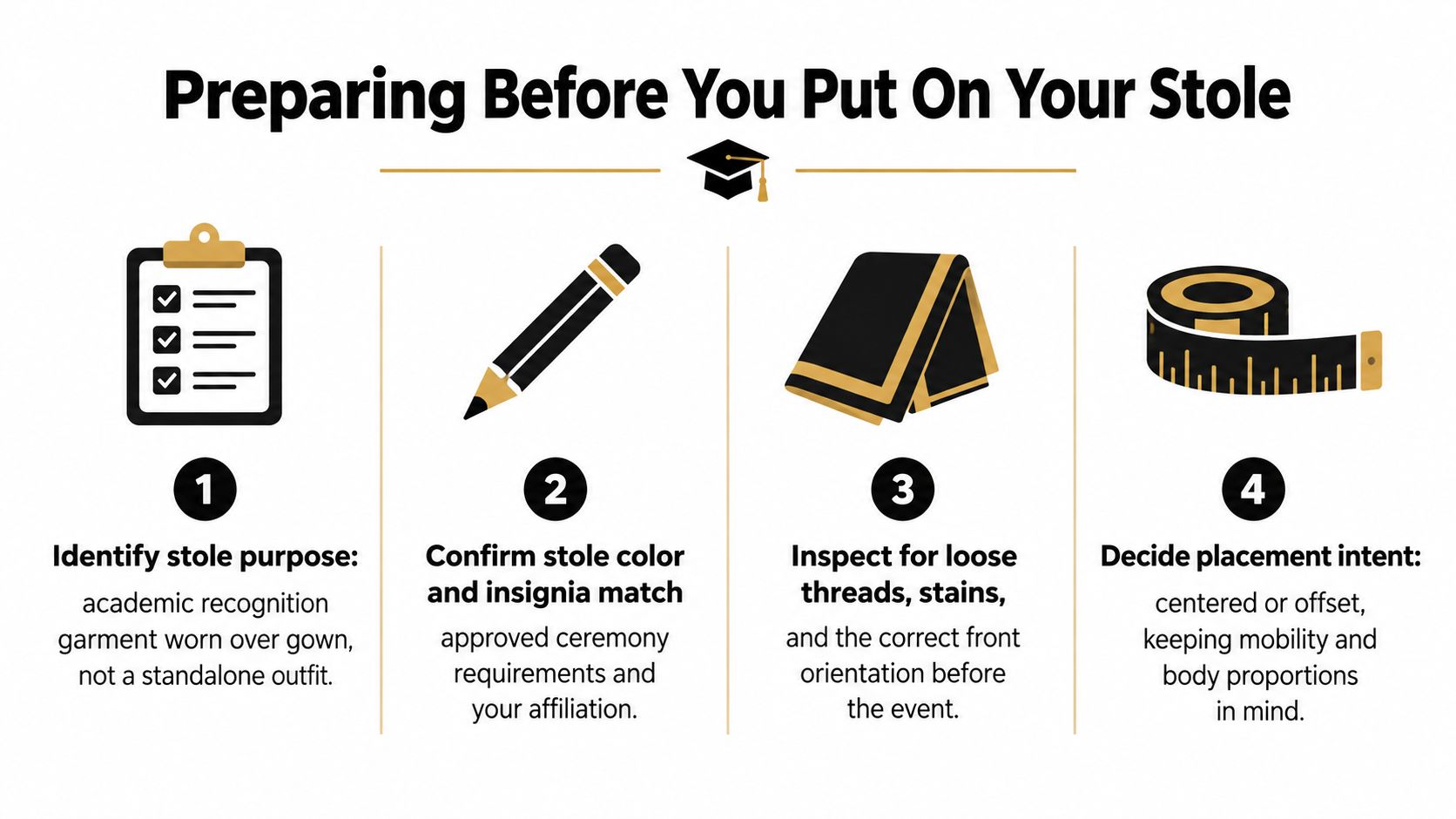
Start by naming what you're holding. An academic stole is generally an additional recognition garment, not the formal academic hood that signals your degree. Institutions may authorize stoles for honor societies, cultural organizations, service groups, or other recognized affiliations, as described in the University of South Carolina Aiken history of regalia. Your own ceremony instructions control whether a particular stole, a number of stoles, or a stole with a hood is permitted.
What to Confirm Before Dressing
- Approval: Is this specific stole authorized for your ceremony, not just sold as a graduation product?
- Quantity and order: How many stoles can you wear, and where does yours sit with hoods, cords, and medals?
- Attachment: Can you pin or otherwise secure fabric to the gown?
- Clothing underneath: Choose an outfit that won't fight the gown neckline, using guidance on what to wear under a graduation gown.
Lay the stole flat, find its front side, and check for twists, loose threads, or reversed lettering. Its basic orientation is simple. It goes around your neck, over the gown, and down the front so its colors, insignia, or message stay visible.
Practical rule: If you can't point to the school instruction that permits your stole, pause and ask commencement staff before you wear it.
Understanding What Your Stole Represents
A stole can do several different jobs, and that's why one school's approval rules don't automatically match another's. An honor stole may recognize academic achievement. A departmental or institutional stole may identify a program, college, or university role.
A heritage or cultural stole can express family, cultural, or community identity. A Greek stole may show fraternity or sorority affiliation, while a custom stole may carry a personal message, class year, or organization name. None of these should be treated as mere decoration. Each carries a meaning the wearer has chosen, or earned, to display in public.
Why Content Rules Differ
Placement is broadly consistent, but wording, symbols, and size limits can vary. Bethel University undergraduate commencement guidance permits heritage stoles celebrating African, Latinx, Native American, or Asian heritage and military stoles for veterans and active duty service members. Bethel caps stoles at 5 inches wide and 72 inches end to end, doesn't allow words or numbers on heritage stoles, and limits military stoles to the service branch name and official symbol without additional words, numbers, badges, or patches.
Use that example as a prompt, not as your rulebook. If you're choosing a Kente design, read about Kente stoles and their meaning before you decide on colors or symbols.
Common Stole Contexts and Styling Priorities
| Stole Type | Ceremonial Purpose | What to Verify |
|---|---|---|
| Honor | Academic recognition | Eligibility and issuing group |
| Institutional | School or department identity | Required placement and colors |
| Heritage or cultural | Family or community heritage | Permitted symbols, wording, and size |
| Greek or organization | Recognized affiliation | Chapter approval and school authorization |
| Military | Service recognition | Allowed branch name and symbol |
Dressing in the Correct Order
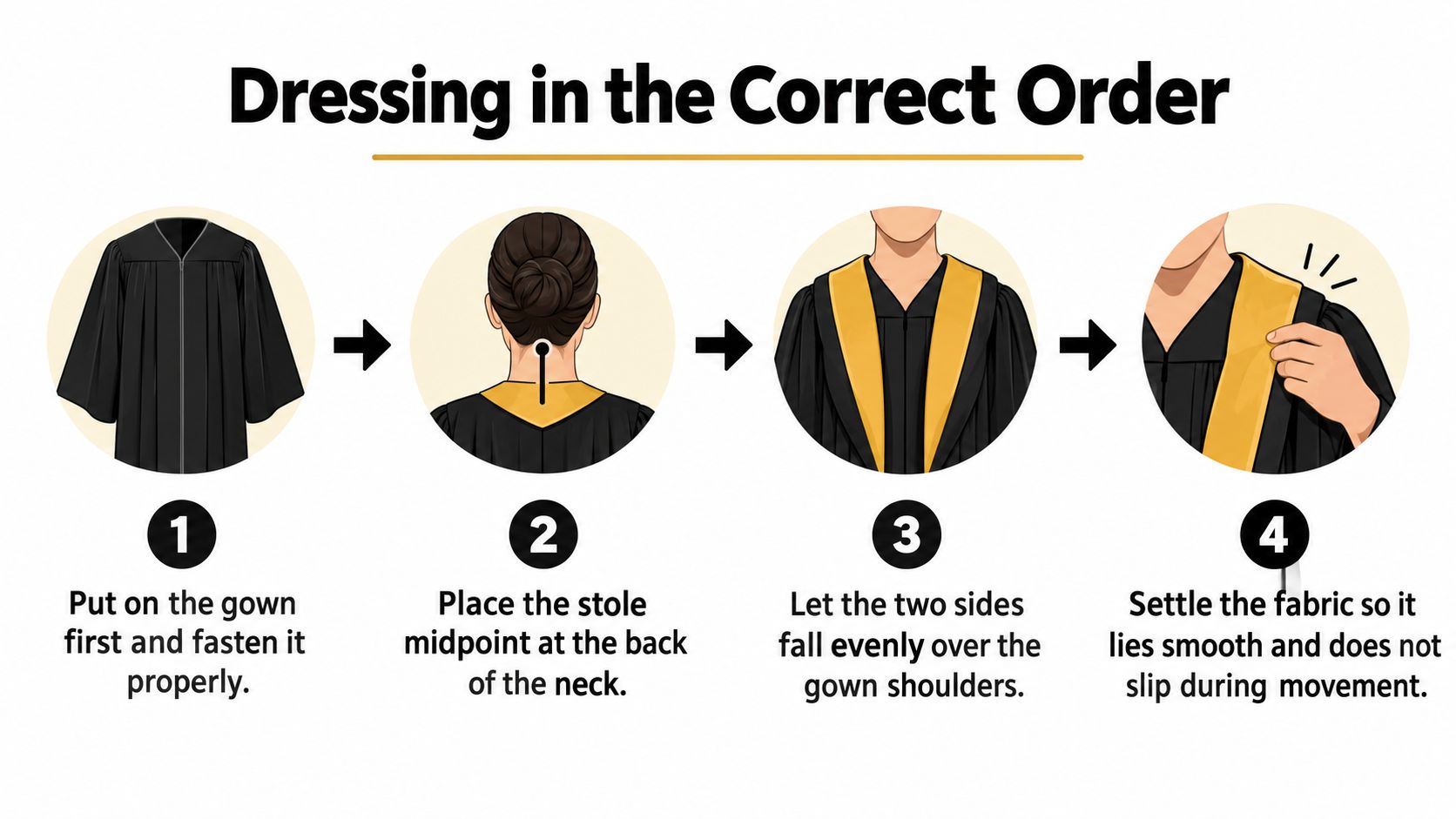
Put on your gown first and fasten it as you'll wear it during the ceremony. Dressing over street clothes that bunch at the neckline gives you a false fit, so settle the gown on your shoulders before you touch the stole.
Hold the stole with the front side facing out and find its midpoint. Place that midpoint at the back of your neck, then bring both sides forward over your shoulders. Let the two panels fall vertically down the front of the gown, outside the fabric, with the pointed ends dropping toward your knees.
Aligning the Two Panels
Smooth each side from shoulder to tip so it lies flat without a half twist. Compare the ends in a mirror or phone photo. They should hang at approximately equal length, and any lettering or insignia should read correctly to someone facing you.
If one side is longer, don't yank the short side down. Lift the midpoint slightly at the back of your neck, shift a small amount of fabric across, and let both panels settle again. Small adjustments at the neck prevent the diagonal pull that later makes a stole rotate while walking.
Adding the Remaining Regalia
Follow your school's order for an approved hood, cords, medals, and pins. If you're wearing a hood, review how to wear the academic hood so its front loop and back drape don't trap the stole underneath. Johnson and Wales University regalia guidance recommends this centered drape and suggests pinning the stole to the gown if it slides, where that practice is allowed.
Consider the contrast. A twisted stole catches on one shoulder, turns its lettering inward, and keeps shortening on one side with every step. A centered, flat stole stays balanced through the stage entrance because both panels carry similar weight and neither is pulling across your chest.
Check yourself from the front, not just by looking down. Your audience and camera see the arrangement you can't fully see from above.
Balancing Stoles with Other Regalia
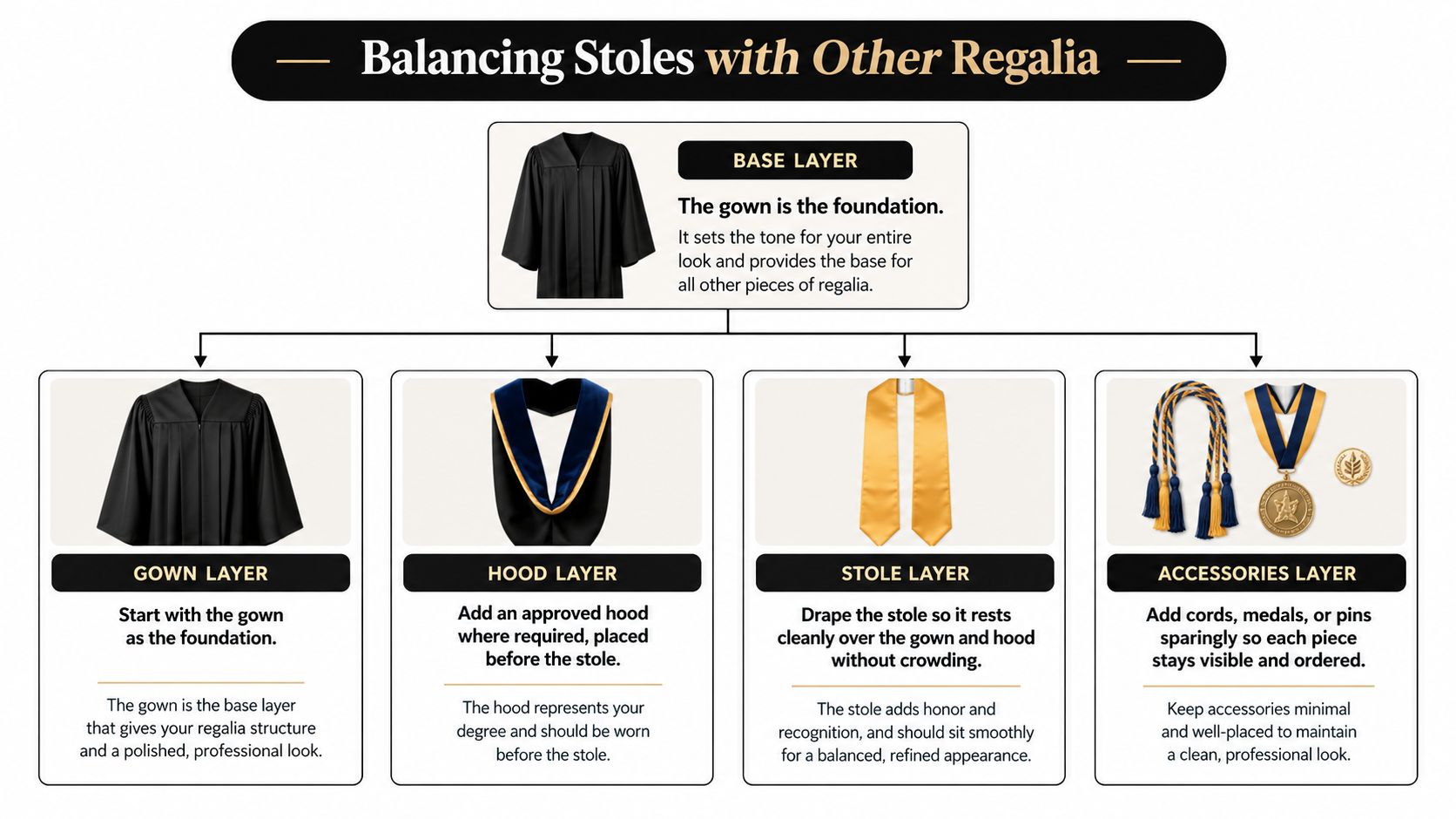
A clean arrangement usually follows a hierarchy, even though your university may prescribe its own order. Start with the gown, add an approved hood where your degree requires one, place one primary stole, then arrange cords or medals so each remains visible. That's a useful default, not a universal law.
The limits matter. University of Baltimore commencement attire guidance advises graduates to wear only one stole while allowing cords and pins separately, and the University of Wisconsin Eau Claire likewise allows multiple cords but only one stole. Other institutions may be stricter or require their own stoles and cords to appear above others.
A Layering Scenario
Picture a master's candidate with a hood, honor cords, and a heritage stole. She puts the hood in place first, checks that its colors show at the neck and back, then drapes the stole so its panels don't bury the hood's front edge. She adds cords last, using guidance on types of graduation cords to identify each one, and separates them so they don't cross the stole's lettering.
Wide fabric, loose cords, and large medals compete for the same chest space. Step back and ask three questions. Can you read the stole, can you see the required insignia, and does any piece swing or slide when you turn?
- If lettering disappears: Move cords or medals, not the message-bearing panel.
- If the hood vanishes: Narrow the stole's shoulder spread slightly.
- If pieces stack thickly: Remove the optional item your school ranks lowest.
Keeping Your Stole Comfortable and Stable
Perfect symmetry in a mirror doesn't guarantee comfort for two hours of standing, walking, sitting, and climbing stage stairs. Bodies differ. So do gowns, hoods, adaptive clothing, sensory needs, and mobility equipment.
A stole may bunch under a hood, catch on crutch handles, rest unevenly when you're seated in a wheelchair, or pull against a neckline that feels irritating. If you're sensitive to fabric at the throat, the principle is similar to choosing any close-fitting garment carefully, and a cashmere neckline guide for men and women can help you think about how a high neckline feels before you layer regalia over your clothes.

Running a Movement Test
Stand, sit, stand again, walk a short route, turn, and hold your photograph posture. Reach as if accepting a diploma, and check whether a panel swings into your hand or across a wheel, cord, or medal. Northeastern State University commencement dress and conduct guidelines support this kind of pre-ceremony check for stability during standing, walking, and photograph poses.
If the fabric shifts, use a discreet, removable attachment only when your institution permits it and it won't damage a rented gown. Test the attachment with movement, not just while standing still. The goal isn't forcing both tips to an identical knee-level point. It's a secure, proportionate drape that preserves heritage details or insignia and lets you participate without constant adjustment.
If an adaptation might conflict with a written rule, contact commencement staff privately and early. Explain the practical need and ask what adjustment they'll approve.
Fixing Common Styling Mistakes
Most backstage problems have a visible cause. Fix the cause at the neckline or layer underneath, and the front panels usually cooperate.
Uneven ends usually mean the midpoint has drifted. Re-center the fabric at the back of your neck instead of tugging one tip. Twisted lettering means a panel rotated at the shoulder, so lift that side, flatten it between your hands, and lay it down again.
Fast Troubleshooting
- Slipping stole: Check whether satin is sliding over a smooth hood or gown, then use an approved discreet attachment if allowed.
- Bunching under the hood: Remove both pieces and rebuild the layers in your school's order rather than stuffing fabric into place.
- Hidden insignia: Narrow or reposition the stole panels so required university or degree elements stay visible.
- Unreadable message: Turn the panel fully outward and move cords or medals that cross key words.
- Constant swinging: Shorten your stride during the test, recheck balance, and secure the fabric only by an approved method.
Some problems aren't styling problems. If a stole is unapproved, altered in a prohibited way, oversized under your school's rules, or stacked with another stole when only one is allowed, don't improvise a disguise. The University of Southern Indiana regalia, stoles, and cords policy permits only adornments provided or approved by the university and prohibits additional adornments on the outside of the gown.
Size deserves the same caution. One university's width or length limit isn't a national standard, so compare any stole you're ordering with your own ceremony document. Proportion also matters. A very wide panel can overwhelm a smaller frame, while a narrow panel may disappear beneath cords on a broader gown, but school limits come before personal preference.
Backstage standard: If you need to keep touching it, it isn't ready yet.
Finish With a Commencement-Ready Stole
Your final rehearsal can be quiet and brief. Put on the complete outfit, including shoes, and stand the way you'll stand for photographs.
Verify permission first in your mind. Then confirm the sequence: gown settled, hood placed where required, stole centered over the gown, cords and medals visible without covering lettering. Walk, sit, turn, and practice receiving a diploma with empty hands.
Ask a family member or coordinator to view you from the front and side. They'll spot a rotated panel, hidden cord, or bunched hood faster than you can by looking down. Make one adjustment at a time, then repeat the short walk so you know the fix holds.
Your Final Mental Model
A polished stole isn't the one with the most decoration. It's the one whose meaning can be seen, whose placement respects required regalia, and whose wearer can move comfortably without managing fabric all ceremony long. Compliance, symbolism, and stability belong together.
When you're selecting a custom graduation stole, a cultural or heritage design, an honor stole, or another specialty option, match the product's width, length, wording, and symbols to your school's written rules before you order. That single check protects both the message you want to carry and your ability to wear it across the stage.
Verify it, center it, balance it, test it in motion, and then leave it alone so you can be present for the moment.
Visit Graduation Cap and Gown to browse custom graduation stoles alongside cultural, heritage, honor, Greek, and other specialty designs, plus the caps, gowns, hoods, cords, and accessories you'll layer with them. Compare the size, colors, and wording of your chosen stole with your ceremony rules, then order early enough to rehearse the complete arrangement before commencement day.