

When you picture a graduation ceremony, the gowns probably all look the same length, right? That’s intentional. The standard length of a graduation gown is designed to fall somewhere between your mid-calf and ankle. This isn't just a random measurement; it's a long-standing academic tradition meant to create a dignified and uniform look for everyone crossing the stage. Understanding the correct gown length and fit is crucial for a polished appearance on your special day.
Why Gown Length Is a Standard Not a Style
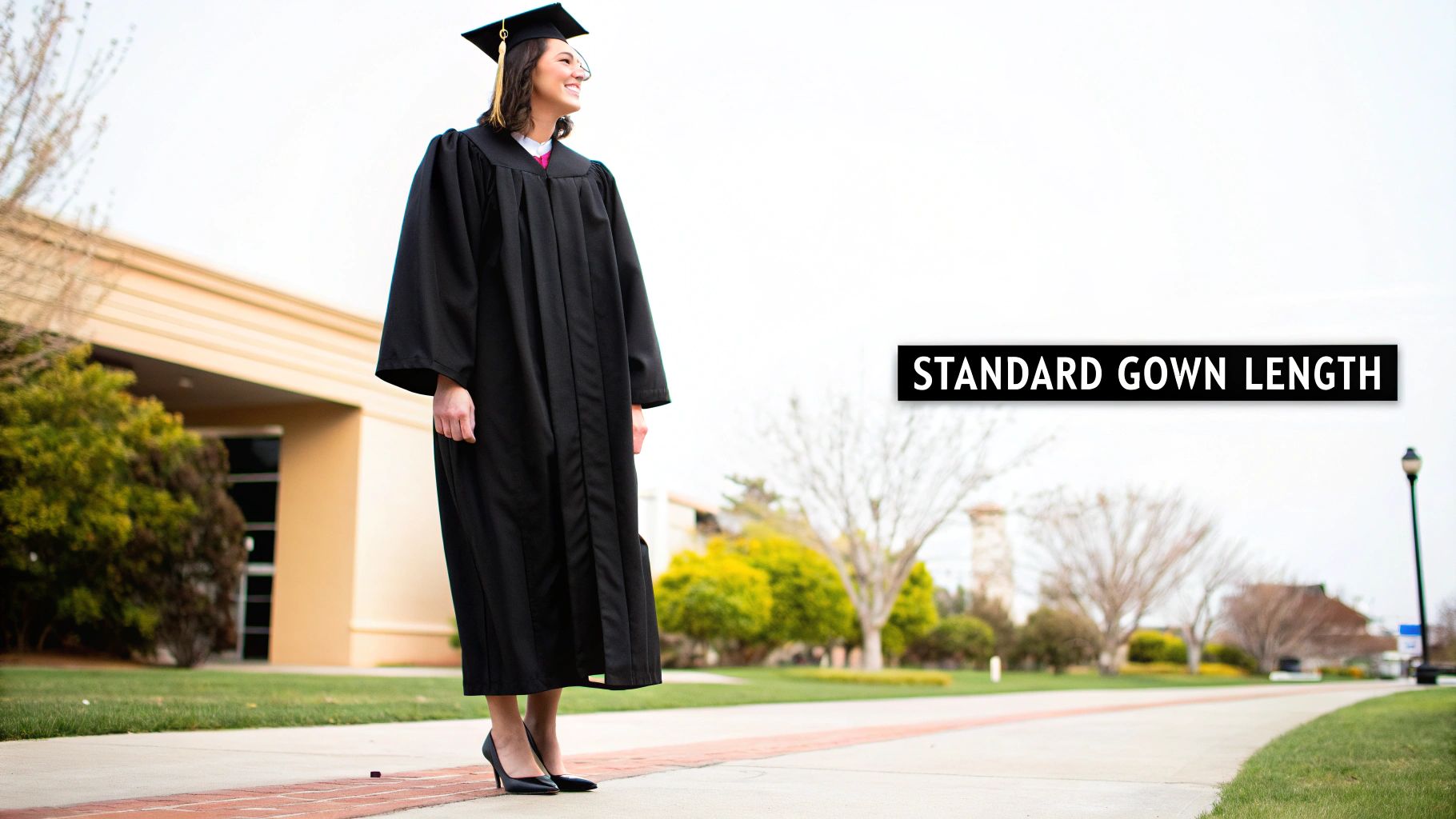
Think of your graduation gown less like an outfit and more like a formal uniform. Just like a sports team wears identical jerseys to show they’re all on the same side, graduates wear gowns of a specific length to create a powerful sense of unity and shared accomplishment. This standardized length of graduation gown is key to academic tradition.
This tradition puts the focus squarely on the academic milestone everyone is celebrating, rather than on individual fashion choices. It’s a practice deeply rooted in history, with regulations dating all the way back to the late 19th century. These rules set precise measurements to ensure uniformity, and today, nearly 95% of U.S. institutions still follow these established guidelines.
A Quick Guide to Gown Length by Height
So how do you find the right length? It’s surprisingly simple. Gown sizing is almost always based on your height, measured from the top of your head to the floor. This one measurement is the most critical factor in making sure your gown drapes correctly for that classic, polished look. This is the primary determinant for the length of graduation gown you will need.
Our classic matte black bachelor's gown, for example, is sized this way to guarantee it fits just right. To make it even easier, we’ve put together a quick reference table to help you match your height to the perfect gown size.
Quick Guide to Gown Length by Height
This chart is your go-to reference for finding the right size. Just find your height range, and you'll see the recommended gown size and its approximate length from shoulder to hem.
| Height Range | Recommended Gown Size | Approximate Gown Length (Shoulder to Hem) |
|---|---|---|
| 4'9" – 4'11" | 41 | 41 inches |
| 5'0" – 5'2" | 44 | 44 inches |
| 5'3" – 5'5" | 47 | 47 inches |
| 5'6" – 5'8" | 50 | 50 inches |
| 5'9" – 5'11" | 53 | 53 inches |
| 6'0" – 6'2" | 56 | 56 inches |
| 6'3" – 6'5" | 59 | 59 inches |
This standardization is designed to take all the guesswork out of the process. By sticking to the height-based sizing, you can be confident your regalia honors academic tradition and helps create that memorable, unified look for your entire graduating class.
How to Measure Yourself for the Perfect Gown Fit
Getting the right fit for your graduation gown is way easier than you might think, and it all starts with taking a couple of quick, accurate measurements at home. You don’t need any fancy equipment—just a measuring tape and a few minutes. Getting this right is the foundation for looking polished and feeling confident on your big day.
The two measurements that really matter for the perfect length of graduation gown are your height and your chest size. These numbers ensure the gown drapes the way it's supposed to, giving you that formal, distinguished look without feeling like you're swimming in fabric or being squeezed too tight. An accurate measurement is your ticket to ordering with total confidence.
Measuring Your Height Accurately
Your total height is the number one factor that determines your gown size and the final length of graduation gown. To get the most precise measurement, just follow these simple steps.
- Stand Tall: Find a flat, empty wall and stand with your back straight against it. Make sure your heels, back, shoulders, and the back of your head are all touching the wall.
- Look Straight Ahead: Keep your chin level with the floor and look forward. This prevents you from accidentally slumping or stretching, which can throw off the measurement.
- Mark the Spot: Grab something flat like a ruler or a hardcover book, place it flat on top of your head, and make a small pencil mark where it meets the wall.
- Measure the Distance: Now, step away from the wall and use your measuring tape to measure from the floor up to the mark. That's your true height.
Pro-Tip: For the most accurate result, take your height measurement while wearing the shoes you plan to wear for the ceremony. Even a 2-inch heel can make a real difference in how the gown hangs, and factoring that in from the start will prevent a gown that ends up looking awkwardly short.
Finding Your Chest Measurement
While your height takes care of the length, your chest measurement is what ensures a comfortable fit across your shoulders and torso. A gown that's too tight in the chest will pull and bunch up, so don't skip this step!
To measure your chest, wrap a flexible measuring tape around the fullest part of your chest, passing it just under your armpits. Keep the tape parallel to the floor and make sure it’s snug, but not so tight that it’s hard to breathe. Write down that number in inches. This measurement helps determine if a standard fit will work or if you’d be more comfortable in a "full fit" size, which offers a bit more room.
For some extra guidance, you can check out an easy guide to taking body measurements for clothes for more detailed instructions.
Once you have both your height and chest measurements, you're all set to order. You can confidently use our comprehensive size, color, and fabric charts to find a gown that will look like it was made just for you, ensuring you look and feel your absolute best.
Decoding Gown Styles for Each Academic Level
It’s easy to assume a doctoral gown is just a longer version of a bachelor’s robe, but that couldn't be further from the truth. Each gown tells a unique story of academic achievement through its specific design, and understanding these differences is key to appreciating the tradition behind them. Every level, from high school to a doctorate, has distinct features that go far beyond just the length of graduation gown.
This visual language is built on details like sleeve shape, fabric choices, and decorative additions. These aren't just random style choices; they’re part of a long-standing code that signals a graduate's level of scholarly accomplishment. As you climb the academic ladder, the regalia naturally becomes more ornate.
High School and Bachelor's Gowns
The journey starts with high school and bachelor's gowns, which are intentionally the simplest in design. You can spot them by their clean lines and traditional pointed sleeves. The main idea here is uniformity, creating a cohesive and dignified look for the entire graduating class.
While they appear nearly identical, the main differences often come down to the quality of the material and sometimes a slightly fuller cut for the bachelor's version. These gowns are meant to be a straightforward symbol of completing a foundational stage of education.
Master's Gowns: A Step Above
The master's gown is where you see the first big, noticeable change—it’s all in the sleeves. Instead of the simple pointed sleeves of a bachelor's gown, the master's gown features a unique oblong sleeve that is open at the wrist.
This long, dangling, arc-shaped sleeve is an unmistakable visual cue that sets a master's degree recipient apart from the crowd. The rest of the gown remains simple and unadorned, maintaining a formal look while clearly signaling a higher level of academic study.
The infographic below breaks down the core elements that ensure a perfect gown fit, with height serving as the most critical starting point.
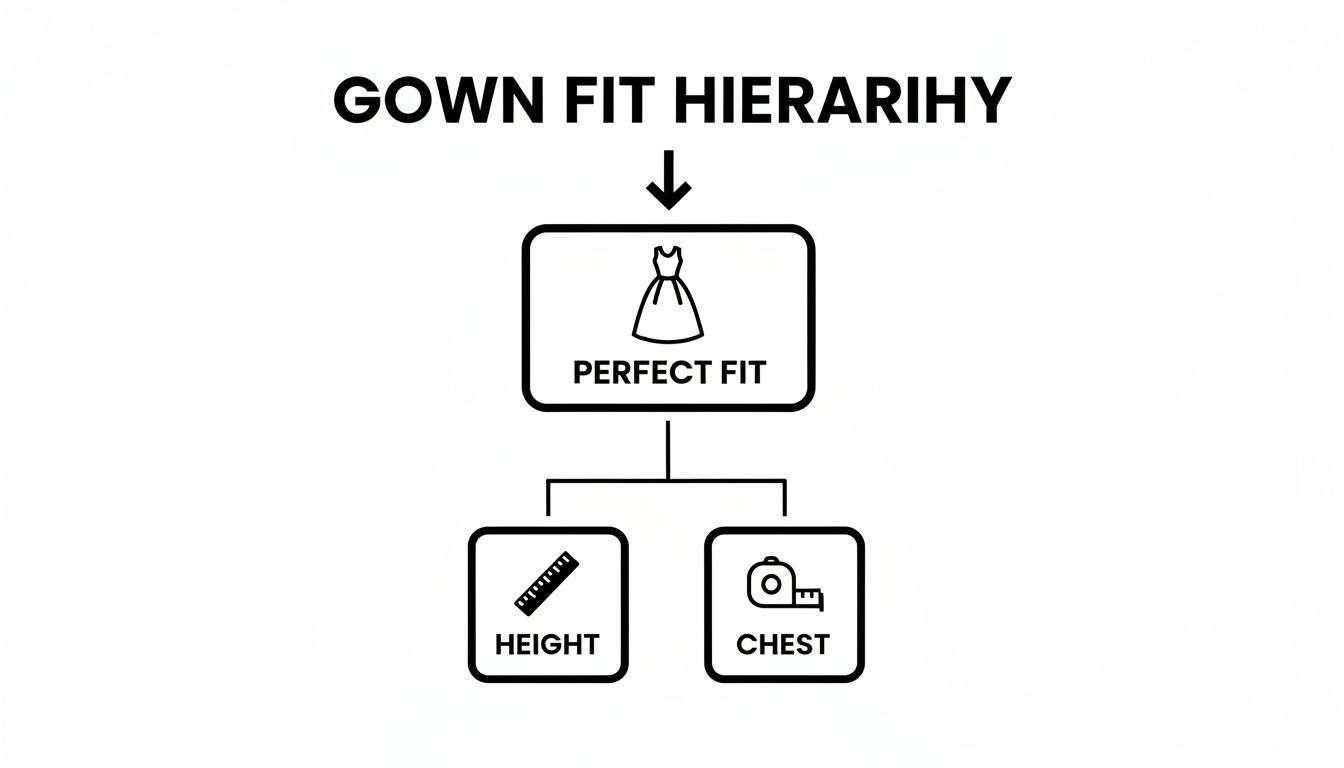
As the diagram shows, getting the right fit starts with your height and is fine-tuned with your chest measurement, which together ensure the gown drapes correctly and looks its best.
Doctoral Gowns: The Pinnacle of Academic Regalia
The doctoral gown is the most elaborate of all academic regalia, designed to represent the absolute highest level of scholarly achievement. It has a much fuller cut than other gowns and is often made from higher-quality fabrics like velvet or premium polyester.
The most prominent features are the three velvet chevrons on each full, bell-shaped sleeve and the wide velvet panels, called facings, that run down the front of the gown. These velvet elements are usually black, but they can also be a specific color that represents the graduate's field of study.
This level of detail is reserved exclusively for those who have earned a terminal degree. Our classic doctoral gown showcases these prestigious elements perfectly.
To help you visualize these distinctions, here’s a quick comparison of the key features at each degree level.
Comparison of Gown Features by Degree Level
This table breaks down the defining characteristics of graduation gowns for each major academic degree, from their length to the specific design elements that set them apart.
| Degree Level | Typical Gown Length | Sleeve Style | Key Distinguishing Features |
|---|---|---|---|
| Bachelor's | Mid-calf | Traditional pointed sleeves | Simple, unadorned design for a uniform look. |
| Master's | Mid-calf to lower-calf | Oblong sleeves, open at the wrist | The unique sleeve shape is the primary distinction. |
| Doctoral | Lower-calf to ankle | Full, bell-shaped sleeves | Three velvet chevrons on each sleeve and wide velvet front panels. |
Understanding these features turns the sea of black robes at any commencement into a fascinating display of individual academic journeys, with each gown telling a story of dedication and achievement.
Beyond Height: Personalizing Your Gown's Look

While your height is the starting point for picking a gown size, it’s the personal touches that really pull the whole look together. Think of the gown as the canvas and your other choices—especially your shoes—as the final brushstrokes. Even small details can completely change how your gown drapes, bridging the gap between a standard fit and a truly polished, intentional appearance.
Your footwear, in particular, is the secret ingredient to perfecting the length of graduation gown. A pair of high heels can easily add a few inches to your stature, lifting the hemline higher up your leg. On the other hand, wearing flats will let the gown hang at its natural, intended length.
This is exactly why you should measure your height while wearing the actual shoes you plan to have on for the ceremony. It’s a simple step, but it’s the best way to avoid any last-minute surprises, like a gown that feels awkwardly short or one that’s long enough to trip over. Getting the proper graduation gown length is that easy.
The Role of Footwear in Gown Length
The style and height of your shoes have a direct impact on where your gown’s hemline will fall. The goal is a clean line somewhere between your mid-calf and ankle, so even a small change in footwear can make a big difference.
- High Heels: Adding 2-4 inches in height will noticeably raise the hem. This can create a sharp, tailored look, but you have to be careful it doesn’t become too short.
- Wedges or Platforms: These give you the height of heels but with a lot more stability, which is a huge plus when you’re walking across a stage. They have a similar lifting effect, so be sure to measure with them on.
- Dress Flats or Loafers: Going with flats is the foolproof way to ensure the gown hangs exactly as it was designed to, based on your natural height. It's a classic, safe choice for achieving the standard academic look.
When picking your graduation shoes, remember that comfort is just as important as style. You’ll be standing and walking a lot, so choose a pair you can wear for hours without a second thought.
Considering Institutional Traditions
Beyond your personal style, it’s always a good idea to check for any specific dress code guidelines from your school. While most institutions stick to the standard academic code, some have their own traditions or preferences that can affect the overall look.
For instance, some universities might suggest a particular shoe color, like black or nude, to keep everything looking uniform. Others might have subtle rules about accessories. These are usually small details, but knowing them ahead of time ensures your entire outfit aligns with the occasion, letting you walk across that stage feeling completely confident and prepared.
From Color Matching to Checkout: Finalizing Your Order
You’ve got your measurements and you know which academic style is right for you. Now for the final step: pulling it all together to make sure your regalia is perfectly coordinated and lands on your doorstep with time to spare.
One of the biggest headaches can be matching the exact hood and tassel colors for your school. Get this wrong, and it can be a real source of stress. Our "Find Your University" tool was designed to eliminate that guesswork completely.
Just select your institution, and we’ll show you the precise, pre-approved colors you need. This guarantees that every piece, from the velvet on your hood to the tassel on your cap, is a perfect match for your university’s official standards. It's the simplest way to get your regalia 100% right without having to dig for color codes.
Beat the Rush by Ordering Early
Graduation season is a wild time, and waiting until the last minute is a recipe for trouble. Placing your order well in advance is one of the smartest things you can do for a smooth, stress-free experience.
Here’s why ordering early is a game-changer:
- Avoiding Rush Fees: Last-minute orders often get hit with expedited shipping charges that can tack on unnecessary costs.
- Ensuring Availability: Popular sizes and specific school color combinations can and do sell out as commencement gets closer. Ordering early means you get exactly what you need.
- Allowing Time for Adjustments: If anything isn't quite right with your order, having that extra buffer makes exchanges or minor alterations much easier to handle.
When you plan ahead, you’re buying yourself peace of mind. Your regalia will be one less thing to worry about, so you can focus on what really matters—celebrating with friends and family.
Whether you're getting a high school cap and gown set or specialized doctoral regalia, our process makes it easy to find it all in one place. Once your size and colors are confirmed, the checkout is simple and direct. We offer a variety of payment options to make your purchase as easy as possible, letting you finalize your order with confidence. Now you're ready to walk across that stage in style.
Common Sizing Problems and Simple Fixes
So, your gown arrived, you tried it on, and... it's not quite right. First things first: don't panic. Most sizing issues have a simple fix that won't add any stress to your big day. The key is knowing what you can easily adjust and what you can't.
Remember, academic regalia is designed to be formal and flowing, not tailored like a suit. That built-in looseness gives you a good amount of wiggle room. That said, the most common snag graduates run into is the length of graduation gown, and how you deal with it depends entirely on whether it’s too long or too short.
Too Long vs. Too Short
A gown that’s a little too long is the easiest problem in the world to solve. Think of it just like hemming a pair of pants. Any local tailor or even most dry cleaners can shorten it for a small fee, making sure it falls perfectly between your mid-calf and ankle so you don't trip on your way to get your diploma. It’s a quick, cheap alteration that makes a world of difference.
On the other hand, a gown that’s too short is a much bigger deal. There’s no extra fabric to let down, which means there’s no way to magically add length. This is why, if you ever find yourself stuck between two sizes, the golden rule is to always size up.
The most important takeaway is this: You can always shorten a gown, but you can never make it longer. A few inches too long is a simple fix; a few inches too short is a permanent problem.
Alterations to Consider and Avoid
When it comes to tweaking your gown, less is definitely more. Stick to the simple, effective fixes and steer clear of any complex changes that could mess with the gown's classic structure.
- Do Hem the Length: This is the most common and recommended alteration by a long shot. A quick hem job ensures you won't trip while walking across the stage.
- Don't Alter the Sleeves or Shoulders: Trying to change the sleeve style or take in the shoulders is a bad idea. These are complex alterations that can easily ruin the intended academic look of the regalia.
To get ahead of these issues from the start, especially when ordering online, look for services that let you try before you buy dresses online. Ultimately, small imperfections are manageable, so don't sweat it too much—focus on celebrating your incredible achievement.
Your Gown Questions, Answered
Alright, let's tackle some of the most common questions that pop up when you're getting your graduation gown sorted. Think of this as your final checklist for making sure everything fits just right for the big day.
Should My Graduation Gown Touch the Floor?
Definitely not. A gown that drags on the ground is a major tripping hazard and just doesn't look right. The sweet spot is for the hem to fall somewhere between the middle of your calf and your ankle.
This length looks dignified, prevents you from tripping as you walk across the stage, and lets your shoes peek out just a bit. This is the ideal length of graduation gown.
What If I Am Between Two Gown Sizes?
This is a classic dilemma. If you find your height puts you right on the line between two sizes, always go with the larger one. It’s a simple fix for a local tailor to hem a gown that’s a little too long.
But a gown that's too short? There’s no fixing that. You can't add fabric, and you'll be stuck with an awkwardly high hemline. Sizing up also gives you a bit more breathing room in the shoulders and chest, which is a nice bonus for comfort.
Here’s the golden rule for ordering regalia: You can always shorten a gown that’s too long, but you can never lengthen one that’s too short. When in doubt, size up.
Can I Wear My High School Gown For College?
It’s tempting to try and reuse your old gown, but it’s just not done. Each academic level has its own specific style of regalia, and wearing the wrong one is a big break from tradition.
For instance, a bachelor's gown is known for its pointed sleeves. A master's gown, on the other hand, has unique oblong sleeves that hang down. Using a high school gown for your college graduation—or a bachelor's gown for your master's ceremony—would be immediately noticeable and out of place.
From high school ceremonies to doctoral commencements, Graduation Cap and Gown has the perfect regalia to make sure you look and feel your best. You can find your university's official colors and order your complete set today and be ready for the big day.