

Your PhD cap and gown isn't just something you wear for a day; it's the final chapter of a long, demanding academic story. It’s a symbol of your intellectual grit, steeped in centuries of scholarly tradition. This comprehensive guide will walk you through every piece of your doctoral regalia, from the velvet chevrons on your gown to the rich, meaningful colors of your academic hood. Understanding your doctoral cap and gown package is key to appreciating this significant milestone.
Why Your PhD Regalia Is More Than Just an Outfit
Think of your doctoral regalia as the uniform for an elite academic club you’ve just earned a lifetime membership into. After years of late-night research, countless revisions, and the monumental task of finishing a dissertation, this specific outfit is the final, visible nod to your achievement.
It's a tradition that connects you to scholars from the 12th century to today—a physical representation of your intellectual lineage.

Unlike the simpler gowns for bachelor's or master's degrees, the PhD cap and gown is deliberately elaborate. Every single element tells a part of your story—your university, your field of study, and the high level of your degree. It’s a visual language understood across the entire world of academia, making the doctorate cap and gown a powerful symbol of success.
The Symbolism Behind Each Component
Each piece of your regalia carries its own weight and meaning, piecing together the narrative of your success. Understanding these symbols transforms the act of getting dressed for graduation into a meaningful ritual.
- The Gown: Those full, bell-shaped sleeves and the three velvet chevrons on each arm? They're exclusive to doctoral degrees. The stripes on a doctoral gown are an immediate mark of distinction, setting you apart from every other graduate.
- The Tam: The soft, multi-sided tam is a step above the standard mortarboard cap, reserved only for those who have reached the absolute pinnacle of their academic field. It’s a clear symbol of scholarly authority.
- The Hood: This is easily the most personal and descriptive part of the whole outfit. Its colors identify both your university and your specific discipline, acting as a vibrant, one-of-a-kind academic fingerprint.
Your PhD regalia isn't just fabric and thread; it's a testament to years of dedication and rigorous work, culminating in an achievement like learning how to write a dissertation that stands out.
A Mark of Perseverance and Pride
Ultimately, wearing your doctoral regalia is a profound act of self-recognition. It honors the resilience, critical thinking, and intellectual curiosity that got you through one of the most challenging academic endeavors possible.
This attire is more than just a requirement for a ceremony; it's the well-earned armor of a scholar.
When you put on your PhD cap and gown, you are not just preparing for a ceremony. You are stepping into a legacy of knowledge, proudly displaying the culmination of your life's most dedicated work.
This guide will serve as your personal consultation, ensuring you appreciate the meaning behind each component, select the perfect fit, and wear your accomplishment with the pride it deserves on your momentous day.
Decoding the Three Core Parts of Your Doctoral Regalia
Your doctoral regalia is more than just a uniform; it's a story told in fabric and color. Every piece you wear on graduation day carries a specific, powerful message about your academic journey. Think of it as an ensemble with three main characters—the gown, the tam, and the hood—each playing a crucial role. Understanding what they represent is the first step to truly appreciating the symbolism you’ve earned.
The tradition of the phd cap and gown isn't new; it's steeped in history, stretching all the way back to the 12th century at medieval European universities like Oxford and Cambridge. Back then, gowns were just everyday wear for scholars. It wasn’t until the Renaissance that they became ceremonial. By the 19th century, the academic hood was standardized to show a graduate’s discipline and alma mater, with the Intercollegiate Code of 1895 formalizing the distinct designs we still see today.
Before we break down each piece, here’s a quick overview of what makes up your doctoral regalia.
PhD Regalia Components at a Glance
This table gives you a quick snapshot of the three main components, their defining features, and what they signify.
| Component | Key Features | Symbolic Meaning |
|---|---|---|
| Gown | Fuller cut, bell-shaped sleeves, three velvet chevrons on each sleeve, and matching velvet panels down the front. | Represents the highest level of academic degree—the doctorate. |
| Headwear (Tam) | A soft, multi-sided velvet cap, often with a gold bullion tassel. Typically comes in 4, 6, or 8-sided versions. | A mark of distinction reserved for doctoral degree holders, signifying authority and expertise. |
| Hood | A colorful drape worn over the shoulders, featuring velvet trim and a satin lining. | Acts as an "academic fingerprint," displaying the graduate's field of study and the official colors of their university. |
Each element comes together to form a cohesive, meaningful outfit that celebrates years of dedication. Now, let's look at each one more closely.
The Gown: A Symbol of Supreme Scholarly Standing
First up is the doctoral gown, the foundation of your entire look. This isn't the simple robe you see on bachelor's or master's graduates. The doctoral version is designed for distinction, with a much fuller cut that creates a stately, commanding silhouette. It immediately signals that you’ve reached the pinnacle of academia.
What really sets it apart are the three velvet chevrons stitched onto each of the full, bell-shaped sleeves. These stripes are an unmistakable mark of the doctorate—a visual shorthand for the highest level of academic attainment. To complete the look, wide velvet panels run down the front of the gown, perfectly matching the chevrons on the sleeves.
This is more than just a piece of clothing; it's a declaration. Our Deluxe Doctoral Gown is crafted to capture this prestige, ensuring you look and feel the part on your big day. The gown’s design is a deliberate statement, setting you apart from every other graduate in the ceremony.
The Headwear: A Tam for Doctoral Distinction
Next is the headwear. For a PhD, you'll typically skip the familiar square mortarboard. Instead, doctoral candidates wear a tam, a soft, multi-sided cap that is a clear indicator of their advanced academic status. The tam is reserved almost exclusively for those holding a doctoral degree.
But the tam offers more than just prestige; it provides far superior comfort during a long ceremony. Tams are usually made of plush velvet and come in four, six, or eight-sided versions, which allows for a more customized and comfortable fit. It's finished with a tassel, which for a doctor is typically a simple, elegant gold color.
The doctoral tam is more than just a hat—it's a crown. It represents the authority and expertise earned through years of dedicated research and intellectual contribution to your field.
Choosing a tam over a mortarboard is a small but significant detail. It’s a nod to tradition and an acknowledgment of your place at the top of the academic hierarchy, completing the look of a scholar who has truly become a master of their discipline.
The Hood: Your Academic Fingerprint
The final, and arguably most symbolic, piece of your phd cap and gown is the academic hood. If the gown tells everyone your degree level, the hood tells them the rest of your story. It’s a vibrant, detailed component that acts as your academic fingerprint, unique to you and your accomplishments.
Worn draped over the shoulders and hanging down the back, the hood uses a language of color to showcase three critical pieces of information:
- The Velvet Trim Color: The color of the velvet trim along the hood's outer edge represents your specific field of study. Dark blue signifies Philosophy (PhD), light blue is for Education, and golden yellow represents Science, to name just a few.
- The Lining Colors: The silk lining inside the hood proudly displays the official colors of the university that granted your degree. This allows anyone familiar with academic regalia to instantly recognize your alma mater.
- The Shell Fabric: The main body of the hood is almost always black, matching the doctoral gown to create a cohesive and formal look.
Together, these three components—the distinct gown, the dignified tam, and the colorful, story-rich hood—create an ensemble steeped in meaning. Each element works in harmony to celebrate not just your graduation, but the immense effort, intellect, and perseverance that earned you the title of "Doctor."
The Hidden Language of Academic Hood Colors
Beyond the gown and tam, the academic hood is easily the most expressive piece of your phd cap and gown. It's where your personal academic story is told through a vibrant, standardized color code. The velvet trim lining your hood is a universal language, instantly communicating your field of expertise to anyone familiar with academic tradition. Think of it as a badge of honor that specifies your unique contribution to the world of knowledge.
Getting this color right is essential. This isn't about personal preference; it's a system established decades ago to bring consistency to academic ceremonies across the country.
The following diagram breaks down the three main components of your regalia, showing how the gown, tam, and hood all come together to create a cohesive, symbolic outfit.
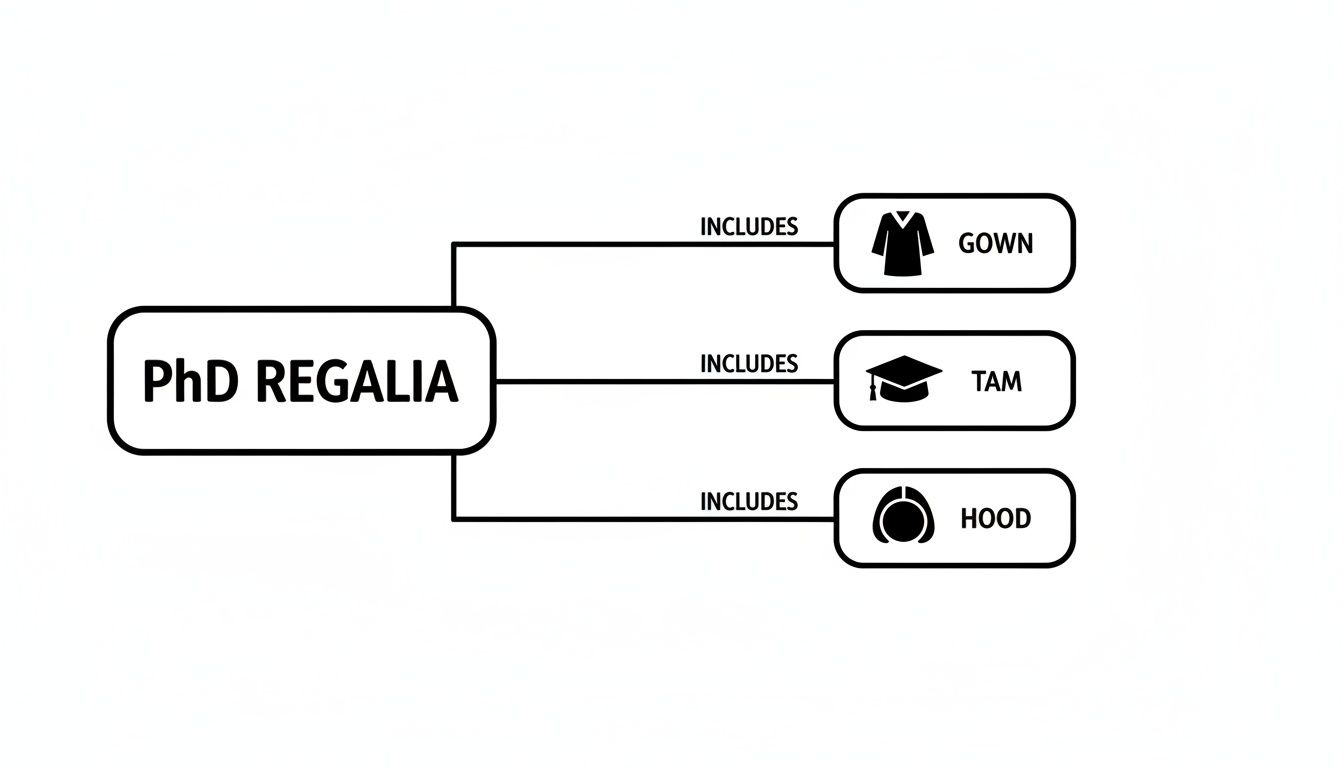
This visual highlights how each element—from the velvet chevrons on the gown's sleeves to the colorful hood—plays its own part in telling your story.
Decoding Your Discipline-Specific Color
The color system is quite specific. While some shades are instantly recognizable, others are more nuanced. For instance, the most common color you'll see on a PhD hood is Dark Blue, representing the Doctor of Philosophy. It’s the traditional color for a wide range of liberal arts and humanities disciplines.
But other fields have their own distinct hues:
- Golden Yellow represents the sciences, including fields like biology, chemistry, and physics.
- Light Blue is designated for education, recognizing doctorates in educational leadership or curriculum studies.
- Peacock Blue signifies public administration and foreign service.
- Drab (a tan or khaki color) is used for degrees in business, commerce, and accountancy.
This system ensures your academic achievement is visually recognized from across the room, adding a powerful layer of meaning to the commencement procession.
The velvet trim on a doctoral hood is more than decoration; it is a declaration. It announces your field of mastery and connects you to a global community of scholars who share your discipline.
Understanding this hidden language allows you to fully appreciate the rich symbolism woven into your attire. When you select your regalia, you're taking part in a tradition that celebrates not just the completion of a degree, but the specific knowledge you’ve cultivated. You can find the perfect color match for your degree by exploring our Deluxe Doctoral Graduation Hood options.
A Quick Guide to Common PhD Hood Colors
Navigating the spectrum of academic colors can seem a bit intimidating, but a few key shades cover the majority of doctoral degrees awarded. Ensuring you have the right one is a critical step in preparing for your ceremony. Here's a quick reference table for some of the most common doctoral disciplines and their corresponding velvet trim colors.
| Academic Discipline | Hood Velvet Color | Examples of Degrees |
|---|---|---|
| Philosophy (PhD) | Dark Blue | History, English, Sociology, Political Science |
| Science | Golden Yellow | Biology, Chemistry, Physics, Environmental Science |
| Education (EdD) | Light Blue | Educational Leadership, Curriculum & Instruction |
| Medicine (MD) | Kelly Green | Medical Doctor, Doctor of Osteopathic Medicine |
| Fine Arts (DFA) | Brown | Music, Theater, Visual Arts |
| Engineering (DEng) | Orange | Civil Engineering, Electrical Engineering |
| Law (JD, SJD) | Purple | Juris Doctor, Doctor of Juridical Science |
This system ensures that every graduate's unique academic journey is properly represented. Your phd cap and gown becomes a complete story, with the hood serving as the vibrant, colorful conclusion that details exactly where your expertise lies.
How to Wear Your PhD Regalia with Confidence
After years of hard work, wearing your doctoral regalia is the final, satisfying step. It’s the uniform that says you’ve reached the pinnacle of your field. This guide will walk you through how to wear each piece so you look sharp and feel comfortable on your big day. Because the last thing you want to worry about is an ill-fitting gown or a crooked tam.
This tradition is more than just a ceremony; it's a global symbol of academic dedication. As doctoral degrees become more common worldwide, the spotlight on these traditions has grown, turning commencements into major cultural events. In the U.S. alone, over 58,000 PhDs were awarded in 2022, a number that underscores just how significant this milestone is for scholars and their communities.
Mastering the Fit: A Step-by-Step Guide
The secret to looking distinguished is getting the fit right from the start. Follow these two simple steps to make sure your gown and tam are sized perfectly.
- Measuring for Your Gown: Your gown size is based on your height, measured from head to toe. For an even better fit, it’s a good idea to also measure the fullest part of your chest. This ensures the gown drapes correctly and doesn't feel too tight or baggy.
- Sizing Your Tam: Grab a soft measuring tape and wrap it around the circumference of your head. For the most accurate reading, place the tape about an inch above your eyebrows and keep it level all the way around.
That’s it. With these two measurements, you can order your phd cap and gown with confidence, knowing it will feel as good as it looks during the long ceremony.
Assembling Your Regalia Like a Pro
Once your regalia arrives, putting it all together is straightforward. Start with the gown—it goes on just like a jacket and should be zipped up completely. A proper fit means the hem falls somewhere between your knee and ankle, creating that classic, stately silhouette.
Next up is the hood. Drape it over your head so the velvet trim faces out and rests on your shoulders. Most hoods come with a small loop on the front to secure it to a shirt button or an internal cord that keeps it from slipping off your back. The final touch is to flip out the silk lining on the back, proudly displaying your university's colors for everyone to see.
The doctoral tam should sit squarely on your head, not tilted. Tradition dictates that the tassel hangs on the right side before your degree is officially conferred and is then moved to the left side afterward.
Finally, place the tam on your head. This symbolic act completes your academic attire and gets you ready to walk across the stage. While academic dress has its own unique rules, the goal is always to project a professional image—a principle that applies in many contexts, like figuring out what to wear for business headshots that look polished and professional.
Caring for Your Academic Attire
Keeping your regalia in pristine condition is essential for photos and any future academic events where you might wear it.
- Remove Wrinkles: As soon as you receive your gown, hang it up. Most wrinkles will naturally fall out within 24-48 hours. For any stubborn creases, use a steamer on a low heat setting. Never use a hot iron, as it can easily damage the fabric.
- Transportation: A garment bag is your best friend. Use one to transport your regalia to protect it from snags, spills, or getting wrinkled on the way to the ceremony.
- Storage: After graduation, store your regalia in a cool, dry place inside the garment bag. This will preserve it as a cherished memento of your achievement for years to come.
Personalizing Your Look with Custom Stoles and Cords
While your phd cap and gown is steeped in academic tradition, your graduation day is also a deeply personal celebration of your unique journey. This is the moment to honor the communities, heritage, and accomplishments that got you to the finish line. Personalizing your regalia with custom stoles and cords is how you transform the standard uniform into a powerful personal statement.

These accessories are far more than just decorative flair; they’re visual storytellers. Each stole and cord you add weaves another layer into your narrative, letting you proudly display the identities that were instrumental on your path to earning a doctorate.
Celebrating Heritage with Cultural Stoles
Cultural stoles are a vibrant and meaningful way to pay tribute to your heritage on graduation day. They allow you to wear your identity with pride, connecting your academic success directly to your cultural roots. These stoles are powerful symbols of community and resilience.
Some of the most popular options include:
- Kente Stoles: Originating from Ghana, Kente cloth is rich with symbolism. Each pattern and color combination carries a specific meaning, often representing concepts like excellence, wisdom, and lifelong learning.
- Serape Stoles: With their bright, striped patterns, these stoles celebrate Latinx and Hispanic heritage, adding a splash of vibrant color and cultural pride to your regalia.
- Flag Stoles: For international students or anyone wanting to honor their national identity, a stole featuring a country's flag is a direct and proud statement of where you come from.
These accessories beautifully merge academic tradition with personal history, creating a look that is uniquely and authentically yours.
By adding a cultural stole to your doctoral regalia, you are making a powerful statement: "My heritage is a part of my success." It is a visual acknowledgment of the community and ancestors who paved the way for your achievement.
Recognizing Milestones and Memberships
Beyond cultural identity, stoles and cords can also signify specific achievements, milestones, and affiliations that were important during your doctoral studies. They're a fantastic way to highlight the unique path you took and the groups you were a part of.
A First Generation Stole, for example, is an incredibly significant marker for students who are the first in their family to achieve this level of education. It honors not just the graduate's hard work but also the family's collective dream and sacrifice. Similarly, stoles for Greek letter organizations or other academic societies recognize the networks of support and camaraderie that helped you succeed.
Highlighting Academic Excellence with Honor Cords
Honor cords are the thin, braided ropes worn around the neck that denote specific academic achievements or membership in an honor society. While they might be more common at the undergraduate level, they can still be part of a doctoral candidate's regalia, especially for distinctions related to a dissertation or departmental honors.
Each cord color has a specific meaning, representing a particular honor society or field of study. To get a better handle on these distinctions, check out our comprehensive guide on honor cord color meanings to see how each one represents a unique accomplishment. These cords serve as a final nod to the exceptional academic performance that defined your doctoral journey.
A Stress-Free Guide to Ordering Your PhD Gown
After years of intense research and dedication, ordering your PhD cap and gown should feel like a victory lap, not another hurdle. Think of it as the easy part of your doctoral journey. This guide will give you a clear timeline and some practical tips to make sure your purchase is smooth, simple, and gets you exactly what you need.
Earning a doctorate is a huge deal. You’re joining an exclusive group—a mere 1.8% of the U.S. population holds a PhD, so your graduation is a rare milestone that deserves its own distinctive regalia. With nearly 204,000 doctoral degrees awarded in 2022, universities host massive ceremonies where every detail of your attire matters. For more on global degree production trends, check out grad-post.com.
Planning Your Purchase: A Simple Timeline
When it comes to ordering academic regalia, timing is everything, especially for a doctoral degree where customization is often part of the deal. To dodge any last-minute stress, just follow this straightforward timeline.
-
Standard Orders (The Smart Move): Place your order at least 4 to 6 weeks before your ceremony. This window gives you plenty of time for any specific customizations, like matching your university’s unique hood colors, and ensures your regalia shows up without needing to pay for rush shipping.
-
Last-Minute Needs: If you find yourself in a pinch, don't worry. We keep a wide selection of doctoral regalia in stock and offer expedited shipping options to make sure you’re ready for your big day, even if time is short.
The goal here is to make this process seamless. Ordering ahead lets you focus on what really matters—celebrating your incredible accomplishment with family and friends, confident that your regalia is completely handled.
Simplify Your Search with University Matching
One of the biggest worries for doctoral candidates is making sure their academic hood perfectly matches their university’s official colors and their discipline’s specific velvet trim. We’ve made this part foolproof.
Our "Find Your University" tool is designed to take all the guesswork out of it. Just type in the name of your school, and our system automatically fills in the correct color combinations for your academic hood and gown. This feature guarantees your regalia will be 100% compliant with your university’s standards, giving you total peace of mind.
Navigating Bulk and Faculty Orders
It's common for entire departments or student cohorts to order together to ensure everyone has a uniform look at commencement. We specialize in handling these bulk orders for both students and faculty, making the whole process simple.
A coordinator can easily manage a group purchase, ensuring consistent quality and on-time delivery for every single person. It's the perfect solution for academic departments needing to outfit faculty for the ceremony or for student groups who want to streamline their ordering. For more details on budgeting, you can check out our article on how much a cap and gown costs.
This whole roadmap is designed to help you avoid the common pitfalls and get your PhD cap and gown on time and exactly right.
Got Questions About Your PhD Regalia? We've Got Answers.
As your big day gets closer, a few practical questions about your PhD cap and gown always seem to pop up. Don't worry, that's completely normal. Let's walk through the final details so you can feel confident and focus on your incredible achievement.
Tam vs. Mortarboard: What’s the Difference?
One of the first questions doctoral candidates ask is about their headwear. While the flat, square mortarboard is what most people picture for graduation, the tam—a soft, multi-sided velvet cap—is traditionally reserved just for doctoral degree holders.
Think of it as an upgrade. The tam is an instant visual cue that you've reached the highest level of academic achievement. Beyond just looking distinguished, most graduates find it far more comfortable to wear during a long ceremony, making it the clear favorite for those earning their terminal degree.
Can I Buy My Regalia Somewhere Else?
Absolutely. While your university will offer its own official regalia, graduates often find they can buy high-quality, fully compliant attire from a trusted supplier for a much better price. It's a smart move.
Purchasing your own set is an especially great option for faculty members or any graduate who expects to wear it again at future academic events. Our "Find Your University" tool makes it easy to ensure a perfect match for your school’s specific colors and design requirements, so you know you'll fit right in.
Choosing to purchase your PhD cap and gown is an investment in your academic future. It provides a lasting memento of your achievement and ensures you are always prepared for future convocations and ceremonies.
When Should I Order My Regalia?
So, how far in advance should you get your order in? To be safe, we recommend placing your order at least 4 to 6 weeks before your commencement ceremony.
This timeline is especially crucial if you're getting custom items, like an academic hood tailored to your specific discipline and university. But if you're on a tighter schedule, don't panic. We keep a huge selection of in-stock options ready to go and offer expedited shipping to make sure you're covered, even at the last minute.
Do You Supply Regalia for University Faculty?
Yes, we are a leading supplier of academic regalia for university faculty, deans, department heads, and other academic staff. We know how important it is to have professional, high-quality attire for institutional events.
We offer a complete range of discipline colors and make it easy to place bulk orders for entire departments or institutions. Outfitting your faculty with distinguished and appropriate attire for every academic ceremony is simple and convenient.
At Graduation Cap and Gown, we are dedicated to helping you celebrate your monumental achievement with the perfect regalia. Explore our full collection of doctoral attire and accessories by visiting our official website today.