

You've just received your commencement date, checked the ceremony requirements, and discovered that you still need a cap and gown. The budget is tight, the deadline is close, and you want to look polished when your name is called. That's a common graduation problem, but the lowest listed price isn't always the lowest real cost.
Affordable graduation gowns should fit properly, match your school's colors, arrive on time, and remain useful after the ceremony. A basic polyester package may be the right choice for one graduate, while a rental, campus borrowing program, or reusable gown may make more sense for someone else. Your degree level also matters. Doctoral regalia includes more components and detail than bachelor's apparel, so comparing only the word “gown” can produce a misleading budget.
Finding Affordable Graduation Gowns Without the Stress
Maya found out on a Monday that her college's commencement ceremony was the following week. She had already paid for family travel and photographs, so she didn't want an expensive regalia package. She also didn't want to gamble on a gown that would arrive late, fit awkwardly, or use the wrong shade of her school color.
Her first search produced everything from basic black gowns to doctoral sets with elaborate hoods. That range made the decision feel harder, not easier. The useful question wasn't “Which gown is cheapest?” It was “Which option gives me the right fit, required pieces, dependable delivery, and reasonable use after graduation?”

Academic regalia is a substantial apparel category, not a tiny ceremonial niche. One market report valued the global academic regalia market at $1.2 billion in 2024 and projected it to reach $2.1 billion by 2033, with a 6.5% CAGR, while also covering historical data from 2018 through 2023 (Academic Regalia Market). For buyers, that scale helps explain why the market includes simple polyester gowns, complete packages, rentals, specialty doctoral pieces, and institutional ordering programs.
Start with the ceremony rules
Before comparing listings, check your school's commencement page or bookstore instructions. Some ceremonies require a cap, gown, and tassel. Graduate ceremonies may also require a hood, tam, or beefeater. A gown that looks inexpensive can become costly if you later need to purchase several missing components.
Write down four details:
- Degree level: Confirm whether you need bachelor's, master's, professional, or doctoral regalia.
- Required pieces: Note whether the ceremony requires a hood, tam, beefeater, tassel, or other item.
- School colors: Check the official colors rather than relying on a general description such as “blue.”
- Arrival deadline: Allow time for measuring, ordering, delivery, and any permitted exchange.
Think beyond the checkout total
A gown that fits well can be worn comfortably through check-in, the processional, stage recognition, photographs, and the recessional. A gown that is too short, too long, or the wrong color can lead to an exchange, a second shipping charge, or a rushed local purchase.
Practical rule: Compare the complete ceremony-ready cost, not just the gown price.
This guide follows that practical path. You'll learn how fabric affects value, why degree level changes pricing, when packages beat single pieces, how buying compares with renting or borrowing, and how bulk orders and reuse can reduce the cost further. The aim is a calm decision, whether you're ordering one bachelor's package, outfitting a doctoral candidate, or coordinating regalia for a group.
What Makes a Graduation Gown Affordable and Worth It
On graduation morning, a gown may travel from a garment bag to a crowded check-in line, an auditorium seat, the stage, and outdoor photographs. Its value depends on how well it handles that day, whether it fits the ceremony, and whether it can be used again. The lowest sticker price is only one part of an affordable choice.
A gown works much like other formal clothing. A simple shirt costs less because it uses efficient fabric and straightforward construction. A structured jacket costs more because it requires lining, shaping, and extra detail. Academic regalia follows the same pattern, with degree level adding further components and design requirements.

Fabric affects the total value
Polyester is the standard affordable gown fabric because it balances ceremony demands with manageable cost. It is strong, abrasion-resistant, wrinkle-resistant, quick-drying, and able to retain heat-set pleats and creases. It also holds color better over time than acetate, which can help a gown stay presentable through laundering and later use (Graduation Gown Fabric Guide).
That combination matters if you buy a gown to keep, borrow one for a family member, resell it, or use it at another ceremony. A gown that survives packing and repeated handling can cost less over its useful life than a cheaper garment that needs replacement after one event.
For a single ceremony, a basic gown may be a sensible purchase. A school or family outfitting several graduates should give more weight to durability and easy care. Rental can also make better financial sense when elaborate regalia would otherwise sit unused after commencement.
Construction shows whether a low price is practical
Check the seams, closures, pleats, sleeves, and neckline. The gown should hang evenly and leave room for the clothing underneath without appearing bulky. Pleats should create a clean drape, rather than collapsing into a shapeless layer.
Construction also affects storage and reuse. A gown that keeps its shape is easier to prepare for photographs and simpler for another graduate to wear. Consistent construction helps a group look coordinated without paying for unnecessary styling.
Use this inspection before ordering:
- Drape: The fabric should fall smoothly from the shoulders.
- Pleats: Permanent or heat-set pleats should keep their appearance after packing.
- Sleeves: The sleeve style should match the degree level and ceremony requirements.
- Closure: A practical closure makes dressing easier and reduces strain around the neckline.
- Care: Simple laundering and storage support a lower long-term ownership cost.
Degree level changes the value calculation
Published pricing lists bachelor's gowns at around $49 to $67, master's gowns at approximately $52.65 to $74.82, and doctoral gowns at roughly $174.63 to $243.32 (Graduation Gown Pricing Guide). Doctoral attire can therefore cost roughly three to four times as much as bachelor's apparel because it may involve additional detail, components, and formal styling.
Price tiers make the buy, rent, and borrow decision clearer. Buying a simple bachelor's gown may be reasonable if it can be reused. Renting or borrowing can reduce the commitment for doctoral regalia needed once. A master's graduate should compare both options according to expected use, required pieces, and storage plans.
A gown is affordable when its quality matches the number of times you'll use it.
Package Deals vs Single Items and Buying vs Renting
A graduate ordering regalia is making two separate decisions. First, choose between a complete package and individual pieces. Then compare buying with renting or borrowing. Separating these choices prevents a low package price from hiding an incomplete set or an ownership cost you will not use again.
A package usually suits someone who needs the standard pieces together. A single-item purchase works better if you already have a cap or tassel, need a replacement, or require a specific hood or tam. Buying can make sense for a simple bachelor's outfit that may be reused. Renting limits the upfront commitment for elaborate doctoral regalia that may leave little personal value after commencement.
Package pricing can change the calculation
One published guide lists cap-and-gown packages at $26 for one set, $21 per set for orders of 50 to 99, and $19 per set for orders of 100 to 149. Extra cap-and-tassel sets are listed at $7.50 each (Cap and Gown Package Pricing). The comparison is useful because a package may cost less than assembling the same pieces separately, especially for a school, family, or student group ordering together.
Check what the package contains before comparing totals. A basic set may not include a master's hood or doctoral tam. Adding those items later can change the apparent bargain, so write down every required piece before opening checkout pages.
| Degree Level | Single Gown Purchase | Package Price | Rental Option |
|---|---|---|---|
| Bachelor's | Around $49 to $67 | Cap-and-gown sets from $26 in the published guide | Compare campus or supplier rental terms |
| Master's | Around $52.65 to $74.82 | Package availability depends on included hood and accessories | Compare rental against ownership for required pieces |
| Doctoral | Around $174.63 to $243.32 | Specialized packages vary by components | Rental often deserves close consideration because of the higher purchase range |
These purchase ranges are starting points, not universal quotes. A school may set its own prices, require particular colors, or include regalia in graduation fees. The guide to cap and gown costs can help you identify which pieces belong in the comparison.
Rental and borrowing reduce ownership responsibility
Rental is often sensible when the garment will be worn once and returned on time. Harvard Graduate School of Education's 2026 regalia pricing shows how doctoral rental can be divided by the pieces included. Ph.D. candidates pay $162 for a gown, hood, and tam; $208 for a gown and hood while keeping the tam; or $304 for only the gown while keeping the hood and tam. Ed.L.D. candidates pay $133 for gown, hood, and tam rental, or $229 for gown and tam rental while keeping the hood. Ed.M. regalia rental is included in the graduation fee charged to the term bill (Harvard GSE Commencement Regalia).
A campus may also provide borrowing or free rental through a student support program. That option can cost less than purchasing or paid rental, but availability, approval rules, sizes, colors, and return dates still need checking.
Hong Kong Baptist University offers a clear example of the same comparison. Its bachelor degree whole-set rental is $110 for 35 days, with a $500 deposit and a $110 extension fee for an additional 7 days. Listed purchase prices are $280 for the gown, $100 for the hood, $110 for the mortarboard, and $10 for the tassel (HKBU Academic Regalia Rental).
Decision check: Choose rental when use is limited and the return deadline is manageable. Choose ownership when the gown will serve for photographs, future ceremonies, or reuse by someone in the family.
For a larger graduation celebration, coordinators may also review table and chair rental packages. That expense is separate from academic regalia, but including it in the event budget prevents clothing costs from being considered in isolation.
Before ordering, compare the complete required set, delivery timing, deposits, return conditions, and your school's rental policy. The lowest sticker price is not always the lowest total cost. A package can reduce the price of several needed pieces, while borrowing may eliminate ownership altogether. Buying becomes more attractive when future use or family reuse spreads the cost across more than one ceremony.
Matching School Colors Fit and Fabric the Smart Way
The most expensive mistake isn't always an expensive gown. It's often ordering the wrong size or color and discovering the problem after the exchange window has narrowed. A few minutes spent checking school requirements can protect the entire budget.

Match color before you match style
Use the university's official commencement information first. If the supplier offers a Find Your University feature, search by institution rather than guessing from a product photograph. Screen colors can shift, and “royal blue,” “navy,” or “light blue” may represent very different official palettes.
Ask your coordinator whether the school requires a particular gown color, hood velvet, lining, or trim. This matters especially for graduate and doctoral regalia, where the hood may communicate discipline or degree level.
Measure the person, not the hanger
Graduation gowns are designed to drape over clothing, so a normal shirt or dress size doesn't tell the whole story. Use the supplier's height and weight guide, then check sleeve length and overall hem placement. If your measurements fall between sizes, review the exchange policy before choosing.
The graduation cap and gown size chart offers a useful reference for this step. Measure while wearing the shoes and clothing you expect to use during the ceremony, especially if the gown must clear the floor without dragging.
Keep these fit checks in mind:
- Shoulders: The gown should sit comfortably without pulling across the upper body.
- Sleeves: Your hands should remain usable for holding a diploma or taking photographs.
- Length: The hem should look formal without creating a tripping hazard.
- Cap fit: The mortarboard should sit securely without constant adjustment.
- Room underneath: Leave space for your planned outfit, but avoid excessive volume.
Choose fabric for the ceremony environment
Polyester works well for affordability and wrinkle resistance, but comfort still depends on the venue and clothing underneath. For a warm outdoor ceremony, choose breathable layers and avoid bulky garments. For a cool indoor venue, a simple layer beneath the gown may be enough.
Add accessories only when they serve a purpose. Bachelor's candidates commonly need a cap, gown, and tassel. Master's candidates may need a hood. Doctoral candidates may need a tam, beefeater, hood, or other specified pieces. Buying every accessory before checking the requirements can erase the savings from a low-priced gown.
After you've reviewed the color and measurement process, this video can help you visualize how academic regalia should sit and move during preparation.
A correct first order usually costs less than a rushed replacement. Keep the order confirmation, inspect the garment as soon as it arrives, and try it on before removing tags or preparing it for the ceremony. That simple routine protects both your time and your money.
Saving More With Bulk Orders Last Minute Options and Reuse
A gown's listed price is only the first part of the calculation. For a school, Greek organization, cultural group, or homeschool network, total value also includes consistent colors, accurate sizes, delivery timing, replacements, storage, and whether the garments can serve another graduating class.
Bulk orders lower the per-student burden
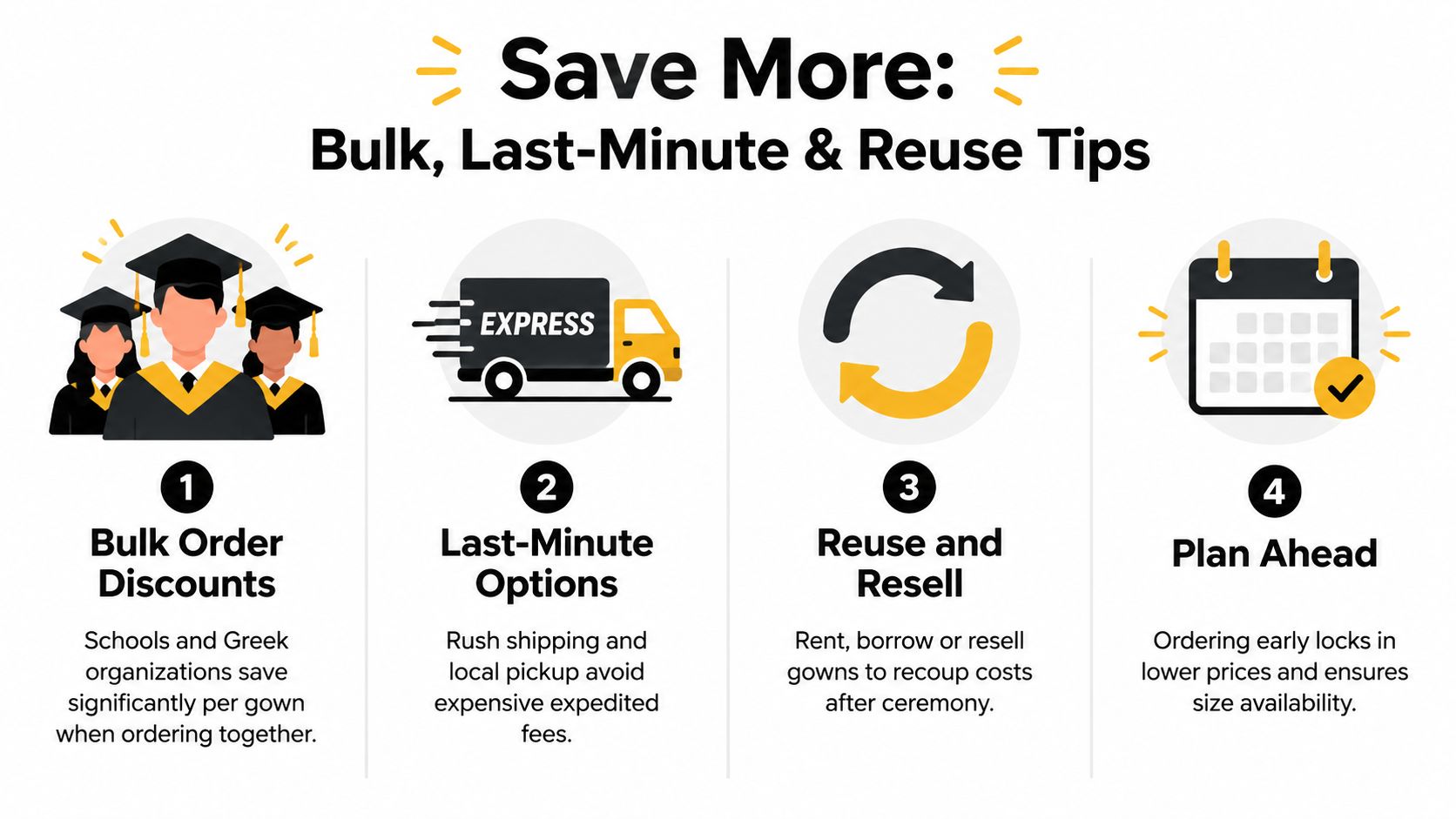
Bulk pricing can reduce the cost assigned to each student because one coordinated order replaces many separate transactions. Standardizing the gown style, color, and required accessories also makes distribution easier. The saving disappears quickly, however, if incorrect information leads to replacements.
Prepare a size spreadsheet before ordering. Include each graduate's name, degree level, height, weight, gown color, and required accessories. Give students a review period so they can confirm their information. A second check works like proofreading an address before mailing a package. It takes little time and can prevent an expensive correction.
Ask suppliers about package structures, delivery timing, inventory, and replacement policies. A group does not save by purchasing extra pieces that students do not need. It saves by ordering the correct standardized set with fewer avoidable changes. For a practical example of organizing a standard package, review these senior cap and gown packages.
Last-minute orders require a plan
A late order may still fit the budget, but it leaves less room to fix mistakes. Before payment, confirm inventory, shipping speed, cutoff times, and return rules. If local pickup is available, compare it with expedited shipping and verify that the reserved gown has the correct size and color.
Rush ordering works best after the ceremony requirements are settled. It becomes costly when a student is still choosing between a bachelor's package and a master's set. Coordinators can reduce emergency purchases by collecting degree information and measurements before the ordering window opens.
One late order may be unavoidable. A late group order needs especially clear responsibilities, including who approves the final list and who receives the shipment.
Reuse changes the value equation
A gown worn once carries its full purchase cost in one ceremony. Borrowing, renting, reselling, or sharing spreads that cost across more than one wearer. A campus sustainability program reports that donated caps and gowns can be rented for free, while some souvenir-grade regalia can be reused an average of six times (Regalia Reuse Program).
Reuse can happen through a family, student organization, resale channel, or institutional closet. Store garments clean and dry in garment bags, then label their sizes and colors. A reusable gown creates value only when the next person can locate it, identify it, and wear it comfortably.
Material choice also belongs in the total-value calculation. A 2025 university partnership announcement described Renew gowns made from 100% post-consumer recycled materials, indicating that recycled-material regalia is appearing in institutional purchasing (Academic Apparel Regalia Prices). Compare durability, care instructions, availability, color stability, and reuse potential alongside the material label.
For coordinators: The lowest invoice can be a poor value if mismatched sizes, outdated colors, or fragile garments are discarded after one ceremony.
Customization and Accessories That Stay on Budget
Personalization doesn't require a costly full redesign. A standard gown creates the uniform base, while one carefully chosen accessory can communicate honors, identity, school pride, or family significance.
Start with the items your ceremony requires, then choose the detail that will appear most clearly in photographs. A custom stole may provide more visual impact than several small additions, while an honor cord or medal may matter more if your institution formally recognizes academic achievement.
Build the outfit in layers
Use this order when planning:
- Required foundation: Choose the correct gown, cap, and tassel for your degree level.
- Academic recognition: Add a hood, honor cord, medal, or other official distinction only when applicable.
- Personal expression: Consider a custom graduation stole, Kente stole, Flag stole, First Generation stole, Greek stole, or international stole.
- Keepsake protection: Add a diploma cover, frame, or garment bag if you expect to preserve the milestone.
- Small finishing details: Consider a year date drop or a coordinated tassel when it supports the overall look.
The order matters because it prevents decorative pieces from competing with required regalia. It also makes the budget easier to control. If you have room for one extra, select the piece that carries the clearest meaning.
Coordinate rather than accumulate
Too many colors can make the outfit look accidental. Choose a primary school color, one recognition color, and an accessory that complements both. If your hood already has strong velvet or lining colors, a simpler stole may create a cleaner appearance.
For families, a diploma cover or garment bag may be a better long-term purchase than another ceremony decoration. For student organizations, a custom stole can create a shared visual identity without requiring every member to buy a different gown.
A custom graduation stole guide can help you evaluate wording, design, and placement before ordering. Review spelling, graduation year, organization names, and color choices carefully. Custom pieces may have different production or return conditions than standard items.
Use a must-have and nice-to-have list
Write two columns before you shop.
Must-have items include the pieces required by your school and the accessories that represent formal academic status. Nice-to-have items include keepsakes and decorative additions that you can remove without affecting ceremony eligibility.
This small distinction protects the core budget. It also leaves room for a meaningful addition without turning the entire purchase into a collection of impulse items. Affordable graduation gowns look polished when the foundation fits, the colors coordinate, and the accessories have a reason to be there.
Why Graduation Cap and Gown Is the Smart Affordable Choice
Affordability becomes easier when one supplier supports the whole decision instead of forcing you to assemble information from scattered listings. Graduation Cap and Gown offers complete packages and individual pieces for bachelor's, master's, and doctoral regalia, along with options for high school, homeschool, and other school milestones.
The practical advantage is choice. You can compare a standard package with separate pieces, use the Find Your University feature for school colors, and review size, color, and fabric guides before placing the order. If you already own a cap or tassel, you don't have to repurchase the entire set.
A useful value checklist
Graduation Cap and Gown's product range includes:
- Core regalia: Caps, gowns, tassels, hoods, tams, and beefeaters.
- Recognition pieces: Custom graduation stoles, honor cords, and medals.
- Cultural and identity options: Kente, Flag, First Generation, Greek, and international stoles.
- Keepsakes: Diploma covers and frames, garment bags, and year date drops.
- Ordering support: Size, color, and fabric guidance, plus choices that support standard and time-sensitive orders.
The store states that it offers a lowest-price guarantee, secure ordering, fast shipping, and free or overnight delivery choices. Its published company information also cites 10,000+ verified reviews and a 98% recommendation rate. Those details don't replace checking your institution's requirements, but they can make a multi-step purchase easier to manage.
Choose according to your real situation
A bachelor's student may need a simple package and a properly matched tassel. A master's candidate may need to compare a complete set with a gown and hood purchased separately. A doctoral candidate may want to weigh rental against ownership because doctoral pricing is substantially higher, especially when the set includes a tam and hood.
A coordinator can use the same store differently. Standardize the gown, collect measurements, verify colors, request bulk support, and order with enough time for inspection. A family may prioritize a reusable gown, a cultural stole, or a diploma cover. There isn't one affordable choice for everyone. There is a better choice once the buyer defines required pieces, expected use, and delivery needs.
Use that checklist before checkout: confirm the degree level, verify the school color, measure carefully, compare package and individual pricing, decide whether you'll buy, rent, or borrow, and leave time to inspect the shipment. That process turns a stressful purchase into a manageable graduation-day task.
Graduation Cap and Gown offers affordable academic regalia through complete packages, individual pieces, school-color matching, size guidance, and accessories for personal recognition. Visit Graduation Cap and Gown to compare options for your degree level, choose the pieces you need, and place your order with confidence.