

At 6:15 a.m., a senior's gown is half-zipped, the tassel is tangled in a hairbrush, and a parent is calling the school office because the package arrived in the wrong color. That scramble is avoidable. Senior cap and gown packages look simple online, but four decisions determine whether the graduate looks polished or uncomfortable in every ceremony photo: fabric and finish, size and fit, school-color matching, and accessories.
A package isn't just a product code. The gown has to hang correctly over the graduate's clothing, the cap must stay secure through the processional, and every color and accessory must follow the school's rules. The buyer who checks those details early gets a calm graduation morning. The buyer who guesses usually ends up steaming wrinkles, pinning loose caps, or searching for replacement pieces under pressure.
The Senior Graduation Morning and Why the Package Choice Matters
The morning usually goes wrong in small ways. A cap slips because nobody checked the fit over thick hair. A gown drags over flat shoes because someone ordered by a rough height estimate. A shiny fabric reflects harsh outdoor light, while a matte finish would have looked cleaner in photographs. None of these problems seems serious at checkout, but they become highly visible once the graduate is standing beside classmates.
Academic dress has a long history. European universities adopted long gowns and hoods from medieval scholarly and clerical clothing in the 12th and 13th centuries, and the square mortarboard became a standardized graduation headpiece by the 1700s. In the United States, the Intercollegiate System replaced earlier school-specific codes by 1896, establishing the modern structure for bachelor's, master's, and doctoral regalia (History's account of cap-and-gown traditions).

The four decisions that prevent a bad order
- Fabric and finish: Choose a construction that drapes cleanly, resists visible creasing, and suits the ceremony setting.
- Size and fit: Use measurements, not a quick height guess. The gown must clear the shoes and allow comfortable movement.
- Color matching: Confirm the institution, campus, and official ceremony requirements before selecting a shade.
- Accessories: Add only the stole, cord, hood, medal, or tassel that the graduate is entitled to wear.
My recommendation is simple. Treat the package like formal eventwear, not disposable clothing. A few minutes spent checking those four details can protect the ceremony photos, reduce exchanges, and keep the graduate focused on the milestone rather than the outfit.
What Comes Inside a Standard Senior Cap and Gown Package
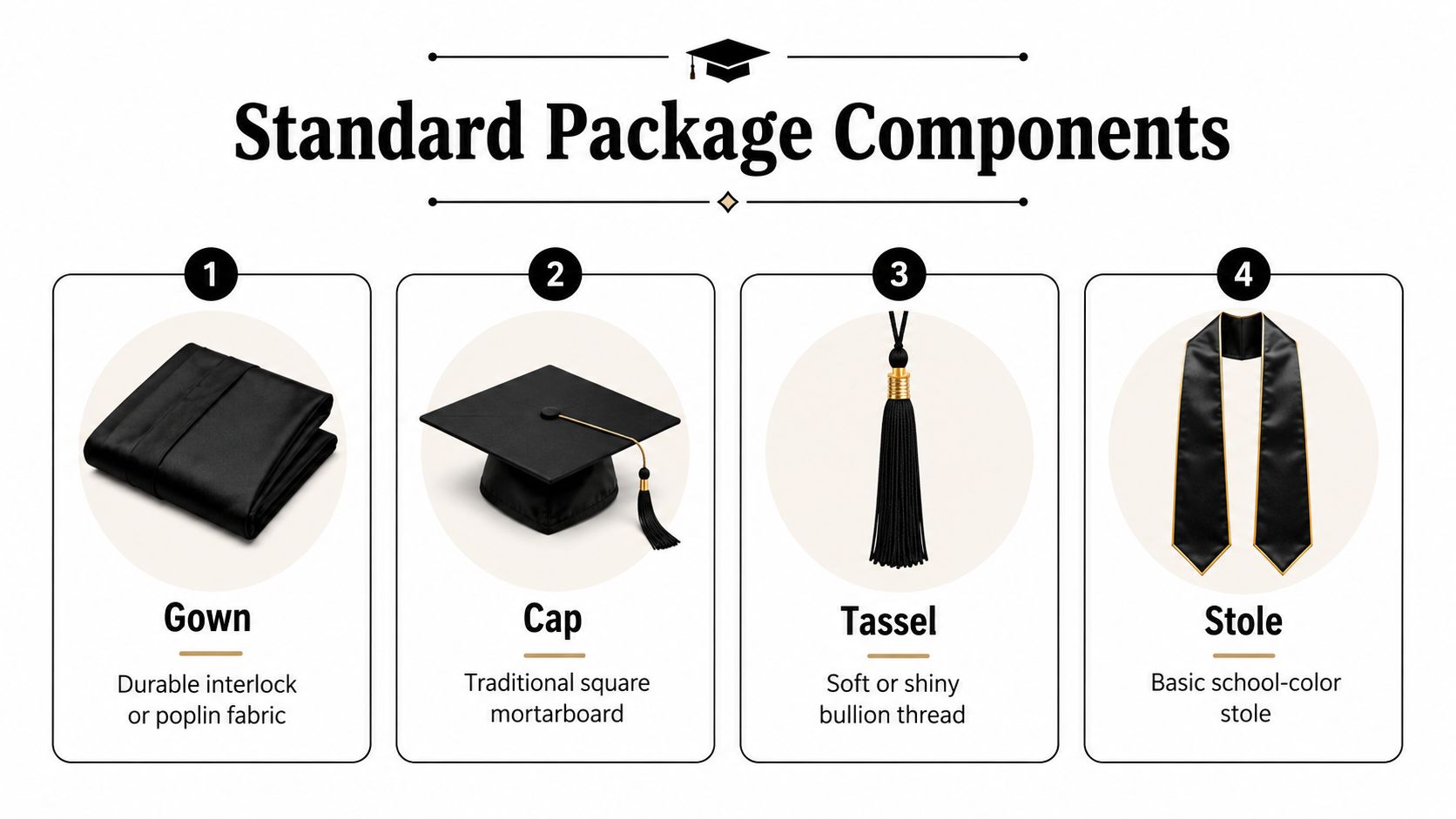
A standard senior package should be easy to understand. Start with the gown, usually offered in durable interlock or poplin fabric. Add the mortarboard cap, a soft or bullion tassel, and a basic stole or honor cord only when the school requires it. That core set covers the essentials for many high school ceremonies.
Separate essentials from upgrades
A package comparison grid should show whether a feature changes the garment or merely changes the label. A satin-lined yoke, sturdier tassel, or embroidered year stole is a genuine upgrade because it changes the finish, construction, or personalization. A different product name for the same basic polyester gown isn't an upgrade by itself.
Check these components before comparing prices:
- Gown construction: Look for the fabric type, finish, sleeve shape, zipper placement, and available sizes.
- Cap design: Confirm whether the mortarboard has an elastic fit, comfort band, or standard button attachment.
- Tassel quality: Check whether the listing specifies soft thread, bullion thread, a year charm, or a custom color.
- Stole or cord: Verify whether it is included, optional, school-approved, or intended for a particular honor.
A high school package generally doesn't need the same components as a college-degree kit. Degree-level regalia may include a hood, velvet trim, or sleeve bars. Doctoral regalia is especially distinctive, while a high school senior usually needs a gown, cap, tassel, and any school-authorized recognition piece. The graduation regalia buying guide is useful when you're comparing complete sets with individual accessories.
Don't pay for a hood or doctoral-style trim unless the ceremony requires it. Read the comparison grid from left to right, identify what is included in every package, then isolate the features that improve fit, appearance, or compliance. That approach keeps the purchase focused and prevents accessory-heavy upselling.
Choosing Fabric, Weave, and Finish That Look Right on Camera
Fabric weight affects the way a gown hangs, wrinkles, reflects light, and feels indoors. A practical guide identifies 100 to 120 gsm matte polyester as a reliable benchmark. Fabric below 90 gsm can look thin and crease easily on camera, while fabric above 130 gsm may feel restrictive and warmer indoors (this graduation gown fabric guide).
For senior packages, I favor a matte body with enough weight to fall smoothly from the shoulders. Lightweight poplin is convenient for transport and can work well when the graduate needs a packable garment. Mid-weight interlock or tropical worsted generally gives a more substantial drape and a cleaner shoulder line, but it can feel warmer during a long indoor ceremony.
| Fabric | Approx. Weight (gsm) | Drape | Wrinkle Resistance | Best For |
|---|---|---|---|---|
| Matte polyester poplin | 100 to 120 | Light and easy | Moderate | Travel, warm venues, simple high school ceremonies |
| Lightweight construction | Below 90 | Thin and fluid | Lower | Short wear times where packing matters most |
| Mid-weight interlock or tropical worsted | Qualitatively heavier than lightweight poplin | Fuller and cleaner | Stronger | Stage lighting, formal ceremonies, repeated handling |
| Heavy construction | Above 130 | Structured | Strong | Cooler venues where warmth isn't a concern |
Why the camera exposes fabric choices
A gown that's too light can show every crease and may lose visual depth under bright lighting. A heavier material absorbs more light and usually maintains a steadier silhouette, but added weight doesn't automatically make a package better. Comfort still matters, especially when graduates sit, stand, walk, and wait in line for extended periods.
Finish matters just as much. A satin-lined yoke can add polish around the neckline while a matte body keeps the overall garment restrained. A fully shiny gown may look festive indoors, but strong outdoor light can make inexpensive fabric appear overly reflective. For photo planning, tools and resources related to ai fashion photography can help teams think through how fabric, lighting, and garment presentation work together, but the physical fabric still needs to look right in person.
Buyer's rule: Choose the lightest fabric that still hangs cleanly and stays opaque over the graduate's clothing.
Getting the Size Right With Head-to-Floor and Body Measurements
Height-only sizing causes avoidable problems. Gown suppliers commonly use height, weight, chest, sleeve length, and head circumference to reduce fit errors, and institutional charts often combine height bands with weight ranges and plus-size options (this academic apparel guide). One supplier specifically directs buyers to measure from the top of the head to the floor while wearing shoes, which is the relevant length for matching a gown (cap-and-gown package sizing guidance).
Use two measurements before opening the size chart
First, stand upright in the shoes the graduate will wear and measure from the top of the head to the floor. Record the result in inches, rather than using shoe size or a rough guess about height. The hem needs to clear the shoes while still falling below the ankles, so the measurement should reflect the actual ceremony footwear.
Next, check the upper body:
- Shoulder span: Measure across the shoulders so the sleeves don't pull when the graduate moves.
- Sleeve length: Check the distance from the shoulder to the wrist or the supplier's stated sleeve point.
- Chest circumference: Measure around the fullest area while wearing the clothing likely to sit under the gown.
- Head circumference: Measure around the head above the ears and across the forehead, keeping the tape snug but not tight.
Use the vendor's chart and choose the size that accommodates the larger relevant body measurement. Don't size a gown for stilettos if the graduate will change into flats. Also check the cap over the graduate's actual hairstyle. Thick hair can make a fitted mortarboard unstable, while a cap that is too loose can shift during movement.
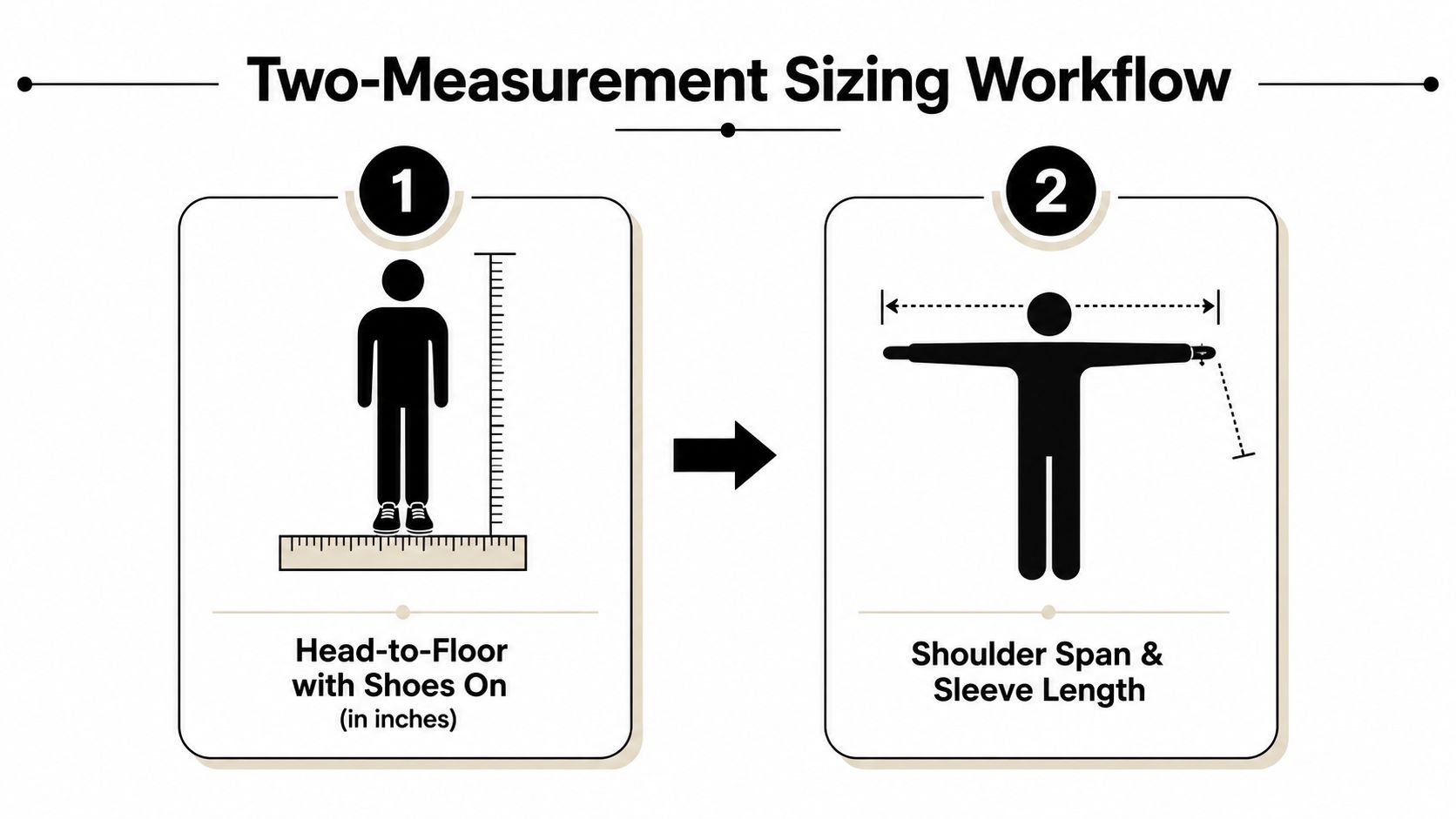
Use this graduation cap and gown size chart as a reference, then schedule a try-on rehearsal about a week before the ceremony. Wear the exact shoes, clothing layers, stoles, and cords. If the hem, sleeves, or cap needs changing, that rehearsal leaves time to resolve the issue instead of discovering it in the processional line.
Matching School Colors and Degree-Level Conventions
Color matching requires more than choosing the shade that looks closest on a phone screen. Use the retailer's Find Your University tool to search the institution, confirm the official name and campus, and review the school-specific color reference. Satellite campuses can use different branding or ceremony requirements, so don't stop at the first matching result.
Then compare the digital swatch with a real photograph from a previous graduating class. Screen calibration and dye lots can alter the appearance, while a class photo shows how the color reads under ceremony lighting. If the school publishes a regalia contract, that document overrides every online color tool.
Color is only one part of the rulebook
High school seniors commonly wear the school's primary color, but college regalia adds degree-level and discipline conventions. Bachelor's and master's gowns are generally black in many institutions, while doctoral regalia can include velvet trim and sleeve bars. Hood and tassel colors may identify the degree field or level, so a college package shouldn't be selected using high school color logic.
| Academic Level | Gown Cut | Primary Color Source | Hood or Trim | Common Exceptions |
|---|---|---|---|---|
| High school | School-designated senior cut | School palette or ceremony contract | Usually no degree hood | All-black ceremonies or association-issued palettes |
| Associate | Institution's academic regalia | Institution and discipline rules | May follow degree-level requirements | Campus-specific instructions |
| Bachelor's | Institution's academic regalia | Institution and academic field | Hood or trim where required | Faculty-cut or all-black requirements |
| Master's | Master's regalia cut | Institution and academic field | Hood and discipline color where required | Program-specific ceremony rules |
| Doctoral | Doctoral regalia cut | Institution and academic field | Velvet trim, sleeve bars, and hood conventions | Institution-specific doctoral design |
The guide to graduation colors and hoods helps organize the terminology, but the registrar or ceremony coordinator has final authority. Verify the degree level, academic program, campus, and required gown color before ordering. A correct shade with the wrong cut is still the wrong package.
Picking Stoles, Cords, Hoods, and Tassels That Match the Graduate
Accessories should communicate something real. A plain gown establishes the ceremony, but a stole, cord, hood, or tassel can identify an honor, affiliation, cultural identity, or academic discipline. The right accessory makes the graduate's achievement legible. The wrong one creates confusion or violates ceremony rules.
Match each piece to its purpose
Stoles offer the broadest visual space. Schools may use them for spirit or class identity, while students may choose approved cultural, Greek, first-generation, international, or leadership stoles. A Kente-inspired stole, flag stole, or organization stole can carry personal meaning, but it should still follow the school's dress policy.
Cords communicate more narrowly. They may represent an honor society, a valedictorian or salutatorian designation, or a department award. Some schools use cords for specific academic distinctions, including cum laude tiers, so the graduate should confirm the color and eligibility with the school rather than relying on a product photograph.
Hoods belong to degree-level regalia. Under Intercollegiate System conventions, the velvet field indicates the academic discipline and the lining reflects the institution. That makes a hood a credential-specific item, not a decorative add-on. Order it only after confirming the graduate's degree level and program.
Tassels finish the cap, and schools often specify their colors. The University of Pennsylvania's academic costume history identifies 1887 as a milestone for the Pennsylvania System and 1896 as the year it was superseded by the Intercollegiate System. That system helped standardize caps, gowns, hoods, and tassels, including the familiar move from right to left at Commencement (University of Pennsylvania's history of academic regalia).
Check whether the cap uses a standard loop or a button attachment. Product listings commonly describe a mortarboard top of about 9 inches by 9 inches, and tassels are often listed at about 9 inches with a 6-inch loop, so those details can be checked against the package description (cap, gown, and tassel specifications). Skip any accessory that looks meaningful but hasn't been verified. An unauthorized cord or blank stole can create more distraction than a simple, correct package.
Pricing, Bulk Orders, and Shipping Windows You Should Plan Around
Don't build a purchasing plan around an assumed price band or a last-minute discount. Package prices vary with fabric, personalization, accessories, quantity, and production requirements. A basic polyester set sits at a different tier from a premium matte-satin bundle, and custom embroidery or a hood add-on changes the order before shipping enters the calculation.
Bulk buyers should ask for a written quote rather than assuming the online individual price applies. The important levers are straightforward:
- Fabric upgrade: A more substantial or refined finish can raise the unit cost.
- Custom stole embroidery: Names, years, school marks, or organizations require additional production handling.
- Hood add-ons: Degree-level accessories should be quoted separately when they aren't part of the base package.
- Rush production: Faster manufacturing or delivery can narrow choices and increase the total cost.
- Quantity: Schools and organizations should ask about tiered pricing, carton packing, size assortments, and replacement pieces.
Plan backward from commencement
Seasonality makes waiting a poor strategy. One market analysis found that high school graduation cap-and-gown search interest and sales peak sharply in June, then decline quickly afterward (the graduation gown seasonality analysis). That pattern matters because families, schools, and warehouses all face pressure close to ceremonies.
A coordinator should gather the school's color contract, size list, accessory requirements, purchase order details, delivery address, and receiving contact before requesting a bulk quote. Parents should confirm the return and exchange policy, personalization restrictions, and whether a replacement can arrive before the ceremony if the size is wrong.
| Package Tier | Typical Per-Unit Price | Bulk Discount Trigger | Recommended Order Lead Time |
|---|---|---|---|
| Basic senior set | Varies by listing and quantity | Ask for a school or group quote | Order early enough for measurement review and exchange |
| Upgraded fabric set | Higher than a basic set | Request a written quantity quote | Allow time for fabric selection and inspection |
| Personalized stole package | Depends on embroidery and design | Confirm minimum order and proof approval | Add production time before the ceremony |
| Degree-level package | Depends on hood, trim, and accessories | Quote by degree and program mix | Confirm academic requirements before production |
| Rush order | Case-specific | Usually handled individually | Use only after stock, size, and delivery are confirmed |
The cap-and-gown cost guide can help frame the options, but the right buying decision is the one that protects fit and delivery. Paying a small premium for early certainty is usually smarter than paying for an emergency replacement after the ceremony deadline has passed.
Pre-Order Checklist and Graduation Day Fit Tips
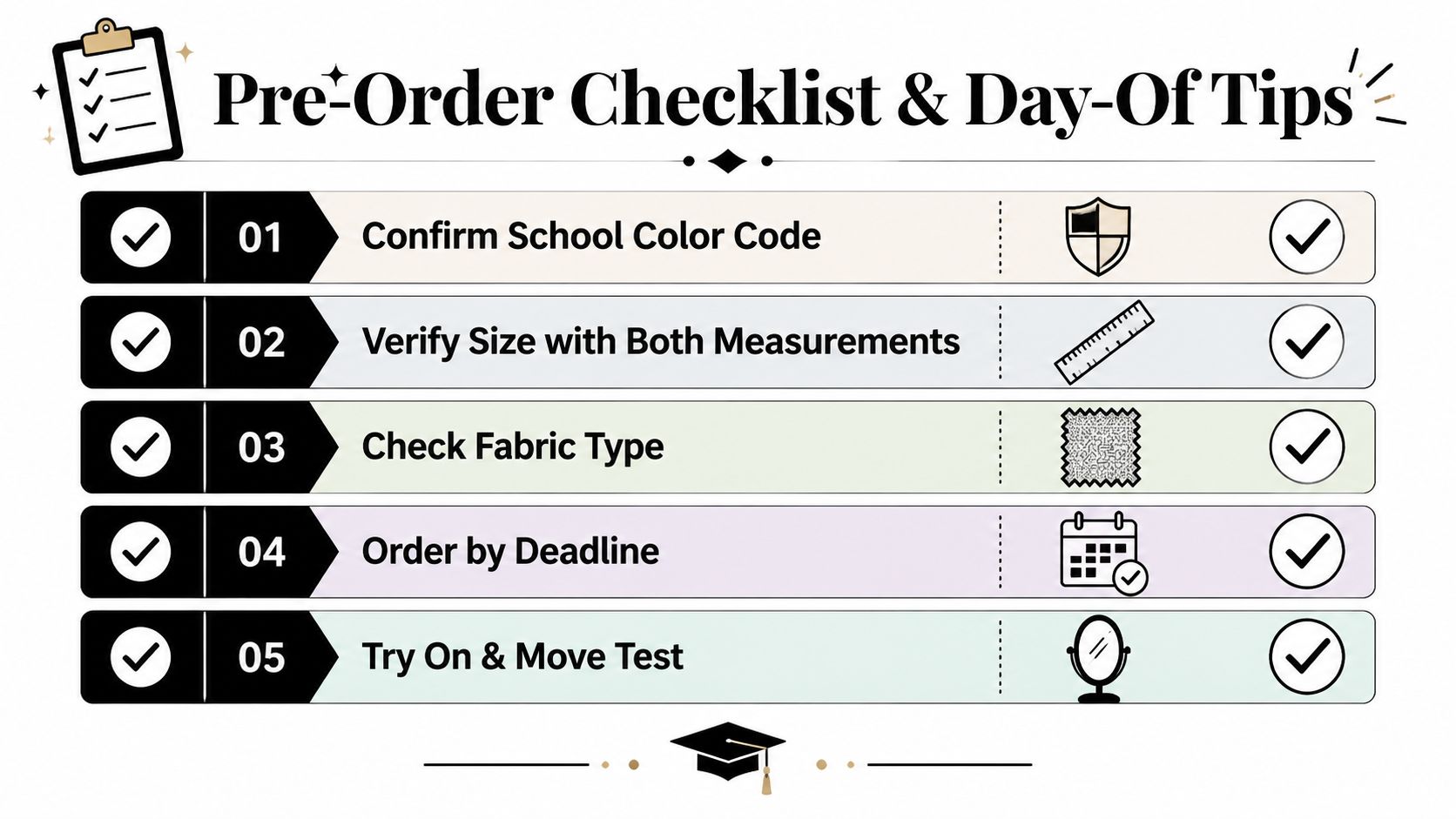
A reliable order is built from five confirmations: fabric, measurements, color, accessories, and delivery timing. Before checking out, verify the ceremony's required gown style and school color, then confirm whether the graduate needs a stole, cord, hood, medal, or specific tassel. Don't add pieces just because the product page displays them together.
Complete the order before the deadline pressure starts
Use this checklist before you close the browser tab:
- Confirm school color code: Match the institution, campus, and ceremony contract.
- Verify both measurements: Record head-to-floor length with shoes and the relevant upper-body measurements.
- Check fabric type: Compare matte poplin, interlock, or another listed construction against venue temperature and photography needs.
- Review every component: Confirm the gown, cap, tassel, stole, cord, hood, and personalization inclusions.
- Lock the delivery plan: Order with enough time for inspection, try-on, exchanges, and any approved replacement.
- Save the paperwork: Keep the confirmation, size details, school instructions, and return policy in one place.
The gown should be steamed according to its care instructions, not attacked with a hot iron. If ironing is permitted, use the correct heat setting and protect the fabric. Hang the garment after steaming so the shoulders settle before the ceremony.
Make the morning boring
Try the full outfit on before graduation day. Pin the cap only if the school permits it, and use a secure method that won't damage the mortarboard. Break in stiff shoes on carpet, then pack safety pins, hem tape, and a backup tassel if the ceremony coordinator recommends one.
A calm morning has a simple sequence. Adjust the cap before leaving home, check that the tassel is attached, inspect the hem and zipper, put on the stole and cords in the approved order, take a final mirror photo, and arrive ready for processional line-up. The graduate should spend the last minutes celebrating, not searching for missing regalia.
Morning standard: Every piece should be tested with the exact shoes, hairstyle, layers, and accessories that will appear at commencement.
Graduation Cap and Gown offers complete senior cap and gown packages alongside individual caps, gowns, tassels, stoles, cords, hoods, and related accessories, with a Find Your University tool for school-color selection. Visit Graduation Cap and Gown to compare package components, confirm sizing and color details, and place an individual or bulk order before your ceremony deadline.