

You're standing in a Tuesday-night-before-commencement scramble. The gown is two sizes too long, the tassel is the wrong color, and the hood you expected in the package never arrived. Graduation regalia for sale can look like a simple apparel purchase, but one missing or mismatched piece can create a stressful problem on a day that should feel celebratory.
The solution isn't panic buying. It's identifying your degree level, confirming your university's requirements, measuring carefully, and matching your order to the ceremony date. Whether you need a complete bachelor's package, doctoral regalia, a cultural stole, or a replacement tassel, a predictable process protects your time and your budget.
Why Graduation Regalia for Sale Is Worth Planning Before You Shop
A few minutes of preparation can prevent several common surprises. University catalogs may use different names for similar garments, sizing charts can conflict, and a school's official color combination may differ from the color you associate with its logo. First-time buyers often hesitate because they're afraid of ordering the wrong set and paying twice during the same graduation year.
Planning gives you three practical advantages:
- Accurate school matching: University-specific catalogs can help you choose the correct gown color, hood lining, trim, tassel, and degree style.
- More reliable fulfillment: You'll have time to handle production, shipping, personalization, exchanges, or alterations before commencement.
- Better package decisions: A complete set may be more practical than buying each component separately, especially when you also need a cap, tassel, hood, or stole.
A school counselor ordering for a graduating class faces the same problem at a larger scale. If several students submit incomplete information, the coordinator may have to sort out missing sizes and colors while the ceremony deadline approaches. A simple order sheet that records degree level, height, university, hood requirement, and accessories turns a confusing catalog into a manageable checklist.
Practical rule: Treat your ceremony date as the starting point for every regalia decision, not as the date you place the order.
Families often plan the clothing, photographs, dinner, and gifts together. If you're also looking for practical graduation presents for daughters, coordinate those purchases with the regalia order so the graduate isn't dealing with several last-minute deliveries at once.
Before browsing, read a school-specific high school graduation checklist if you're buying for a secondary-school ceremony. It can clarify whether the school supplies the cap and gown, requires a particular tassel, or permits personal stoles and cords.
The rest of the buying process follows a clear sequence. First, inventory the pieces you need. Then confirm degree-level styling and school colors, measure for fit, choose any identity or honor accessories, and review delivery and return terms. Once those decisions are separated, graduation regalia for sale stops feeling like a gamble.
Every Piece of Graduation Regalia Explained and What It Does
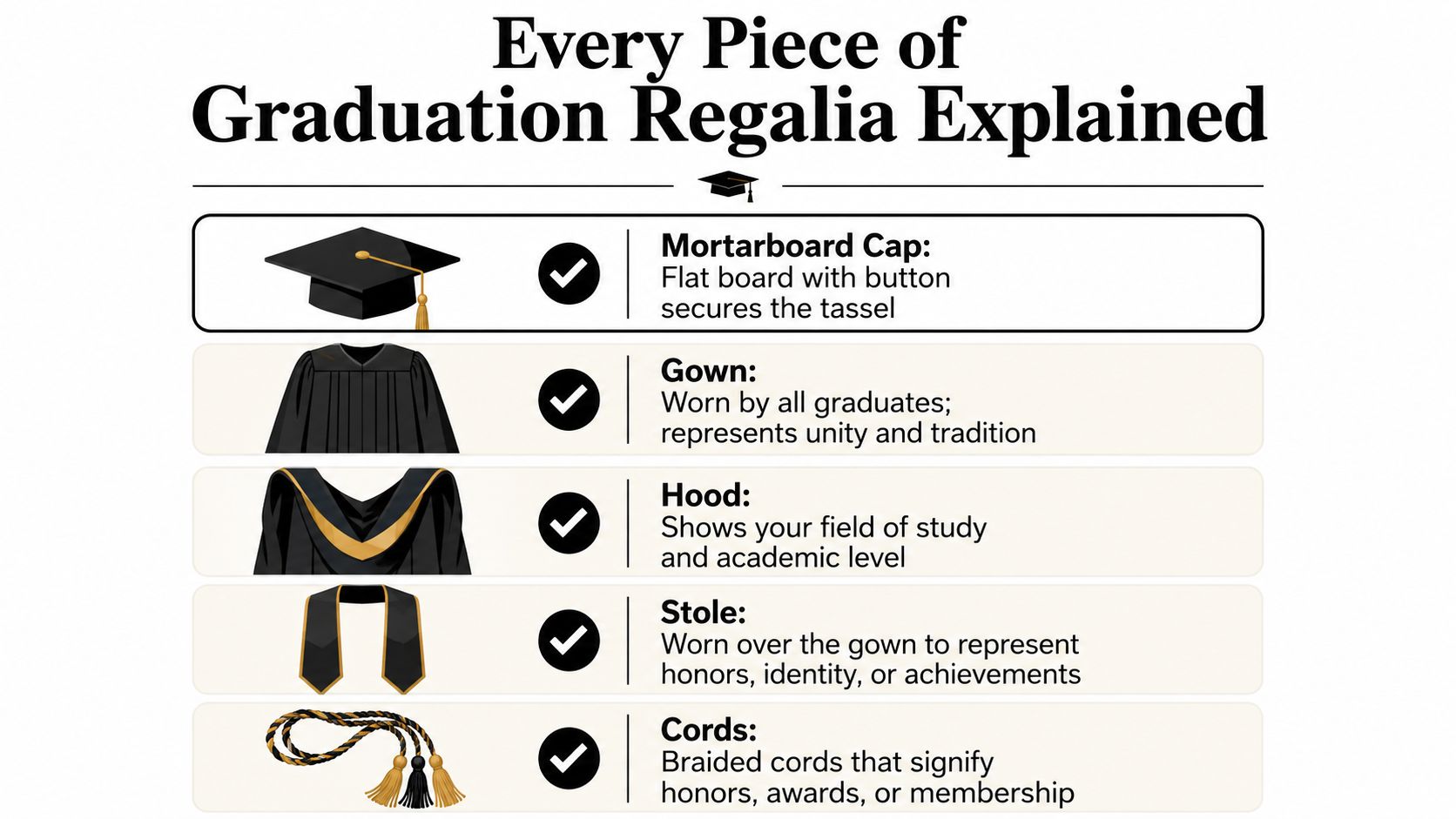
Academic regalia is easier to order when you can identify each piece visually. Start with the cap, then the gown, hood, tassel, and optional accessories. Your ceremony may require only some of these items, so don't assume that a complete-looking package is automatically the correct one.
The standard pieces
Mortarboard cap: This is the flat, square board with a button in the center. The button holds the tassel, while the elastic or fitted portion sits on your head. Position the cap flat, with the point toward the front, rather than tilting it backward for photographs.
Gown: The gown is the main garment and usually closes at the front. Bachelor's gowns commonly have a simpler silhouette, while master's gowns may include distinctive sleeve details. Doctoral gowns generally have more formal velvet trim and are paired with a tam.
Hood: A hood is associated with graduate-level regalia and displays color inside the hood to identify the academic discipline. The exterior shell corresponds to the degree and institution's tradition. The front point should sit at the chest, while the longer section falls down the back.
Tassel: The tassel attaches to the cap button and hangs to one side before the ceremony. Some ceremonies direct graduates to move it at an official moment, so follow your institution's instructions rather than relying on a general custom.
Stoles and cords: These are optional or institution-approved accessories. A stole may represent culture, first-generation status, an organization, or an academic group. Cords may recognize honors, departmental achievements, or participation in a recognized program.
A master's student once arrived at a fitting session with a gown and cap but no hood. The gown fit correctly, yet the outfit was incomplete for the ceremony. A doctoral candidate had the opposite problem. She brought a hood but discovered that the tassel color didn't correspond to her discipline. Both situations were avoidable with a piece-by-piece inventory.
Run this inventory before adding products to your cart
- Confirm the gown: Check degree level, color, closure, and sleeve style.
- Confirm headwear: Decide whether you need a mortarboard, tam, or another approved style.
- Confirm the tassel: Match its color and degree designation to your school's instructions.
- Confirm the hood: Graduate candidates should verify size, lining, velvet color, and whether it's worn before or placed during the ceremony.
- Confirm accessories: Add only approved stoles, cords, medals, or other recognition items.
- Confirm ceremony rules: Some schools provide certain pieces or restrict colors and decorations.
Choosing Regalia by Degree Level and School Colors
Degree level affects more than the wording on a product page. It can change the gown's cut, sleeve treatment, hood length, headwear, and trim. A bachelor's candidate usually needs a gown, mortarboard, and tassel. A master's candidate may need a hood, while a doctoral candidate may need a doctoral gown, tam, and hooding-specific accessories.
School colors create another layer of confusion. A university's primary colors may appear on the gown or trim, while the hood lining identifies the academic discipline. The discipline-color chart associates white with Arts, Letters, and Humanities, drab with Business, light blue with Education, orange with Engineering, pink with Music, and golden yellow with Science. Confirm the combination with your institution because ceremony instructions take priority. (GradGowns' academic regalia color guide)
The safest starting point is a university-specific collection or a retailer's Find Your University tool. Search by school first, then verify your degree level and program. This reduces the risk of selecting a generic gown that looks close but uses the wrong hood lining, velvet trim, or tassel.
A joint degree, interdisciplinary program, or certificate ceremony can create edge cases. The school may instruct graduates to wear the regalia for the degree being conferred, the program's primary discipline, or a shared ceremony standard. Don't infer the answer from your major alone. Ask the registrar, graduate school, or commencement office.
The types of graduation gowns guide can help you distinguish common styles before you compare school-specific products.
| Degree Level | Gown Style | Hood Length | Headwear | Common Color Confusion |
|---|---|---|---|---|
| Associate | Basic ceremonial gown | Usually not required, unless specified | Mortarboard | School color may be mistaken for discipline color |
| Bachelor's | Standard gown with a simpler silhouette | Usually not worn | Mortarboard | Tassel and stole colors may be confused with hood colors |
| Master's | Gown with graduate-level sleeve styling | Longer graduate hood | Mortarboard | Interior hood color identifies the field, not always the school's primary color |
| Doctoral | Formal gown with distinctive trim | Doctoral hood or hooding piece | Tam | Velvet trim, hood lining, and tassel may follow separate conventions |
Use the table as a starting point, not a substitute for your commencement instructions. The university's approved catalog controls when general traditions and local requirements differ.
Sizing, Fabric, and Fit Without the Guesswork
You arrive at gown pickup and discover the sleeves cover your hands. A quick measurement before ordering prevents that ceremony-day problem. Graduation gowns are sized mainly by height, with weight or chest information often used to refine the fit. A published gown sizing guide pairs sizes such as 42, 45, 48, 51, 54, 57, 60, and 63 with progressively taller and heavier wearers.
Ask someone to help measure. Stand straight in the shoes planned for commencement and measure from the top of your head to the floor. Wrap the tape around the fullest part of your chest without tightening it. If the product requests sleeve information, measure from shoulder to wrist with your arm relaxed.
Many charts use 3-inch height bands. One guide lists 4'10" to 5'0" for size 45, 5'1" to 5'3" for size 48, 5'4" to 5'6" for size 51, 5'7" to 5'9" for size 54, and 5'10" to 6'0" for size 57. (Graduation cap and gown sizing guide) Use the graduation cap and gown size chart as a reference, then confirm the chart attached to the exact product. Size labels can differ between suppliers.
A practical fit check
At the fitting milestone, the gown should hang smoothly, without pulling across the chest or bunching at the shoulders. A bachelor's gown commonly reaches mid-calf. Graduate gowns often sit closer to the ankle, although the product design and your measurements determine the final length.
| Size Label | Height Range | Chest Range | Recommended For |
|---|---|---|---|
| 45 | 4'10" to 5'0" | Use the product chart | Shorter wearers |
| 48 | 5'1" to 5'3" | Use the product chart | Short to average-height wearers |
| 51 | 5'4" to 5'6" | Use the product chart | Average-height wearers |
| 54 | 5'7" to 5'9" | Use the product chart | Taller average-height wearers |
| 57 | 5'10" to 6'0" | Use the product chart | Tall wearers |
Fabric affects how the gown feels during the ceremony. Polyester and other synthetic fibers are common because they support a consistent appearance and lower unit costs for larger orders. (Academic dress fabric overview) They may feel less breathable during a long event, so compare cost, wrinkle resistance, finish, and comfort before choosing.
For the cap, measure around your head about one inch above the eyebrows and ears. For gown length, measure from the top of your head to the floor while wearing ceremony shoes. Another guide notes about 8 inches of floor clearance for the hem. (Cap and gown measuring guidelines) These checks matter whether you order individually, use the Find Your University tool, or arrange bulk regalia for your class.
Custom Stoles, Honor Cords, and Cultural Regalia That Tell Your Story
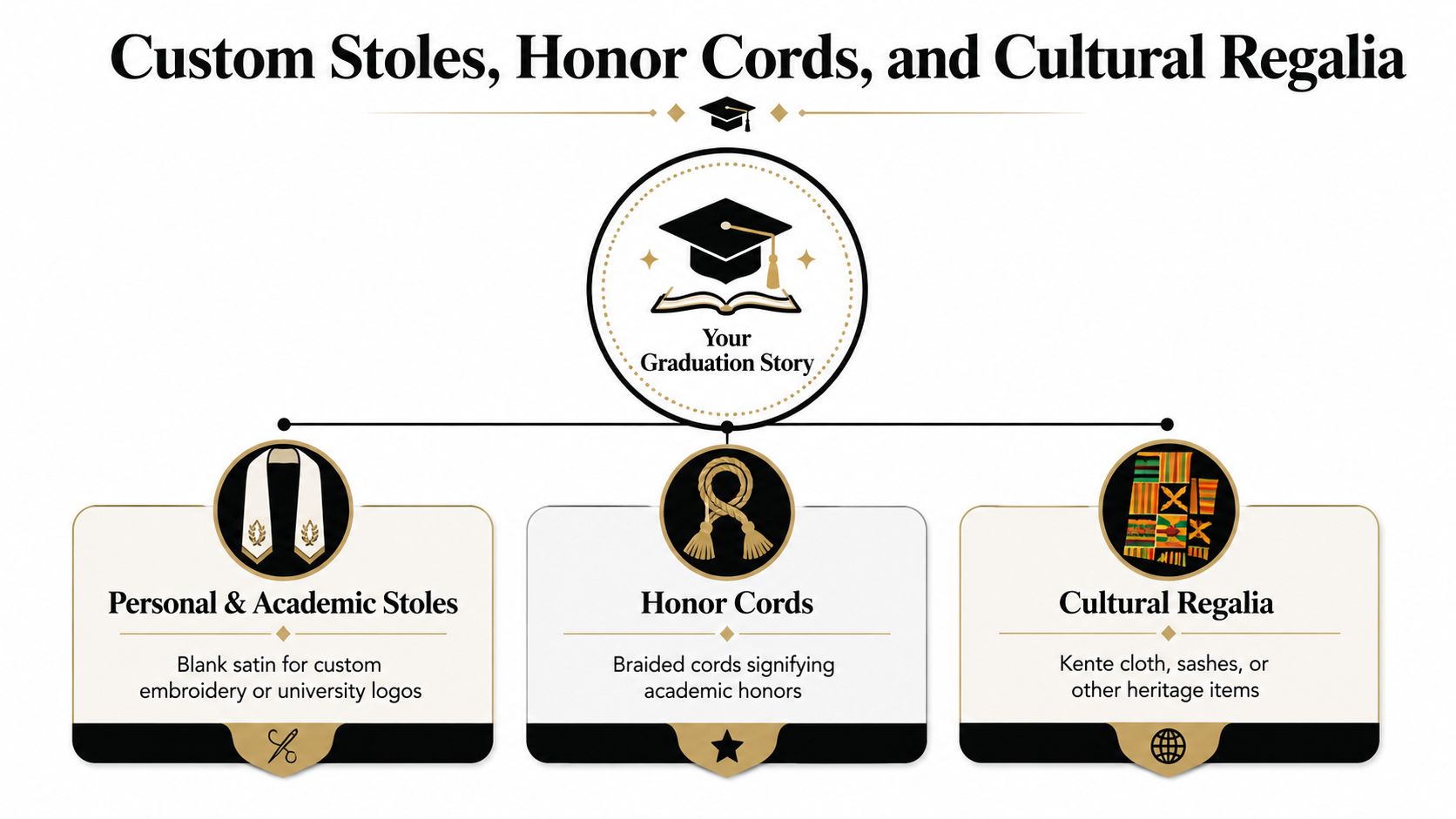
A stole can be more than decoration. It may mark a heritage, organization, achievement, or personal milestone that the standard gown cannot show. Choosing one gives the graduate a way to carry a meaningful part of their identity into a ceremony built around formal academic tradition.
Start with the story you want visible
A personal or academic stole works well for a school name, program, field of study, message, or custom artwork. Blank satin stoles allow personal decoration, while printed or embroidered options create a finished look without requiring a last-minute craft project.
Honor cords identify academic honors, departmental awards, or approved organizational achievements. Their colors and eligibility rules vary by institution, so check whether the school supplies them or requires graduates to purchase them separately.
Cultural regalia can carry even deeper meaning. Options may include Kente stoles, Serape stoles, Indigenous beadwork stoles, Stoles of Gratitude, Flag stoles, First Generation stoles, Greek letter stoles, and international designs. These pieces should complement the school's rules rather than compete with required hoods or other official elements.
Layer pieces in ceremony order
Put on the gown first and close it fully. Place approved stoles over the gown so they hang evenly down the front. Add honor cords over the stoles, allowing both ends to fall at the front. Graduate hoods settle on the shoulders last when the ceremony or institution calls for them, although doctoral candidates may carry a hood until the hooding moment.
If you're wearing more than one stole, ask the commencement office whether there's a preferred order. Some ceremonies specify which item should be closest to the neck, and others limit the number of accessories for uniform photographs.
The custom graduation stole collection is a useful place to compare personalized formats before deciding whether you need embroidery, printing, or a ready-made cultural design.
A bachelor's graduate might choose a First Generation stole, an honor cord, and a university tassel. A Greek organization member may choose a Greek letter stole, provided the institution permits it. A graduate celebrating heritage may select Kente or Serape fabric while keeping the school's required gown and hood unchanged.
Wear the required academic pieces first. Add identity pieces only after you know the ceremony permits them.
The global graduation stole market was valued at $410 million in 2024 and is projected to reach $710 million by 2033, according to MarketIntelo's graduation stole market report. That projection reflects why stoles deserve careful consideration. They're often the most visible personal element in a formal outfit, not an afterthought added to the cart.
Price Ranges, Bulk Orders, and Shipping Timelines You Can Count On
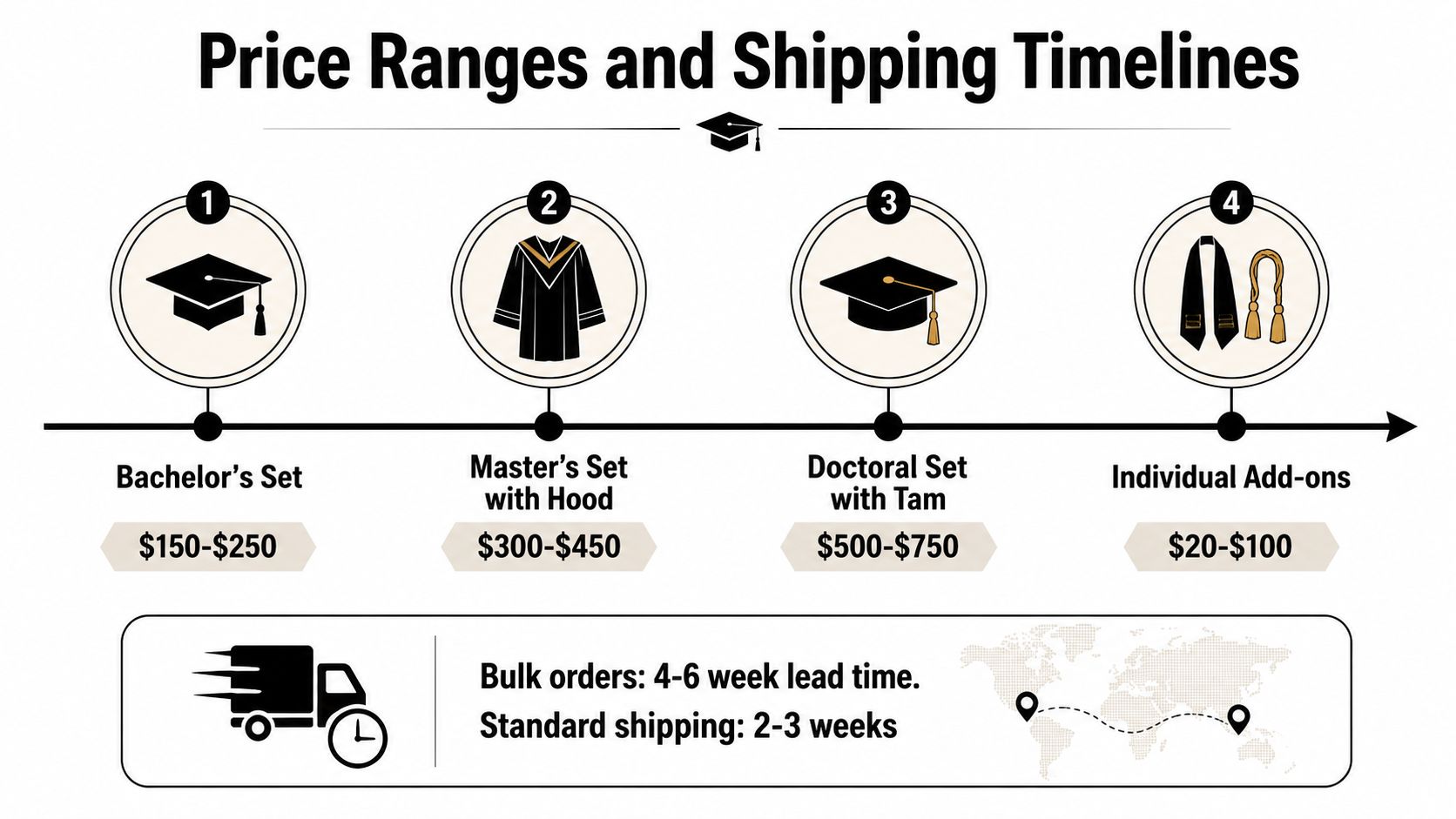
Budgeting works better when you separate the core set from optional pieces. A bachelor's package generally centers on the gown, cap, and tassel. A master's package may add a hood, while doctoral regalia can include a more formal gown and tam. Stoles, cords, diploma covers, frames, garment bags, and year date drops should be treated as separate accessory decisions unless the product description clearly includes them.
The market supports both low-cost synthetic garments and more substantial fabric options. Polyester remains common because it offers standardized sizing, color consistency, and a crisp appearance at a lower unit cost. If comfort or photography matters more than the lowest initial price, compare the fabric description and construction details rather than assuming every black gown feels the same.
Build the order around the deadline
For an individual order, check whether each piece is in stock, made to order, personalized, or eligible for expedited shipping. A ready-to-ship cap may arrive sooner than an embroidered stole, so placing both in one cart doesn't guarantee that they'll follow the same timetable.
Bulk buyers should prepare a consolidated list. Student government associations, honor societies, Greek chapters, schools, and departments can simplify fulfillment by collecting each wearer's height, degree, color requirements, and accessory choices before placing the order. Ask about quantity pricing, production windows, packaging, exchanges, and whether sizes can be adjusted after the order is submitted.
Before paying, confirm three dates: the last order date, the estimated ship date, and the ceremony delivery deadline.
For last-minute orders, ask directly whether rush production, expedited delivery, or in-stock substitutions are available. Confirm the return window before adding custom embroidery or printed names because personalized products may have different return conditions.
The global academic regalia market was valued at $1.2 billion in 2024 and is projected to reach $2.1 billion by 2033, a projected 6.5% compound annual growth rate, according to MarketIntelo's academic regalia market report. A separate graduation gown study estimates a $1.2 billion global market in 2025, projected to reach $1.7 billion by 2034 at a 4.2% CAGR. It also places bachelor's gowns at 48.5% of 2025 market share, or about $582 million, and Asia Pacific at 38.2% of revenue. (Graduation gown market study) These figures point to a recurring, multi-market category, but they don't replace the product-specific delivery estimate you need for your ceremony.
Watch the video for a visual overview of common regalia components and ordering considerations.
Buy Versus Rent and Other Smart Last-Minute Decisions
Renting can make sense when you need regalia for one short ceremony and have no reason to keep it. Buying becomes more attractive when the graduate wants a keepsake, expects another academic ceremony, plans to pass the gown to a sibling, or wants control over the fit and accessories.
A high-school senior may prefer a rental if the school provides a coordinated class order and personal customization isn't allowed. A first-generation college graduate may choose to buy a stole and gown because the pieces carry family meaning. A parent attending a doctoral hooding may value ownership if the regalia will be used for future academic events or professional photographs.
Sustainability adds another question. A university program described by Circular Thrift offers free borrowing and asks graduates to donate used gowns, while another circular-thrift program collects, cleans, and recirculates regalia through rental. A major supplier also says gowns made with recycled materials can keep dozens of bottles from landfill per gown. The practical issue is reuse. Ask how many times a rented garment is recirculated, how it's cleaned, and what happens when it reaches the end of its service life.
| Factor | Buy Regalia | Rent Regalia |
|---|---|---|
| Ownership | You keep the garment and accessories | You return the set after the ceremony |
| Reuse | Suitable for future ceremonies, family members, or resale | Depends on the rental provider's program |
| Personalization | Easier to add approved stoles, embroidery, or keepsakes | Customization may be limited |
| Fit control | You can exchange or alter before the event | Available sizes may be restricted |
| Last-minute flexibility | In-stock items may be purchased quickly | Rental availability may depend on stock and return cycles |
| Environmental question | Reuse matters if you wear or pass it on | Circularity depends on cleaning and recirculation practices |
If the deadline is close, check whether expedited shipping is still available, whether an in-store pickup option exists, and whether the cap or gown can be altered locally. Don't order a personalized item after the seller's production cutoff without confirming that it can arrive before the ceremony.
Your Quick-Reference Ordering Checklist and Last-Minute FAQ
Use this checklist before you place an order:
- Verify Degree Level: Confirm whether you're buying associate, bachelor's, master's, or doctoral regalia.
- Match University Colors: Use the official commencement instructions or a university-specific collection.
- Take Accurate Measurements: Record height, chest, and head circumference using the product's chart.
- Choose Fabric and Style: Compare synthetic, matte, or more structured options for comfort and appearance.
- Select Stole and Cords: Confirm which cultural, identity, honor, or organization pieces the ceremony allows.
- Confirm Bulk Order Count: Gather every wearer's size and accessory information before submitting a group order.
- Check Shipping Deadline: Review production, shipping, personalization, exchange, and return terms.
Last-minute questions
How do I verify my school's official colors?
Check the commencement office's instructions first, then use the degree-level guidance and university search process described above. Don't rely only on a logo or a photograph from a previous ceremony.
What should I do if my gown arrives wrinkled?
Hang it and use gentle steaming if the care instructions permit it. Avoid applying direct high heat until you've checked the fabric guidance.
Do honor cords ship separately?
They can. Review the order confirmation and shipment tracking for separate fulfillment, especially when cords are added to a gown package.
How can I fix a tight mortarboard?
Check whether the cap has an adjustable band. If it doesn't, contact the seller quickly about an exchange, and avoid stretching the board or damaging the stitching.
Where can I find a replacement tassel?
Look for an individual tassel matching your degree and school requirements. Confirm the color before ordering because discipline and university conventions can differ.
Can international students ship regalia overseas?
Ask the retailer about international destinations, customs handling, delivery estimates, and return arrangements before purchasing. Personalized pieces may require extra planning because they can't always be returned or replaced quickly.
Graduation Cap and Gown offers a Find Your University tool, degree-specific bachelor's, master's, and doctoral collections, complete packages, individual pieces, custom and cultural stoles, honor cords, hoods, tams, and last-minute and bulk-order options. Visit Graduation Cap and Gown to match your school and degree, confirm sizing and colors, and order the regalia and accessories your ceremony requires.