

You're ready to order your graduation outfit, but the cap & tassel listing leaves you wondering: does it include the gown? Is that gold tassel right for your degree? And which side should it hang on when you walk into commencement?
Those questions are understandable because schools don't all follow the same rules. The safest approach is to check your university's instructions first, your degree level next, and your field of study after that. That order helps you choose the right pieces without mistaking a familiar tradition for a universal requirement.
What a Cap and Tassel Set Includes at Each Level
Choose your academic level before choosing a set. If you've opened a cap & tassel listing and can't tell whether a gown, hood, or tam comes with it, check the itemized contents rather than relying on the photograph.
The cap, usually called a mortarboard, has a rigid square top over a softer skullcap. The tassel is the dangling ornament, typically made of silk or similar material, whose loop attaches at the top of the cap. Neither term, by itself, means that a gown or hood is included.
Components of a cap and tassel set by degree level
Syracuse University's regalia requirements distinguish undergraduate, master's, and doctoral outfits, including an eight-sided tam with a gold tassel for its doctoral graduates.
| Level | Headwear | Tassel | Other pieces |
|---|---|---|---|
| Bachelor's | Mortarboard | Silk or similar tassel | Gown; some retail packages add a hood |
| Master's | Mortarboard | Silk or similar tassel | Gown and hood |
| Doctoral | Tam, eight-sided at Syracuse | Gold tassel at many schools | Doctoral gown and hood |
High school and pre-K sets are generally built around a cap, tassel, and gown rather than the university hood system. For university graduates, the hood and headwear deserve particular attention because they aren't interchangeable across levels.
A doctoral graduate who buys a bachelor's mortarboard package, for example, could receive a perfectly usable outfit that still lacks the required tam. A bachelor's package containing a hood presents a different question: whether that hood belongs in the graduate's own ceremony.
Purchase check: A complete retail package is complete only for the contents listed, not automatically for your school's commencement requirements.
Before ordering, confirm:
- Degree level: Match the listing to the qualification being awarded.
- Gown: Check that it's included and appropriate for the ceremony.
- Hood: Confirm whether your school requires one.
- Headwear: Look specifically for a mortarboard or tam.
- Tassel: Verify inclusion rather than assuming it comes attached.
Graduation Cap and Gown organizes bachelor's, master's, and doctoral ordering separately by level, so start with that distinction.
Where the Tassel Goes Before and After the Degree Is Conferred
At many schools, bachelor's candidates start with the tassel on the right and move it left only when instructed after conferral. Master's and doctoral candidates often wear it on the left throughout. Your own school's ceremony instructions take priority over either convention.
The University of Miami's commencement FAQ makes that distinction explicit: bachelor's candidates move their tassels after degrees are awarded, while master's and doctoral candidates wear theirs on the left throughout.
Tassel side before and after conferral by school and level
| Institution | Degree level | Before conferral | After conferral |
|---|---|---|---|
| Valdosta State | Bachelor's | Right | Moved to left |
| Western Governors University, 2026 Anaheim guidance | Bachelor's | Right | Confirm the ceremony's transition instructions |
| Western Governors University, 2026 Anaheim guidance | Master's | Left | Left throughout |
| University of Miami | Bachelor's | Right | Moved to left |
| University of Miami | Master's and doctoral | Left | Left throughout |
| Southern Illinois University | Undergraduate | Right | Follow the conferral cue |
| Southern Illinois University | Graduate | Left | Left throughout |
| Schools that say not to move it | Any | Stays where instructed | Stays where instructed |
The important difference isn't just right versus left. It's whether your ceremony includes a tassel transition for your degree level.
Valdosta State's guidance describes the right-to-left transition. Western Governors University's Anaheim guidance distinguishes bachelor's candidates from master's graduates, showing why a graduate shouldn't copy someone wearing a different type of regalia.
This timeline illustrates the common pattern, subject to school instructions.
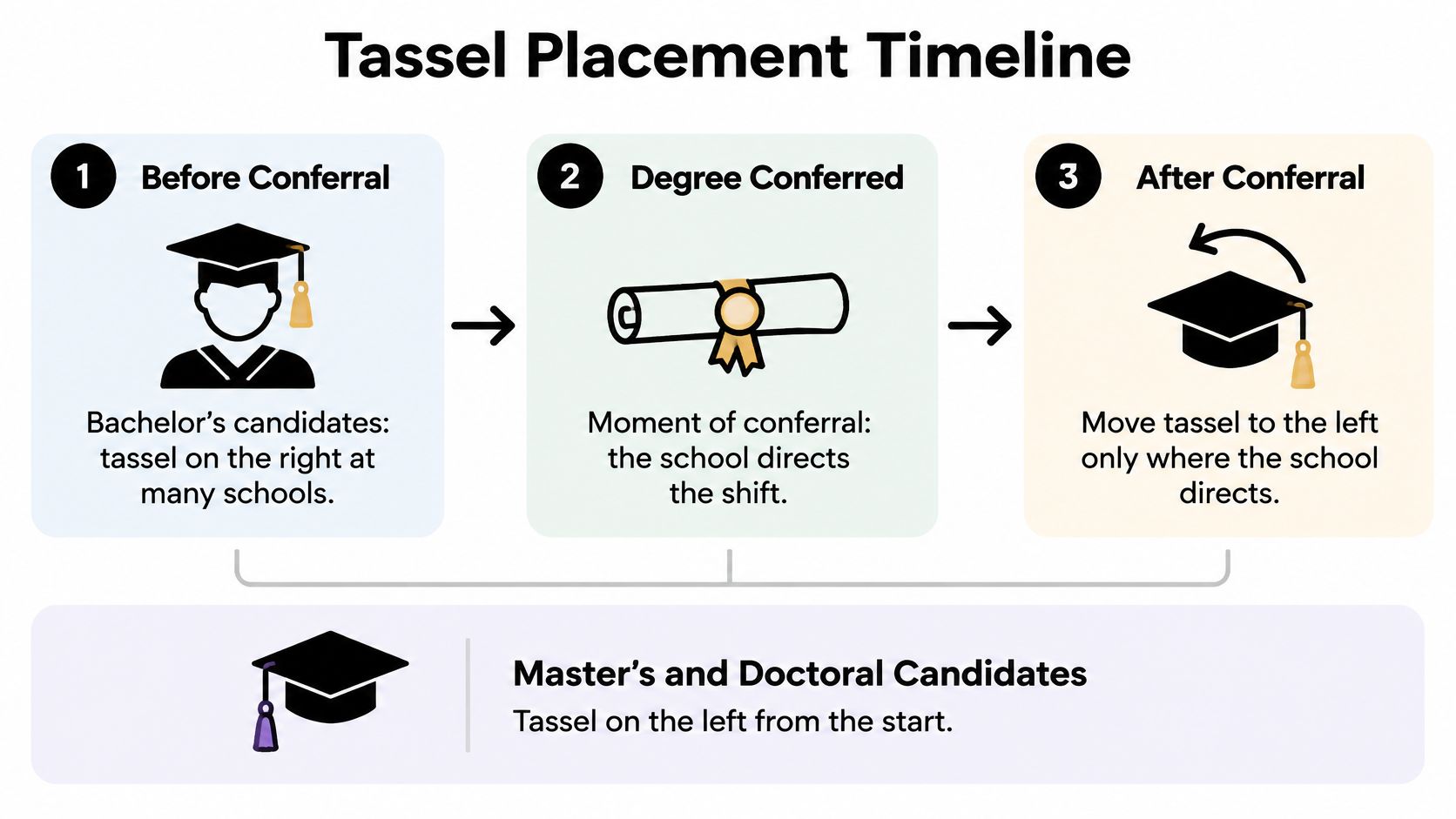
A calm ceremony-day routine
- Read your school's instructions. Use the guidance for your actual ceremony, not another university's photographs.
- Identify your degree level. Check whether your group participates in a conferral transition.
- Set the starting side. Position the tassel before joining the procession.
- Wait for the official cue. Don't move it merely because you've crossed the stage or received a diploma cover.
- Follow cap etiquette. Southern Illinois University directs graduates to wear the board horizontally, with its point centered at the front, and to keep the cap on except during the National Anthem.
At William & Mary, the collective transition happens at the president's instruction, as its commencement regalia guidance explains. That makes the movement a coordinated ceremony action, not an individual choice about timing.
If your school tells you not to move the tassel, leaving it in place is correct. You haven't missed a required graduation ritual.
What Tassel Colors Signal by Field and Degree
Choose tassel color by university first, degree level second, and field third. Color can identify a discipline, an academic level, or school affiliation, so selecting it by major alone can produce the wrong result.
The American academic-dress system was standardized by the 1895 American Intercollegiate Commission at Columbia University, a milestone described in the Congressional Research Service's history of academic regalia. That shared history doesn't mean every university now uses identical tassel colors.
Tassel colors by field at two universities
| Field | University of South Carolina | UW Bothell |
|---|---|---|
| Business | Drab | Royal blue |
| Arts and humanities | White | Not listed in this comparison |
| Computer science and science | Golden yellow | Golden yellow for sciences |
| Education | Light blue | Not listed in this comparison |
| Engineering | Orange | Orange |
| Fine arts | Brown | Brown |
| Medicine | Green | Not listed in this comparison |
| Music | Pink | Not listed in this comparison |
| Nursing | Apricot | Apricot |
These examples show both agreement and variation. Engineering, fine arts, nursing, and sciences align across the listed conventions, but business does not. An omitted field also isn't permission to choose a color by analogy.
Different tassels can look equally appropriate in a photograph while carrying different academic meanings.

When degree rules override field colors
UW Bothell specifies black tassels for master's candidates. The University of Texas at Arlington's academic-dress history also identifies gold as a traditional option for a doctor's cap.
UTSA's regalia guidance demonstrates another distinction: graduate discipline colors operate alongside doctoral gold bullion tassels, while bachelor's candidates may wear university tricolor tassels.
Consider a science doctoral graduate whose school associates science with golden yellow. That graduate still needs to check whether the doctoral gold rule replaces the discipline color.
Use our graduation tassel color meaning guide to understand the terminology, then apply your school's specific rule. Don't treat a general color chart as final authorization for commencement.
Cap Styles, Tassel Types and How the Board Fits
The soft headband, not the rigid square board on top, decides whether a mortarboard stays in place. Washington State University's regalia documentation describes the board, central button, silk cord, and multi-thread tassel, while noting that cord and tassel lengths can vary by academic level.
The board works like a picture frame resting on a hat: it can look perfectly level while the band underneath slides around. Learn the parts first, then compare styles.

Cap styles and tassel types compared
| Option | What it is | Common use | Fit or size note |
|---|---|---|---|
| Standard mortarboard | Rigid square board over a soft headband | Bachelor's and most master's wear | A loose headband lets the board shift |
| Four-sided tam | Black velvet tam with a fuller top | Usually master's degrees | Fit by headband circumference |
| Six-sided tam | Black velvet tam with six sides | Doctoral, depending on university | Fit by headband circumference |
| Eight-sided tam | Black velvet tam with eight sides | Doctoral, depending on university | Fit by headband circumference |
| Jumbo bullion tassel | Extra-thick bullion tassel | College tams | Confirm level-appropriate length |
| Solid, two- or three-color tassel | Tassel in a single color or combination | School or discipline colors | Confirm the exact combination |
Tams are made from black velvet with a poof-style top, and they generally carry a gold bullion tassel rather than one in school colors. Our explanation of what a graduation tam is helps you tell the shapes apart before you select headwear.
The WSU documentation also describes a metallic gold cord-and-tassel combination for doctoral wear. Gold tassels are still not interchangeable: thickness, length, and attachment all have to match your school's requirements.
For a visual reference while preparing your regalia, use the video below.
Check the fit rather than reshaping the board
Measure your head circumference around the forehead and compare it with the size guide before ordering. Then check the fit in this order:
- Band security: It should feel snug without sliding.
- Board position: It should sit level rather than tip backward.
- Tassel clearance: It should hang freely without lying across your face.
If the band fails the first check, select the size matching your measurement rather than trying to bend the board into a better fit. Doctoral buyers should also confirm that their required tam and tassel are supplied together.
Decorating a Cap Within School Policy
Your school sets the decoration rules, so read its policy before you buy supplies. Kansas State, for instance, allows decoration only on the flat top of the cap and prohibits political references, three-dimensional objects, flowers, lights, and dangling materials under its graduation cap guidelines.
Expect other schools to draw the line somewhere else. Some limit how high decorations may rise above the board, some restrict loose glitter, lights, or certain wording, and some allow designs that others would refuse. There is no shared national standard, which is why a friend's approved cap at another university proves nothing about yours. The only reliable answer comes from your own institution's current commencement policy.
Check the decoration, not just the message
- Three-dimensional elements: Check height limits and whether raised objects are permitted at all.
- Lights: Verify electrical and distraction restrictions before planning an illuminated design.
- Loose glitter: Distinguish loose material from a fixed decorative finish.
- Political messages and slogans: Read the wording restrictions rather than assuming a respectful message is automatically allowed.
- Cultural symbols: Ask whether personal or identity-based adornments require advance approval.
- Dangling items: Confirm whether anything may extend beyond the edge of the board.
These rules exist for practical reasons as much as appearance. A raised decoration can block the view of the graduate seated behind you, and hanging pieces can catch on a neighbor's gown in the processional line.
Leave the tassel attachment usable
Keep the central button accessible and leave room for any required tassel movement. A design that covers the attachment point can make an otherwise compliant cap hard to wear correctly.
Before buying supplies: Save your school's current policy and compare each planned material against it, item by item.
Our guide to decorating a graduation cap walks through design ideas, but your institution has the final word on what enters the ceremony. Find the current commencement policy on its website before gluing anything down, since rules can change between academic years.
If a design fails inspection, officials may require its removal or replacement on ceremony day. Reading the policy first is far easier than rebuilding your cap while classmates line up.
Order the Right Set for Your Level
Order a complete package when you need the whole outfit; order individual pieces when you already own regalia your school accepts. That is the short answer. Whichever route you take, verify in the same order you would check a tassel color: your school's rules first, your degree level second, your field of study third.
A package reduces the number of separate selections, but you still confirm its contents piece by piece. Individual pieces make sense when you are replacing a missing tassel or when an approved gown and hood are already hanging in your closet.

Match the order to the ceremony
Start with your school's official commencement or regalia page, since it states which colors and components your ceremony requires. Then compare that list against the tassel options on the Graduation Cap and Gown site, which include Solid Color, Two Colors, Three Colors, Jumbo, Kente, and LGBTQ types. Separating the required ceremony tassel from any keepsake you choose for yourself prevents a common mix-up at checkout.
Bachelor's cap, gown, tassel, and hood packages can be customized and purchased with a click. Check the cap size against your head measurement, and confirm each component matches your degree level rather than selecting by appearance alone.
Doctoral orders deserve extra attention on headwear. Four-sided tams usually belong to Master's degrees, while six and eight sided versions serve Doctor's degrees depending on the university's preference.
The cap and gown ordering guide walks through measurement and checkout in more detail.
Count custom orders before choosing them
Group coordinators should settle quantities before committing to customization. Customized tassel colors require a minimum of 10 pieces, while customized year date drops require a minimum of 100 pieces.
- Individual graduates: Confirm level, required color, and fit before checkout.
- Group organizers: Separate standard selections from custom requests and count each accurately.
- Returning graduates: Compare existing pieces with the new ceremony requirements before replacing them.
Once those details agree, place the order for your level. You will have a clear checklist when the parcel arrives and fewer decisions left for commencement morning.
Graduation Cap and Gown offers complete academic-regalia packages and individual caps, tassels, hoods, and tams for different graduation levels. Visit Graduation Cap and Gown with your school's requirements and measurements ready, then choose the pieces that match your ceremony.