

Three weeks before commencement, a graduation coordinator discovers that the honor-cord order was never approved. The supplier needs the colors, quantity, artwork, and delivery date, while the registrar still has a changing honors list and the commencement committee hasn't confirmed which organizations may wear cords. A small accessory has suddenly become a procurement, branding, and academic-policy problem.
That's why custom honor cords should be planned alongside gowns, diploma orders, and ceremony programs, not added after the main regalia order. The right purchase has to meet institutional rules, reproduce approved colors closely, arrive on schedule, and remain readable when graduates wear several recognition pieces at once.
Why Custom Honor Cords Are a Buying Decision
A cord worn at commencement communicates institutional recognition. It can identify Latin honors, departmental honors, an honor society, leadership, or another approved distinction. Some universities assign exact colors and restrict cords and stoles to designated purposes, as shown in Simmons University's commencement cord and stole policy.
A registrar or commencement committee usually controls that decision. Student affairs may review organization-related regalia, academic affairs may confirm honor categories, and purchasing staff may require an approved supplier or purchase order. If a group orders a cord independently, the product can still be prohibited at the ceremony.
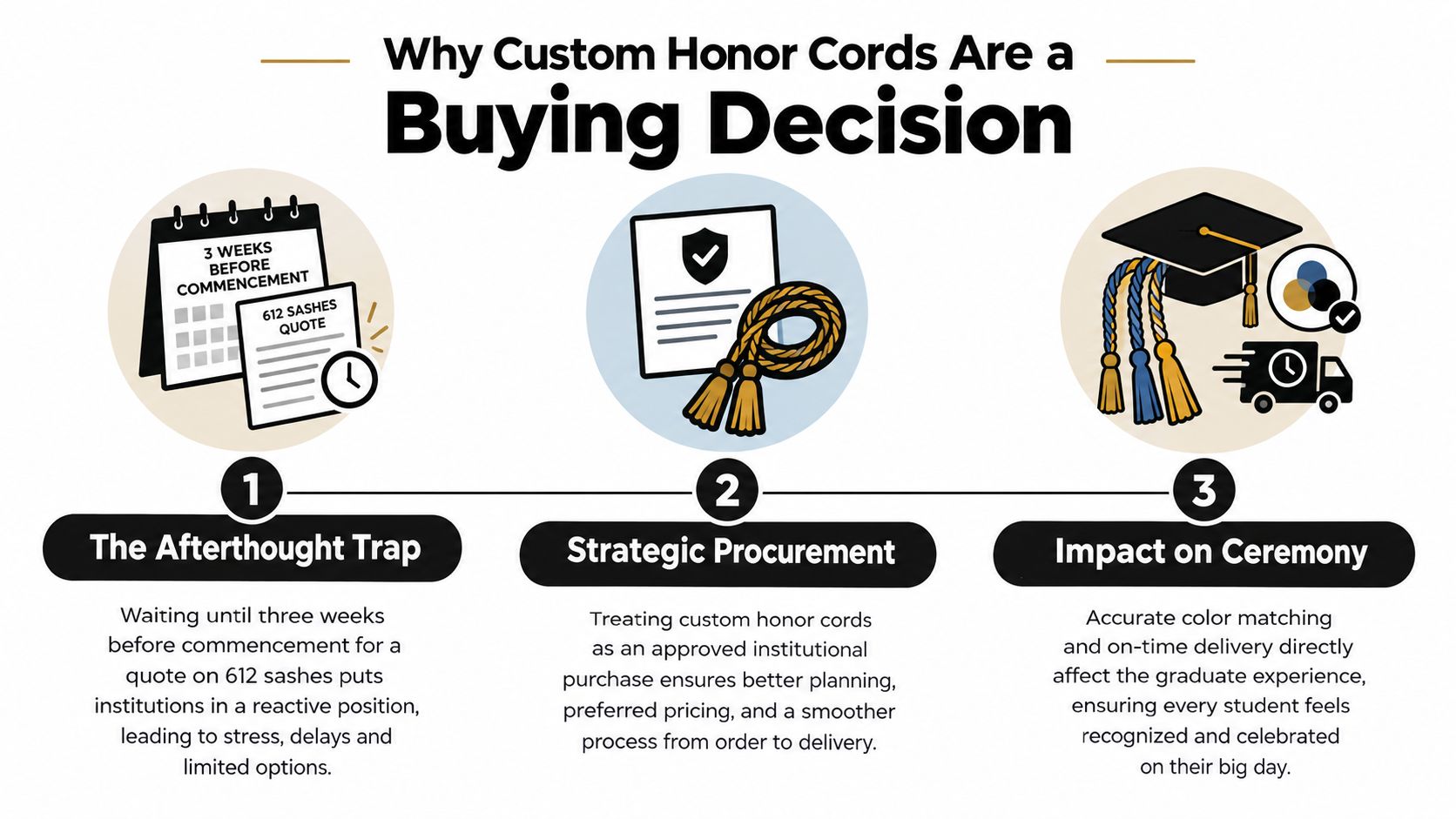
The afterthought trap
The most common failure isn't a dramatic manufacturing defect. It's a late decision. A coordinator may need cords for a modest honors cohort, but a supplier's minimum order can exceed the actual group size. The result is excess inventory, a delayed quote, or a rushed substitution.
Color creates another risk. A gold cord that looks acceptable on a screen may clash with the school's approved tassel or gown trim under stage lighting. Suppliers often approximate textile colors rather than reproduce a perfect laboratory match. One manufacturer describes PMS matching as “as close as available”, and custom runs may require minimum quantities such as 12 units or 100 cords, depending on the construction and color combination, according to Jinsheu's custom honor cord options.
Treat the cord as controlled regalia
A school should decide four things before requesting production:
- Who approves it: Identify the registrar, commencement office, academic affairs contact, or student organization office with final authority.
- What it represents: Tie each color or combination to a defined recognition category.
- Where it may be worn: Confirm whether graduates may wear it with a hood, stole, medallion, or other approved item.
- When the request is due: Some institutions require approval as early as 30 days before commencement, while others use fixed fall or spring deadlines, as demonstrated by Kansas State University's regalia guidelines.
Practical rule: If the cord needs institutional approval, the approval date belongs on the same project calendar as gown rentals and diploma production.
A late order can create mismatched colors, unapproved symbols, incorrect quantities, or no usable replacement window. Custom honor cords aren't party decorations. They're wearable policy decisions that happen to appear in every graduate photograph.
What a Custom Honor Cord Actually Is
A custom honor cord is a graduation accessory made from twisted or braided strands and worn over academic regalia. It differs from a stole or sash, which is a broader fabric piece worn over the shoulders. The buyer can specify the cord's color combination, strand arrangement, finished length, tassels, and sometimes tags, charms, or other identifying details.
The tradition reaches back to academic dress at medieval European universities during the 12th and 13th centuries, when scholars wore long robes for practical reasons and institutional distinction. In the United States, the broader system was formalized through the Intercollegiate Code of Academic Costume in 1895, which standardized caps, gowns, hoods, and related conventions that many schools still follow, according to this history of graduation honor cords, stoles, and hoods.
Custom versus stock
The dividing line is simple. A stock cord usually comes in a supplier's established color and construction, with a standard tassel and no organization-specific treatment. A custom cord changes the specification, whether that means two school colors, a braided pattern, an unusual shade, or a commemorative tag.
| Feature | Stock Cord | Custom Cord |
|---|---|---|
| Color | Standard catalog shade | Selected combination or made-to-spec shade |
| Construction | Existing strand and twist pattern | Specified strand count, twist, or braid |
| Identification | Usually no custom identifier | Optional tag, charm, or approved detail |
| Quantity | Often available in smaller quantities | May carry a minimum order requirement |
| Approval | May already fit standard regalia | Usually needs institutional review |
A common use is GPA-based recognition. One university example assigns gold braided cords to Summa Cum Laude at a 3.95-4.00 GPA, Magna Cum Laude at 3.75-3.949, and Cum Laude at 3.50-3.749, while another university example describes cords as recognition for academic excellence, departmental honors, honor society membership, and leadership distinctions, as documented in The Pomp Behind the Circumstance.
Custom matters because a school's approved identity system rarely fits every stock catalog. A two-color braid may be the clearest way to distinguish a department. A metal charm may identify a recurring program. The form stays familiar, but the specification becomes institutional.
Materials, Length, and Construction Choices
Cord construction affects how the item hangs, photographs, and survives handling. Suppliers commonly use synthetic yarns such as rayon and polyester. Typical builds include two spun rayon strands twisted evenly or braided polyester yarn, according to this technical guide to graduation honor cords.
Choose the strand structure first
Two strands create the familiar undergraduate appearance. More strands can produce a fuller visual effect, but they may add weight and make multiple cords harder to separate on the gown. The buyer should approve the strand count with the school's stacking policy, not choose it only from a product photograph.
Twisted and braided constructions behave differently. A tighter twisted cord tends to lie flatter and present a cleaner line. A braided multi-strand build can offer a more substantial appearance and may hold a decorative treatment more securely. Both should be checked against the gown fabric and any stole or hood the graduate will wear.
Specify the yarn and finish
Rayon provides the conventional sheen associated with many honor cords and generally accepts dye cleanly. Polyester is a practical choice where durability matters, though its appearance can be slightly less glossy. Metallic or bullion blends create a premium effect, but they can feel rougher against the neck and may require additional production time.
End finishing matters as much as the body of the cord. Suppliers commonly produce cords with finished bodies around 59-68 inches and tassels of about 4 inches at each end, according to Custom Grad Tassel's honor cord specifications. Other product listings show a total length pattern of 60 inches, including 52 inches of cord and two 4-inch tassels, or 70 inches, including 62 inches between tassels and two 4-inch tassels, as shown by Senior Class Products' silver-grey honor cord listing.
| Variable | Options | Best For |
|---|---|---|
| Strand count | Two, three, or more strands | Matching institutional appearance and layering needs |
| Yarn | Rayon, polyester, metallic or bullion blend | Sheen, durability, or premium presentation |
| Body construction | Twisted or braided | Flatter drape or stronger visual structure |
| Finished length | Standard supplier length or approved custom length | Consistent fit across the graduating group |
| End treatment | Yarn, bullion, metallic, bound tip | Coordinating with gown tassel weight |
Don't approve length from a product title alone. Ask whether the listed measurement includes the tassels, then request the finished specification on the purchase order. For available styles, compare Graduation Cap and Gown's honor cord collection with the school's approved regalia requirements before selecting a custom build.
Color Symbolism and Matching School Branding
Color should answer a recognition question before it answers an aesthetic one. Gold commonly signals academic excellence, crimson can indicate achievement, blue often appears in honor society or institutional recognition systems, and white can represent a high academic distinction or a clean record. Those associations aren't universal rules, so the school's written policy controls.
A university may use a tiered system for Latin honors. Memphis University, for example, states that cords represent undergraduates with GPAs ranging from 4.0 to 3.25, with white for distinction, red or crimson for high distinction, and gold for highest distinction, according to its commencement cord and stole policy. Another institution may assign different colors, so coordinators should never publish a universal color chart as though it applies everywhere.
Match the brand without promising perfection
Submit the school's official PMS Solid Coated reference when requesting a quote, but treat it as a target rather than a guarantee. Yarn, dye lots, sheen, metallic content, and stage lighting can alter the perceived result. A supplier may get close to an approved color without producing an exact textile equivalent.
That limitation matters for recognizable palettes. Stanford cardinal red, Michigan maize and blue, and LSU purple and gold each create different coordination problems when placed beside black gowns, colored hoods, or satin stoles. The cord should support the complete regalia system rather than compete with the gown tassel or embroidered stole.
Color approval should happen on a physical sample whenever possible. A screen image is a reference, not a production standard.
| Cord Color | Common Meaning | Representative Use |
|---|---|---|
| Gold | Academic excellence or highest distinction | Latin honors or broad academic recognition |
| Crimson or red | Achievement or high distinction | Institutional honors tiers |
| Blue | Honor society or academic affiliation | Society or department recognition |
| White | Distinction or academic recognition | A defined honors category |
| Two-color combination | School, department, or organization identity | Approved institutional braid |
For a practical explanation of common associations, use this honor cord color guide and meanings, then confirm every color with the institution before production. Cultural and identity recognition may use stoles, cords, or a coordinated combination, but those pieces still need to fit ceremony policy and the school's visual standards.
How Many Cords Can a Graduate Wear
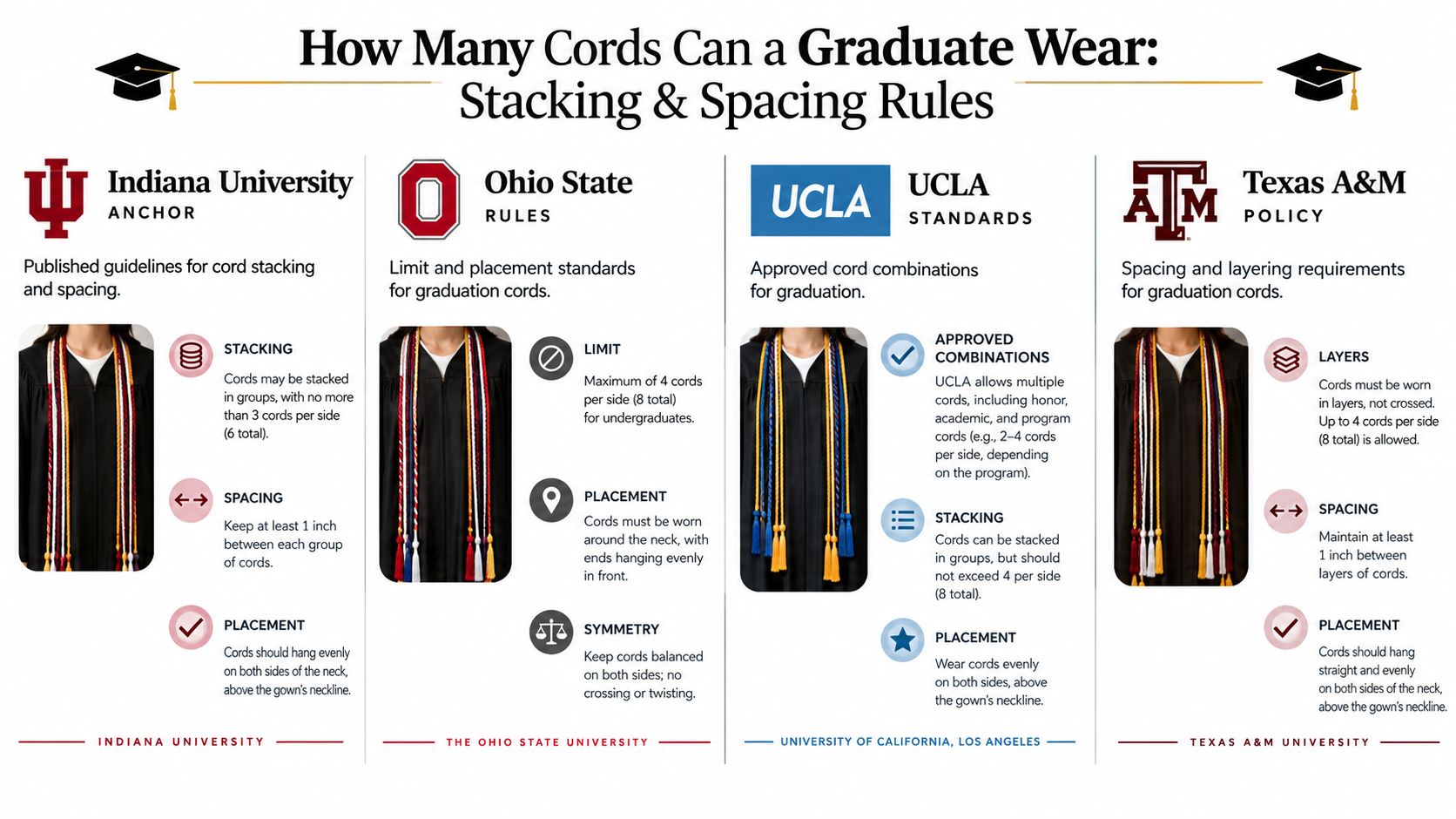
There isn't one universal stacking rule. Some institutions allow multiple cords, while others limit the number of adornments or require specific placement with a hood and stole. A coordinator should publish the local rule in the commencement instructions instead of leaving graduates to interpret photographs from another university.
Indiana University provides unusually precise wear guidance. It directs the wearer to pin the cord to the left shoulder, halfway between the shoulder seam and collar, with the loop over the outside of the sleeve so two cords hang in front and two hang in back. It also states that the arm shouldn't go through the loop, as explained in Indiana University's honor cord instructions.
Build a readable order
For graduates wearing several approved pieces, the coordinator should decide whether cords sit side by side or layer over a stole. Academic honors generally deserve the clearest position, while organization or identity recognition can remain visible without covering the primary distinction. A hood changes the available space, so the final arrangement should be tested on the actual gown.
Use a simple decision sequence:
- Confirm the maximum: Check whether the institution permits multiple cords and whether it limits total adornments.
- Resolve duplicates: If two organizations use the same color, approve side-by-side placement, a combined braid, or another standard solution.
- Protect visibility: Keep cords separated enough to identify their colors in photographs.
- Test comfort: Walk, sit, and cross the stage in the complete regalia set.
- Publish the rule: Include a diagram or plain-language instruction in the ceremony program.
Visual clutter is the practical problem. A graduate may qualify for academic honors, an honor society, service recognition, and cultural recognition at the same time. The school can honor all of those identities, but it shouldn't force graduates to wear an unreadable bundle that catches on the gown or obscures the hood.
Ordering Process, Lead Times, and Bulk Pricing
A reliable order starts with approval, not a product page. The coordinator should identify the approving office, document what the cord represents, and confirm that the organization or academic category is authorized to wear it. Some institutional policies require requests by fixed academic-calendar deadlines, and some limit an organization to a single approved cord, stole, or medallion request, as shown in Kansas State's regalia guidelines.
Phase one involves internal approval
Create a short approval packet containing:
- Purpose: The honor, department, society, leadership role, or identity category represented.
- Color reference: The approved brand or recognition colors, with the source of each reference.
- Visual proof: A flat drawing showing the braid, tassels, tag, and placement.
- Quantity logic: The expected eligible group, plus a plan for additions.
- Wear instructions: Whether the item may be worn with a hood, stole, or other cord.
Don't ask a supplier to solve a policy dispute. The vendor can clarify construction and feasibility, but the institution must decide what the cord means and who may wear it.
Phase two locks the specification
Submit color references, artwork, quantity, delivery address, and ceremony date together. For a crest or emblem, provide vector artwork when available and approve the digitized embroidery proof before production. Confirm whether the quoted length includes tassels, because finished cord measurements vary by supplier.
Ask the vendor to state the MOQ plainly. Custom combinations may require 12 units for some runs or 100 cords for fully custom braided combinations, according to Jinsheu's custom cord listings. Those thresholds can make a department-level order more sensible than separate small orders from each organization.
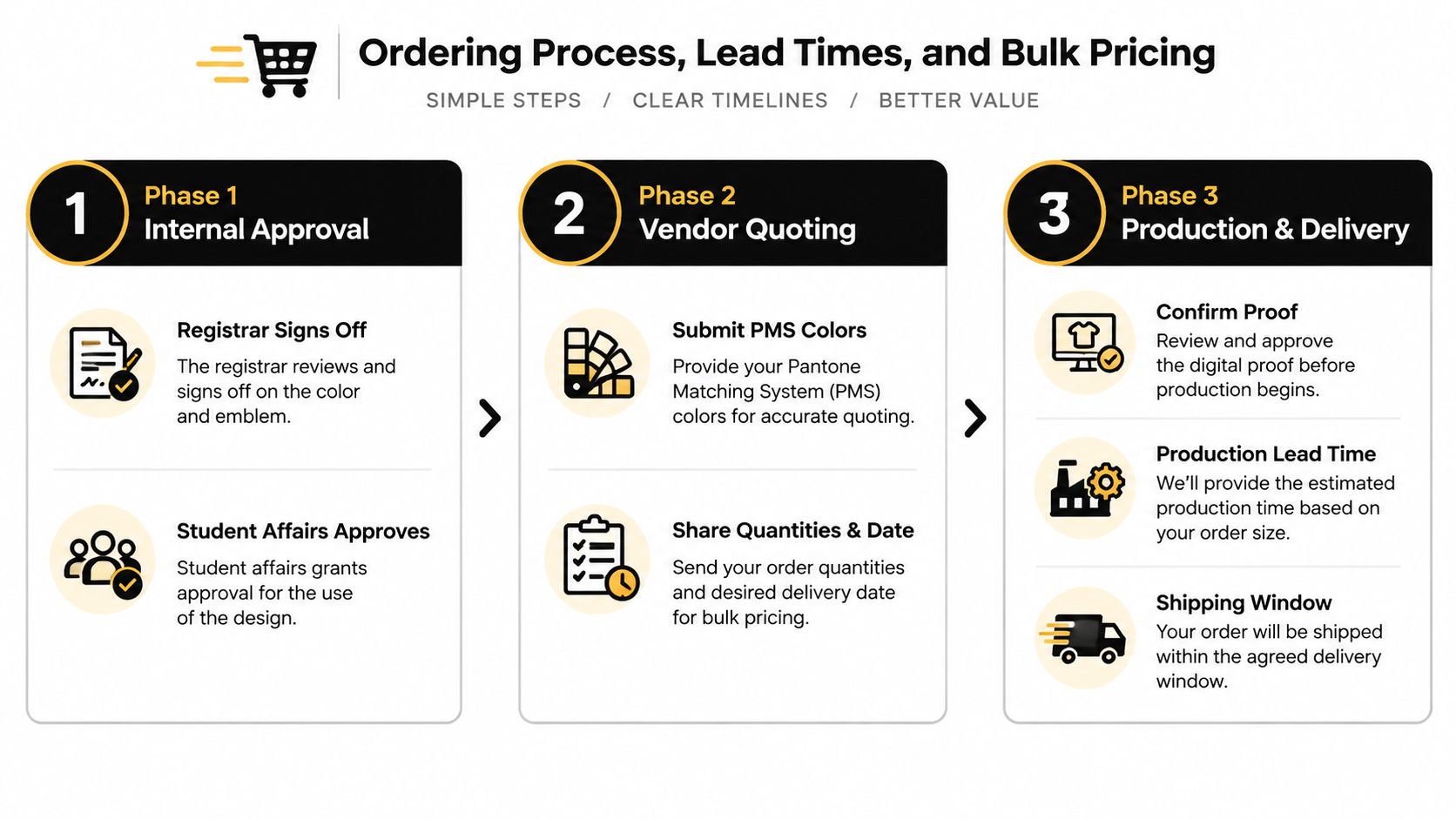
Phase three protects the delivery window
Get a written production schedule, shipping method, payment terms, sample policy, and damage-replacement process. A rush promise is not a substitute for a confirmed production slot.
Bulk pricing usually depends on quantity, construction, packaging, and setup work. Ask for separate lines for the cord, tassel, tag, artwork, sampling, packaging, shipping, and any rush service. Coordinators ordering related accessories can also review bulk graduation tassel options to keep the tassel finish consistent across the ceremony.
Before releasing production, require written confirmation of:
- Approved proof: The institution signs the final color and construction proof.
- Quantity: The supplier confirms the exact production count and any MOQ adjustment.
- Ship date: The delivery window leaves time for inspection and sorting.
- Replacement terms: The supplier explains how defects or shortages will be handled.
- Packaging: Cords arrive labeled by color, group, or distribution bundle if needed.
Coordinator Checklist for a Smooth Cord Order
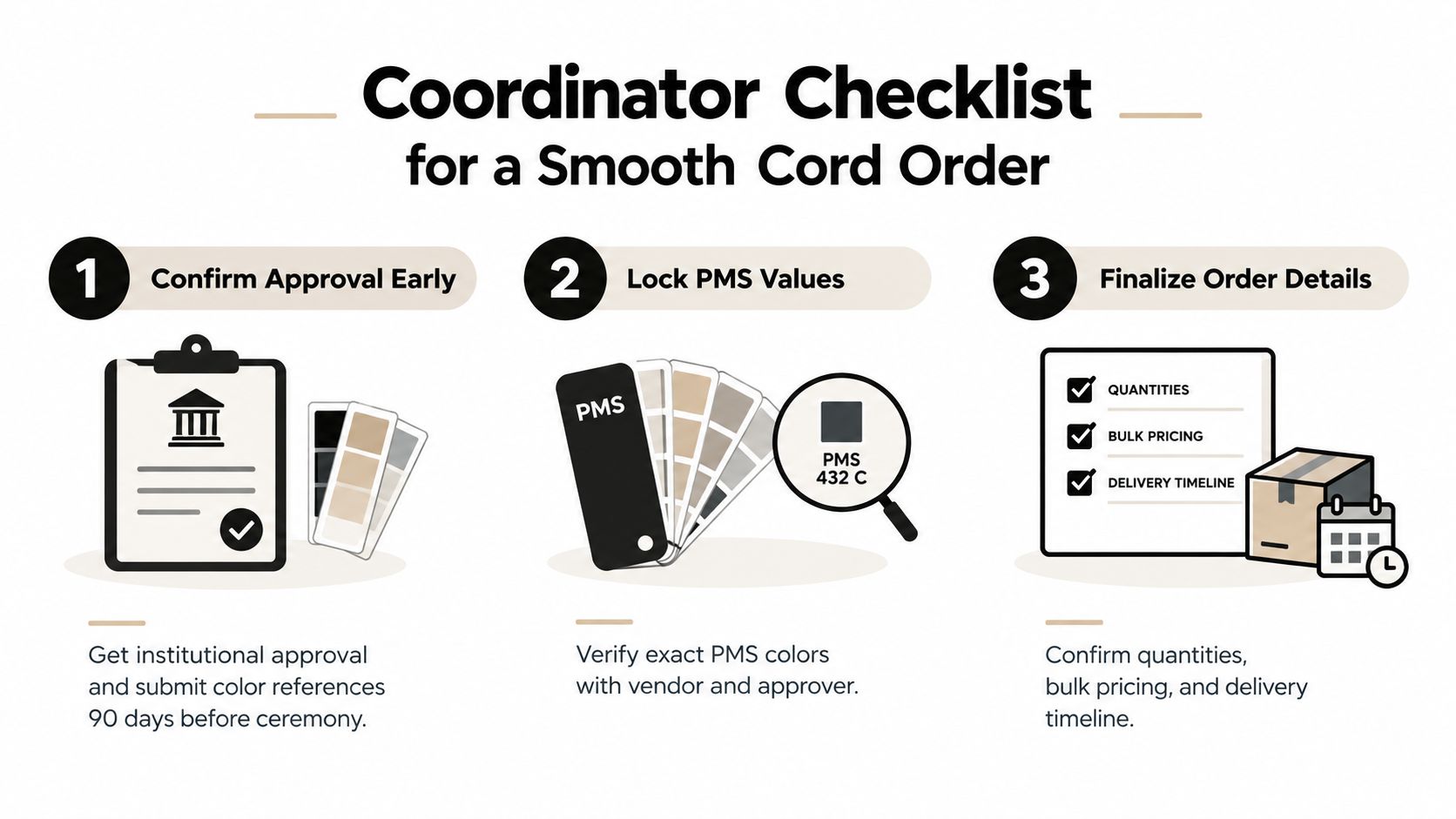
A coordinator needs one working document that connects approval, design, quantity, and delivery. Start by naming the decision owner. Then submit the color references early enough for the registrar, student affairs office, or commencement committee to review them before production becomes urgent.
The order file should contain the approved purpose, color references, construction drawing, quantity estimate, delivery address, and wear instructions. Keep the signed proof with the purchase order. If someone asks why a particular group receives a blue and gold braid rather than a solid cord, the answer should be documented, not reconstructed from email threads.
Use this buying checklist
- Confirm approval authority: Identify who may authorize each cord, stole, medallion, or organizational recognition item.
- Submit color references early: Provide school and recognition colors at least 90 days before the ceremony when the planning schedule allows.
- Verify PMS values: Compare the supplier's proposed color with both textile references and Pantone materials.
- Specify construction: Record strand count, twist or braid, finished length, tassel style, and end treatment.
- Approve artwork: Use vector artwork for logos and approve the embroidery font, dimensions, and placement on a signed proof.
- Check the MOQ: Consolidate eligible groups at the department or institution level when a small cohort cannot meet the supplier's requirement.
- Plan for additions: Hold a reorder path for late honors changes or newly approved recipients.
- Inspect a sample: Review dye-lot consistency, drape, tassel weight, and visible finishing before full production.
- Publish stacking rules: Tell graduates where cords sit, how many may be worn, and how they interact with hoods and stoles.
Do and don't
Do verify PMS colors under D65 lighting when the supplier provides a controlled comparison. Don't approve a color from a screenshot, because screen settings can change the apparent shade.
Do require vector artwork for crests and marks. Don't accept raster embroidery files under 300 dpi when the supplier needs a clear source for digitizing.
Do build a 10% overage into the order when the institution's purchasing policy and budget allow it. Don't wait for the registrar's final honors list before releasing production, because late eligibility changes shouldn't put the entire ceremony order at risk.
One-page purchase-order summary
Record these fields on the first page:
- Institution and approving office
- Recognition category and authorized wearer
- Cord colors and PMS references
- Strand count and construction
- Finished length, tassel style, and end finish
- Artwork file name and proof approval date
- Quantity, MOQ treatment, and packaging
- Unit pricing, setup charges, shipping, and payment terms
- Sample approval status
- Production date and delivery window
- Inspection contact and damage-replacement terms
- Published ceremony wear and stacking instructions
Use the broader high school graduation checklist as a planning reference, but keep the cord purchase tied to the institution's own regalia policy. A complete file prevents the most expensive mistake in graduation procurement, approving a beautiful cord that the ceremony rules won't permit.
Graduation Cap and Gown offers custom honor cords and related graduation regalia, including options for matching or combining cord colors. Review the specifications early, confirm your institution's approval requirements, and visit Graduation Cap and Gown to start a coordinated order.