

The meaning behind the colors on a doctoral hood is pretty straightforward. The velvet trim color signifies your academic discipline, while the satin lining colors represent the university that granted your degree. It's a combination that creates a unique visual story of your academic achievement, instantly telling everyone both what you studied and where you earned it.
Quick orientation before you read on: hood colors are one part of a larger academic colors system. The velvet trim on your hood codes your discipline, the tassel and gown trim follow related conventions, and stoles carry their own meanings — you can see how they connect in our guide to the meaning of graduation tassel colors. If you're earning a PhD specifically, the same discipline code applies no matter which gown style your school uses; the velvet you wear is determined by the Intercollegiate Code, not by the cut of the gown.
How We Verified These Color Standards
We built the charts below by cross-checking three kinds of sources: the Intercollegiate Code of Academic Costume as ratified in 1895, the current faculty-color listings maintained by the Intercollegiate Registry of Academic Costume, and published regalia guides from university registrars and commencement offices. Where a color entry appeared inconsistent across sources, we deferred to the registry and to registrar practice at degree-granting institutions. An entry would be disqualified if it contradicted the ACE code, existed only on retailer product pages with no institutional use, or described a degree that is no longer conferred. Two things we verified along the way are worth knowing: the original 1895 code established just eight faculty colors (white for Arts and Letters, scarlet for Theology, purple for Law, blue for Philosophy, golden yellow for Science, brown for Fine Arts, pink for Music, and green for Medicine), and the system has since expanded to 34 recognized colors, five of which were retired in 1959–1960 because the degrees they represented were rarely awarded (source).
Decoding Your Academic Story

Your doctoral hood is far more than just a piece of ceremonial attire; it's a symbolic flag representing years of intense work, research, and intellectual dedication. Think of it like a coat of arms for your academic journey. Every color and fabric choice tells a specific part of your story, instantly recognizable to anyone familiar with academic tradition. Understanding the doctoral hood colors meaning allows you to appreciate the rich history you're now a part of.
This system of colors isn't random. It's governed by a set of standards maintained by the American Council on Education (ACE), which ensures consistency across most U.S. institutions. The ACE's Intercollegiate Code of Academic Costume acts as a universal language, allowing your achievements to be understood at any graduation ceremony in the country.
The Three Core Components
To really get it, it helps to break the hood down into its three main parts. Each one plays a distinct role in telling the story of your hard-won accomplishment.
- The Shell: This is the main body of the hood, typically made of black fabric to match your doctoral gown. Its job is to provide the foundational structure and color.
- The Satin Lining: Your alma mater gets its moment to shine here. Displayed on the inside of the hood, these are the official colors of your university.
- The Velvet Trim: This is the big one for identifying your field of study. The color of this five-inch band of velvet corresponds to a specific academic discipline.
The velvet trim on doctoral hoods is a remarkably precise code. There are over 20 standardized colors laid out in the ACE's Intercollegiate Code, worn by the 180,000+ advanced degree recipients globally each year who follow U.S. regalia conventions.
For a quick reference, here's a look at some of the most common velvet colors and the fields they represent.
Quick Guide to Common Doctoral Hood Velvet Colors
This table provides a quick reference to the most common velvet trim colors and the academic fields they represent, helping graduates instantly identify their discipline.
| Velvet Color | Field of Study (Discipline) |
|---|---|
| Dark Blue | Philosophy (Ph.D.) |
| Light Blue | Education (Ed.D.) |
| Golden Yellow | Science |
| Green | Medicine (M.D.) |
| Purple | Law (J.D.) |
| Brown | Fine Arts |
| Orange | Engineering |
| Drab | Business / Commerce |
This system brings a standardized clarity to academic regalia, making each hood a clear statement of scholarly achievement.
Your hood is a visual representation of your entire doctoral experience. The velvet trim announces your expertise to the world, while the satin lining honors the institution that guided you. It is a powerful symbol of your place within the global academic community.
Graduation Cap and Gown offers doctoral regalia, including gowns, tams, and hoods. Confirm the required style and colors with your institution before ordering.
The Anatomy of a Doctoral Hood
Think of your doctoral hood as a flag that tells your entire academic story. It's not just a decorative piece of fabric; every inch of it is designed to communicate who you are as a scholar. Its precise construction, guided by long-standing tradition, sets it apart as the ultimate symbol of academic achievement.
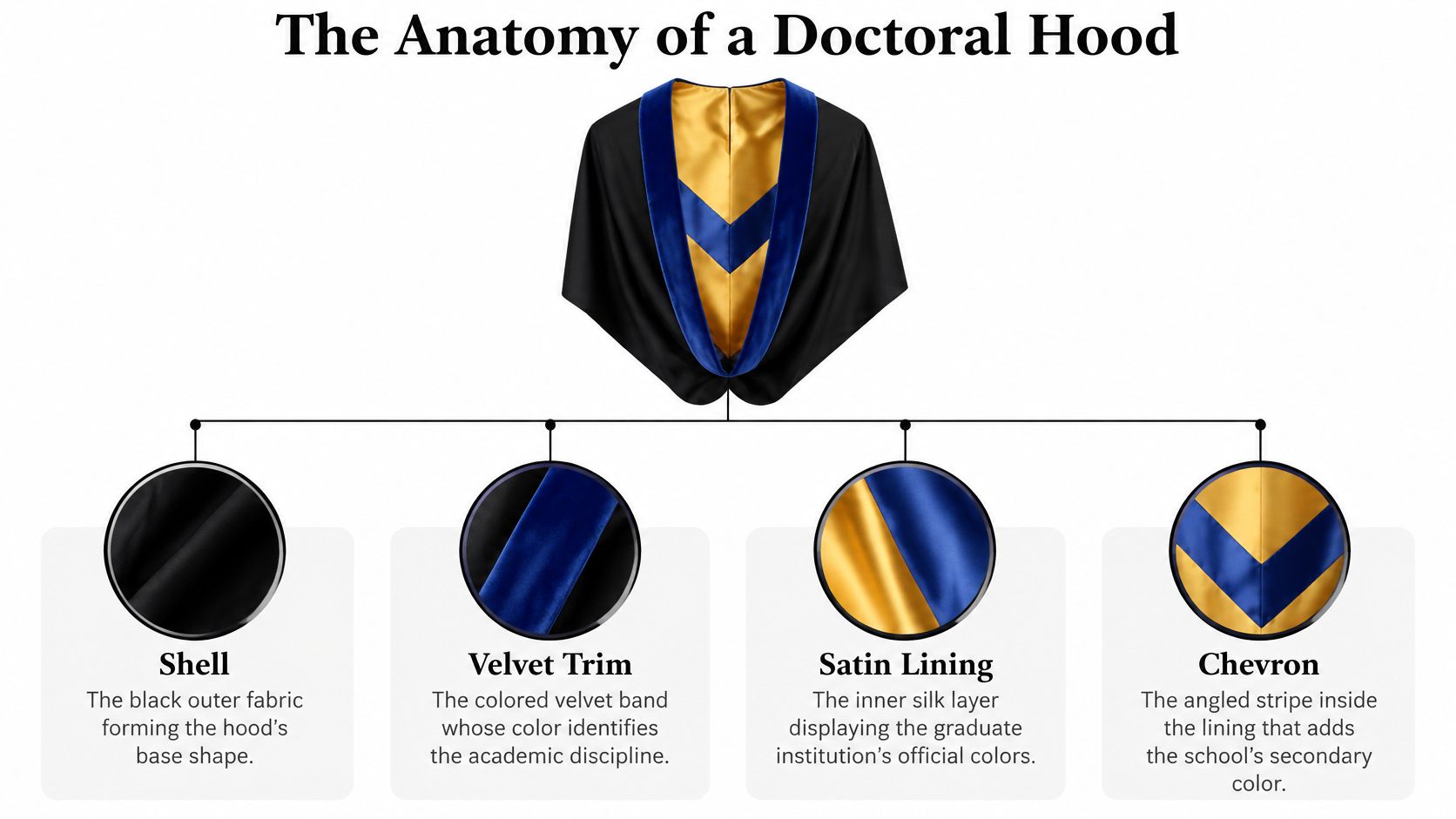
While the gown signals your rank, the hood provides the details. Each element—the shell, the velvet, and the lining—plays a specific role in broadcasting the significance of your regalia to everyone in the room.
As an editorial note, verifying the velvet and lining against registry listings before ordering is always worthwhile, since institutional records remain the definitive source for color pairings.
The Black Shell and Official Dimensions
The foundation of the hood is its black shell, which is made from the same fabric as your doctoral gown. This creates a sleek, uniform look that lets the vibrant colors of the velvet and lining really pop.
What sets a doctoral hood apart are its dimensions. According to the official academic code, a doctoral hood must be exactly four feet in length. That's a noticeable step up from the three-and-a-half-foot master's hood, visually representing the higher level of study you've completed.
The specific length and velvet width are not arbitrary details; they are the core identifiers of a doctoral-level achievement, instantly setting you apart in any academic procession.
This strict measurement ensures your regalia accurately reflects the prestige of your accomplishment. Our doctoral regalia packages include tams, gowns and hoods with premium black matte fabric and superior detail and lightweight construction, with an option to upgrade to deluxe fluting around the yoke and shoulders.
The Velvet Trim: A Symbol of Expertise
The most prominent feature of the hood is its wide velvet trim. This bold band of fabric is where your specific field of study is announced to the world. The academic code mandates this trim be five inches wide—a significant jump from the three-inch trim on a master's hood.
This extra width provides a powerful splash of color that corresponds directly to your discipline. For example, the deep, traditional blue of a Doctor of Philosophy (PhD) or the rich green of a Doctor of Medicine (MD) is displayed right here, making your area of expertise immediately recognizable.
The Satin Lining: A Nod to Your Alma Mater
While the velvet trim shows what you studied, the satin lining reveals where you earned your degree. The colors on the inside of the hood are the official colors of your university or college. This is usually displayed with one primary color and a secondary color forming a chevron, or V-shape.
This combination creates a unique design for each institution, serving as a tribute to the academic community that supported you. When you wear the hood correctly, it's turned out to proudly display these institutional colors, telling the final part of your story.
It is always advisable to confirm your school's pairing before production starts, as the hood's lining and chevron (satin fabric) represent school colors, the shell is always black polyester with a matte finish, and the velvet color represents the specific degree or field of study.
If you need a hand getting it just right, our guide on how to wear the academic hood has detailed, step-by-step instructions. This ensures every piece of your academic journey is perfectly displayed during your ceremony.
The Story Behind Your Regalia Colors
The academic regalia you'll wear on graduation day is so much more than a uniform. It's a living piece of history, with roots that stretch all the way back to the great European universities of the 12th and 13th centuries. What started as practical clerical clothing—designed to keep scholars warm in drafty, unheated halls—slowly transformed into a powerful symbol of scholarly identity.
At first, these robes and hoods were purely functional. Over time, though, they started to signify a scholar's rank and specific field of study, connecting them to a long and proud lineage of academic trailblazers. When this tradition crossed the Atlantic, it lacked any real structure, resulting in a chaotic mix of styles across American colleges. Each institution did its own thing, making it nearly impossible to recognize a graduate's credentials once they stepped off their own campus.
Creating a Unified Academic Language
Imagine a world where a Doctor of Science from one university wore green, while another wore gray. It created a ton of confusion. As higher education in the United States grew and became more interconnected, the need for a standardized system became glaringly obvious.
This led to a landmark meeting where the Intercollegiate Commission on Academic Costume adopted the Intercollegiate Code of Academic Costume. Representatives from leading American institutions gathered to establish a clear, consistent visual language for academic achievements that could be understood from coast to coast.
This code transformed academic dress from a patchwork of local customs into a respected national standard. It ensured that a doctoral hood would carry the same meaning and prestige, whether at a ceremony in California or Maine.
Discover more insights about this time-honored tradition and its significance from Herzing University's overview of the doctoral hood.
From Medieval Halls to Modern Ceremonies
The code specified everything, from the cut of the gown to the exact dimensions of the hood. For doctorates, it established the iconic five-inch wide velvet trim to signal the field of study and the satin lining to display the institution's official colors. This system is what directly connects your modern regalia to its medieval origins while ensuring total clarity and uniformity.
When you understand this history, you start to see your own graduation in a new light. The hooding ceremony isn't just a formality; it's a profound rite of passage. It officially makes you part of an unbroken chain of scholars stretching back nearly a millennium.
When you purchase your doctoral regalia from us, you're not just buying a gown and hood—you're acquiring a piece of this legacy. Your regalia tells a story, one of personal dedication and a deep connection to centuries of academic tradition. Customers should choose hood colors based on their highest level of education or the current school they are attending.
A Complete Guide to Doctoral Hood Colors
Now that we've covered the history behind academic regalia, let's get down to the details that matter most to you: finding the color for your specific discipline. This section is your go-to reference for matching your hard-earned degree to its official velvet color. Pinpointing the right shade for your field is the most important step in making sure your regalia is perfect for the big day.
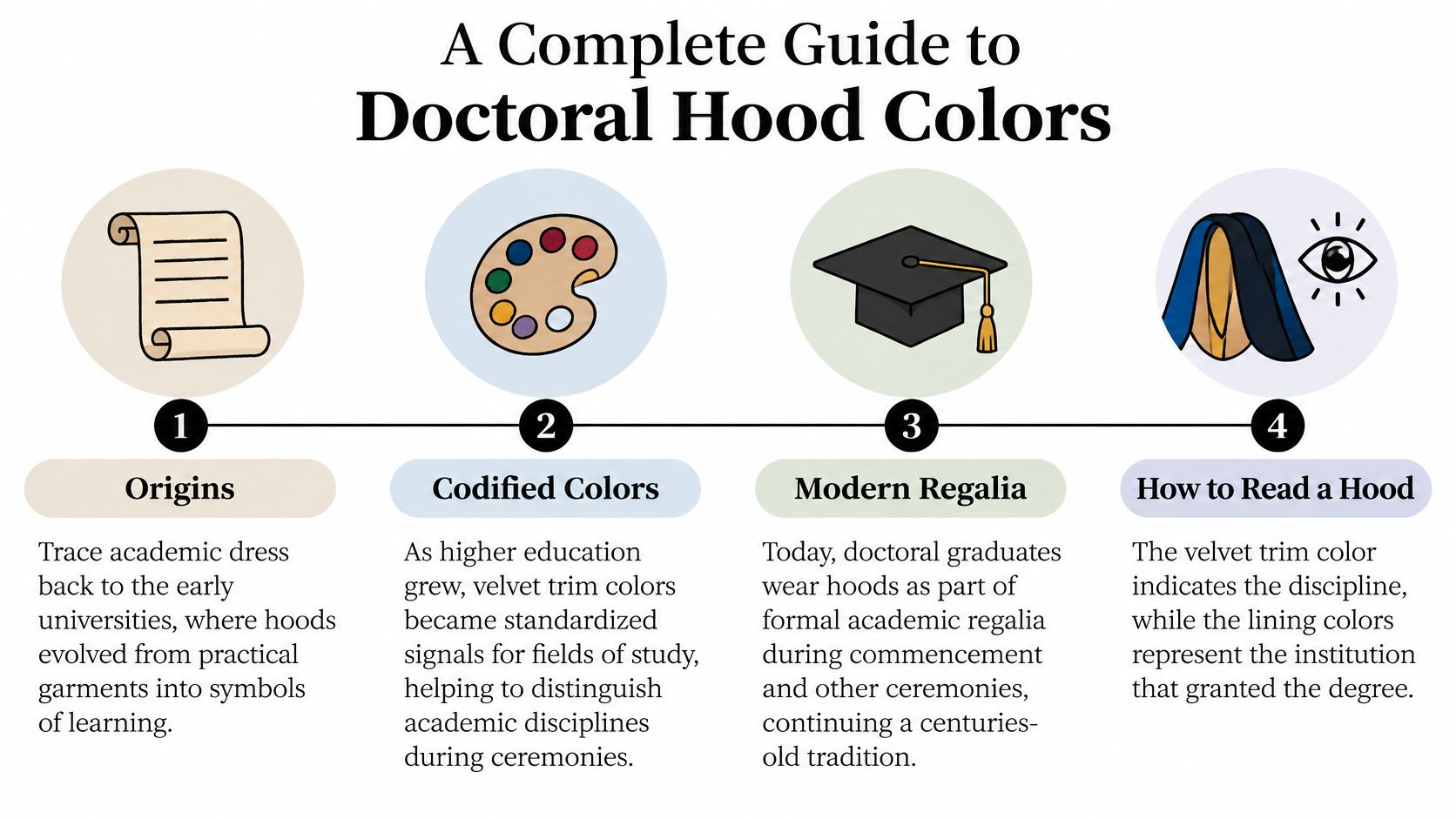
It helps to see this as one layer of the broader academic colors code rather than an isolated chart. The same framework that assigns your hood's velvet also governs tassel colors, gown facing and trim colors, and the hues used on stoles — so the discipline color you find below will usually echo elsewhere in your regalia. And because doctoral regalia colors follow the Intercollegiate Code regardless of gown style or manufacturer, a PhD in chemistry wears the same dark blue velvet whether the gown is classic black matte or a deluxe fluted design.
The system we use is based on the standards set by the American Council on Education (ACE), which is the official code followed by most universities and colleges across the United States. We've laid everything out so you can easily find the color that represents your years of dedication, whether you're in the humanities, the sciences, or anywhere in between.
The creation of the Intercollegiate Code back in 1895 marked a turning point. It brought much-needed consistency to academic dress, creating the universal language of colors we still use today.
The Special Case of the PhD
One of the most common points of confusion—and one we get asked about all the time—is the color for a Doctor of Philosophy (PhD). The official velvet color for any PhD is Dark Blue, no matter the graduate's field of study. So, if you earned a PhD in Chemistry, you might expect golden yellow, but your velvet will be dark blue.
Why? The dark blue doesn't represent your department; it represents the degree itself. It stands for the mastery of philosophy, research, and scholarly inquiry that serves as the bedrock of every PhD. It's a unifying symbol that connects all Doctors of Philosophy, honoring their shared contribution to the world of knowledge.
The use of Dark Blue for all PhDs was a clarifying update to the academic code. It standardizes the visual representation of the degree, emphasizing the shared scholarly foundation of all Doctors of Philosophy.
It's a simple but important distinction. For example, a Doctor of Education (EdD) wears Light Blue. But a Doctor of Philosophy in Education (PhD) wears Dark Blue.
Official Doctoral Velvet Colors by Academic Discipline
Ready to find your color? The detailed chart below maps a wide range of degrees to their official velvet color. This list covers nearly every discipline, with each hue carefully chosen to reflect the history and identity of its field.
Once you know your color, you're all set to find the perfect doctoral academic hood that honors your achievement.
| Academic Field | Official Velvet Color | Associated Degrees (Examples) |
|---|---|---|
| Agriculture | Maize | D.Agr. |
| Arts, Letters, Humanities | White | D.A.L., D.H.L. |
| Business, Commerce, Accountancy | Drab (Tan) | D.B.A. |
| Dentistry | Lilac | D.D.S., D.M.D. |
| Economics | Copper | D.Ec. |
| Education | Light Blue | Ed.D. |
| Engineering | Orange | D.Eng. |
| Fine Arts, Architecture | Brown | D.F.A. |
| Forestry | Russet | D.F. |
| Journalism | Crimson | D.Journ. |
| Law | Purple | J.D., S.J.D. |
| Library Science | Lemon Yellow | D.L.S. |
| Medicine | Green | M.D. |
| Music | Pink | D.Mus. |
| Nursing | Apricot | D.N.P. |
| Oratory (Speech) | Silver Gray | D.S.P. |
| Pharmacy | Olive Green | Pharm.D. |
| Philosophy | Dark Blue | Ph.D. |
| Physical Education | Sage Green | D.P.E. |
| Public Administration | Peacock Blue | D.P.A. |
| Public Health | Salmon Pink | D.P.H. |
| Science | Golden Yellow | D.Sc. |
| Social Work | Citron | D.S.W. |
| Theology | Scarlet | D.Min., Th.D. |
| Veterinary Science | Gray | D.V.M. |
While this chart is your guide for the hood, it's also neat to see how this color language extends to other parts of graduation attire. For more on that, you can check out our detailed guide on the meaning of graduation tassel colors and see how all these traditions fit together.
Picking the right color is more than just checking a box; it's about claiming your place in a long line of scholars in your field. Each color tells a story of discovery, practice, and expertise, connecting you to everyone who came before.
Doctoral Hood Colors in Spanish (Colores de Toga de Doctorado)
La codificación moderna de los colores de toga en Estados Unidos se formalizó el 16 de mayo de 1895, cuando la Intercollegiate Commission on Academic Costume aprobó el Intercollegiate Code of Academic Costume. El sistema original estableció ocho colores para identificar grandes áreas académicas: blanco para Artes y Letras, escarlata para Teología, morado para Derecho, azul para Filosofía, amarillo dorado para Ciencias, marrón para Bellas Artes, rosa para Música y verde para Medicina. La idea central era separar dos tipos de información visual: la forma y la longitud de la toga o de la capucha indicaban el nivel del título, mientras que los colores señalaban la disciplina (fuente).
Entre 1895 y 1961, el sistema estadounidense de colores académicos se expandió considerablemente: la autoridad especializada registró un total de 34 colores de facultad, aunque cinco fueron retirados en 1959 o 1960 porque representaban títulos que se otorgaban con muy poca frecuencia. La expansión refleja el crecimiento y la diversificación de la educación superior durante la primera mitad del siglo XX (fuente).
Según el código interuniversitario, estos son los colores de terciopelo correspondientes a cada carrera:
- Azul oscuro – Filosofía (PhD), sin importar el campo de estudio
- Azul claro – Educación (Ed.D.)
- Verde – Medicina (M.D.)
- Morado – Derecho (J.D.)
- Amarillo dorado – Ciencias
- Naranja – Ingeniería
- Marrón – Bellas Artes y Arquitectura
- Caqui (drab) – Administración de Empresas y Comercio
- Lila – Odontología
- Salmón – Salud Pública
- Escarlata – Teología
- Blanco – Artes, Letras y Humanidades
La capucha doctoral consta de tres elementos: el forro de satén muestra los colores de la universidad, la franja de terciopelo indica la disciplina, y la capucha negra exterior es idéntica para todos. La evidencia histórica muestra que las universidades no adoptaron los colores de toga de manera uniforme, y que las preferencias institucionales pueden ser más importantes que el código nacional. En una recopilación de instituciones, algunas utilizaban colores asociados con el nivel del título (azul oscuro para el doctorado, por ejemplo), mientras que otras empleaban colores para indicar específicamente la asignatura o especialidad (fuente). Si tu universidad tiene su propia tradición, la costumbre institucional suele prevalecer sobre el código nacional.
How to Order Your Perfect Doctoral Regalia
You've done the hard work, and now it's time for the exciting part: ordering the regalia that brings your academic story to life. Getting every detail right ensures you look and feel your best on graduation day. This practical guide will walk you through the process, making it simple to order your perfect doctoral regalia with total confidence.
The journey from student to scholar is a long one, and your regalia should reflect the dignity of that achievement. We'll cover everything from matching your university's official colors to ensuring a perfect fit, so you can focus on what really matters—celebrating.
Find Your University and Match Your Colors
This is the most critical part of the whole process. Your doctoral hood's satin lining must perfectly match your institution's colors. Every university has a unique combination, and getting it right is a sign of respect for your alma mater. It's the one visual element that connects you directly to the academic community that shaped you.
To make this completely effortless, follow these steps:
- Verify with Your School's Registrar: Contact your university's registrar or commencement office to confirm the precise color combination for your hood's lining and chevron. Sometimes schools have specific traditions or recent updates to their regalia, and confirming these details guarantees perfection.
Once your university colors are locked in, the rest of the process is a breeze. This ensures that when you turn your hood out during the ceremony, it proudly and accurately displays your academic heritage. The doctoral hood is customizable with the colors needed for the school and degree.
Measuring for a Perfect Fit and Choosing Options
An ill-fitting gown can be a distraction on a day when your focus should be on your accomplishment. Taking a few moments to get accurate measurements is essential for a polished, professional look. Your doctoral gown should feel comfortable, not restrictive, allowing you to walk across the stage with total ease.
Just follow these simple steps for sizing:
- Measure Your Height: Stand up straight with your shoes on and measure from the top of your head to the floor. This is the main measurement for your gown's length.
- Measure Your Sleeve Length: Measure from the center of your back, across your shoulder, and down to your wrist.
- Consider Your Tam Size: Wrap a measuring tape around your head about an inch above your eyebrows to find the perfect size for your doctoral tam.
Beyond the fit, you'll also want to think about the fabric. We offer options that provide both durability and comfort, making sure your investment will last for years to come. For a complete overview of all the components, from the gown to the cap, check out our helpful guide on the essentials of a PhD cap and gown.
Timing Your Order for a Stress-Free Graduation
Don't let ordering your regalia become a last-minute scramble. It is generally advisable to allow ample time before your commencement date to secure your regalia, verify all details, and accommodate any potential adjustments you might need.
Ordering early is the single best way to ensure peace of mind. It gives you time to try everything on, check all the details, and make sure your regalia is absolutely perfect for your big day.
Ready to take the next step? You can browse our complete collection of doctoral regalia packages, which include the gown, hood, and tam. The doctoral hood is customizable with the colors needed for the school and degree, ensuring your regalia reflects your specific achievement.
Exceptions and International Variations in Regalia
While the American Council on Education (ACE) code brings a welcome sense of order to academic dress here in the United States, it isn't a universally followed law. The world of regalia is full of fascinating exceptions and regional traditions that add a lot of character to the story of academic achievement. Getting to know these variations gives you a much richer picture of academic dress on a global scale.
Even within the U.S., some universities with deep roots choose to honor their own heritage over complete adherence to the ACE guidelines. These institutional traditions often predate the 1895 Intercollegiate Code and are a source of immense pride.
American University Traditions
A handful of prestigious American universities have established their own distinct regalia that makes their graduates instantly recognizable. These aren't mistakes; they're intentional choices to preserve a unique identity.
- Harvard University: Graduates wear striking crimson gowns, a bold departure from the standard black that makes their scholars stand out in any academic procession.
- Yale University: Yale graduates are distinguished by their own unique shade of blue in their gowns and hoods, a tradition that reinforces their powerful institutional brand.
- Brown University: Brown also maintains its own specific regalia colors and designs, reflecting its long history as an Ivy League institution.
These exceptions are a great reminder that while the ACE code is the standard, academic freedom can extend even to the ceremonial dress that celebrates it.
The Pivotal PhD Color Change
The ACE code itself has evolved over time. A really significant change happened in 1987 when the council decided that the velvet trim for all Doctor of Philosophy (PhD) degrees would be dark blue. Before this, PhD colors could vary by school, with some using shades like orange or crimson, which created a lot of confusion.
This update standardized the look for roughly 40,000 U.S. PhD graduates that year alone, cementing dark blue as the universal symbol for the PhD. If you want to dig deeper into this history, you can discover more about the evolution of academic dress in the United States.
The 1987 decision to standardize the PhD velvet to dark blue was a clarifying moment, ensuring the degree's visual identity was consistent and instantly understood across the country, regardless of the field of study.
This change really shows how the meaning behind regalia can be intentionally refined to bring greater clarity to academic traditions. If you're curious about the bigger picture, you can explore our guide on what is academic regalia for some foundational knowledge.
International Regalia Systems
Once you look outside the United States, academic dress traditions vary wildly, often reflecting a country's unique educational history. The American system, for example, has heavily influenced practices in places like Canada, but many nations follow their own distinct codes.
The United Kingdom, home to some of the world's oldest universities, has a particularly rich and complex system. Institutions like Oxford and Cambridge have their own intricate rules for gowns, hoods, and caps that differ from the American model and even from each other. Their regalia often includes more elaborate gowns, different hood shapes (like the "full" shape), and specific headwear for different occasions. This variety underscores that the language of academic dress, while sharing common roots, has evolved into many beautiful and distinct dialects around the world.
Frequently Asked Questions
What do the colors on a doctoral hood mean?
The velvet trim color identifies your academic discipline — dark blue for Philosophy, green for Medicine, purple for Law, and so on. The satin lining inside the hood displays the official colors of the university that granted your degree. Together they tell anyone familiar with academic tradition both what you studied and where you earned it.
Why is the PhD hood always dark blue?
Dark blue velvet represents the degree of Doctor of Philosophy itself rather than any specific department, a standard the American Council on Education set in 1987. Before then, PhD colors varied by school, with some using orange or crimson. The unifying color honors the shared scholarly and philosophical foundation behind every PhD, from physics to literature.
What is the difference between a doctoral hood and a master's hood?
A doctoral hood is four feet long with a five-inch velvet trim, while a master's hood is three and a half feet long with a three-inch trim. Those dimensions are the primary visual cues distinguishing the two degree levels in a procession.
¿Qué color corresponde a cada carrera en la toga de doctorado?
Según el código interuniversitario estadounidense: azul oscuro para Filosofía (PhD), azul claro para Educación, verde para Medicina, morado para Derecho, amarillo dorado para Ciencias, naranja para Ingeniería, marrón para Bellas Artes, y caqui para Administración de Empresas. El forro de satén siempre muestra los colores de la universidad que otorgó el título.
How do you wear a doctoral hood correctly?
- Place the hood over your head with the velvet side up and the small tapered end in front of your neck.
- Secure the front loop to a shirt button or an internal cord on the gown to keep it from slipping.
- Then have a friend or ceremony marshal turn the satin lining inside-out over your back so your university's colors face outward.
For all your commencement needs, from a single honor cord to a complete doctoral package, Graduation Cap and Gown offers the highest quality regalia to honor your achievement. Find your perfect fit and colors at Graduation Cap and Gown.