

Academic regalia is the traditional outfit—the gown, cap, and hood—worn for commencement ceremonies. But it’s so much more than a uniform. Think of it as a visual language that tells the story of a graduate's journey, instantly signaling their degree level, field of study, and the institution they’re proud to represent.
The Story Behind Your Graduation Attire

Have you ever stopped to wonder what your graduation outfit actually means? It’s not just a fancy robe for a day of photos. When you put on your regalia, you’re stepping into a tradition that connects you to a long and rich legacy of scholars stretching back for centuries.
Every piece you wear is packed with symbolism, transforming your graduation from a simple ceremony into a genuine milestone. This tradition is a powerful nod to your personal hard work, but it also celebrates the collective pursuit of knowledge. It’s a formal acknowledgment of your transition from student to graduate.
The Purpose of Academic Regalia
At its heart, academic regalia serves a few key purposes that make commencement so special. It's a time-honored system designed to visually communicate your accomplishments to everyone in the room.
- Honors Tradition: Wearing regalia connects you to the historical roots of higher education, which trace all the way back to the universities of 12th-century Europe.
- Signifies Achievement: The specific cut of your gown, the length of your hood, and the color of the velvet trim all work together to announce your degree and academic discipline.
- Creates Unity: When every graduate is dressed in their regalia, it creates a powerful sense of shared purpose and collective success, visually uniting the entire graduating class.
Academic regalia is a formal dress code that uses distinct colors and components to represent a graduate's degree, discipline, and alma mater. It’s a unified system that brings order and significance to the ceremony.
To help you get familiar with the core components, here is a quick breakdown of what each piece represents.
Quick Guide to Academic Regalia Components
| Component | What It Represents | Primary User |
|---|---|---|
| Gown | The degree level (e.g., Bachelor's, Master's, Doctoral) | All graduates |
| Cap/Tam | The level of academic achievement | All graduates |
| Hood | The specific field of study and the graduating institution | Master's and Doctoral graduates |
| Tassel | The level of study; its placement indicates graduation status | All graduates |
Each of these pieces comes together to tell a complete story.
From a simple black bachelor's gown to an elaborate doctoral ensemble with velvet trim and a colorful hood, every element has a purpose. Understanding these details adds a much deeper layer of appreciation to your special day. As you get ready for your own ceremony, knowing what your graduation cap and gown represent makes the entire experience that much more meaningful. The following sections will break down the history and symbolism piece by piece.
The Rich History Behind Your Graduation Gown
Ever stop to wonder why you wear that specific gown and hood to graduate? This tradition isn't some modern invention; it’s a direct line back to the earliest days of higher education. To really get the story behind your academic regalia, we have to go way back to the medieval universities of 12th and 13th-century Europe.
Back then, there were no heated lecture halls or comfy, climate-controlled libraries. For a scholar, life was often drafty and cold. The long, heavy gowns and hoods we now connect with graduation were born from a very simple and practical need: to stay warm.
These garments were the everyday uniform for both students and the clergy, who were often one and the same. The design, including the hood, gave them an extra layer of protection against the elements, making academic life just a little more bearable.
From Practicality to Prestige
Over the centuries, what started as functional clothing slowly morphed into a powerful symbol of scholarly identity. Leading universities like Oxford and Cambridge began to formalize academic dress, creating specific designs in the attire to mark different levels of academic achievement and social standing.
The gown became so much more than a robe; it became a mark of belonging to a revered intellectual community. This evolution cemented the idea that academic attire wasn't just for warmth, but for representing one's dedication to knowledge. This symbolic shift laid the groundwork for the tradition we still honor today.
As this tradition crossed the Atlantic, it took root in colonial America. The first American colleges, heavily influenced by their European counterparts, adopted similar customs for academic dress. By the mid-1700s, places like King's College (now Columbia University) required students to wear their "college habits," keeping the tradition alive.
The academic gown made its first recorded appearance at the University of Cambridge in 1284, but the tradition of specialized academic dress emerged much earlier in the 12th century as a functional solution to the unheated halls of medieval universities.
This European influence was profound, shaping American academic ceremonies for hundreds of years. The problem was, as more universities popped up, each one developed its own variations. This led to a confusing and inconsistent system across the country. A student's gown from one university might mean something completely different at another.
Creating a Standard for American Universities
The need for a unified system became glaringly obvious by the late 19th century. In 1895, a pivotal moment arrived with the establishment of the Intercollegiate Code of Academic Costume. This code was created by representatives from top American universities to standardize the design, materials, and colors of academic regalia nationwide.
This standardization created the clear, visual language that gives your regalia its meaning today. The code laid out specific details that are still largely in use:
- Gown Style: It defined the cut of the gown for Bachelor's, Master's, and Doctoral degrees—especially the distinctive sleeve designs.
- Hood Colors: The code assigned specific colors to different fields of study for the hood's velvet trim.
- Institutional Identity: It also designated the satin lining of the hood to display the official colors of the graduating institution.
While the practice of wearing academic dress daily faded in the United States after the 19th century, its ceremonial importance only grew stronger. You can learn more about how these traditions were preserved in this detailed history of graduation attire.
Understanding this rich history transforms your cap and gown from a simple outfit into a meaningful connection to a legacy of scholarship stretching back nearly a thousand years. When you wear your regalia, you aren’t just celebrating your own success; you are taking part in a tradition shared by countless scholars who came before you, from the cold halls of medieval Europe to the modern commencement stage.
Decoding Each Component of Your Academic Regalia
Now that we’ve touched on the rich history behind academic regalia, let's break down exactly what you'll be wearing. Each piece tells a part of your unique academic story. Think of it as a visual language that communicates your achievements to everyone on graduation day. From the cut of your gown's sleeves to the specific colors on your hood, every single detail matters.
This section is your field guide to each piece of academic dress. We'll explore the gown, hood, and headwear, explaining what they signify and how they differ across degree levels.
The Academic Gown: A Foundation of Achievement
The gown is easily the most recognizable piece of your regalia, but its style is far from one-size-fits-all. The design—especially the sleeves—immediately signals the degree you've earned. This is one of the most important visual cues in the whole academic uniform.
- Bachelor’s Gown: This gown is known for its simple, elegant design and pointed sleeves. It's a straightforward garment that signifies the completion of your undergraduate studies.
- Master’s Gown: The key feature here is the unique oblong sleeve. It’s closed at the end but has a slit for your arm to pass through. Historically, these long sleeves could have been used as pockets or pouches.
- Doctoral Gown: As the most elaborate of the three, the doctoral gown features full, bell-shaped sleeves. What really sets it apart are the three velvet bars, known as chevrons, on each sleeve and the wide velvet panels running down the front.
These subtle but significant differences are all part of a standardized system. The infographic below shows the historical milestones that led to the unified regalia system we use today.
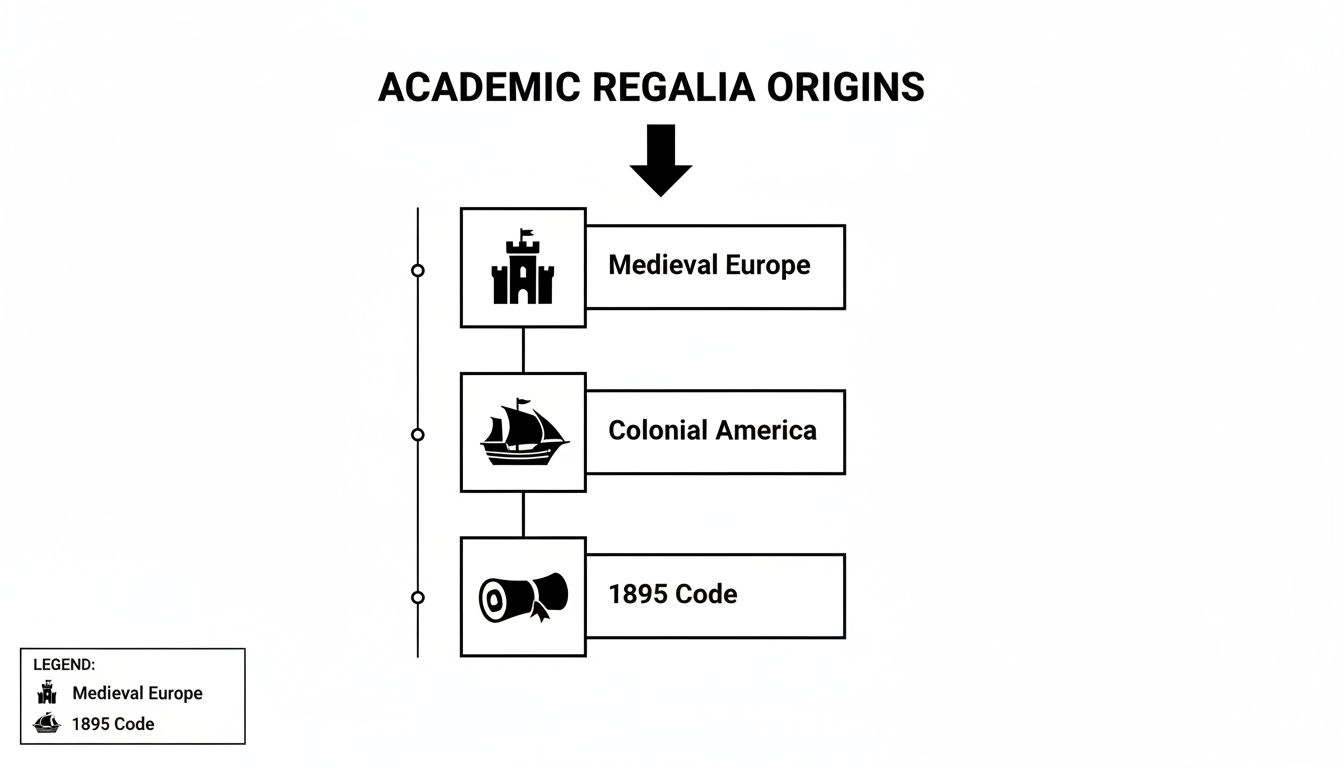
As the diagram shows, the 1895 Intercollegiate Code was a landmark moment that formalized these specific gown distinctions, turning practical medieval garments into the meaningful system we still follow.
The Academic Hood: A Story in Color and Fabric
If the gown is the foundation, the academic hood is the main event—at least for graduate-level regalia. Worn around your neck and draping down your back, it’s a vibrant tapestry of color that communicates three key facts about your degree at a single glance.
- Degree Level: The length of the hood itself indicates the degree. A Master's hood is shorter than the more elaborate and longer Doctoral hood.
- Field of Study: The color of the velvet trim is the code for your academic discipline. For instance, light blue represents Education, while a rich golden yellow stands for Science.
- Granting Institution: The satin lining of the hood proudly displays the official colors of the university that conferred your degree, making your alma mater instantly recognizable.
The standardization of these elements was a major goal of the Intercollegiate Commission, established in 1893 to bring some order to the chaos of academic dress. The commission's work culminated in the 1895 Intercollegiate Code of Academic Costume, which prescribed the specific cuts, materials, and color systems that are still widely followed today. While some institutions have their own variations, the majority still adhere to these foundational principles.
Headwear: The Crowning Piece
The headwear you don for graduation also signifies your academic standing. The two most common forms are the classic mortarboard and the more distinguished tam.
The mortarboard is the traditional square-shaped cap that everyone recognizes. It's worn for both Bachelor's and Master's degrees. The tassel attached to the top is another key indicator; before the degree is conferred, it’s worn on the right side, and after, it’s ceremoniously moved to the left.
Doctoral graduates, however, get an upgrade to the tam. This soft, often multi-sided cap is typically made of velvet and is considered a mark of high academic distinction.
Accessories: Cords and Stoles of Distinction
Beyond the core components, many graduates wear accessories that celebrate special achievements and personal identity. These pieces add a meaningful, personal layer to the traditional regalia.
Honor cords and stoles aren't just decorative; they are symbols of exceptional academic performance, leadership, and cultural heritage, allowing each graduate to tell a more complete story of their journey.
- Honor Cords: These braided ropes, often in specific colors, signify academic honors (like cum laude), membership in honor societies, or participation in specific university programs.
- Stoles: Worn around the neck over the gown, stoles can represent involvement in Greek life, student government, or study abroad programs. Cultural stoles that celebrate a graduate's heritage, such as Kente or Serape patterns, are also incredibly popular.
Each of these components—from the cut of your gown to the color of your cords—works together to create a stunning tribute to your hard work. For a more detailed look at the different gown styles, you might be interested in our guide on the types of graduation gowns available.
How to Wear Your Regalia With Confidence
Let's be honest—putting on your academic regalia for the first time can feel a little strange. But knowing how to wear each piece correctly is the key to looking polished and feeling confident on graduation day. This guide will walk you through it, step-by-step, so you can focus on your achievement, not on whether your hood is on straight.
Following a few simple tips will help you carry yourself with the poise your accomplishment deserves. The whole process is pretty straightforward once you see how all the components work together.
Assembling Your Regalia Step by Step
First things first, put on your gown. It’s designed to go over your regular clothes, so you’ll want to plan your outfit accordingly. Most people opt for professional or business-casual attire, but don't forget about comfort—you'll be in that gown for hours.
Next up is the academic hood, which is usually the trickiest part of the whole getup. The hood drapes over your shoulders and down your back, showing off the colors that represent your university and field of study. You want to position it so the velvet trim frames your neck and the colorful satin lining is flipped out, proudly displaying your school's colors.
A couple of small safety pins will be your best friends here. Securing the front of the hood to your gown keeps it from sliding backward or bunching up. It’s a tiny trick that makes a huge difference in keeping you comfortable and looking sharp all day.
Mastering the Mortarboard and Tassel
The final piece of the puzzle is your mortarboard or tam. The cap should sit flat on your head, with the board parallel to the ground—don't tilt it back. Make sure one of the square's points is centered right on your forehead.
Pro Tip: If your cap feels a little wobbly, a few bobby pins can discreetly secure it to your hair. This is a game-changer, especially if your ceremony is outdoors and you have to deal with a breeze.
The tassel hangs on the right side of the cap before your degree is officially conferred. This is a long-standing academic tradition. Once all the degrees have been awarded, you’ll be instructed to move your tassel from the right to the left side, a moment that symbolizes your official transition from candidate to graduate. For doctoral graduates wearing a tam, the tassel is usually fixed to the left and isn't moved.
Putting It All Together for a Polished Look
Once every piece is in place, give yourself a final check in the mirror. Your gown should be zipped, your hood should lie flat, and your cap should feel secure. For a complete visual guide with some extra pointers, check out our detailed instructions on how to properly wear an academic hood.
Here’s a quick final checklist before you walk out the door:
- Gown: Fully zipped and as wrinkle-free as possible (a steamer is your friend; an iron is not).
- Hood: Draped correctly with the colors showing and pinned securely to your gown.
- Cap: Positioned flat on your head, with the tassel on the right.
- Footwear: Wear comfortable shoes! You'll be doing a lot more standing and walking than you think.
Taking a few minutes to get your regalia just right ensures you'll look as distinguished as the achievement you're celebrating. It’s all about feeling confident and being fully present for one of the most memorable days of your life.
Finding the Right Regalia Without the Stress
Let's be honest, figuring out your academic regalia can feel like one more complicated item on an already long pre-graduation checklist. But it really doesn’t have to be. Getting the right cap, gown, and hood should be exciting, not stressful.
The key is knowing where to find everything you need in one place, with guarantees that you’re getting the right attire at the best price. Our goal is to make this step simple so you can focus on what really matters—celebrating your big day.
Match Your School Colors Instantly
One of the biggest worries for graduates is making sure their regalia perfectly matches their university’s specific colors. With hundreds of schools, each with its own unique combination of colors for hoods and tassels, the fear of getting it wrong is real.
We take that uncertainty completely off your plate. Our 'Find Your University' feature does all the heavy lifting. Just pick your school, and our system instantly shows you the correct color combinations for your degree and field of study. It ensures your regalia is a perfect match, every time.
Gone are the days of digging through university handbooks or websites. Our system gives you an immediate, accurate match so you can order with total confidence, knowing your regalia will meet your school's exact standards.
Complete Packages for Every Degree
To make things even easier, we offer complete regalia packages tailored to each academic level. Instead of hunting down each piece separately, you can get everything you need in one convenient set, ensuring a perfect match in fabric, color, and style.
- Bachelor's Degree Packages: These sets include a high-quality gown, a classic mortarboard cap, and a tassel with your year-date drop. It’s everything an undergraduate needs to look the part.
- Master's Degree Packages: Building on the Bachelor's set, these packages add the all-important academic hood, carefully crafted with the velvet trim and satin lining that represent your field of study and university.
- Doctoral Degree Packages: Our most distinguished sets feature the premium doctoral gown with its velvet chevrons, a deluxe doctoral tam, and the full-length doctoral hood—creating an impressive ensemble for the highest academic achievement.
Quality Materials and Sizing You Can Trust
Your regalia is more than just an outfit for a day; it's a keepsake. We are committed to providing high-quality materials that look and feel distinguished. You can choose between our classic matte finish for a modern, elegant look or a traditional shiny fabric that catches the light beautifully.
Finding the right fit is also crucial. A poorly fitting gown can be distracting on a day when you should feel your best. Our sizing guides make it easy to select the correct gown length based on your height, ensuring it drapes just right. For more detailed advice, you can explore our guide on graduation gown length to guarantee a perfect fit.
We're so confident in our products that we offer a lowest-price guarantee, giving you peace of mind that you’re receiving the best value anywhere.
Fast Shipping for Last-Minute Needs
We get it—sometimes graduation plans come together at the last minute. Life happens, and deadlines can sneak up on you.
That's why we offer fast shipping and even overnight delivery options for those on a tight schedule. Our reliable service ensures your academic regalia arrives with plenty of time to spare, proving we're the most dependable source for every graduate, no matter the timeline.
Let's Talk About Making Your Regalia Your Own

While the tradition of academic regalia is steeped in centuries of history, it’s anything but a stuffy, static custom. Think of it as a living tradition, one that’s constantly evolving to reflect the students who wear it. Today's graduation ceremonies are a beautiful mix of that timeless history and deeply personal expression.
This wasn't always the case. Back in the 1960s, a period of huge social and political change, many students saw the cap and gown as a symbol of the establishment they were protesting. Some rejected the garments entirely, and a few universities even canceled commencement altogether.
But since the 1980s, academic regalia has seen a major comeback. There's a renewed appreciation for what it all symbolizes, and graduates are now finding incredible ways to make it their own.
Celebrating Your Story with Cultural Stoles
One of the most powerful trends we see today is the rise of cultural and affinity stoles. These additions turn the traditional black gown into a canvas for your personal story, letting you celebrate your heritage, identity, and the unique path that got you to this moment. They add a vibrant, meaningful layer to the whole ensemble.
These stoles are way more than just accessories; they're bold declarations of pride. They connect your academic success to your personal roots, making the ceremony an even more significant milestone.
By personalizing your regalia with a stole that represents your heritage or community, you honor both the academic tradition and your individual story. It’s a way to say, “This is who I am, and this is what I have achieved.”
Some of the most popular and meaningful options include:
- Kente Stoles: Woven with intricate patterns from Ghana, these vibrant stoles symbolize ancestry, cultural richness, and community pride.
- Serape Stoles: Featuring brilliant stripes, these stoles honor Mexican and Latinx heritage, representing a vibrant spirit and the celebration of a major life achievement.
- First-Generation Stoles: These are a powerful emblem for students who are the first in their families to graduate from college, signifying resilience, trailblazing, and family pride.
- Flag and International Stoles: Perfect for international students or those who studied abroad, these stoles display a country’s flag to celebrate global citizenship and diverse backgrounds.
Make It Uniquely Yours
Adding a personal touch to your academic regalia makes your graduation day that much more memorable. It’s your chance to share a piece of your story with everyone celebrating alongside you. Whether you’re honoring your family, your culture, or a specific community that shaped you, a custom stole makes your achievement uniquely your own.
At Graduation Cap and Gown, we offer an extensive collection of specialty stoles designed to help you celebrate your identity with pride. Understanding the symbolism behind each one can help you pick the perfect design for your ceremony. For some inspiration, you can explore our detailed guide on the meaning behind different graduation stoles. Finding the right one ensures your regalia is a true reflection of your incredible journey.
Your Regalia Questions, Answered
Graduation day is exciting, but it’s easy to get tangled up in the details of your regalia. What do the colors mean? Can you wear more than one cord? Don't worry, these are the questions every graduate has. We've got the straightforward answers to help you feel completely confident when you walk across that stage.
From figuring out the right color for your major to knowing how to handle your gown, let’s clear up the common points of confusion so you can focus on your big moment without any last-minute stress.
How Do I Know the Correct Color for My Major?
The easiest way to think about this is that the color of your tassel and the velvet on your hood is a visual code for your field of study. For example, White is the classic color for Arts and Letters, while Drab (a tan color) signifies Business. The simplest way to get it right is to check your university’s official commencement website or refer to a standard academic color chart.
If you’re still scratching your head, our team is always here to help. Just reach out, and we can help you confirm the exact colors you need for your degree.
This whole color-coded system isn't new. It was established over a century ago by the Intercollegiate Code of Academic Costume to create a universal language for academic achievements, a tradition that’s still going strong today.
Can I Wear Multiple Cords or Stoles?
Absolutely! In fact, most universities encourage it. Think of your regalia as a canvas to display everything you've accomplished. It's very common for graduates to wear multiple honor cords representing different academic honors, honor society memberships, or participation in special programs.
The same goes for stoles. You can proudly wear a cultural stole, like one of our beautiful Kente stoles, right alongside a stole for your Greek organization or another student group. While it’s always smart to double-check your school's specific rules, celebrating your various achievements is what the day is all about.
What Is the Difference Between a Masters and Doctoral Gown?
The main giveaways are the sleeves and the velvet trim. A Master's gown has distinctive oblong sleeves that are sealed at the end, with a slit for your arm to pass through. It’s a unique look you’ll only see at this level.
A Doctoral gown, on the other hand, is much more ornate. It has big, bell-shaped sleeves, and each one is decorated with three velvet stripes, called chevrons. You'll also see matching velvet panels running down the front of the gown. You can see these key differences for yourself on our Master's and Doctoral regalia pages.
At Graduation Cap and Gown, our goal is to make finding the perfect regalia for your milestone simple and stress-free. Take a look at our complete collection of gowns, hoods, and accessories at https://www.graduationcapandgown.com and order with confidence.