

Three weeks before commencement, a professor discovers a short email from the ceremony coordinator: faculty members must provide their own regalia. The professor has a doctoral degree, a departmental color tradition, an unfamiliar hood, and no idea whether to buy, rent, or ask the department for a loaner set.
That situation is common because faculty graduation regalia sits at the intersection of tradition and logistics. You need the correct degree level, colors, size, and accessories, but you also need to meet ordering deadlines and arrive ready to march, hood graduates, or sit on stage without last-minute repairs.
Why Faculty Regalia Matters at Commencement
Faculty regalia isn't formal clothing for photographs. The gown, hood, headwear, and color details create a visual language that can communicate academic rank, degree level, discipline, and institutional identity across a crowded commencement hall. A faculty member wearing the wrong hood trim or an unsuitable gown may still look polished, but the outfit won't accurately represent the academic role they're performing.
A university may require faculty in commencement seating to wear regalia while leaving each faculty member responsible for securing it. Another campus may provide rentals, departmental loaners, or an on-site backup process. Because policies differ by institution and ceremony type, start with your commencement office, dean's office, or department administrator rather than assuming a standard rule. This overview of academic regalia can help you identify the basic pieces before you contact your campus.
The questions to answer first
Before choosing a product, confirm:
- Which degree level applies: Faculty usually wear regalia corresponding to their highest earned degree, unless their institution specifies another convention.
- Which discipline color belongs on the hood: The velvet trim generally identifies the field associated with the degree.
- Which lining represents the institution: School colors often appear inside the hood.
- Who supplies the outfit: Your options may include personal ownership, rental, departmental inventory, or a formal loaner program.
- What the ceremony requires: A faculty marshal, platform party member, hooding participant, and seated faculty member may follow different instructions.
Practical rule: Treat regalia as part of your commencement assignment, not as an accessory you can solve after arriving on campus.
The safest process is simple. Confirm the ceremony rules, identify the correct degree and colors, measure carefully, choose buy, rent, or borrow based on likely use, and inspect every item before commencement morning.
The History Behind Faculty Regalia
The outfit you see on a commencement platform has roots in medieval European university dress. Institutional histories commonly connect modern American academic clothing with the university costumes associated with fourteenth- and fifteenth-century Oxford and Cambridge, where scholars wore garments suited to formal academic life and local climate. Over time, universities developed their own visual customs, so gowns, hoods, and colors could vary substantially from one campus to another.
American institutions eventually moved toward a shared system. The University of Pennsylvania adopted the “Pennsylvania System of Academic Costume” in April 1887 after a faculty committee recommended a consistent approach. From the 1887 Commencement onward, the system appeared in the program and was expected to guide trustees, faculty, and students. The university replaced it with the Intercollegiate System in 1896, which has continued in effect to the present time. The University of Pennsylvania's history of academic regalia documents this transition from local variation toward a common code.
Why standardization still matters
The Intercollegiate Code became another important anchor. A historical summary describes the style as standardized by an Intercollegiate Code in 1895, while the Intercollegiate Bureau of Academic Costume established its dress code in 1897. The same reference reports that most American universities followed that code by 1902. This institutional history of academic costume places those developments within the broader evolution of university dress.
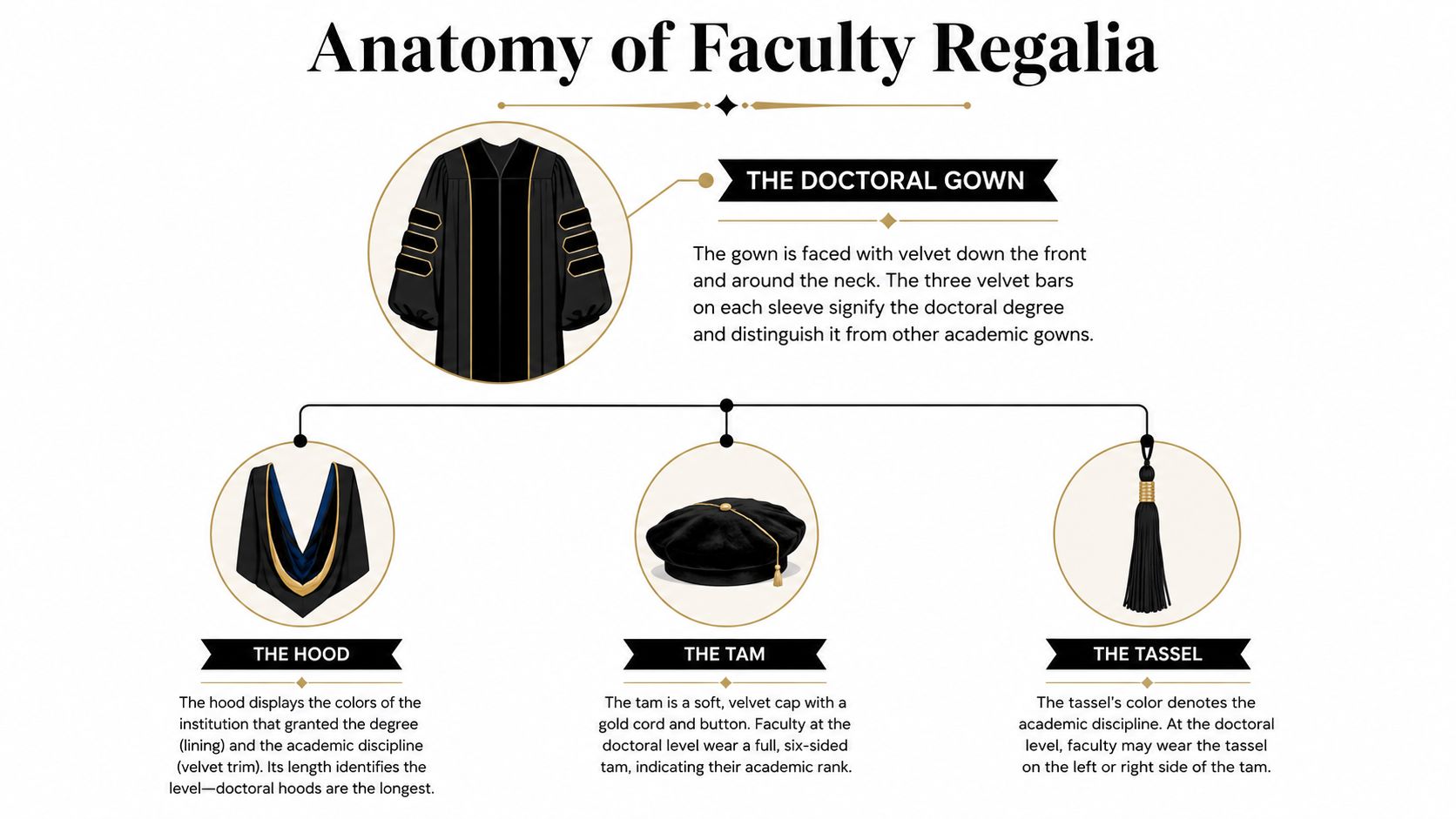
That history explains several details that can seem arbitrary to first-time faculty participants. Hood colors distinguish disciplines, linings identify institutions, and doctoral gowns use velvet features to signal advanced academic status. The code transformed regalia into a structured system, so a faculty member's clothing can communicate information before they speak.
Watch the embedded visual guide before your fitting or departmental distribution meeting. It's especially useful when you're handling a hood or doctoral tam for the first time.
Components of Faculty Regalia Explained
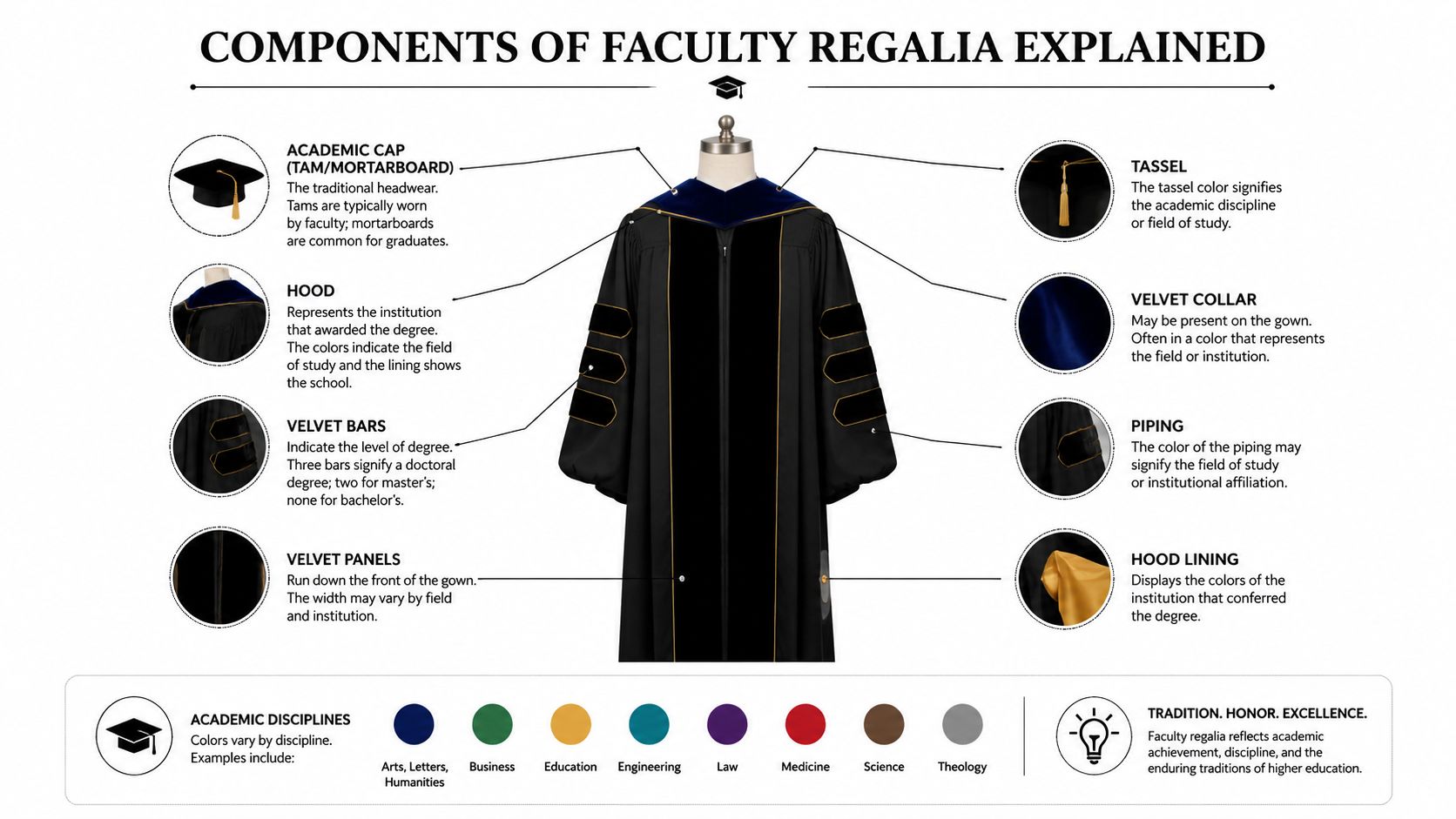
You are minutes from the faculty procession, holding a gown, hood, and tam that look almost right. Start with the gown, because its cut determines whether the rest of the set will sit correctly. Bachelor's and master's gowns are generally simpler. Doctoral faculty gowns use velvet panels and sleeve bars. The University of New England's regalia guide describes a five-inch velvet panel around the neck and down both front edges, plus three-inch velvet bars on each sleeve. The University of New England's regalia guide explains these features and their connection to doctoral attire.
Before buying, renting, or borrowing, compare the gown with your campus expectations. Some faculty gowns are plain black; others include institution-specific details. Check the sleeve shape, velvet treatment, and fabric. A complete set is useful only if those details match the ceremony's written requirements.
Read the hood from the outside in
Treat the hood like a labeled garment. Its three visible layers are:
- The shell: The main body rests over the shoulders and falls down the back.
- The velvet trim: This identifies the academic discipline and degree category.
- The satin lining: This commonly reflects the institution's colors.
Length and trim help distinguish similar-looking hoods. A master's hood is typically 3 feet 6 inches long with three-inch velvet trim, while a doctoral hood is 4 feet long with five-inch trim. Do not select a master's hood because it resembles the doctoral version in a product photo. Confirm the degree category before ordering, especially if you are borrowing from a colleague.
For setup, follow this guide to wearing an academic hood. Connect the front loop to the gown, then ask a colleague to inspect the back. A small twist can hide the lining or pull the trim out of place, and it is difficult to spot while facing a mirror.
Choose the right headwear
Bachelor's and master's faculty commonly wear a mortarboard, the square academic cap. Doctoral faculty often wear a tam, a softer, rounded cap made from velvet or another formal fabric. A tam may sit more comfortably during a long procession, but the ceremony's written rules take priority.
The tassel normally hangs on the right side unless your institution gives different instructions. A doctoral tam may arrive with its tassel attached, or with a separate tassel to position yourself. Confirm what is included before ordering, then check the complete set at least once before commencement morning.
Decoding Academic Colors and Degree Codes
Commencement colors work like a shorthand. The velvet trim points toward the discipline, while the satin lining commonly points toward the institution. That distinction prevents a frequent ordering mistake: selecting a school-colored hood without confirming the field color.
Examples help. Dark blue is commonly associated with philosophy, golden yellow with science, and light blue with education. These examples are useful starting points, but a campus may follow its own approved palette or interpret degree categories through institutional policy. Confirm the color with your registrar, commencement office, or department before purchasing.

Use the hood as a decoding exercise
Suppose you're watching the procession and see a hood with light blue velvet and a lining in the university's maroon and white colors. The trim suggests education, while the lining identifies the institution. If another faculty member wears golden yellow trim with the same lining, the shared lining points to the same university, while the different trim points to a different academic field.
Core rule: The trim tells what you studied. The lining tells where you studied.
That rule helps with visual recognition, but it shouldn't replace your institution's specifications. Some universities have approved color charts, and some departments use colors that differ from a retailer's general catalog. Use the retailer's Find Your University feature when available, then compare the result with your campus guidance. This guide to graduation hood colors offers another reference point while you verify the details.
A faculty marshal should also check colleagues' hoods before the procession. A hood turned inside out, a hidden lining, or the wrong trim can be corrected in a quiet staging area instead of on stage.
How Regalia Differs by Degree Level
A faculty marshal arrives for lineup wearing a doctoral gown but a master's hood. The mismatch is easy to spot, and it can delay a quick correction before the procession. Degree level affects the gown's cut, sleeve treatment, hood dimensions, and headwear, so confirm the institution's rule before placing an order.
| Degree Level | Gown Style | Hood Specifications | Headwear |
|---|---|---|---|
| Bachelor's | Simpler gown, usually without the doctoral velvet treatment | Bachelor's hood or institution-approved equivalent, confirm campus requirements | Mortarboard |
| Master's | Gown with master's sleeve styling | Typically 3 feet 6 inches long with 3-inch velvet trim | Mortarboard |
| Doctoral | Gown with a five-inch velvet front panel and three-inch sleeve bars | Typically 4 feet long with 5-inch velvet trim | Doctoral tam, or the headwear required by the institution |
The dimensions in the table are standard reference points, not permission to guess. Campus specifications may require a particular hood, color, or doctoral headwear. A doctoral gown's five-inch front velvet and three-inch sleeve bars distinguish it from simpler styles, while the hood length and trim help identify the degree level.
Use your highest degree only if your institution directs faculty to do so. A department chair with a doctorate who marches regularly may reasonably choose a doctoral gown and tam. A faculty member with a master's degree who attends as seated faculty may need a master's package instead. The role, ceremony instructions, and campus inventory can matter as much as the diploma.
If the order page is unclear, send the commencement coordinator a product description before paying. Check the hood, gown, and headwear as one set, since matching only the gown can leave the rest incorrect.
Shop by degree rather than by appearance, starting with doctoral regalia options. Bachelor's, master's, and doctoral categories make it easier to compare the required combination before you buy, rent, or borrow.
Buying Renting or Borrowing Faculty Regalia
The buy, rent, or borrow decision depends on how often you'll wear the set, how exact the fit must be, and how much deadline risk you can tolerate. Institutional policies vary. Some campuses require faculty to secure their own attire, while others provide rentals or maintain departmental loaner regalia.
Buying makes sense for a faculty member who marches regularly, serves as a marshal, or needs a consistent doctoral presentation across ceremonies. Ownership gives you control over fit, hood colors, and preparation time. It also means you must store, clean, and maintain the garments between uses.
Renting suits a one-time participant or someone whose degree and institution may change soon. Rental availability can solve the immediate problem, but the exact size, color combination, and delivery window may depend on inventory. Confirm what happens if the garment arrives late, fits incorrectly, or must be returned immediately after the ceremony.
Borrowing from a department can be practical when the inventory is well managed. It becomes risky when loaner sets lack complete hoods, have mixed sizes, or are distributed without a documented return process.

Use a simple decision filter
Ask these questions before committing:
- Frequency: Will you participate in commencement regularly or only once?
- Precision: Do you need a specific doctoral velvet treatment, hood trim, lining, or cultural accessory?
- Timing: Is there enough time to correct a size or color problem?
- Responsibility: Who handles cleaning, storage, shipping, and returns?
- Department readiness: Does the loaner set include the right degree level and complete accessories?
For individual purchases, faculty regalia packages can combine the core pieces. Departments planning for multiple faculty members should ask about bulk ordering and establish an inventory record with sizes, degree levels, colors, pickup dates, and return deadlines. Graduation Cap and Gown offers complete packages and individual pieces, including faculty gowns, hoods, tams, and accessories, with school-color selection tools and shipping options. Compare the full delivered cost and return terms rather than choosing on garment price alone.
Sizing Ordering Timelines and Customization
Order by working backward from the ceremony, not from the date you happen to remember the event. First confirm the ceremony date, delivery address, campus pickup process, and the last acceptable arrival date. Then allow time to inspect the set, try it over your expected ceremony clothing, and request a correction if the gown, hood, or headwear is wrong.
Build the order carefully
Use the retailer's size guide instead of guessing from your everyday clothing. Gown sizing usually depends on height and weight ranges, while cap or tam sizing depends on head measurement. Measure with the footwear and clothing you expect to wear, keep the tape level, and record the result before opening the order form.
Check the hood separately. A doctoral hood should match the doctoral degree specification, while a master's hood follows its own length and trim dimensions. If you're ordering for a department, collect each person's measurements in a shared worksheet and have one coordinator verify every color and degree field.
Work backward from ceremony day
A useful sequence looks like this:
- Confirm policy: Ask whether faculty must buy, rent, borrow, or collect regalia from campus.
- Confirm academic details: Verify highest degree, discipline color, institution lining, and headwear.
- Measure: Record gown height and weight range, head size, and any fit notes.
- Select components: Choose a complete package or individual gown, hood, tam, tassel, and accessories.
- Review customization: Consider custom stoles, honor cords, Kente or other cultural stoles, medals, diploma covers, garment bags, and year date drops.
- Inspect on arrival: Check zippers, seams, velvet, lining, color, size, and included pieces.
- Prepare a backup: Keep the ceremony office or department contact available if something is missing.
Late orders may have institution-specific pickup or backup options, but don't assume a rush service can provide every color and size. Fast or overnight delivery can help when available, yet it can't replace early verification of the degree code and measurements.
Care Storage Etiquette and Faculty FAQs
Open the package as soon as it arrives. Remove the gown and hood, check every component against the order, and hang the garments so you can identify creases, missing accessories, or incorrect colors before commencement morning.
Use a garment steamer on the fabric, keeping the steam moving rather than pressing the steamer head against velvet or satin. Hang the gown from a sturdy hanger, allow the hood to rest without sharp folds, and keep the set in a garment bag between ceremonies. For transport, carry the bag upright when possible and avoid placing heavy objects on top of it.
Day-of conduct
Put on the gown before lining up, secure the hood according to campus instructions, and ask a colleague to check the back. Keep the hood lining visible, place the tassel where the ceremony directs, and bring small supplies such as bobby pins for headwear and a lint roller for dark fabric.
Faculty marshals should arrive early enough to check the procession order, platform access, seating, hooding procedure, and recession route. Don't improvise during the ceremony. A marshal's job is to follow the established movement pattern and help others stay together.
Frequently asked questions
Can faculty wear cultural stoles?
Usually, cultural or identity stoles can be included when the institution permits them. Confirm whether your campus restricts accessories for platform participants, and choose a stole that sits comfortably beneath or over the gown without obscuring the hood.
What if the regalia arrives in the wrong size or color?
Contact the supplier and commencement coordinator immediately. Photograph the issue, keep the packaging, and ask whether an exchange, replacement, campus loaner, or pickup option is available. Waiting until ceremony morning removes most practical solutions.
Can I wear regalia from a previous institution?
Possibly, but the hood lining and trim may identify the former institution or a different discipline. Ask whether your current campus expects institutional colors, a specific hood, or a standard faculty gown before relying on an older set.
Should I wear the doctoral hood before the ceremony?
Follow the ceremony's instructions. Some events place doctoral hoods during a hooding procedure, while others expect faculty members to arrive already wearing them. The commencement office's directions take priority over general custom.
Graduation Cap and Gown offers faculty gowns, degree-specific hoods, doctoral tams, complete regalia packages, customization accessories, and school-color selection tools for departments and individual faculty members. Visit Graduation Cap and Gown to compare the correct degree level, verify sizing, and arrange your order before the ceremony deadline.