

Your family is gathered in the audience, phones raised, waiting for your name. As you cross the stage, the gown may look like everyone else's, but a first generation graduation stole makes one part of your story visible at a glance. It tells your parents, grandparents, siblings, friends, and classmates that you're the first in your immediate family to reach this academic milestone.
That moment carries personal meaning, but choosing and wearing the stole also involves practical questions. What does “first generation” mean at your school? Does the university provide the stole? Which colors and dimensions will work with your gown? How should you position it with a hood, honor cords, or medallions?
This guide answers those questions in plain language. You'll learn what the stole symbolizes, why campuses increasingly recognize first-generation graduates, how to wear it neatly, what to consider when customizing it, and how to care for it after commencement.
Introduction to the First Generation Graduation Stole
For many graduates, commencement begins at home. A family member adjusts the cap, a parent checks the gown zipper, and relatives find the best spot for photographs. If the graduate is the first in the family to complete a four-year degree, a stole brings those acts of support together in one visible milestone marker.

A graduation stole is a long sash worn over academic regalia. A first-generation stole identifies the graduate with a community whose parents did not complete a four-year degree, based on how many universities define eligibility. It works alongside the gown and hood, much like a cultural stole, honor cord, or academic medallion. The gown creates the formal foundation. The stole adds a specific part of the graduate's story.
The meaning reaches beyond the fabric. First-generation students may complete college without a family roadmap for applications, financial aid, course planning, or campus systems. The degree belongs to the graduate, while the stole can recognize the family members, mentors, and community who helped make it possible.
Family meaning: The stole can publicly mark the moment one graduate opens a new educational path for the family.
The achievement also has a measurable educational context. One synthesis reports that 24% of first-generation students had earned a bachelor's degree six years after starting college, compared with 59% of continuing-generation students, a 35-point gap (FirstGen Forward's completion-gap insights). These figures place the stole in context. It is more than an attractive sash. It marks progress through an educational route that has presented different obstacles for many students.
That meaning should guide practical choices. Confirm your school's definition and regalia rules, then check whether the campus supplies a stole or expects graduates to order one. Review the available color, length, lettering, and material options so the piece sits neatly over the gown and remains visible in photographs. A reliable regalia source can help turn a family milestone into a correctly sized, ceremony-ready choice.
What a First Generation Graduation Stole Is and What It Symbolizes
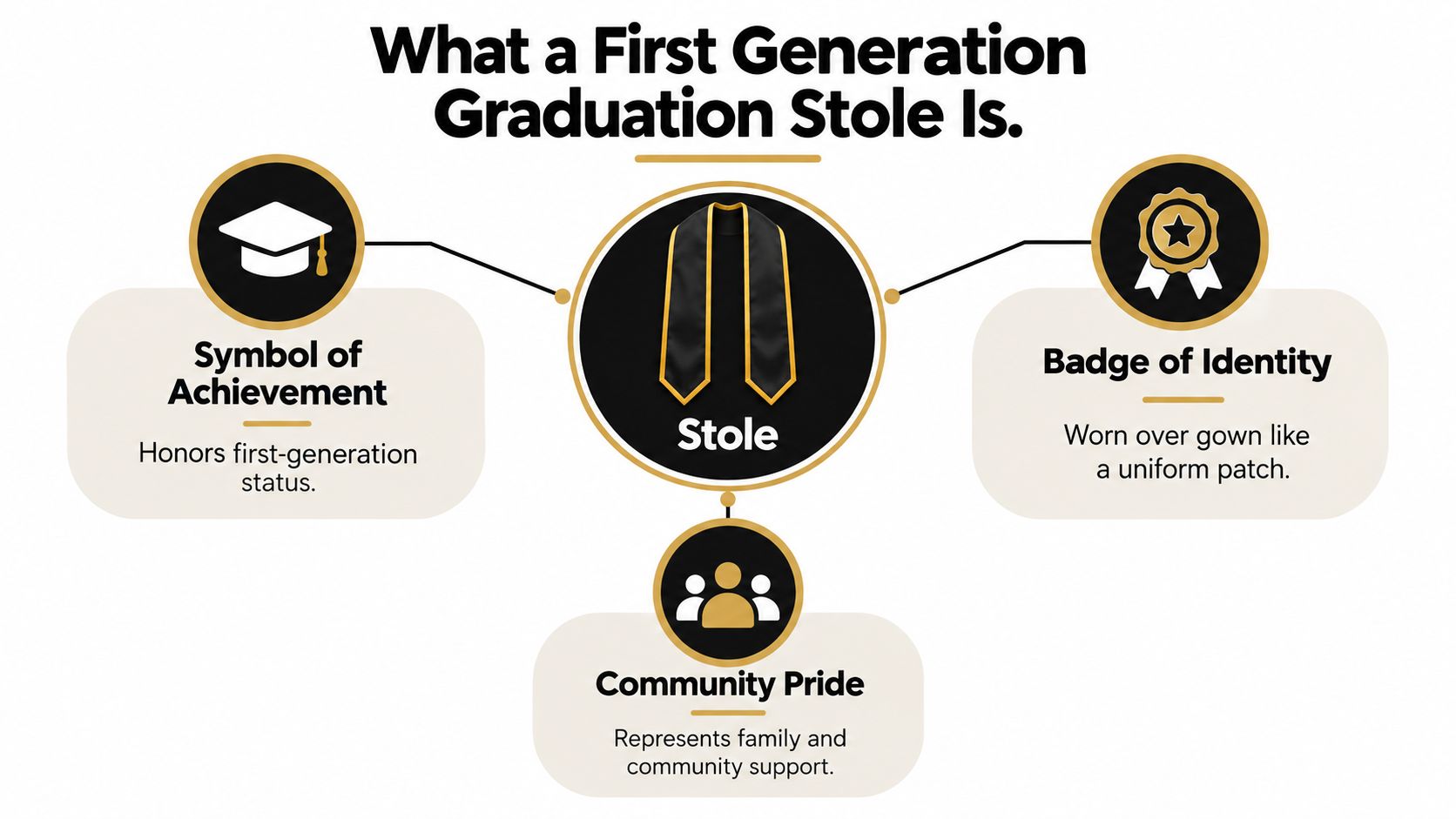
Think of academic regalia as a uniform and the stole as a badge attached to it. The gown establishes the formal setting. The stole adds information about the person wearing it. In this case, it signals first-generation achievement.
The sash usually rests around the back of the neck, with both ends hanging down the front of the gown. Its long, narrow shape gives the school or organization enough space for vertical lettering, trim, seals, or other symbols without covering the entire gown.
How the design communicates first-generation status
A good stole works like a readable sign. High-contrast colors make the lettering easier to see from the audience. Vertical text follows the natural direction of the hanging fabric, while institutional seals or logos add an official connection to the campus.
One documented Michigan State University design uses white fabric with green edging, vertical FIRST GENERATION lettering, and an official seal on the reverse side. The layout demonstrates why schools often use strong contrast, restrained color palettes, and two-sided details. Guests may see one side during the stage walk, while the other side appears in photographs or during a recognition ceremony (Michigan State University's first-generation stoling ceremony).
Eligibility language can differ by institution, so students should check their campus definition before ordering. The University of Colorado Boulder, for example, identifies first-generation stoles as recognition for students who are the first in their family to graduate with a bachelor's or graduate degree (University of Colorado Boulder's regalia recognition information).
Why families connect with the symbol
A diploma confirms that a degree was awarded. The stole communicates part of the journey behind that diploma. It can honor parents who encouraged the student, relatives who provided care, and younger family members who now see college as a more familiar possibility.
The stole doesn't claim that the graduate succeeded alone. Instead, it creates space for the graduate to stand as the person who reached the milestone while recognizing the support surrounding that accomplishment. For a fuller explanation of how graduation stoles carry meaning across different communities, see this guide to graduation stole meaning.
History and Growth of First Generation Recognition on Campus
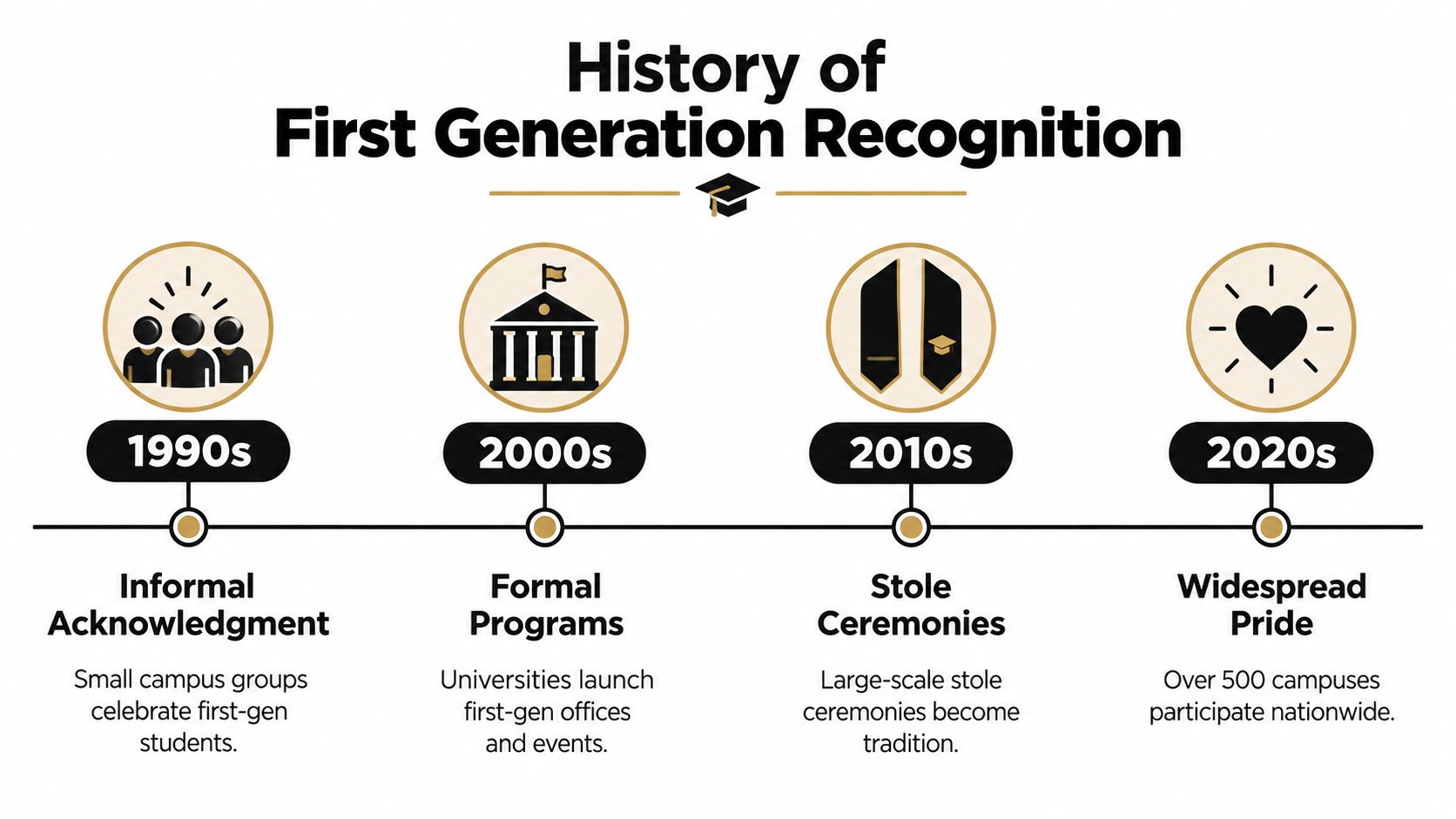
A student once might have received a quiet congratulations from a campus group. Today, many colleges mark first-generation achievement through organized programs, eligibility rules, ceremonies, and dedicated regalia. The shift makes a personal family milestone visible within the larger commencement ceremony.
The change also reflects how many students identify as first generation. A Brookings review reported that over 40% of entering students are first-generation and about one-third of graduating students are first-generation (Inside Higher Ed's review of completion gaps). That scale gives colleges a practical reason to establish clear recognition, rather than leaving students to arrange it independently.
From personal pride to campus tradition
UNC Greensboro illustrates how recognition can become a shared tradition. More than 200 graduates wore first-generation stoles in Spring 2024, while the university reported that around 50% of each class is first in their families to attend a four-year university (UNC Greensboro's first-generation pride coverage).
At that size, the stole serves two purposes. It remains a meaningful family keepsake, and it becomes a practical way for graduates to identify one another during commencement. Families can understand its meaning at a glance, much like a sign that explains an achievement without requiring a speech.
Campus policies also place first-generation stoles among other recognized regalia categories. The University of Colorado Boulder, for example, lists them alongside items such as legacy cords. That comparison shows why students should confirm their school's color, eligibility, approval, and ordering requirements before purchasing a stole.
Why the tradition continues to matter
Completion data helps explain why the recognition carries weight. One analysis of U.S. students who first enrolled in 2011–12 found that 19% of first-generation students attained a bachelor's degree by 2017, compared with 46.6% of continuing-generation students (FirstGen Forward's synthesis of completion data).
Those figures describe an educational pattern, not the whole story of any graduate. They do show why a stole can function as more than decorative fabric. It marks a completed degree within a context where first-generation students have faced different completion outcomes. Canada's 2026 Statistics Canada article also reported graduation rates of 68.60% for first-generation postsecondary students and 73.66% for non-first-generation students, indicating that differences in completion appear across national contexts as well.
For families, the history leads to a simple decision: treat the stole as both a symbol and part of the ceremony's dress code. Check campus rules first, then choose a design that will sit correctly over the gown and remain legible in photographs.
How to Wear Your First Generation Stole With Academic Regalia
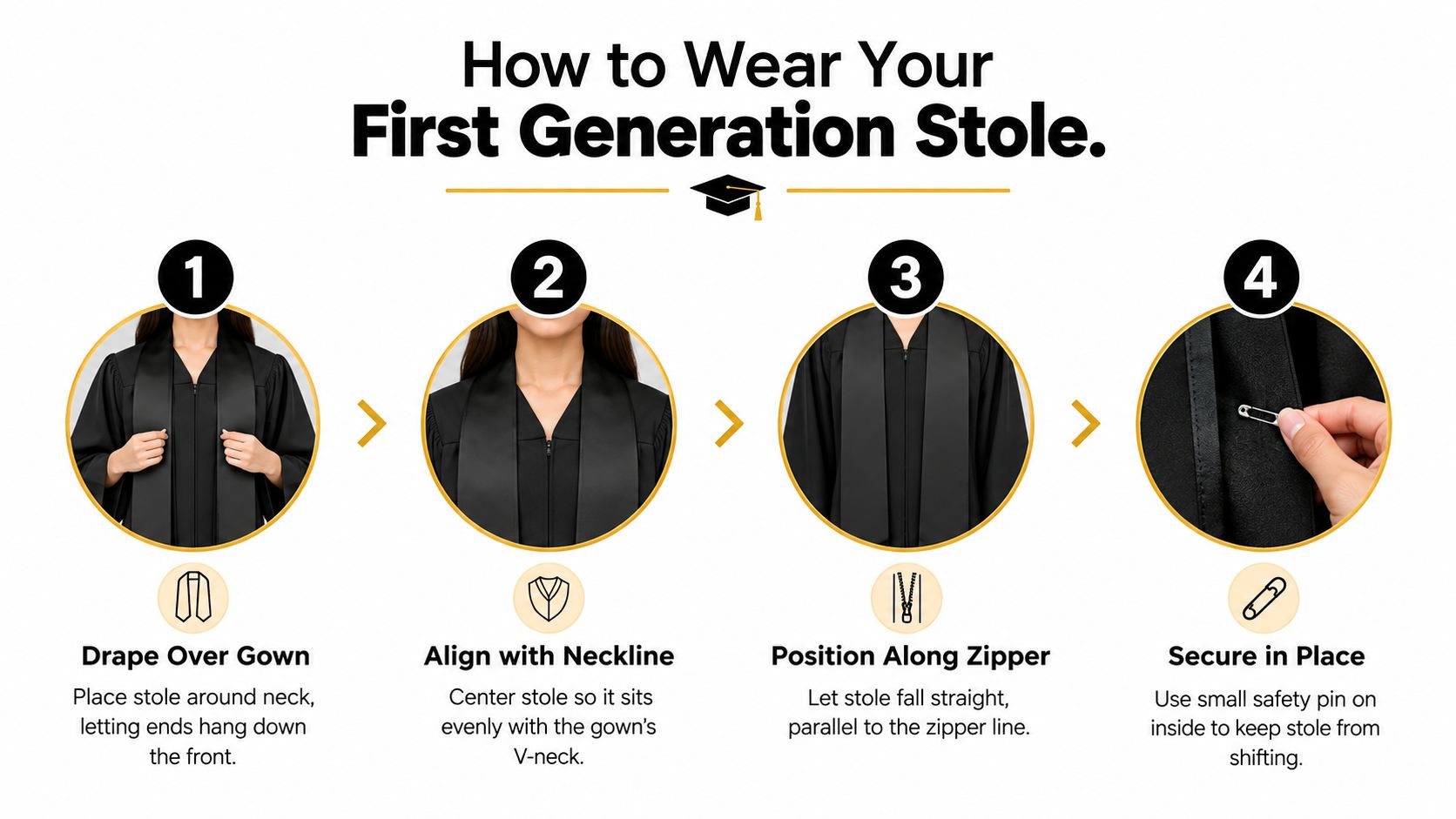
The correct placement is simple. Drape the stole around the back of your neck and let both ends fall over the front of the gown. The ends should hang at an even length, with the stole centered over the gown's neckline and front closure.
Follow these placement checks
- Find the center. Place the middle of the stole at the back of your neck. This prevents one side from appearing longer than the other.
- Align the neckline. Let the stole sit evenly near the gown's V-neck. It shouldn't bunch beneath the collar or twist toward one shoulder.
- Keep the front straight. Allow both panels to fall parallel to the gown zipper or front pleats. Straight vertical lettering will photograph more clearly than lettering that turns sideways.
- Secure the inside if needed. A small safety pin placed discreetly on the inside of the gown can reduce shifting. Avoid pinning through visible lettering, embroidery, or delicate trim.
- Check the back. Ask a family member or friend to look at the rear before the ceremony. Some school seals and double-sided designs are intended to be visible from different angles.
A first-generation stole can be worn with a doctoral hood, master's hood, honor cords, medals, or other approved accessories, but campus protocol controls the final order. If the university gives specific instructions, follow those directions over general styling advice. You'll find additional guidance in this resource on how to wear graduation regalia.
Prepare for the stage and photographs
Put the stole on after the gown is fully zipped and before you add items that may sit over it. Cords can rest on top if your institution permits them, while a hood may overlap part of the stole near the shoulders. The goal isn't to make every item perfectly visible at every moment. The goal is to keep the first-generation text recognizable and the regalia comfortable.
Photography check: Stand in front of a mirror, turn slightly to each side, and ask whether the lettering remains readable. A quick adjustment before lineup is easier than fixing a twisted stole on stage.
Customization Design Sizing and Material Options Explained
A first-generation stole can be official-looking, personal, or a blend of both. Start with the school's requirements, then choose details that support the message rather than compete with it.
Color is usually the first decision. Some universities prescribe a specific palette. The University of Colorado Boulder identifies first-generation stoles as white with gold trim, while a documented Michigan State University design uses white fabric, green edging, vertical wording, and an official seal. These examples show why students should check the campus program before selecting a color independently (University of Colorado Boulder's recognition guidance).
Compare the main design choices
Lettering should be readable before it's decorative. Bold vertical text such as FIRST GENERATION or FIRST GEN tends to work well on a narrow sash. Thin scripts and crowded phrases may lose clarity in group photos, especially when the stole hangs several feet away from the camera.
Institutional details add authority. A university seal, school name, or official trim can make a privately purchased stole coordinate with a campus ceremony. Confirm whether your school permits unofficial colors or logos before adding them.
Personal details add family meaning. A family name, cultural symbol, flag, or short dedication can turn the stole into a keepsake. Use a clear focal point and leave enough open fabric for the first-generation designation to remain obvious.
The common dimensions are practical, not arbitrary. First-generation graduation stoles are commonly about 72–78 inches long, with a typical width near 5 inches. Examples include a 72-inch premium lined stole and a 5 × 78-inch standard fit (first-generation stole sizing examples).
| Option Type | What to Consider | Best For |
|---|---|---|
| School-color stole | Confirm the university's approved color and trim rules | Official campus programs |
| High-contrast text | Choose lettering that remains clear from a distance | Stage photographs and livestreams |
| Institutional seal | Check placement, orientation, and logo permissions | University-sponsored ceremonies |
| Personal embroidery | Keep names or dedications short enough to stay legible | Family keepsakes |
| Lined or satin fabric | Consider how the material drapes and reflects light | A polished formal appearance |
| Standard-length sash | Match the stole to your gown and preferred front coverage | Most traditional regalia combinations |
The custom graduation stole collection can help you compare personalization ideas before committing to a layout. Review the finished design as a flat image if possible. A phrase that looks balanced on a screen may feel crowded once it follows the curve of your shoulders.
Design principle: Let one message lead. “First Generation” should remain easy to identify, while family, cultural, and academic details provide supporting context.
Care Storage Accessibility and Ordering Tips for a Smooth Graduation
A stole usually arrives folded or packaged, so give it time to settle before the ceremony. Hang it in a clean, dry place, or lay it flat beneath a light cloth if the fabric creases easily. Avoid placing heavy items on top, since pressure can flatten trim or leave new folds.
Keep the fabric ceremony-ready
Use the care instructions supplied with the stole. Some materials may tolerate gentle steaming, while others require more cautious handling. Keep the steamer away from printed lettering, embroidery, seals, and glued embellishments until you know how the material reacts.
For travel, place the stole in a garment bag or a clean protective sleeve. Don't leave it loose in a suitcase where shoes, zippers, or cosmetics can mark the surface. After commencement, store it flat or on a wide hanger, away from moisture and direct sunlight.
Accessibility deserves attention too. Students who have limited shoulder mobility, sensory sensitivities, or difficulty fastening garments may prefer a lightweight stole and a discreet inside fastening prepared before lineup. Ask a trusted person to help with centering and securing it, and tell ceremony staff in advance if you need assistance.
Check the campus program before ordering
University recognition programs don't all use the same process. The University of North Texas's 2026 first-generation stole program required students to be completing a degree in Spring 2026 or Summer 2026 at UNT Denton or UNT Frisco, at either the undergraduate or graduate level, and to complete one required engagement activity. UNT also distributed the stoles on a first-come, first-served basis (Jostens' college stole information).
That example gives families a useful checklist:
- Confirm eligibility: Check whether your school defines first generation through parents, guardians, degree level, or another standard.
- Ask about participation: Some programs require an event, workshop, or engagement activity.
- Verify distribution: A campus may provide stoles only while supplies last.
- Plan for personal orders: If the university doesn't supply one, compare size, fabric, color, and customization before placing an order.
- Protect the delivery window: Allow time to inspect the item, remove wrinkles, and resolve any issue before commencement.
The guide to ordering cap and gown also helps families organize regalia purchases alongside the stole, tassel, hood, and other ceremony pieces.
Celebrating Your First Generation Achievement and Next Steps
A first-generation stole can turn commencement into a family milestone. Some graduates wear it during the main ceremony. Others receive it at a separate first-generation celebration, where placing the stole becomes part of the event.
At Elon University, each first-generation student chose a meaningful person to bestow the stole during a 2024 ceremony. The university paired the stole with a keychain engraved with the campus latitude and longitude, tying the keepsake to a symbolic return-to-campus message.
That ritual gives families a clear role. A parent, grandparent, sibling, mentor, or friend can place the stole over the graduate's shoulders. The gesture works like passing a family story from one person to the next, showing that the degree belongs within a continuing family journey.
After commencement, photograph the stole with the diploma and preserve the program. Store the regalia carefully so younger relatives can later ask about its words, colors, and ceremony. Those questions give the graduate a chance to explain the work involved in becoming the first.
The stole also requires a practical choice before ordering. Check your university's color and eligibility rules, then compare the first-generation design with cultural or honor regalia you plan to wear. If you need matching pieces, use Find Your University to search school colors and review first-generation, custom, cultural, and honor-stole collections.
Graduation Cap and Gown offers first-generation stoles, custom graduation stoles, caps, gowns, cords, medals, and other regalia for commencement. Visit Graduation Cap and Gown to compare school colors, individual pieces, and complete packages, then choose a first-generation stole that reflects the academic milestone and family legacy.