

You're standing in your cap and gown, checking the mirror before the ceremony, and the standard black regalia suddenly feels incomplete. The vibrant sash over another graduate's gown catches your eye. You may be wondering what it represents, whether it's appropriate for your ceremony, and how to tell a Ghanaian Kente stole from a printed imitation.
A Ghana graduation stole can mark academic achievement while honoring cultural heritage, family support, resilience, and identity. It's more than a bright accessory added for photographs. The textile behind the tradition has a long Ghanaian history, and its modern academic use gives graduates a way to connect personal success with a broader legacy.
The central idea: A Kente stole should be chosen and worn as a meaningful symbol, not treated as a generic satin sash.

This guide covers the stole's origins, the meaning of its colors, practical ways to assess authenticity, correct placement over a gown, preservation, and buying considerations. For a broader introduction to the symbolism, see this guide to Kente stole meaning.
Introduction What Makes a Ghana Graduation Stole Special
A standard graduation stole often identifies an honor society, academic organization, school group, or special achievement. A Kente stole can do those things too, but its visual language begins somewhere deeper. Its colors, woven structure, and cultural lineage connect the ceremony to Ghanaian textile traditions and to the experiences of African and African diaspora communities.
That distinction matters on a day when most graduates wear similar robes. The gown creates a shared academic setting, while the stole gives the graduate room to express a personal and cultural story. For one student, it may honor parents or grandparents. For another, it may recognize African heritage, a first degree in the family, or the sacrifices that made graduation possible.
The textile most associated with this tradition is Kente, a multicolored cloth with iconographic designs linked to the Ewe and Akan peoples of Ghana and Togo. Kente has also been described as a royal textile, which helps explain why it carries a sense of ceremony and distinction rather than looking like ordinary fabric.
A Ghana graduation stole isn't automatically authentic simply because it uses Kente-like colors. The buyer still needs to ask how it was made, where it came from, and whether the seller clearly distinguishes handwoven cloth from printed fabric. Respectful wear also requires attention to context. Graduation is a setting centered on achievement and recognition, but the wearer should understand the heritage represented by the design.
You don't need to memorize every pattern before commencement. You do need enough context to choose thoughtfully, explain what you're wearing, follow your school's rules, and treat the stole as a keepsake rather than a disposable prop.
What a Ghana Graduation Stole Is and Where It Comes From
Suppose a graduate steps onto the commencement stage in a plain academic gown, then adds a bright woven sash across the shoulders. That sash is a graduation stole, a long, narrow piece of regalia worn from the back of the neck with both ends falling down the front. A Kente graduation stole gives this familiar academic form a connection to Ghanaian textile heritage.
The distinction matters at the point of purchase. A Ghana flag sash uses national colors and imagery. A Kente stole refers to a textile tradition shaped by weaving methods, colors, patterns, and cultural history. Some products blend these ideas, while others use printed fabric that only resembles Kente. Read the description carefully, and ask whether the cloth is handwoven, printed, or Kente-inspired.
From woven cloth to academic regalia
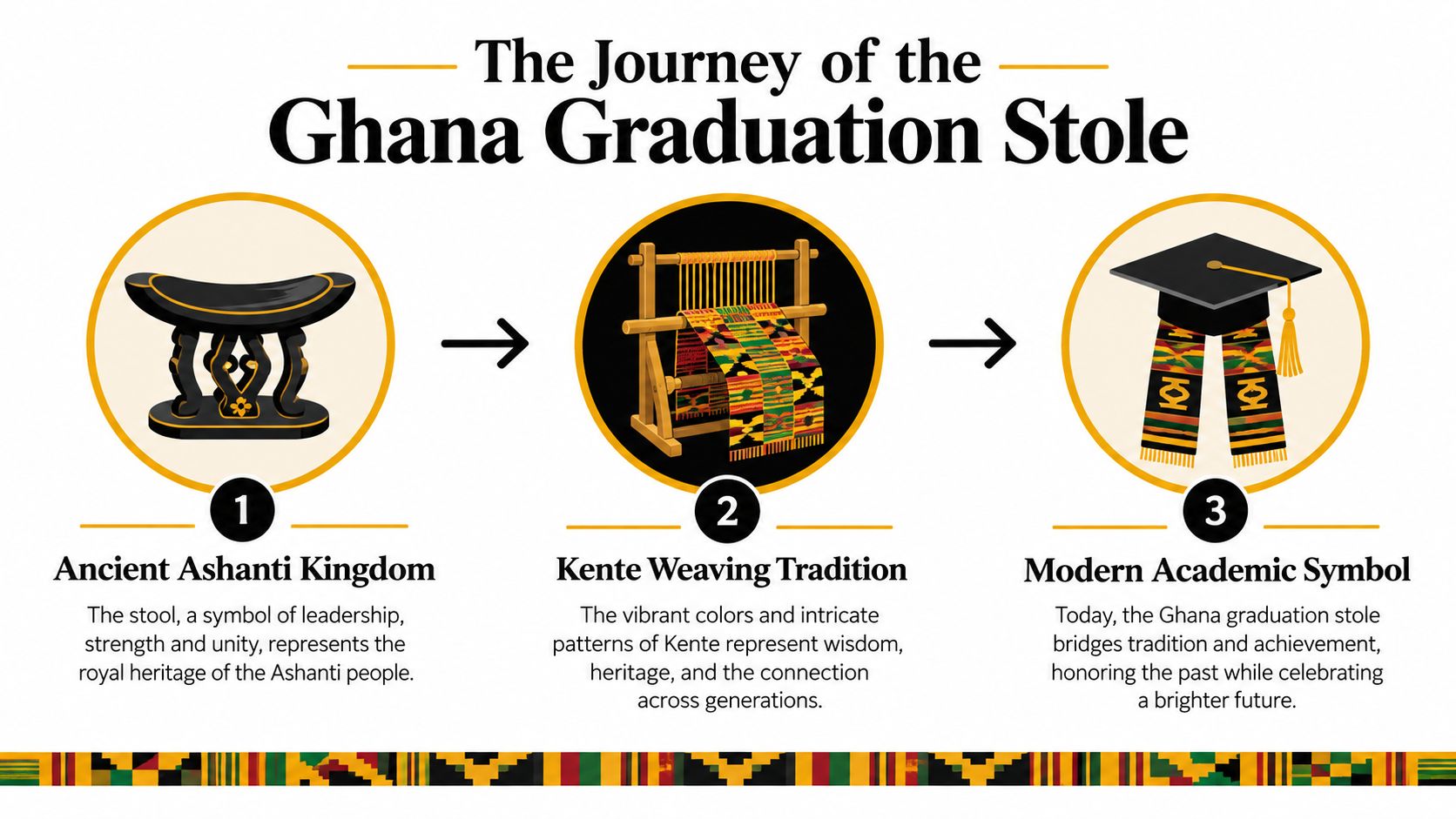
Kente is a West African textile associated with the Ewe and Akan peoples of Ghana and Togo, with multicolored designs and iconographic patterns that originated about 400 years ago. Its design works like a visual language. Color, geometry, arrangement, and inherited motifs communicate ideas without written text. The University of North Carolina at Charlotte describes Kente as a symbol of achievement.
Educational and cultural accounts also describe Kente as a centuries-old royal textile associated with kings, queens, and important state figures in Ghana. Its ceremonial character helps explain why a Kente stole can feel more significant than an ordinary decorative sash. Graduation use in the United States developed during the 1970s as a visible expression of African heritage, connecting academic recognition with a wider African and African American cultural story.
The modern commencement tradition
The U.S. academic use of Kente was formalized in 1993 at West Chester University of Pennsylvania, when four faculty members created a pre-commencement “Donning of the Kente” ceremony for African American students. The history of HBCU graduation stoles places this ceremony within the broader development of Kente stoles and academic recognition.
That ceremony also clarifies why the stole may be placed on a graduate by a mentor, family member, professor, or community supporter. The gesture makes the sash a visible reminder that a degree can reflect collective encouragement, sacrifice, and persistence.
For families choosing one, the clearest description is this: the stole is academic regalia made meaningful through Ghanaian textile heritage. Choose a piece whose construction and origin are explained clearly, wear it in a setting that recognizes achievement, and treat it as a keepsake rather than a costume.
The Meaning Behind Kente Colors and Patterns
Kente colors can help a graduate choose a stole that reflects a journey, a value, or a connection to family. They shouldn't be treated as a rigid code that makes one design correct and another incorrect. Meanings can vary by tradition, design, and context, but the commonly cited associations provide a thoughtful starting point.
Gold or yellow may speak to the value of education and the dignity of achievement. Green can suit a graduate entering a new phase of growth. Red may acknowledge struggle and sacrifice, while blue can express peace, harmony, or the support of a community. Black often connects maturity with ancestral energy, and white can mark purity and victory.

Kente color meanings for graduation stoles
| Color | Symbolic Meaning | Common Graduation Use |
|---|---|---|
| Black | Maturity and ancestral energy | Honoring heritage, growth, and the journey behind the degree |
| Red | Sacrifice and struggle | Recognizing challenges, perseverance, and commitment |
| Gold or yellow | Royalty and wealth | Celebrating achievement, value, and distinction |
| Green | Growth and renewal | Marking a new chapter and future development |
| Blue | Peace and harmony | Representing community, balance, and supportive relationships |
| White | Purity and victory | Celebrating completion, success, and a fresh beginning |
These associations are summarized in Kente color symbolism. Use them as a reflection tool. A graduate who feels that red represents the sacrifices made by family may choose a design with strong red accents. Someone focused on renewal after completing a difficult program may prefer green. Another graduate may choose colors that connect with a family tradition rather than a personal interpretation.
Patterns add another layer. Kente designs are not random decoration, and many are connected with proverbs, values, or historical ideas. You don't need to claim a specific pattern meaning unless the seller or a knowledgeable cultural source identifies it clearly. If a product page only lists colors and calls the fabric “Kente style,” treat that as a visual description, not proof of a traditional pattern interpretation.
For more guidance on the difference between cultural symbolism and general academic recognition, explore this resource on graduation stole meaning.
How to Spot an Authentic Ghana Kente Stole
The most important buying question isn't “Does this look like Kente?” It's “What exactly am I buying?” A Ghana graduation stole may be handwoven in Ghana, printed with a Kente-inspired design, or made from another fabric that borrows Kente's visual appearance. Those options can serve different needs, but a seller should describe them accurately.
One supplier description states that its stoles are individually handmade in Ghana, West Africa, from 100% rayon fabric. That tells you about the stated material and production claim for that product. It doesn't mean that every authentic Kente textile is rayon, or that rayon alone proves Ghanaian origin.
Compare construction, not just color
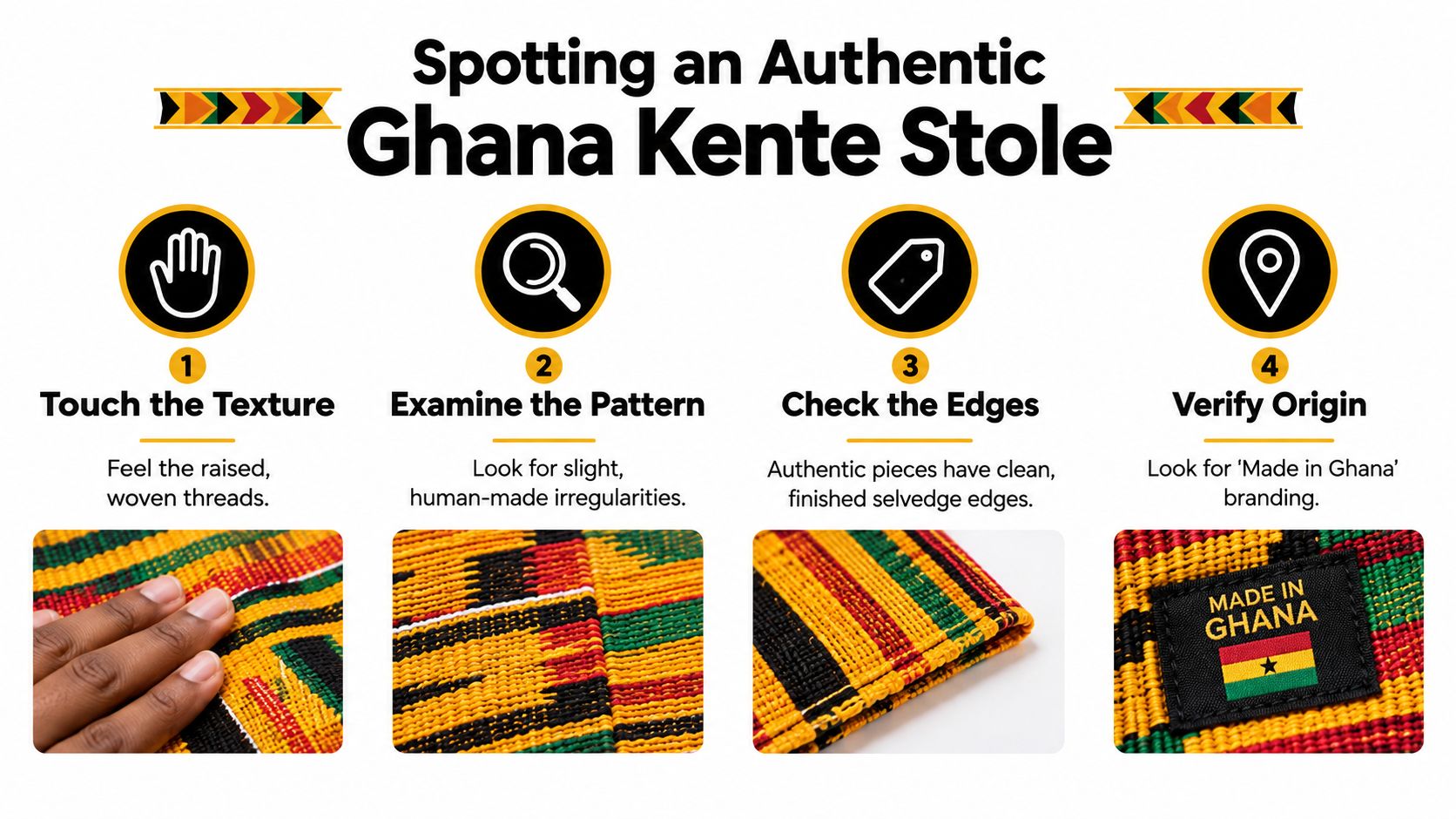
A handwoven textile usually gives you more to examine than a printed surface. Look at the texture, the reverse side, the edges, and the way the colors sit within the fabric. A printed lookalike may reproduce a familiar pattern on a smooth surface, but the visual resemblance doesn't establish the same construction or provenance.
The distinction also matters because Kente has been recognized as a geographical indication of Ghana. Under that protection, the name is reserved for cloth woven with traditional techniques in approved Ghanaian communities. A product using broad phrases such as “Ghana flag graduation stole,” “international stole,” or “hand-woven in Ghana” should therefore be evaluated through its specific description and origin information.
Use this checklist before ordering:
- Read the material description: Confirm whether the item is handwoven cloth, printed fabric, rayon, satin, or another stated material.
- Check the origin claim: Look for clear information about Ghanaian production rather than relying on a product title alone.
- Inspect the construction: Ask whether the fabric has a woven texture, finished edges, and a distinct reverse side.
- Request clarification: If “authentic Kente” appears without details, contact the seller and ask what the claim means.
- Separate design from provenance: A Kente-inspired print can be attractive, but it shouldn't be presented as handwoven Ghanaian Kente without support.
The web contains many product listings but fewer neutral explanations of authenticity and respectful use. This Ghana flag graduation stole listing illustrates why shoppers should distinguish a Ghana flag sash from claims about traditional Kente cloth.
If you're comparing construction visually, this video can help you think about what to examine:
How to Wear and Style Your Ghana Stole With Cap and Gown
A well-chosen stole can still look untidy if it sits too high, twists at the neck, or competes with other regalia. Put on the gown first, zip it fully, and smooth the shoulders before placing the stole. Then drape the center evenly behind your neck so both ends hang at similar lengths down the front.
The most reliable placement is simple:
- Center the stole: Find the midpoint and place it at the back of your neck.
- Keep both sides even: Let the ends fall parallel to the gown's front opening.
- Set the height: Position the fabric so it lies neatly on the chest without crowding the hood or collar.
- Check movement: Walk, sit, and raise your arms briefly to make sure the stole won't slide.
- Secure discreetly: If your school allows it, use a small hidden pin at the back rather than pinning through a prominent woven area.
Follow institutional protocol
Your university may treat cultural regalia as personal attire, or it may regulate what can be worn at commencement. Ask the registrar, commencement coordinator, department, or cultural program before ordering a customized piece. Confirm whether the school permits multiple stoles, embroidery, honor cords, medals, or symbols from student organizations.
The University of Ghana provides a useful example of formal regulation. Its instructions place the stole facings below the collarbone without overlapping and pair specific colorways with degree categories, including white-and-black for Arts, Science, Public Health, and Fine Arts, yellow-and-black for Medicine and Dental Surgery, and red-and-black for Law. The University of Ghana's gown-wearing guidance shows that a Kente stole can function as a regulated academic identifier, not merely decoration.
Build a balanced ceremony look
If you're wearing a hood, honor cords, or a medal, place each item so the stole remains visible. Avoid layering thick items directly under the neck area, where they can bunch the fabric. For clothing beneath the gown, a simple neckline keeps attention on the regalia. If you're still choosing your ceremony outfit, this guide on where to find a long-lasting graduation dress offers another practical wardrobe reference.
Your school's general guidance on how to wear graduation regalia can help you check the gown, hood, cap, and stole together before the ceremony. Take a test photograph in full regalia. Camera angles often reveal a crooked center or uneven ends before you reach the stage.
Caring for Your Kente Stole Before and After Graduation
Treat the stole as a textile keepsake, especially if it's handwoven or made from rayon. A washing machine, strong detergent, bleach, or aggressive rubbing can distort the weave, damage fibers, or affect the color. Start with the care label and the seller's instructions, because the safest method depends on the stated material and construction.
For a small mark, blot gently with a clean cloth and cool water. Don't scrub across the woven surface. If the item needs more extensive cleaning, professional textile cleaning is safer than experimenting with household chemicals.
A simple preservation routine
- Handle it with clean hands: Oils and residue can transfer to light-colored areas.
- Avoid direct heat: Don't place an iron directly on the weave. If pressing is necessary and the care instructions permit it, use low heat with a protective cloth between the iron and fabric.
- Air it before storage: Make sure the stole is completely dry before folding or packing.
- Choose a cool location: Keep it away from direct sunlight, humidity, and cramped storage.
- Use protective wrapping: Acid-free tissue or a suitable archival box can reduce dust and friction.
For display, a shadow box can hold the stole with a tassel, photographs, or other graduation memorabilia. For storage, fold along natural lines without compressing it under heavy items. If you travel with it, place it flat between soft layers rather than stuffing it into a small bag where the fabric can crease.
Where to Buy and Customize Your Ghana Graduation Stole
Your purchase should reflect the story you want the stole to carry. Choose among a handwoven Ghanaian Kente stole, a Ghana flag sash, or a Kente-inspired printed design. Then check the material, origin statement, dimensions, customization choices, delivery timing, and your school's regalia policy.
Graduation Cap and Gown lists cultural and academic accessories through its online store, including Ghana flag sashes, Kente options, custom stoles, honor cords, and other graduation pieces. Its Find Your University feature helps shoppers check school information, while size and fabric guides clarify fit and appearance. Departments, cultural organizations, and ceremony coordinators should ask about bulk ordering and delivery choices before ordering.
Match the product to the story
A Ghana flag stole places national identity at the center. A Kente stole communicates Ghanaian heritage through its woven visual language and its connection to African and African diaspora achievement. A custom stole may include a name, degree, organization, or approved detail. Keep personalization secondary to the textile's design, especially when the pattern itself carries cultural meaning.
Authenticity deserves a closer look. A handwoven Kente stole should identify its Ghanaian origin and explain its material or weaving method. Printed fabric may reproduce Kente colors and motifs without being woven Kente, so read the product description instead of relying on a photograph. If a seller gives no origin statement, construction details, or clear fiber information, ask before buying. Ghana's geographical indication also matters because it connects qualifying products to their Ghanaian place of origin, rather than treating every Kente-style print as equivalent.
Use where to buy graduation stoles as a planning reference, then compare the listing with your institution's requirements. Order early enough to inspect the stole, test its position over the gown, and resolve sizing or customization concerns before commencement.
Wearing the stole at commencement is appropriate when it reflects your identity, achievement, community, or an approved cultural recognition. Wearing a Ghanaian textile as a costume, or presenting a printed imitation as handwoven Kente, can turn appreciation into performance. Ask what relationship you have to the tradition and whether your school or community has guidance for its use.
For an accessory outside commencement, you might find a refined pashmina wrap. A wrap serves as a fashion layer, while a Ghana graduation stole is academic regalia with cultural meaning and ceremony-specific use.
Graduation Cap and Gown also lists Ghana flag sashes, Kente and other cultural stoles, custom graduation accessories, and academic regalia for students, families, and ceremony organizers. Visit Graduation Cap and Gown to compare options, confirm fit and fabric details, and select a stole that respects both your achievement and the tradition you wear.