

You're at the edge of the stage with a hinged folder in both hands. A relative reaches for it, the photographer wants one more shot, and the sheet inside either lies flat or buckles at the first turn. That folder is a diploma cover, a fitted jacket for one sheet of paper. School colors are the uniform. The lining is what touches the credential.
A handsome cover is a ceremony and short-term handling tool, not an archival enclosure. Fit decides whether the paper survives the handshake, the photos, and the ride home. Color is the easy choice. Size is the deciding factor, because schools don't share one paper size, and one university can change dimensions by printing date or by professional degree.
Before you shop, write down the school, the degree, the graduation year, and the paper's measured width and height, including any seal or ribbon that sticks past the sheet.
What a Diploma Cover Actually Does
Say you walk off the stage and the diploma is still in the folder. If the pocket is right, the sheet faces forward for the handshake and the family photo. If the pocket is wrong, a corner folds under the seal before you reach the aisle.
A diploma cover is a presentation and handling folder, usually padded, with a pocket, photo corners, or a sleeve. It keeps one document facing forward for the handshake, the photos, and the ride home. It isn't the credential. It isn't a frame. It isn't a home for the next few decades.
The jacket has to fit the sheet
Think of the cover as a jacket cut for one piece of paper.
- Too small: the paper bends at the seal, or a ribbon gets crushed against the hinge.
- Too loose: the sheet slides, then creases where the folder closes.
Color follows the gown or the school palette, so it feels like the obvious decision. Fit is the decision that protects the document. Schools don't print on one shared size, and a single university can revise its sheet by printing date. Rice University is the clearest preview of that problem. Diplomas from different years at the same school can need different covers, which is why a label that says "standard" is only a starting guess.
You'll sort this in a practical order. First comes the paper size and which way the sheet faces. Then come styles, linings, and school colors. After that, separate the walk across the stage from long-term keeping. If the folder shows up empty or late, there's a different set of choices. If the diploma itself is lost or damaged, the registrar, not a retailer, controls the replacement.
Practical rule: Write the school, degree, graduation year, and the ruler measurement of the sheet, and include anything that sticks past the paper.
That note is the whole job before you click an order button. A seal, a ribbon, or a thick corner mount can turn a "close enough" pocket into a bend.
Diploma Sizes That Decide the Cover
A 17-by-14-inch diploma and an 8.5-by-11-inch diploma need different pockets, even if both carry the same degree title. Measure the actual sheet, then check the cover's interior dimensions. The paper and pocket are separate measurements. A seal, ribbon, corner mounts, or hinge may also take up room, so the document should fit without folding or pressing against the closure.
Diploma dimensions can vary by school, degree, and printing year. Rice University's registrar lists diplomas printed before November 1, 2017, at 18 by 23 inches and those printed on or after that date at 17 by 23 inches. Other sizes include 8.5 by 11 inches, 11 by 14 inches, and 11 by 17 inches, but none is a universal standard. A tight cover can bend the sheet; a loose one can let it slide and crease.
Diploma paper sizes that change the cover
| Example | Who it fits | Paper size | Cover note |
|---|---|---|---|
| Common letter format | Many certificates and some degrees | 8.5 x 11 in | A starting point, not a guarantee |
| Cornell and Florida State | Diplomas those schools specify at 11 by 14 | 11 x 14 in | Match vertical or horizontal orientation to the pocket |
| University of Scranton graduate | Graduate diplomas | 11 x 14 in | Bachelor diplomas at Scranton are larger |
| University of Pennsylvania | Current diploma | 9 5/8 x 12 1/4 in | Not letter size and not 11 by 14 |
| Penn State medicine | Medical diplomas | 14 x 17 in | Check which edge is the width |
| Penn State law | Law diplomas | 17 x 14 in | Horizontal rather than vertical |
| University of Scranton baccalaureate | Bachelor's diplomas | 16 x 20 in | Requires a larger presentation cover |
| Rice before November 1, 2017 | Alumni of that printing era | 18 x 23 in | Printing year determines the size |
| Rice on or after November 1, 2017 | Later Rice diplomas | 17 x 23 in | Larger than letter size |
Traps that a degree name won't catch
At some schools, one diploma size covers several degree levels, while professional programs use a different sheet. That makes the degree name an incomplete sizing guide. Measure the paper or ask the school for its current dimensions.
Penn State, for example, lists 14 by 17 inches for medical diplomas and 17 by 14 inches for law diplomas. The measurements use the same two dimensions in a different order, which signals a different orientation. Record whether the sheet sits vertically or horizontally before choosing a pocket. A cover can have enough area on paper and still be the wrong fit if its opening faces the wrong way.
Other examples show why one school's size cannot stand in for another's. Scranton graduate diplomas measure 11 by 14 inches, while its baccalaureate diplomas measure 16 by 20 inches. The University of Pennsylvania lists a current diploma measuring 9 5/8 by 12 1/4 inches. Cornell and Florida State specify 11 by 14 inches. School, degree type, and printing year can all change the measurement.
Graduation Cap and Gown recommends checking with your school for the correct diploma cover color and size, or measuring the diploma yourself. For a department or group order, use the school's dimensions or a sample diploma rather than guessing from the degree level. The cover is a ceremony and short-term handling tool, not an archival enclosure. A fitted pocket helps keep the sheet in place during presentation, but it does not make the cover a long-term storage solution. If you later want to display the credential, a diploma frame with a picture is a separate fit decision. Before ordering, note the school, degree type, printing year, orientation, and actual paper dimensions.
Styles Materials and School Colors
At commencement, a diploma cover is a fitted jacket for one sheet of paper: the outside sets the ceremony's look, while the lining and pocket sit closest to the credential. School colors make the folder part of the event, but the material touching the diploma matters more for handling.
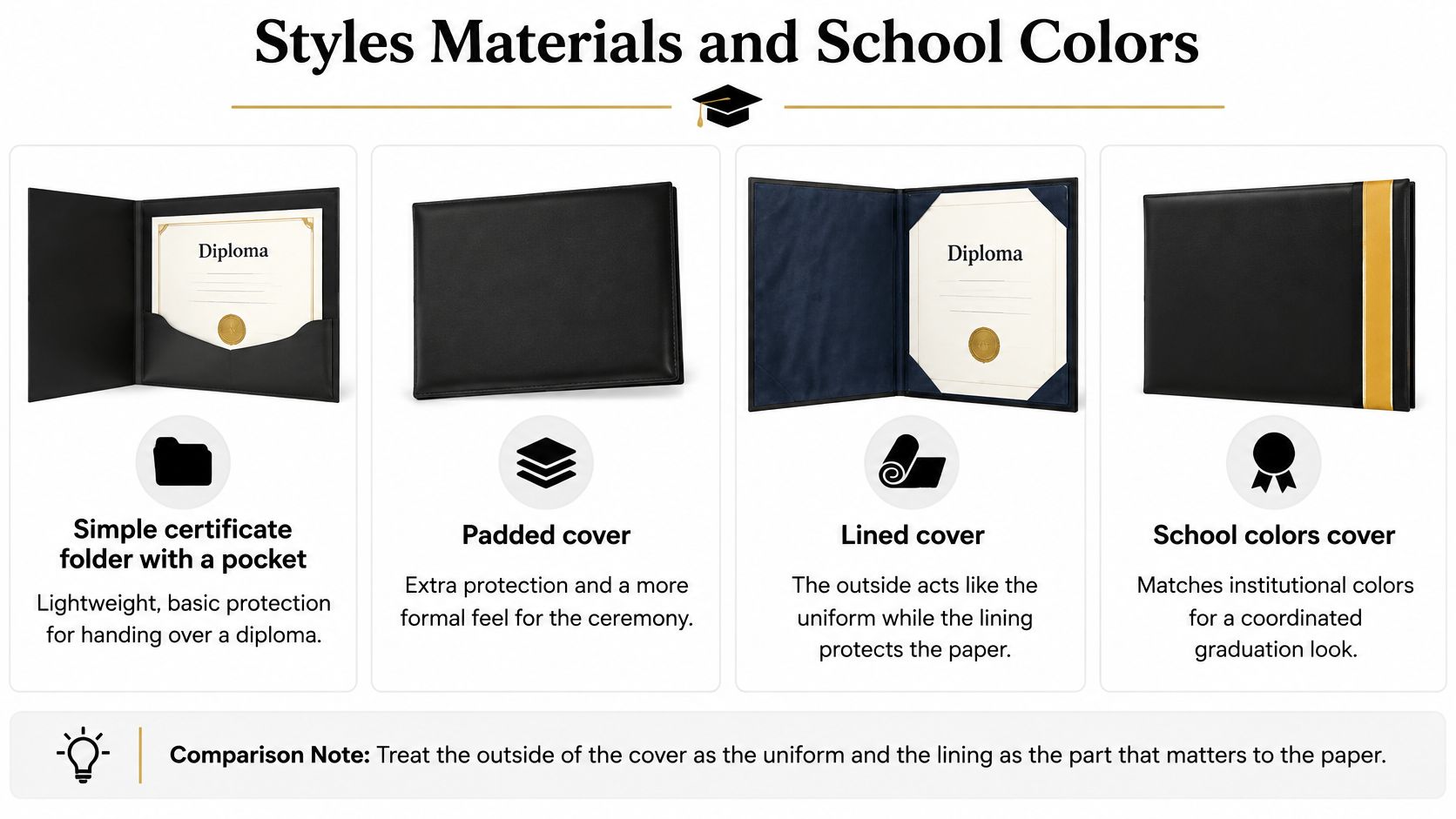
Four covers you'll actually meet
A simple certificate folder is lightweight and has a basic pocket. It suits a short handoff, though it provides less padding when other items are stacked on top.
A padded diploma cover has a hinged spine and a more formal feel. The padding softens everyday bumps, while the hinge helps the sheet face forward when the folder opens for a photograph.
A clear window displays the graduate's name without opening the folder. It also leaves the diploma closer to scuffs and light, and can hold warmth against the paper.
A solid cover keeps the diploma out of view until the folder opens. It gives up the instant name display, while its closed front can take handling and show foil or a school seal.
Match the cover to the ceremony, and consider what its lining touches.
What the outside is made of
Leather-like vinyl or polyurethane is a common lightweight surface that can be foil-stamped. Cloth or linen has a softer, less shiny appearance. Genuine leather can darken or crease with handling. These exterior materials affect the look and feel, not the interior fit. Foil, a school seal, and a year or degree line are surface details.
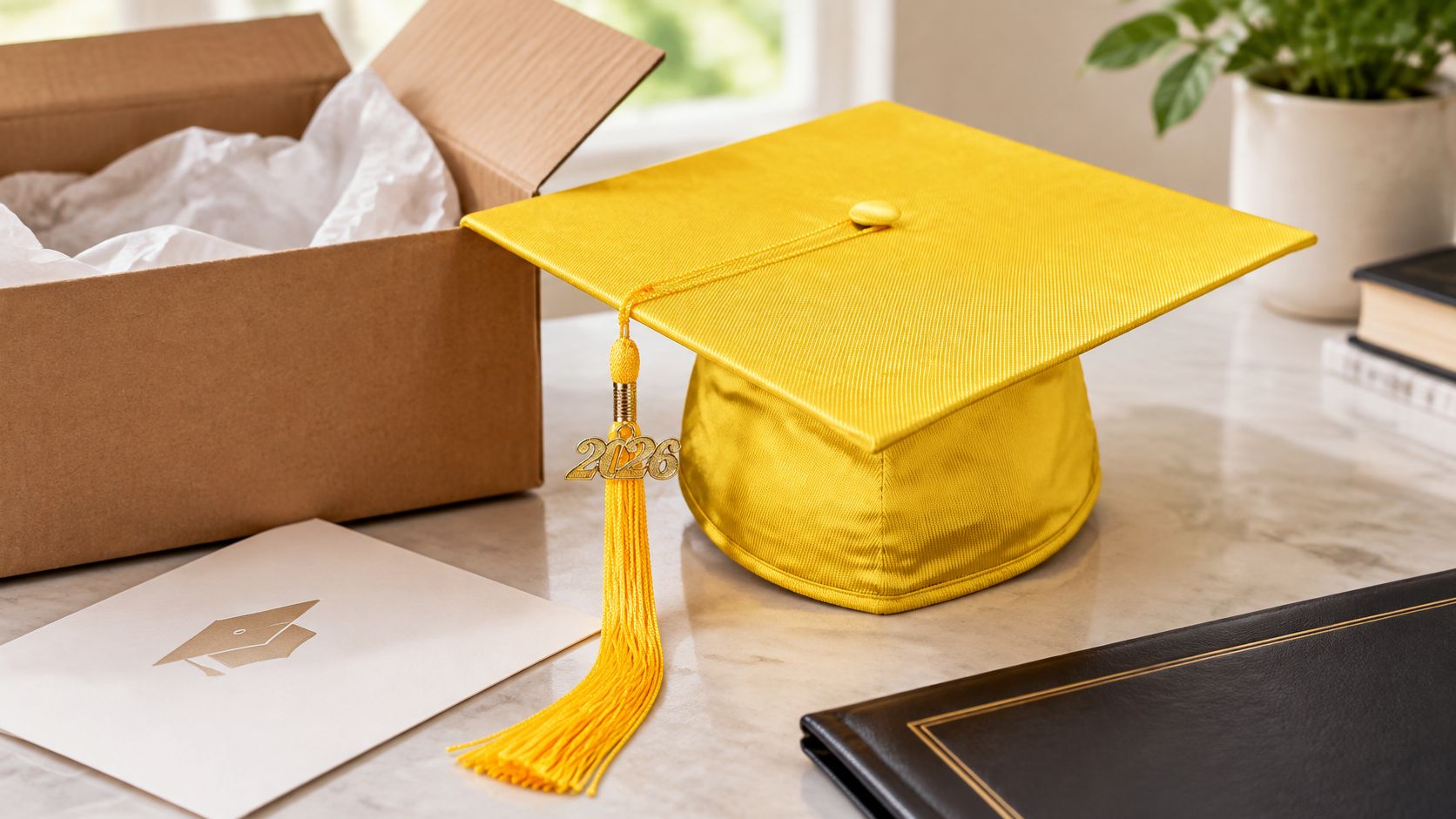
School colors often follow the ceremony palette or the colors already used on gowns and hoods. If the school has no rule, black, navy, and burgundy are formal choices. A matching cap can complete the look, but it serves a different purpose from a diploma cover. Graduation Cap and Gown lists the Shiny Gold High School Cap & Tassel - Graduation Caps as a cap-and-tassel option.
A polished cover is a ceremony and short-term handling tool, not an archival enclosure. A clear window or attractive lining may look protective without being suitable for long-term contact with paper. Keep style decisions focused on how the folder looks and opens; consider the materials touching the diploma when deciding how to store it.
For a formal walk across the stage, a padded, closed cover gives the diploma a neat presentation and a buffer during handling. Choose a window when displaying the name matters more. A short look at how a cover opens and closes makes the hinge and pocket easier to picture.
Ceremony Use Versus Long-Term Storage
A graduate carries the diploma across the stage, then brings it home in a handsome cover. That folder can protect the paper during the ceremony and short-term handling, but it is not an archival enclosure. A cover may look protective while its lining, window, or adhesives are unsuitable for long-term contact.
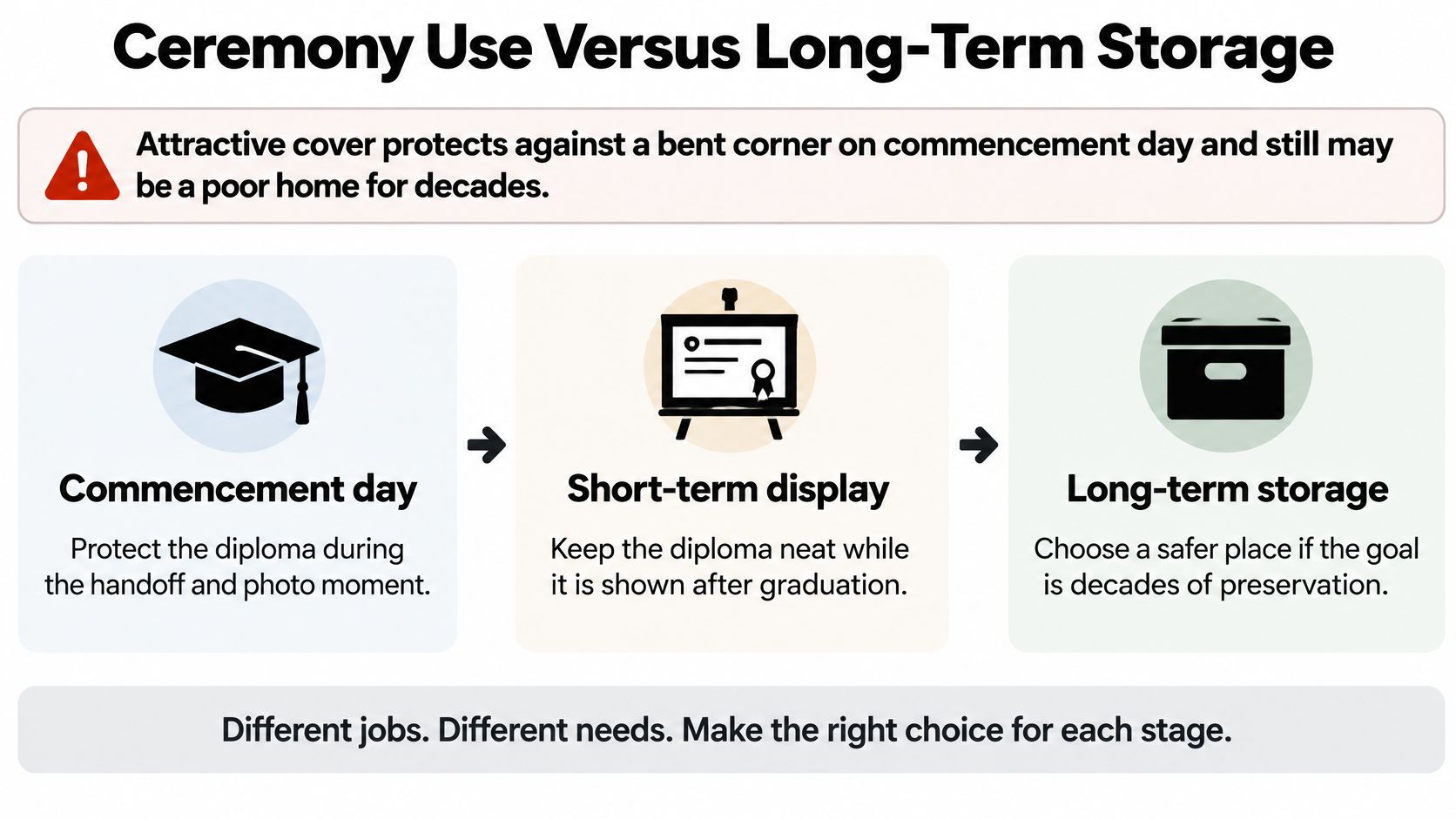
For storage, the material touching the diploma matters as much as the outside of the cover. The University of Oklahoma's archival processing guide describes how to handle and store documents by format. Use acid-free, lignin-free supports, a rigid enclosure, and flat storage where appropriate. Limit exposure to light and avoid places with swings in humidity and temperature. Paper and coatings can discolor, distort, or stick to non-archival plastic or acetate, particularly in warm or damp conditions.
Three jobs, three homes
Ceremony transport is for carrying the diploma safely through the event. Hold the cover by its edges, and keep tape, glue, staples, and paper clips away from the document. Avoid pressing a seal against the lining while posing for photos.
Display calls for a frame or shadow box with an archival mat, backing, and glazing. The diploma usually should not remain clamped inside a decorative cover within the frame. A wood diploma frame can present the credential, but it does not make the ceremony folder an archival box.
Archival storage means choosing an enclosure suited to the document and storing it in a stable place. The University of Oklahoma guide notes that framed diplomas are generally removed from hard frames for archival care. Larger documents belong in flat boxes, while letter- or legal-size items can stand in folders. At home, store a large diploma flat rather than leaning it upright, and avoid attics and basements where conditions can fluctuate.
If you do not know what the lining, window plastic, or adhesive is made of, place acid-free tissue between the diploma and the cover for temporary keeping. Then transfer the sheet to a suitable folder or box. The school, not the cover, verifies seals, signatures, serial numbers, watermarks, or QR checks.
Use the ceremony cover for the walk and photos. Give the diploma a separate home for long-term storage.
When the Cover Arrives Empty or Late
You arrive for the ceremony expecting a diploma, but the folder holds only a program. Distribution depends on the school and event, so graduates in similar programs may receive their covers in different ways. Treat the cover as a fitted jacket for the ceremony copy, and confirm what will go inside before ordering or traveling.
The University of Wisconsin–Madison spring graduation page describes different arrangements: some graduates collect covers from a bookstore, while doctoral covers are distributed at a ceremony. The University of Oklahoma offers mailing for graduates who cannot attend in person. If you miss the lineup, ask the registrar whether the folder will hold the official diploma or serve as a ceremonial cover while the document is mailed later.
What you may print on the outside
Personalization comes after confirming the contents. A name, degree, year, school name, or seal identifies the ceremony copy in photos; spell the graduate's name as they want it shown. The cover does not need to repeat every line printed on the diploma.
- Attending with the official diploma: Measure the sheet and match it to the pocket. The cover helps handle the document during the ceremony.
- Attending with an empty or ceremonial folder: Keep programs, photocopies, and thick cards out of a pocket fitted for the diploma unless the school permits that insert.
- Ordering from home after the ceremony: Check the shipping and tracking details before choosing when to order, so the folder can arrive for photos. Confirm whether it is meant for the official document or a ceremony stand-in.
Paper and a digital record side by side
Keep the cover for the printed ceremony copy even when a digital record exists. If the official document is provided digitally, follow the registrar's instructions for saving or printing it, and use a cover for a printed copy only if the school allows one. A school's verifiable file and the cover have different jobs: the file provides the digital record, while the cover presents and carries the paper copy.
Accessibility arrangements are separate from the folder. Ask the university about wheelchair access or sign-language services, then choose a cover you can hold by its edges while seated or moving. The lining touches the credential, so avoid gripping the cover in a way that presses on the seal.
Replacing a Lost or Damaged Diploma
A replacement diploma may document the same degree without being an exact twin of the original. Drexel University says its replacements include an embossed statement identifying them as replacements, current officials' signatures, and the original conferral date. The University of Pennsylvania also places current officials' signatures and a dated replacement statement on its diplomas.
Fees and waits are school rules
Each registrar sets its own process, cost, and timing. The Ohio University registrar requires a notarized statement for a diploma that was lost, destroyed, never received, or affected by a legal name change. The fee is $15, and the university advises allowing six weeks. For other schools, check directly with the registrar for current fees and processing estimates.
Replacement diploma fees and waits
| School | What changes or is required | Fee |
|---|---|---|
| Ohio University | Notarized statement if lost, destroyed, never received, or tied to a legal name change | $15 |
| University of Scranton | Check replacement requirements and processing time with the registrar | Contact the registrar |
| University of Southern California | Check replacement requirements and processing time with the registrar | Contact the registrar |
| Drexel University | Embossed replacement statement, current signatures, original conferral date, not an exact duplicate | Contact the registrar |
| University of Pennsylvania | Current officials' signatures and a dated replacement statement | Contact the registrar |
Start with the school's registrar. A retailer cannot issue a school credential, and Graduation Cap and Gown does not provide replacement diplomas. If the issue is instead a cover ordered in the wrong size, review the refunds and returns policies. Those policies address the product, not the diploma itself.
Until a replacement arrives, keep the original flat, dry, and away from direct sunlight. A replacement may bear current signatures and a statement identifying it as a replacement, so it may not look exactly like the first document. A fitted cover can help with ceremony handling, while long-term preservation calls for appropriate archival storage.
Choose and Order the Right Diploma Cover
Pick the cover with a sequence, not a second size chart.
- Use the measured paper, the degree, and the year to pick the interior size and the orientation. A wide law diploma and a portrait bachelor diploma are not interchangeable pockets.
- If the diploma will be carried or photographed, choose a padded ceremony cover in the school color. Closed and padded beats a window unless the name has to show in every photo.
- Decide separately on acid-free storage, or a frame with an archival mat and glazing, for the years after the ceremony.
- Add a name, degree, year, or seal only after the spelling is settled and you know whether the folder will hold the official diploma or a ceremony insert.
- Order a single cover if the school didn't supply one. For a department that needs matching folders, send one confirmed size, not a guess based on degree level.
We serve individuals and schools as a third-party vendor, and we don't keep your school's regalia rules on file. The school, or a measurement, has to come first. Diploma covers, frames, and garment bags sit alongside caps, gowns, and stoles at Graduation Cap and Gown.
For a custom diploma cover, email the wording and artwork and ask for a mockup. We can create a mockup of a custom stole, gown, or diploma cover from what you send. Customized covers have a minimum of eight pieces, and the reply includes a quote and an estimated delivery date. One graduate who missed commencement can still order a standard cover for an official or ceremony document.
Once the credential is safe, a separate gift can mark the first job rather than the ceremony. A guide to leather essentials for a graduate's first job is a useful next read for a portfolio, belt, or bag that gets daily use. Measure today, order the ceremony cover for the day you walk, and set the archival home as a second step.
Graduation Cap and Gown carries diploma covers, frames, garment bags, and the caps, gowns, hoods, and stoles that complete the ceremony look, with size and color choices for high school through doctoral regalia. Match the cover to your measured diploma and your school's colors, then keep long-term storage as its own decision. Visit Graduation Cap and Gown to order the cover that fits the sheet you'll carry.