

You're walking off the stage, looking for your family, and trying to keep a sheet of paper from bending against your gown. Or you're shopping before commencement, staring at a diploma cover labeled standard and wondering whether it'll fit. Before choosing a color, separate carrying a diploma from hanging it. Those jobs call for different protection, and neither starts with assuming your school uses letter-size paper.
Why the Diploma Needs Its Own Case
A graduation diploma holder gives your document a place to stay flat while you move through a crowded hall, pose for photographs, and travel home. Your gown pocket wasn't designed for that job. Neither was the space between a water bottle and a pair of shoes in your graduation bag.
Think of the holder as a book jacket for a credential. The paper remains the official record; the cover is what you and your family handle. A good fit lets you open the document for a photograph without pinching a corner or touching the printed surface.
Carrying and displaying are different jobs
Say your family wants a photograph outside the auditorium, but you won't choose a permanent frame until you move into your apartment. You need something portable today, not a wall display balanced on your lap during the ride home.
Keep these purposes separate:
- Ceremony and travel: A book-style holder or padded cover supports the sheet during handoffs and photographs.
- Home or office display: A frame keeps the document visible without repeated handling.
- A broader graduation keepsake: A cap and gown shadow box can bring clothing and ceremony mementos into a display without making the diploma cover do every job.
Fit comes before appearance
A handsome case can still be the wrong case. If its retaining corners sit too close together, you may have to bow the paper to insert it. If a window overlaps the printed border, the document can look awkward even when the cover closes neatly.
Practical rule: Choose protection for the document you actually have, not the diploma you expect every school to issue.
Start with the paper's dimensions and intended use. Padding, color, and decoration become much easier decisions once you know what the case must hold.
Diploma Sizes That Decide the Fit
A diploma can be wider than a standard sheet, or unusually tall. Medical, law, and university-specific formats make size the first holder decision, before color or padding.
Penn State lists associate, bachelor's, master's, and doctoral diplomas at 8.5 × 11 inches, medical diplomas at 14 × 17 inches, and law diplomas at 17 × 14 inches, according to its diploma information. Northwestern's published specifications distinguish its letter-size bachelor's, master's, and PhD diplomas from its larger MD diploma.
Published diploma sizes by school and degree
These school-published examples show how much formats can vary.
| School and credential | Diploma size | Orientation note | Fits a letter opening |
|---|---|---|---|
| Penn State associate, bachelor's, master's, doctoral | 8.5 × 11 in | Portrait | Yes |
| Penn State medical | 14 × 17 in | Portrait | No |
| Penn State law | 17 × 14 in | Horizontal | No |
| Northwestern bachelor's, master's, PhD | 8.5 × 11 in | Portrait | Yes |
| Northwestern MD | 14 × 11 in | Horizontal | No |
| Florida State University diploma | 11 × 14 in | Portrait | No |
| Cornell diploma | 11 × 14 in | Portrait | No |
| Yale diploma | 12.5 × 10.375 in | Wider than tall | No |
The Florida State University diploma information gives an 11 × 14-inch format. Cornell's diploma is also 11 × 14 inches, while Yale's is 12.5 × 10.375 inches. These examples are a useful reminder that a school's registrar is the source for the format of its own diplomas.
A Yale diploma does not fit a letter-size opening. It also will not fit an 11-inch-wide, 14-inch-tall portrait opening in its intended reading orientation, even if rotating the space could accommodate the paper physically. The opening must suit both the sheet and how it is meant to be read.
Leave room for what surrounds the sheet
A holder's usable space must fit the whole sheet without forcing its edges. Flaps, retaining ribbons, and backing boards can reduce that space, even when the holder's exterior measurements seem large enough.
Frames add another measurement: the assembly must accommodate the diploma and any mat, while the mat window may cover a small blank margin to hold the sheet in place. Keep seals, signatures, and printed borders visible.
Graduation Cap and Gown recommends checking with your school for the correct diploma cover color and size, or measuring the diploma yourself. Use the resulting dimensions when comparing holder openings.
How to Measure and Match a Holder
A medical-school diploma, a law-school diploma, and a university diploma may come from the same institution in different sizes. Start with the exact sheet you need to protect. A ruler and clean, flat surface will help you compare it with a holder's usable space.
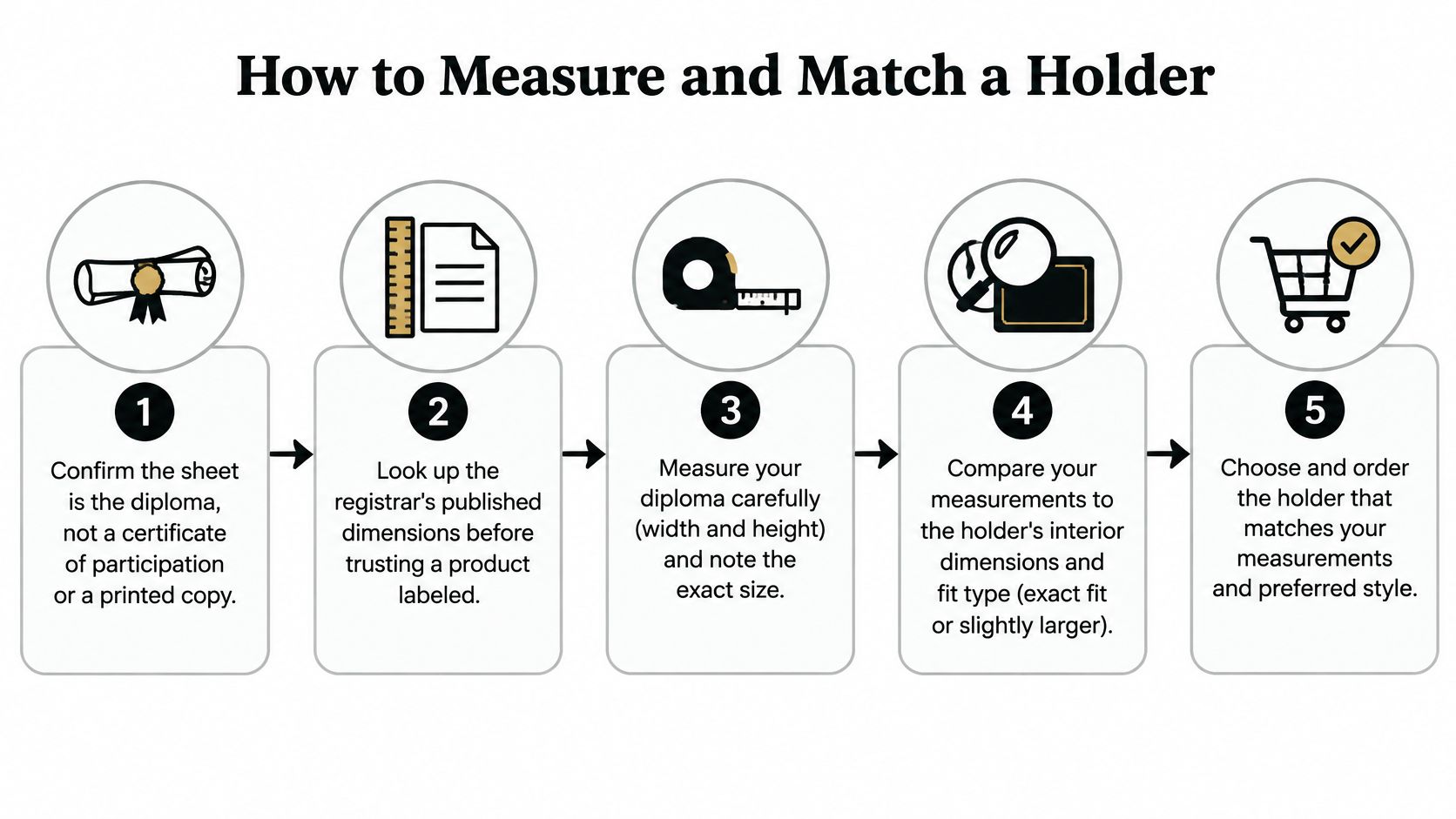
This visual guide keeps the measuring sequence close at hand.
Follow the document from school to case
- Confirm what you're measuring. Use the diploma itself if it has been issued. A participation certificate or ceremony insert may have different dimensions. If the diploma is not yet available, check the registrar's specifications for your exact credential.
- Check the registrar's specifications. A university may issue different formats through its medical school, law school, and other academic divisions. Match the information to the school or program that awarded your degree.
- Measure the outer edges. Lay the document flat and measure its width and height to the nearest eighth of an inch. Include deckled or irregular edges, and keep the ruler clear of any raised seal.
- Check how the wording reads. Note whether the document is meant to be read in portrait or horizontal orientation. A cover that opens sideways does not necessarily hold the sheet in the orientation you expect.
- Match the usable space. For a holder, check the area inside and how the retaining system contacts the paper. For a frame, account for the mat and make sure its window leaves important wording visible. If you plan to display a portrait beside the diploma, see our guide to diploma frames with pictures.
- Read the size description closely. A listing may give the outside dimensions, the document capacity, or the visible window. The outside case will be larger than the sheet, so it cannot tell you by itself what fits inside.
- Confirm the cover color with your school. Commencement instructions can clarify which color to choose for a school-organized presentation or coordinated photographs.
- Ask the school about a missing diploma. Graduation Cap and Gown does not provide replacement diplomas. Contact the school directly to ask about a copy or reissue.
Keep the original and its records together
Yale's diploma services include parchment diplomas, certified electronic credentials, and replacement-diploma options. An electronic credential can help verify a degree, while a holder protects the physical document.
Penn State retains diplomas it could not distribute or mail for five years, according to its diploma retention policy. Protecting and collecting the original avoids relying on a future reissue.
For a video reference alongside the written steps:
Materials That Keep the Paper Safe
A diploma may travel in a case before it hangs on a wall, so choose materials for the job they perform. A soft cover can look formal in photographs, yet the paper may still bend inside a tightly packed suitcase.
For carrying, check support beneath the surface
Vinyl and polyurethane leather covers offer wipeable exteriors for ceremony-day handling. Since a flexible outer layer may not support the paper, check for a firm insert or board beneath the padding.
A rigid board holder helps limit flexing while the diploma travels. Its exposed edges still need protection from water and rough handling.
The exterior style below illustrates a formal presentation cover. Check its interior construction and usable dimensions separately.
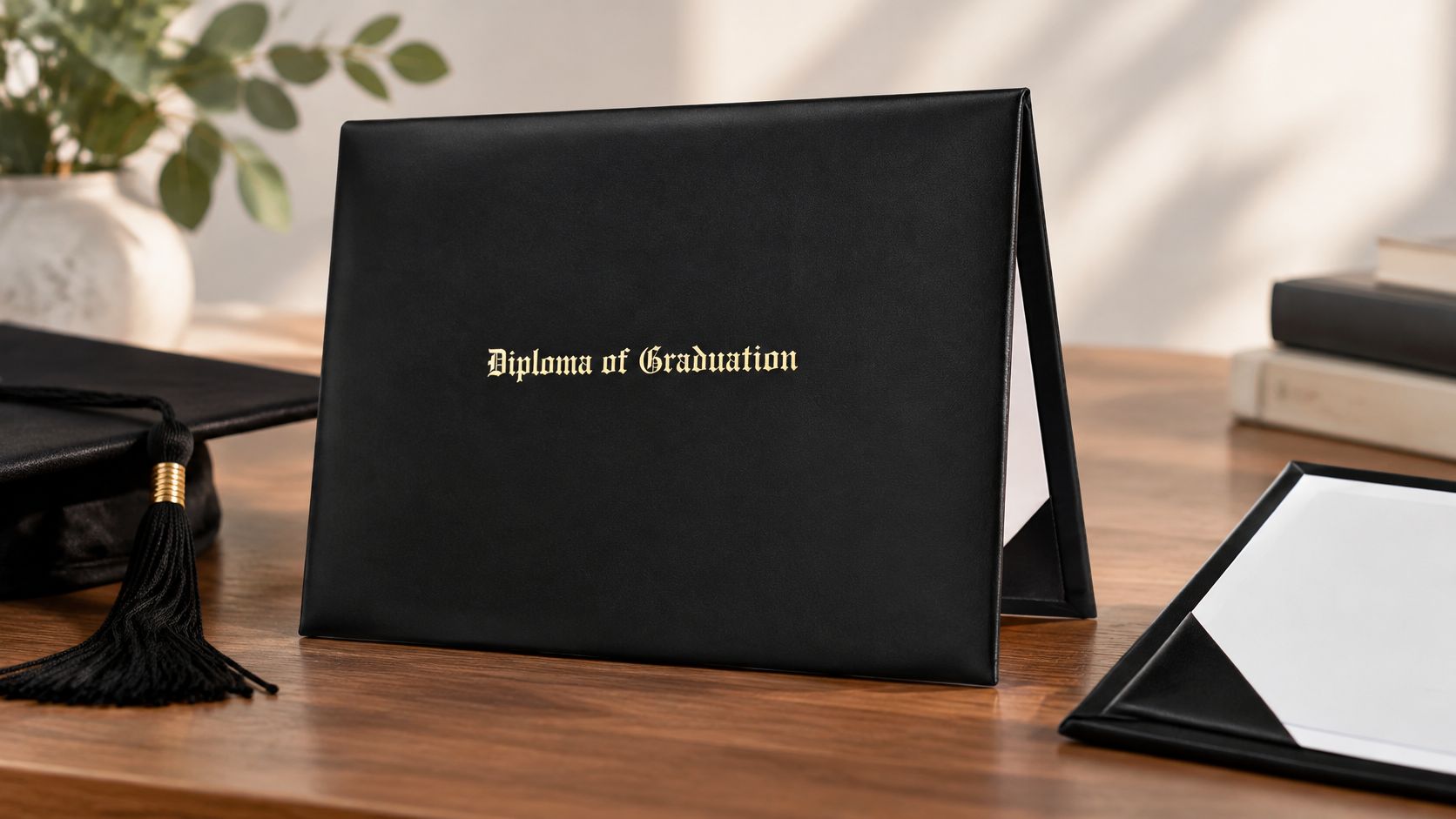
Check how the retaining corners meet the paper. They should hold the sheet without pulling its corners inward or rubbing against a seal. Metal corner guards suit a rigid structure better than a soft padded edge, where pressure may leave dents.
For wall display, inspect the hidden materials
A frame's molding is only part of the choice. Acid-free matting and backing help separate the diploma from unsuitable surrounding materials, while glazing with ultraviolet protection helps limit light exposure. Keep unglazed displays out of direct sunlight.
Acrylic weighs less and is less likely than ordinary glass to shatter during handling, though it can scratch. Clean it with a suitable cloth and cleaner. Glass offers a crisp viewing surface but needs careful transport and secure mounting.
Use a spacer or mat to keep the document from resting against the glazing. Raised seals, foil details, and textured signatures should not press against a plastic window.
- For paper contact: Favor smooth, acid-free materials and avoid applying adhesive directly to the diploma.
- For storage: Choose a dry interior closet. Keep the case flat or upright, fully supported.
- For moisture control: Keep the document away from basements, heaters, and sealed bags that can retain damp air.
Padding improves presentation; a firm structure supports the sheet. Suitable framing materials serve a different purpose: they help protect the diploma on display.
Don't laminate the original or try to flatten a curled diploma with household heat. If the paper is already damaged, seek document-conservation advice before attempting a repair.
Personal Details That Still Look Official
A parent orders a personalized cover as a graduation gift. The graduate's name is correct, the school color looks right, and the outside reads neatly in photographs. The thoughtful part is knowing where to stop: personalization belongs on the case, not as an alteration to the credential.
A school name, graduation year, degree title, or restrained monogram can make the cover personal without competing with the paper. A blind-debossed seal offers texture without extra color. If you use a crest, confirm that it's the school's correct mark and that you're permitted to reproduce it.
Let the university control the official wording
Northwestern's diploma FAQs identify the graduate's name, degree, institution, graduation date, applicable honors, and official signatures as diploma details. A major isn't a guaranteed element of every university's diploma.
Yale prints the degree conferred and Latin honors but doesn't print the major. That distinction matters when choosing an outside imprint: a field of study and an awarded degree title aren't automatically interchangeable.
For a coordinated school presentation, match the approved wording rather than improvising a more impressive-sounding title. A cover can celebrate an accomplishment, but it doesn't establish or modify the qualification.
Keep the design quiet enough for the document
Consider a hypothetical navy cover with a gold 2026 and the graduate's exact degree title. It gives a bachelor's ceremony photograph a clear focal point without filling the outside with competing messages.
Alternatively, a plain black holder suits a letter-size sheet that will later move into a frame. The frame mat can supply the extra color, leaving the ceremony case simple.
- Follow school direction: Use the requested cover color when the school specifies one.
- Personalize sparingly: A small monogram makes a family gift distinctive without dominating it.
- Skip visual clutter: Leave slogans, nicknames, and clip art off a formal presentation case.
When you're organizing an imprint for a school or department, CertSeal's certificate layout and branding tips offer useful context for spacing and visual hierarchy. Apply those design principles to the outside presentation, not to rewriting an issued diploma.
Our custom diploma cover guide can help you think through that exterior treatment. When the school gives no color direction, black or navy keeps attention on the graduate and the document.
Choose a Holder, Cover, or Frame by Situation
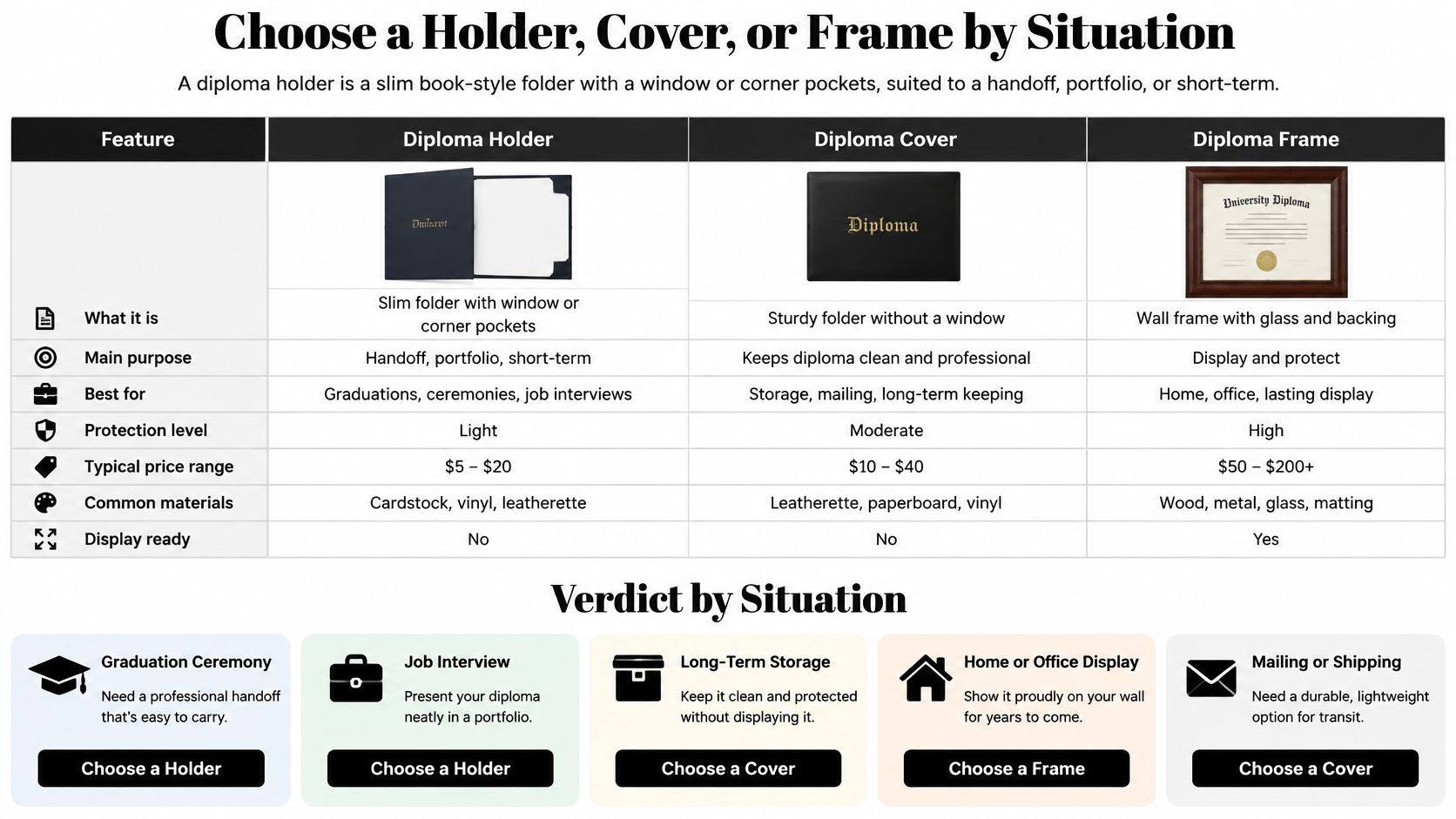
A diploma that travels to commencement needs a different case from one that will hang on a wall. Start with the paper's actual size, especially for medical, law, or Yale diplomas that may not fit standard letter-size products. Then choose a format for how you'll carry, present, or display it.
| Format | Best moment | How it holds the sheet | Carry or hang | Watch-out |
|---|---|---|---|---|
| Diploma holder | Hand-off, portfolio, short-term display | Book-style folder, window or corner pockets | Easy to carry, lies flat | A slim folder may offer a simpler presentation |
| Diploma cover | Commencement and family presentation | Presentation case | Carried, then stored | A substantial case takes space beside a gown or in a suitcase |
| Diploma frame | Home or office wall | Glazing over a mat or backing | Hung on a wall | The document and mat need to fit inside |
Product names can vary. Read the construction and intended use before trusting the product name: a holder may be a slim folder, while a cover may be a presentation case. The comparison chart shows how the three formats differ.
Compare what happens after the handoff
For a ceremony and a car ride, a holder or cover is easier to manage than a glazed frame. Carry it separately from shoes, drink containers, and anything that could press into it. Keep heavy bags off the case.
If you want to read the diploma without removing it, check how the interior holds the sheet. Corner pockets leave much of the paper exposed when opened; a window may cover part of a border. A frame keeps the document visible, while a presentation cover is made to open for viewing and then close for storage.
A slim holder packs easily beside a gown. A padded cover makes a more substantial presentation, but needs more room. For long-term wall display, choose a frame suited to the document and its planned mat. A cover propped open on a shelf does not provide the same arrangement as a frame.
Make the choice by situation
-
Diploma that will travel or be handed over
Choose a holder or diploma cover suited to the occasion. Graduation Cap and Gown sells diploma covers; the Black Imprinted Diploma Cover is listed at $12.95. Check the current listing for the details that matter to your choice.
A case can travel with the graduate, then be stored after the ceremony. Keep it separate from items that could bend or press against the diploma.
-
Diploma that will hang at home or in an office
Choose a frame that fits the document and leaves room for the planned mat. Consider the room and where the frame will hang before selecting a broad molding. The wood diploma frame guide offers ideas for choosing a wood frame. For a more informal style, explore rustic photo frame materials and sizes. Keep the decorative choice in balance with the diploma's protection and fit.
-
Medical, law, Yale, or another non-letter-size diploma
These documents may fall outside standard letter size, so choose a case that accommodates the full sheet. Don't fold or trim the paper to fit a smaller holder. If a suitable presentation cover is unavailable, use a rigid document case for transport while you arrange a frame or other display.
Check the order before checkout
Once you've matched the case to the document, check the remaining practical details:
- Arrival timing: Choose shipping that gives you time to inspect the case before the ceremony.
- Handling: Make sure the way the case opens suits how you'll present or store the diploma.
- Careful opening: When it arrives, test any retaining corners gently and check the case before setting it aside with your ceremony essentials.
Graduation Cap and Gown sells diploma covers and frames, along with caps, gowns, garment bags, hoods, tams, tassels, stoles, honor cords, medals, and diplomas. Choose a case that suits the diploma's purpose, then coordinate it with the regalia you need for commencement.