

Most advice about graduation honor cords starts with a color chart. That's the wrong place to start. Gold doesn't mean the same thing at every college, blue isn't a universal society marker, and even the number of cords can carry different meanings from one campus to another.
I've helped prepare graduates for ceremonies where cords represented Latin honors, honor societies, military service, departmental achievement, leadership, or community contribution. The reliable rule is simple: the institution or organization awarding the cord decides what it means. Before you buy, borrow, pin, or photograph one, verify the local policy.
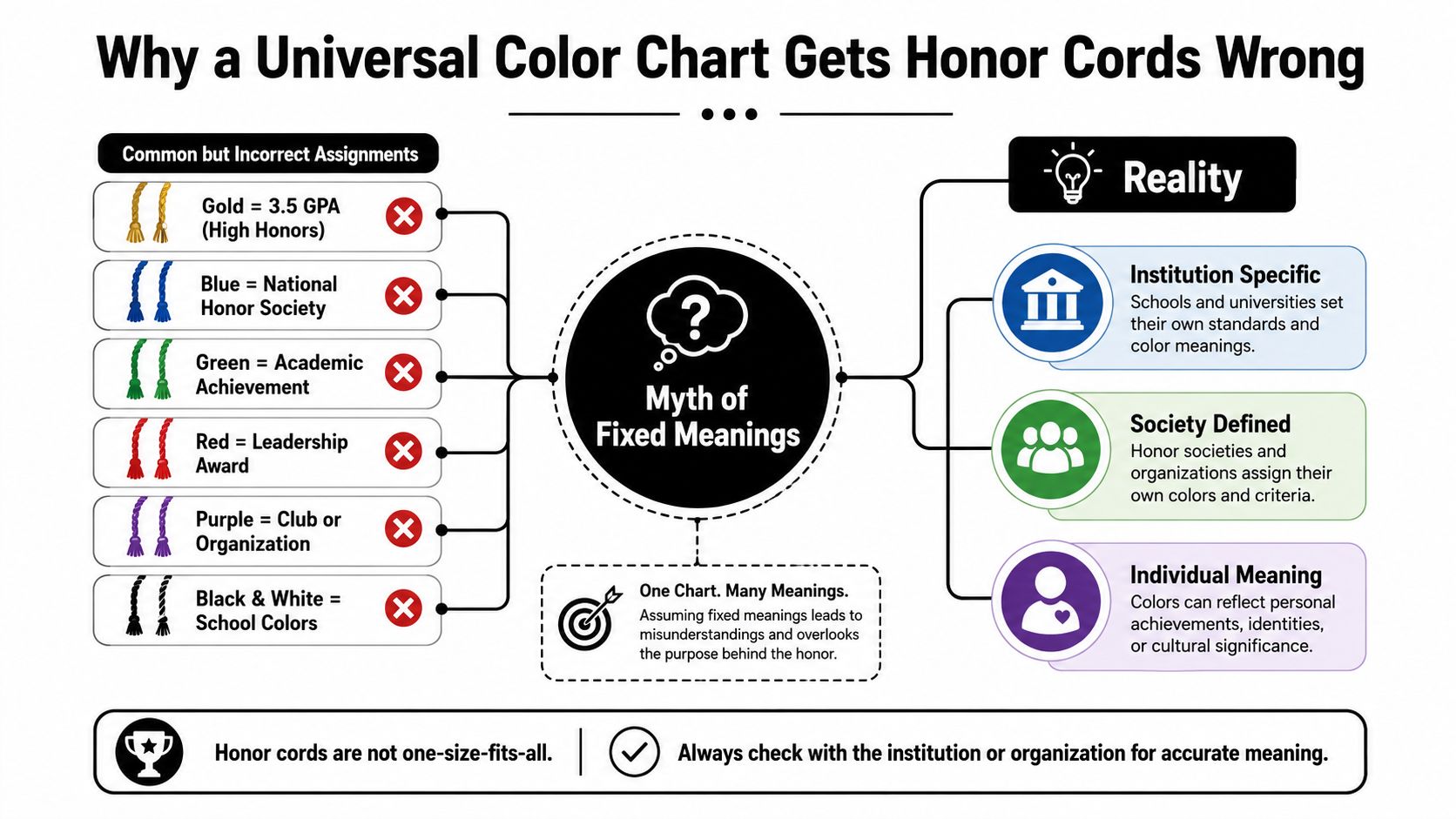
Why a Universal Color Chart Gets Honor Cords Wrong
A single chart that claims to decode every graduation cord is convenient, but it's also misleading. Viral graphics often assign fixed meanings to colors such as gold, silver, blue, and red. In practice, a color may identify Latin honors at one university and an honor society, service group, or academic department at another.
That difference isn't a minor technicality. It can affect eligibility, ordering, ceremony placement, and how your achievement is understood in photographs. A gold cord might be reserved for a Latin-honor tier at one institution, while a gold combination elsewhere may identify a named society or award. Blue could be used for an academic organization at one campus and a different discipline or recognition group at another.
The color is only meaningful when you know who issued it and under which policy.
Graduation regalia developed as a formal visual language, but honor cords themselves are a relatively modern addition rather than an ancient feature of academic dress. Independent background on academic costume notes that the Intercollegiate Code of Academic Costume standardized U.S. caps, gowns, and hoods in 1895, with honor cords becoming more widely used later in the twentieth century as ceremonies expanded and schools needed visible ways to recognize achievement. Read more about the development of academic regalia.
The registrar's policy outranks the internet
At many universities, the registrar, honors college, academic dean, or student affairs office controls the official meaning of cords. Some institutions reserve particular colors for Latin honors so students and guests can recognize academic standing at a glance. Others authorize cords for societies, departments, identity groups, service, or leadership.
One university may award a single pair for cum laude, two pairs for magna cum laude, and three pairs for summa cum laude. Another may use one color for each tier, or issue the same cord to every graduate who qualifies. Those patterns are real, but they aren't universal.
The safest decoding method is:
- Identify the issuer: Find out whether the cord comes from the registrar, department, honor society, or another organization.
- Read the official policy: Use the school's commencement or graduation page, not a general retail chart.
- Confirm the number of cords: A pair, a braided cord, and multiple separate cords may represent different distinctions.
- Check reserved colors: Some schools prohibit organizations from using colors set aside for Latin honors.
If a chart conflicts with your school's published instructions, follow the school. The chart may describe a common convention, but commencement staff are responsible for preserving the meaning used at that ceremony.
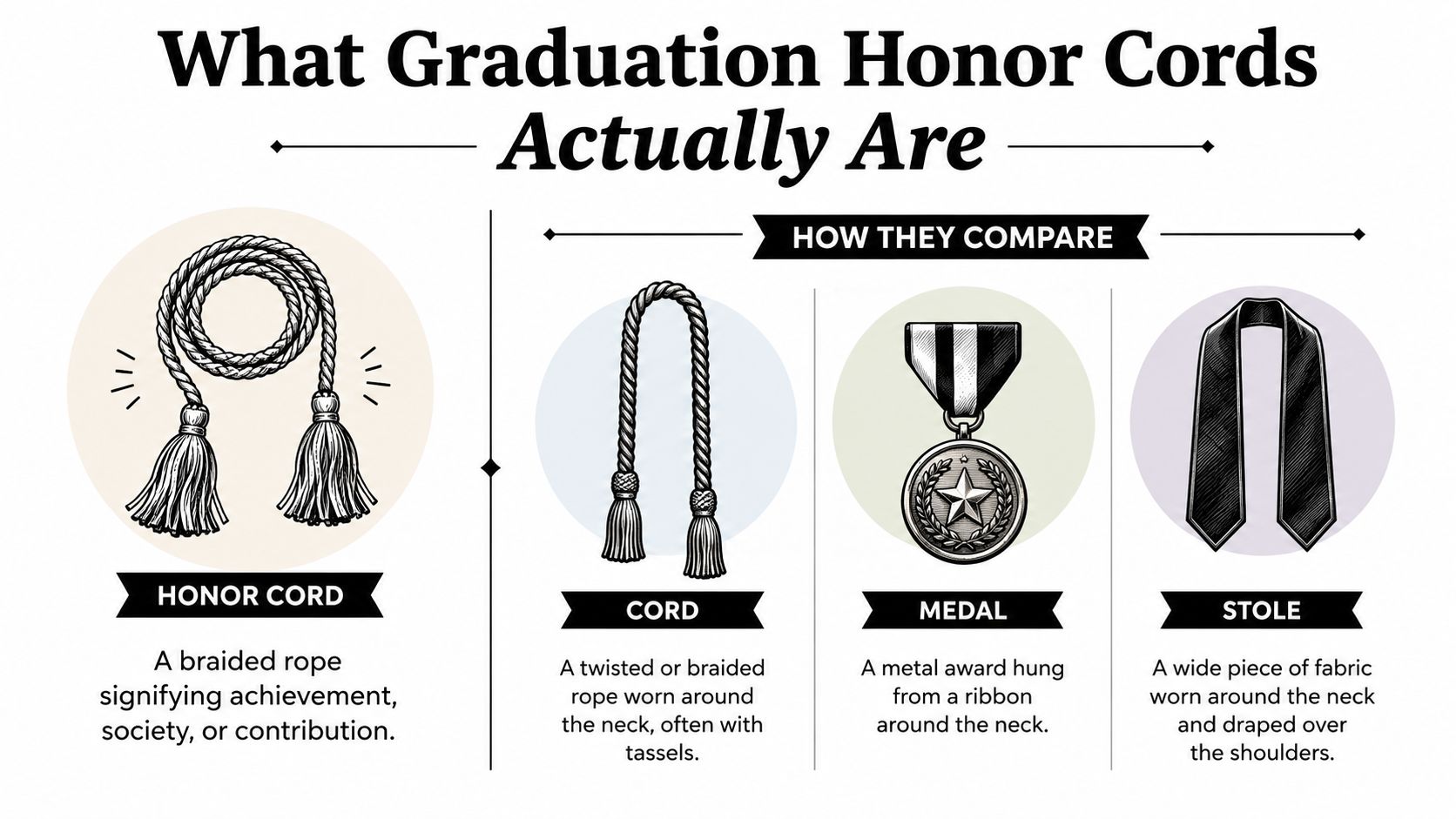
What Graduation Honor Cords Actually Are
A graduation honor cord is a braided or twisted rope worn over an academic gown. It usually drapes around the neck or shoulders, with the ends hanging down the front of the robe. The issuing institution or organization uses the cord to identify a defined achievement, membership, service record, or contribution.
Cords are lightweight, but they're part of the formal regalia system. They aren't just decorative accessories chosen to coordinate with a cap and gown. The color, braid, number of strands, knot, and placement can all matter when a school has established rules.
Cord, stole, hood, and medal
The easiest way to distinguish common graduation accessories is to compare their shape and job:
| Regalia piece | What it looks like | What it commonly communicates |
|---|---|---|
| Honor cord | A narrow twisted or braided rope that hangs down the front | Academic distinction, society membership, service, or another approved recognition |
| Stole | A wider fabric sash worn over the shoulders and down the front | Organization, cultural identity, academic program, or group affiliation |
| Hood | A larger fabric piece draped over the shoulders and down the back | Graduate-level degree field and institution colors |
| Medal | An award suspended from a ribbon or chain | A named prize, leadership distinction, service recognition, or special honor |
A useful clothing analogy is stole as scarf, hood as cape, and cord as necklace. The stole creates a broad vertical panel. The hood sits across the shoulders and back. The cord follows the neckline and creates narrower lines over the gown.
How cords are constructed
Most cords have a looped or joined center section that rests behind the neck. The two ends then fall down the front of the gown. Depending on the design, the ends may be finished with tassels, pointed ends, braided tips, or another decorative treatment.
A quality cord should hang evenly and hold its shape without feeling excessively stiff. Look for a clean braid, secure joining point, consistent color, and finishings that won't unravel during dressing or movement. If you're layering several pieces, a slimmer cord may sit more comfortably beneath a stole, while a fuller braid may remain more visible over a dark gown.
Length also matters. A cord that's too long can catch on a zipper, medal, or stole. A cord that's too short may sit unevenly when you walk. Don't cut it to solve the problem unless the manufacturer or ceremony staff specifically approves that alteration. A discreet knot or permitted pin can adjust the fit without permanently changing the item.
How Honor Cord Colors and Combinations Are Used
You can interpret cord colors more responsibly by grouping them into recognition families, rather than assigning one fixed meaning to every shade. These families help you understand what a cord might represent, but the issuing school still has the final say.
| Color family | Typical association | Caveat for students |
|---|---|---|
| Latin-honor colors | Cum laude, magna cum laude, summa cum laude, or related academic standing | Colors and GPA bands vary by institution |
| Academic society colors | Honor society or discipline-based membership | The same society may follow its own approved combination |
| Service and leadership colors | Military service, volunteer work, student leadership, or institutional service | Participation may not be enough if the organization has eligibility rules |
| Departmental combinations | Recognition in nursing, education, communication, neuroscience, or another field | The department or university may reserve a specific braid |
| Multiple or braided cords | More than one distinction, or a higher level of recognition | The number of cords can indicate a tier at some schools, but not all |
Examples show why context matters. Some institutions use one pair for cum laude, two pairs for magna cum laude, and three pairs for summa cum laude. Other schools use combinations tied to named groups, such as red-and-black for Sigma Tau Delta, blue-and-gold for Beta Gamma Sigma, or purple-and-green for Kappa Delta Pi. See a broader overview of graduation cord types.
Latin honors are only one family
Gold is often associated with academic achievement, but it isn't automatically a summa cum laude cord. One university publishes gold braided cords for Latin honors across GPA bands of 3.50 to 3.749 for cum laude, 3.75 to 3.949 for magna cum laude, and 3.95 to 4.00 for summa cum laude. Another uses gold, silver, and navy for its three Latin-honor levels. Review one university's academic regalia policy.
Georgia Tech offers another policy-based example. Its registrar identifies white cords for honors at a minimum GPA of 3.15, gold cords for high honors at 3.35, and white-and-gold braided cords for highest honors at 3.55. Check Georgia Tech's published honor-cord rules.
Societies and service use their own language
Color combinations can identify membership rather than GPA. Temple University lists burgundy-and-gold for Alpha Sigma Lambda, double gold for the Arnold Fletcher Award, purple-and-gold for Delta Mu Delta, violet-jade-and-gold for Kappa Delta Pi, red-white-and-blue for military service, green for a symbolic Foundation gift, and blue-and-gold for Order of the Sword and Shield recipients. See Temple University's honor-cord categories.
That's why you shouldn't pin a meaning to a cord until you know its issuer. The same color family can appear in several recognition systems, and a braided combination may be more specific than a single shade.
Who Qualifies for Honor Cords at Real Universities
There's no national eligibility formula for graduation honor cords. Each university decides how it calculates honors, which academic records it accepts, and whether a cord is attached to Latin honors, an honor society, a department, or another achievement.
The most familiar route is GPA-based Latin honors, but even that process can include institutional GPA, overall GPA, transfer work, credit requirements, ranking, and final grade calculations. Students who are close to a cutoff shouldn't rely on an unofficial degree audit or an old handbook. Final eligibility can change after grades are posted.
Published policies show wide variation
The University of Memphis assigns three Latin-honor bands and three cord colors. Summa cum laude uses a 3.80 to 4.00 GPA, magna cum laude uses 3.50 to 3.79, and cum laude uses 3.25 to 3.49. The policy considers both institutional GPA and overall GPA, then uses the lower of the two when determining eligibility. Read the University of Memphis undergraduate honors policy.
A university in Macau sets honor-cord eligibility at a cumulative GPA of 3.80 or above, showing that some institutions attach the cord to a high defined threshold rather than a general description such as “good standing.” Review the Macau university honor-cord requirement.
| University | Cum Laude | Magna Cum Laude | Summa Cum Laude | Cord policy notes |
|---|---|---|---|---|
| University of Memphis | 3.25 to 3.49 | 3.50 to 3.79 | 3.80 to 4.00 | Uses the lower of institutional and overall GPA; colors identify the three bands |
| Georgia Tech | Minimum 3.15 honors threshold | Minimum 3.35 high-honors threshold | Minimum 3.55 highest-honors threshold | White, gold, and white-and-gold braided cords correspond to the published levels |
| University with published GPA bands | 3.50 to 3.749 | 3.75 to 3.949 | 3.95 to 4.00 | Gold braided cords are assigned across the three Latin-honor bands |
| Macau university policy | Not separately stated | Not separately stated | Cumulative GPA of 3.80 or above for the cord | Eligibility is tied directly to the published cumulative GPA requirement |
The number of cords also varies. Some universities use one pair, two pairs, and three pairs to show increasing Latin-honor levels. Others use a single color or braid for each level. A cord count can therefore communicate hierarchy, but only within the system that issued it.
Non-GPA cords have separate requirements
Department honors may require more than enrollment in a major. An honor society may require membership in good standing, completed coursework, or an approved induction. Military, leadership, and community-service cords may require documented participation, nomination, or institutional authorization.
Start with the registrar for Latin honors. Contact the honors college, department, commencement office, or society adviser for other categories. The bookstore may sell approved regalia, but it usually isn't the final authority on whether you qualify.
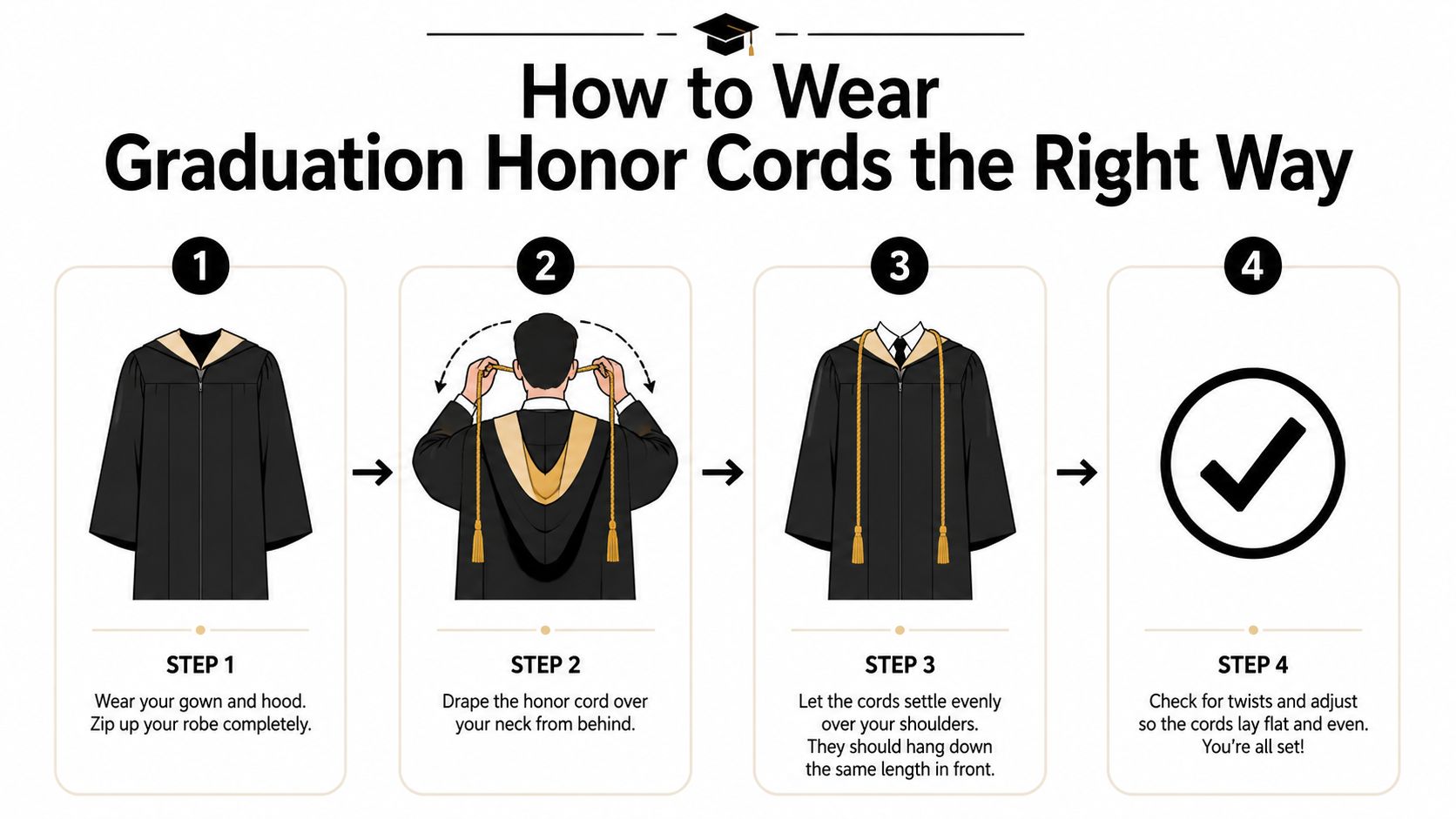
How to Wear Graduation Honor Cords the Right Way
Put on the gown first, then arrange the rest of the regalia in the order your ceremony team specifies. A cord should never be the piece that determines how the entire outfit sits.
A steady dressing sequence
- Zip the gown completely. Smooth the shoulders and make sure the neckline sits evenly.
- Place the hood or stole. Graduate hoods and institutional stoles can affect where cords rest, so arrange them before final cord placement.
- Drape the cord from behind. Set the joined center or loop at the back of your neck, allowing both ends to fall over the front of your shoulders.
- Center the ends. Adjust the cord until both sides hang at a similar height and the braid faces outward.
- Check every layer. Remove twists, separate overlapping strands, and confirm that the cord isn't caught under a collar or zipper.
The official cord normally needs to remain visible. Society or organization cords may follow a different placement instruction, especially when a school wants Latin-honor colors kept distinct. Don't wrap a cord tightly around your neck. It should rest over the gown and hang freely.
If your commencement coordinator gives a different placement order, follow that instruction.
A long cord can sometimes be shortened with a discreet knot behind the neck or a permitted pin. Don't cut, staple, or permanently alter it without approval. If the cord slips, ask a dresser, marshal, or classmate to reset it rather than tugging at the front during the procession.
For a visual refresher on arranging a complete outfit, use this guide to wear graduation regalia correctly.
This short video can also help you see how the cord settles over the gown:
Choosing the Right Style, Material, and Customization
The right honor cord needs to satisfy two tests. It should follow the issuing organization's visual rules, and it should hang cleanly with the rest of the regalia.
Satin gives a smooth, traditional finish and catches light in photographs. Metallic or metallic-trim cords stand out more strongly, especially against a dark gown. Braided construction creates a fuller texture, while soft woven styles can feel easier to wear when several pieces overlap.
| Style | Appearance and feel | Best use | Customization notes |
|---|---|---|---|
| Satin | Smooth surface with moderate shine | Traditional school or Latin-honor presentation | Stock colors are usually easiest to match |
| Metallic | Reflective, bright finish | Ceremonies where visibility matters | Metallic tones can look different under indoor lighting |
| Braided | Fuller texture and defined strands | Tiered honors or formal organization recognition | Confirm whether strand count has a policy meaning |
| Soft woven | Flexible and comfortable | Multiple-cord layering or long ceremonies | May have a less structured appearance |
| Printed or emblematic | May include wording, seals, logos, or symbols | Institutional, departmental, or society orders | Requires proof approval and careful color review |
Width, thickness, shine, and stiffness affect the way a cord hangs beneath a stole or beside a medal. A thick braid can create a strong visual line, while a narrow satin cord may layer more subtly. If your organization plans to add names, achievement wording, dates, a school seal, or a society emblem, ask for a proof before production.
Color matching requires a sample
Stock colors are easier to replace and reorder. Special dyeing can create a closer institutional match, but it may require more coordination and may not behave exactly like a standard color in photographs. Ask the school for an official color reference, including a Pantone reference when one exists, then compare a physical swatch in daylight.
Confirm whether one, two, or three strands represent a specific honor before choosing a construction. For a school or organization, also settle the minimum order quantity, invoicing process, proof approval, and whether future orders must match the original color lot.
Organizations producing their own regalia may also need equipment for attaching or decorating cords. If you're comparing sewing tools for decorative cord work, you can compare couching foot options before committing to a production method.
For custom wording or organization-specific designs, review personalized graduation cord options and request a sample before placing a large order.
Ordering, Timing, and Bulk Purchasing for Commencement
Ordering early removes the most avoidable problems. You need time to verify eligibility, confirm the approved color, inspect the construction, and correct an order if the wrong braid arrives.
A practical timing calendar
| Ordering window | Suitable use | Main risk |
|---|---|---|
| 8 to 12 weeks out | Standard personal orders and planned organization purchases | Waiting too long can remove sample and correction time |
| 4 to 6 weeks out | Late orders that may need expedited shipping | Shipping options and color availability may be narrower |
| 2 to 4 weeks out | Rush replacements or urgent corrections | Material, finish, and exact color matching may require compromise |
The final window is especially difficult for bulk coordinators because one missing or incorrect shipment can affect an entire group. A student ordering one standard cord has different options from a department ordering custom cords with shared artwork and a single delivery address.

Students should verify before checkout
Start with the official commencement page. Confirm the cord type, color, number of strands, eligibility date, pickup process, and whether the school supplies the item. Some universities contact qualifying students directly, while pickup may vary by department or unit. See an example of institution-specific pickup guidance.
Then compare the policy with the product description. Don't order a gold cord just because an internet chart calls gold an honor color. Confirm that the braid, pair count, and finish match the school's instructions.
Graduation Cap and Gown offers a Find Your University feature for checking school colors, along with individual honor cords, custom accessories, and regalia packages. Use the tool as a starting point, then compare the selected color with the registrar's approved specification.
Coordinators need a controlled purchasing process
For a department or student organization, assign one person to maintain the recipient list and one person to approve the visual proof. Decide whether the supplier should ship everything to one campus address or send individual packages to graduates. A single campus delivery can simplify distribution, while individual addresses may reduce handling for a dispersed group.
Before placing a large order:
- Confirm the quantity: Include approved recipients and a plan for replacements.
- Approve the proof: Check wording, logos, strand count, and color representation.
- Request a swatch: Compare the physical sample with the gown, stole, tassel, and school branding.
- Document the reorder: Save the product name, color name, construction, and approved artwork.
- Avoid near-matches: Two different blues may look similar online but separate visibly under ceremony lighting.
A rushed order can still work, but it may limit the available material or prevent a perfect match. Early sampling is less stressful than trying to solve a color dispute on commencement week.
Common Commencement Coordination Questions Answered
The same questions arrive every spring, often from students who are already dressed and standing outside the venue. The answer to nearly all of them begins with the same authority: your school's published ceremony policy.
Can I mix cords from different organizations?
Only if each organization and the commencement office allows it. A student may qualify for multiple recognitions, but the school may limit which cords can be worn together, reserve certain colors, or require one organization to use a stole instead of a cord.
How many cords can I wear?
There's no universal maximum. A school may allow several cords, but too many layers can tangle with a stole, hood, medal, zipper, or microphone. Ask the commencement team whether it has a preferred order or limit, then prioritize official institutional regalia and approved recognitions.
Are cords required?
Usually, cords are recognition accessories rather than a condition of participating in commencement, but ceremony rules vary. A student who qualifies may choose not to wear one, or may be unable to obtain it in time. Check whether the honor is recorded separately from the accessory.
What if my cord arrives on the morning of commencement?
Open the package before entering the venue. Check the color, braid, join, and finish, then ask a marshal or dressing volunteer to place it. Don't improvise with scissors, safety pins, or a replacement color that hasn't been approved.
Is the honor printed on my diploma?
That depends on the institution and the type of recognition. A cord can represent a society, service category, or ceremony-only distinction, while Latin honors may be handled through the transcript, diploma, commencement program, or another official record. Ask the registrar, not the bookstore.
What if the bookstore sells a different cord?
The bookstore may carry approved items, but it isn't automatically the policy authority. Compare the product with the registrar's instructions and contact the commencement office if the color or combination seems inconsistent.
Can clothing affect how the cords look?
Yes. A simple neckline and a neutral or coordinating outfit beneath the gown usually let the regalia remain the visual focus. Avoid bulky collars or heavy embellishment where the cord, stole, or hood needs to lie flat.
Can I take photos without the cord?
Follow the venue's photo and regalia rules. If you remove a cord for a personal photograph, put it back before the procession or stage crossing if the ceremony requires it. Keep the cord in a safe place rather than placing it loosely in a bag where it can tangle.
The most useful preparation is a final policy check with the registrar or commencement coordinator. Confirm what you qualify for, what you're allowed to wear, and how the pieces should be arranged before the ceremony begins.
Graduation Cap and Gown offers individual graduation honor cords, double cords, custom stoles, medals, and complete academic regalia, with a Find Your University tool to help compare school colors. Visit Graduation Cap and Gown to check approved-looking cord styles, review customization options, and order the pieces you need before commencement day.