

At midnight, a graduate sits with a laptop open, scrolling through graduation stole listings while a robe hangs ready on the door. The options look beautiful, but the decision feels surprisingly personal. Which colors represent the journey? Should the stole honor family, culture, academic achievement, an organization, or several of those at once?
A graduation stole is a decorative, scarf-like piece of academic regalia worn over the shoulders with a cap and gown. It hangs down both sides of the front, usually ending around waist level, which makes it one of the most visible pieces in commencement attire, as described in this guide to graduation stole history and wear. Because it appears in stage photos, family portraits, and video, a stole carries more weight than a simple accessory. Many graduates also keep theirs as a long-term reminder of the people, community, and work behind the degree.

The strongest graduation stole ideas balance meaning, visibility, comfort, and school policy. The sections below will help you move from late-night scrolling to a design that tells one clear story, photographs well, and has a realistic path through your university's approval process.
A Quick Picture Before You Pick Your Stole
A stole sits directly over the gown, so it becomes the first detail many people notice. A graduate wearing a plain black gown with a carefully designed heritage stole communicates something different from a graduate wearing an honors stole, a Greek organization stole, or a family tribute. None of these choices is automatically more meaningful than another. The right choice depends on what the graduate wants the ceremony to remember.
Practical rule: Choose the message before choosing the decoration.
Start by writing one sentence: “I want my stole to show…” The ending might be “my academic honors,” “my Filipino heritage,” “my nursing journey,” “my first-generation experience,” or “the organization that supported me.” That sentence gives the design a center. Without one, graduates often add every possible symbol, color, date, and phrase until the front of the stole becomes difficult to read.
Why placement changes the decision
The stole's position gives it unusual visual importance. It rests over the shoulders, frames the gown, and remains visible while the graduate walks, turns, receives a diploma cover, and poses for photographs. Embroidered text, crests, and symbols work especially well because the stole functions as a high-visibility signal for achievement and affiliation, not as a detail meant to be inspected up close, according to guidance on graduation stole meanings and colors.
A thoughtful design also leaves room for the graduate's body and movement. Text should be readable from a distance, symbols should have breathing space, and the two hanging panels should feel balanced. If one panel carries a large emblem and the other carries several small lines of text, the result may look uneven in person and on camera.
A useful starting choice
Pick a primary category first, then add only a supporting detail. An honors stole can stand alone with cords. A cultural stole can carry the main visual story while a small academic symbol supports it. A Greek stole can use organization colors and letters without also competing with a long personal message.
That late-night graduate doesn't need the most decorated stole on the internet. They need one that will still feel accurate and meaningful when the family looks at the photograph years later.
The Long Story Behind a Simple Sash
The graduation stole carries a tradition that reaches back almost 1,000 years to medieval Europe, when academic dress developed from clerical garments worn by Catholic and Anglican priests. As universities grew during the 12th and 13th centuries, the form and symbolism of the stole evolved alongside scholarly ceremony, making it one of the oldest surviving elements associated with commencement attire, according to the history of graduation stoles and sashes.
The original association was authority, office, and formal ceremony. Academic institutions later adopted visual elements connected with the clergy, and the stole gradually became part of a broader language of scholarly recognition. Its modern use no longer depends on religious meaning. The same basic shape now carries honors, organizational affiliation, cultural identity, service, and personal achievement.
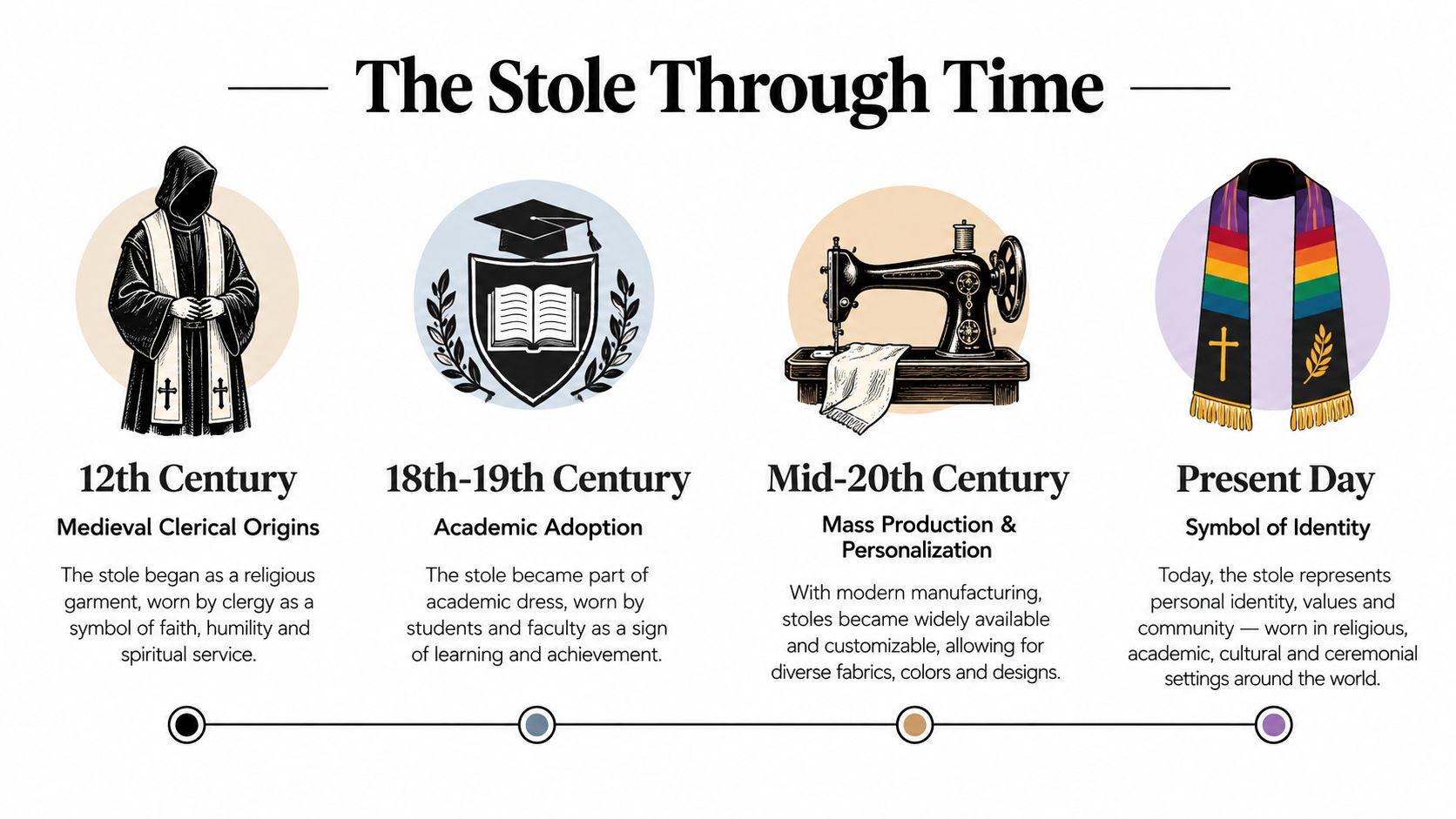
From inherited form to personal meaning
This history explains why a modern stole can feel ceremonial rather than merely decorative. Students aren't just adding a colorful sash to a uniform. They're using an established academic form to say who they are and what they accomplished.
The rise of culturally specific stoles makes that shift especially visible. The Donning of the Kente began in 1993 at West Chester University, when four faculty members created a ceremony recognizing obstacles overcome by African American students, as documented in the meaning of graduation stoles and Kente designs. The ceremony established a distinct institutional moment for using regalia to affirm heritage and resilience alongside academic success.
Kente itself comes from a 400-year-old Ghanaian weaving tradition, and Kente stoles became increasingly popular among African American students during the late 1980s and early 1990s, according to the same historical summary. That context matters when a graduate chooses a culturally specific stole. The pattern isn't just attractive. It may connect the ceremony to ancestry, community, institutional recognition, and a story of perseverance.
For more background on symbolism and modern use, see this explanation of graduation stole meaning. A design that respects that history will usually feel stronger than one chosen only because its colors happen to match a favorite outfit.
Idea Categories Worth Exploring Before You Design
Good graduation stole ideas usually begin with one of a few recognizable purposes. The categories overlap, but separating them helps a graduate decide what belongs on the stole and what belongs on cords, medals, the cap, or a private keepsake.
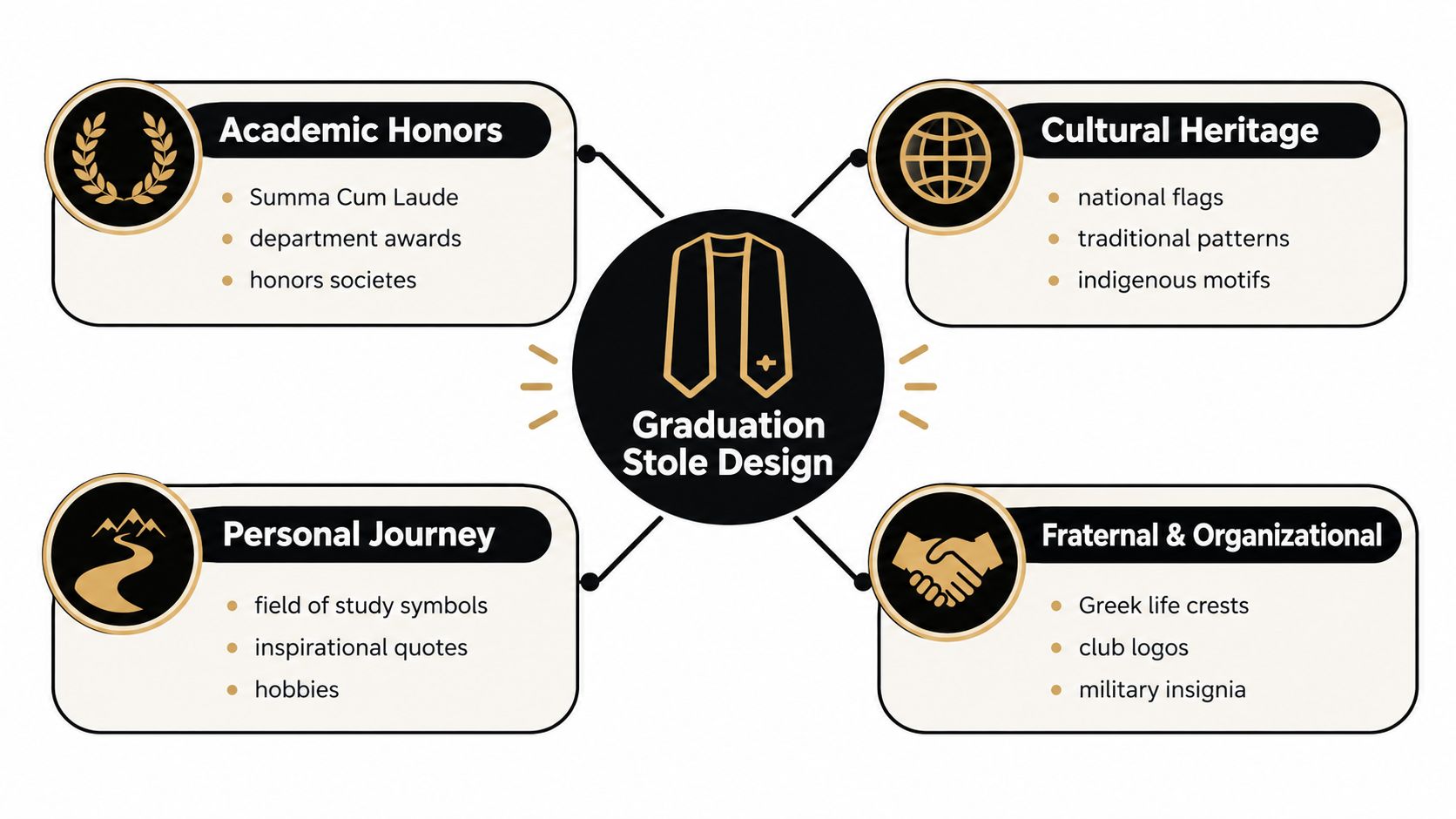
Academic honors
An academic stole can identify an honors program, department distinction, academic society, or a formal achievement. Some graduates use a simple color field with embroidered wording, while others pair the stole with honor cords so each piece has a separate job.
Keep the hierarchy clear. If the stole says “Honors” in large lettering, the cord can provide the additional color. If a department awards its own stole, avoid adding unrelated symbols that make the official recognition harder to see.
Cultural heritage
Heritage stoles may include flags, regional patterns, language, woven-inspired designs, or symbols connected to a family's background. Popular directions include Filipino, Mexican, Nigerian, Indigenous, Jewish, Kente, international, and flag-inspired designs, but a meaningful result depends on context.
Ask who created the pattern, what the symbols represent, and whether the design reflects the graduate's own connection. A generic pattern can look polished while saying very little. A carefully chosen motif, language element, or family reference can make the stole feel rooted and specific.
Greek life and organizations
Greek stoles often use Greek letters, chapter colors, organization crests, founding information, or a campus group's visual identity. Clubs, cultural associations, athletic groups, and service organizations can use the same approach.
Check trademark and campus approval requirements before submitting artwork. A crisp organization name on one panel and a restrained crest on the other will usually read more clearly than a crowded collection of logos.
Family and personal journey
A personal stole can recognize parents, guardians, mentors, siblings, hometowns, or the experience of becoming a first-generation graduate. Short names, a meaningful phrase, a degree field, or a small hometown reference can work well. Long messages often belong on a card presented with the stole rather than on the fabric itself.
Field-specific themes
A nursing stole might use a caduceus or a restrained medical symbol. A STEM graduate might choose an atom, DNA helix, circuit pattern, or mathematical reference. Education, music, theater, film, and visual arts offer equally clear directions, such as a book, musical motif, film reel, palette, or brushstroke.
Choose a primary category and one supporting layer. A heritage stole paired with an honor cord tells a more coherent story than a stole divided among five unrelated themes. More examples appear in this overview of graduation stole types, but the most effective design still starts with the graduate's own sentence about what the ceremony should express.
Colors, Symbols, and What They Actually Signal
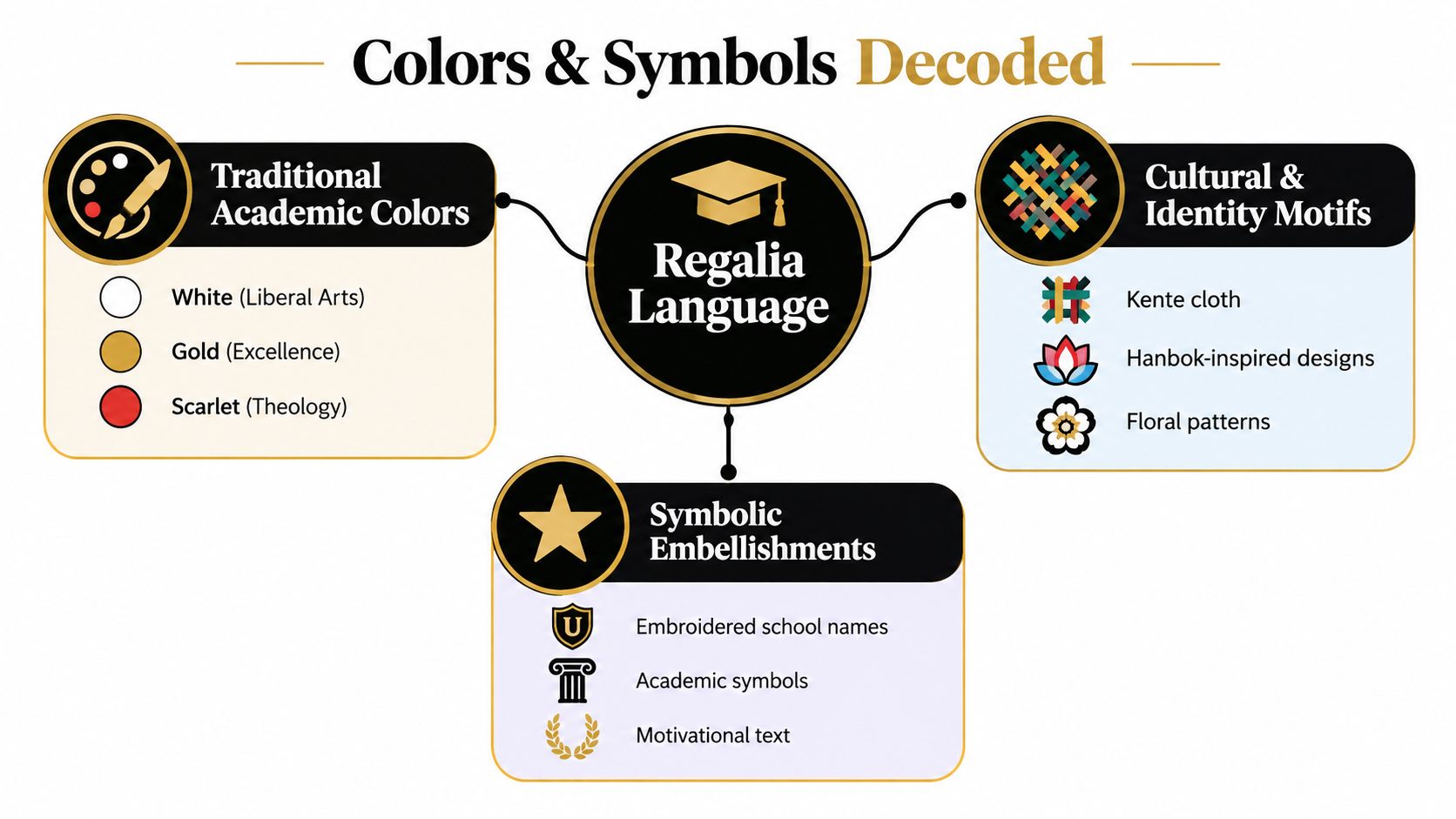
Color can establish the meaning of a stole before anyone reads its lettering. Traditional academic associations commonly include white for liberal arts, gold for excellence, and scarlet for theology, but universities and organizations may assign colors differently. Treat traditional meanings as a starting point, not a substitute for checking the ceremony's official guide.
Cultural and identity-based palettes require more care. Kente, flag colors, regional patterns, floral forms, Hanbok-inspired styling, and other heritage references may communicate belonging, family history, or institutional recognition. A graduate should understand the source and meaning of a motif before using it, especially when the design comes from a culture other than their own.
Use a three-part color test
- Anchor the primary color. Connect it to an honor, heritage, school, organization, or field of study. A strong base color makes the design feel intentional.
- Add one or two accents. Choose colors that create contrast under stage lighting and remain distinct against the gown. Gold thread can look elegant, but thin metallic details may disappear when photographed from a distance.
- Limit the focal points. Two clear motifs per panel are usually easier to read than a dense collection of small icons. A laurel and torch can communicate achievement. A DNA helix and degree field can communicate scientific identity. Adding every possible symbol weakens both messages.
Common symbols work best when viewers can recognize them quickly. Laurels suggest achievement, torches suggest knowledge, hands can suggest service or community, Adinkra glyphs may connect to Ghanaian symbolism, and lotus motifs can carry spiritual or cultural associations. DNA helices, film reels, paint palettes, and Greek letters identify fields or organizations when used with enough visual space.
Photograph fabric samples with a phone from across the room. If the text and contrast disappear on the screen, they won't improve on stage.
For culturally specific choices, review the context before ordering. The discussion of Kente's political and symbolic use in this fashion scholarship on Kente cloth is a useful reminder that fabric can carry history beyond its surface appearance. A guide to Kente stole meaning can help with initial research, but a cultural organization, family member, or campus affinity group may provide the most relevant perspective for a specific design.
Materials and Techniques That Make Designs Pop
Material affects how a stole falls and looks under ceremony lighting. When reviewing our custom graduation stoles, check the listed fabric, dimensions, lining, and care requirements for the chosen style. Confirm that the material and layout suit your lettering or artwork before approving the design.
Silk blends can offer a polished sheen and a softer luxury feel, but they may require a higher budget and more careful handling. Recycled or eco-focused fabrics can suit graduates who want sustainability to influence the purchase, although the supplier should explain how the material handles printing, embroidery, pressing, and storage.
Compare the production choices
| Option | Best For | Drape | Photo Quality | Cost |
|---|---|---|---|---|
| Polyester satin | Bright colors, accessible custom designs, frequent use | Smooth and structured | Strong reflection and color pop | Lower to moderate |
| Silk blend | A refined, polished presentation | Soft and fluid | Elegant sheen | Higher |
| Recycled or eco fabric | Sustainability-minded designs | Depends on the weave | Depends on surface and color | Varies |
| Embroidery | Honors, names, crests, durable symbols | Heavier where stitching is dense | Raised detail reads well up close | Higher |
| Screen printing | Bold flat graphics and faster production | Light | Vibrant color blocks | Lower to moderate |
| Heat-transfer applique | Detailed images and photo-style artwork | Light to moderate | Fine detail can be strong | Moderate |
Embroidery gives a raised texture and premium feel, but dense stitching adds weight. A twill backing can stabilize heavy embroidered areas and help prevent the fabric from twisting. Screen printing keeps artwork flat and colorful, while heat-transfer applique can reproduce fine detail but may not last as long as well-executed embroidery.
Match technique to ambition
Choose embroidery for a school crest, Greek letters, or a short honor designation that should remain durable. Choose printing for a full-color cultural pattern, field illustration, or artwork that needs broad color coverage. Use a contrast lining when the inside of the stole may show as the graduate turns for photographs. The interior then looks finished rather than accidental.
For a custom design, review the custom graduation stole options before finalizing artwork. Ask about fabric weight, proofing, backing, finishing, and care, not only the front image.
Rules, Sizing, and What Your School Will Allow
A beautiful stole can still cause trouble if it violates commencement policy. Universities may regulate the number of pieces, approved colors, dimensions, symbols, and placement. Rules vary enough that a product description should never replace the school's official commencement handbook.
Some institutions treat stoles as optional. Arizona State University states that caps, gowns, and tassels are required, while its gold Stole of Gratitude is traditional but not required, according to ASU's cap and gown guidance. Other schools take a stricter approach. The University of Southern Indiana permits only university-approved adornments and allows students to wear only one approved stole or cord of their choosing in addition to certain university-provided items. Its policy also reserves solid gold, red, or blue stoles for Commencement Honors, as stated in the USI regalia, stoles, and cords policy.
Confirm dimensions before ordering
Commercial sizing often falls within a broad range of 4 to 6 inches in width and 72 to 84 inches in length, but these are not universal approvals. Northeastern State University provides a more restrictive example, stating that stoles may not exceed 4 inches wide and/or 66 inches long, and that students shouldn't alter approved stoles, according to its commencement dress and conduct guidelines.
Finishing can matter too. Fringe, chevron cuts, rolled hems, pointed ends, and added layers may change how a school evaluates the piece. Don't assume that a standard retail size will fit a university's requirements.
Use a written approval workflow
- Download the current handbook. Look for sections covering adornments, cords, stoles, hoods, and cultural or organizational regalia.
- Contact the right office early. Email the bookstore, registrar, commencement office, or department coordinator with a concise question.
- Attach a digital mockup. Show front and back artwork, dimensions, colors, symbols, and wording.
- Save the response. Keep written approval with the order confirmation in case staff members ask about the design at check-in.
Avoid offensive imagery, political statements, commercial logos, or symbols that could be misread. Greek letters and cultural designs may require additional review. Some institutions also require stoles to remain outside the gown hood so recognition stays visible.
Layering Multiple Stoles Without the Cluttered Look
Layering has become a common question because graduates often receive recognition from several communities. The problem isn't that multiple pieces lack meaning. The problem is that every layer competes for the same narrow area in front of the gown.
For 2026 ceremony photography, restraint is the safer design choice. Wide-angle lenses, stadium lighting, and family phone videos flatten fine detail, so a crowded arrangement can become an indistinct block of color. Readable lettering and intentional symbols usually survive photography better than heavy decoration.
More personalization isn't always more communication.
Establish the order of importance
First decide which stole carries the most institutional weight. That may be an official honors stole, a Greek organization stole, a first-generation stole, or a cultural stole connected with a formal recognition ceremony. Put that piece where it remains most visible, then use the other items as support.
A practical arrangement often places stoles first, with cords over them, as described in this guide to layering graduation stoles. Confirm whether the hood takes precedence at your institution, because the hood may need to sit in a specific position. A lei should be long enough to remain visible without tangling with cords, the hood, or the stole ends.
Test common combinations
| Combination | Priority Stole | Secondary Layer | Cord/Lei Placement |
|---|---|---|---|
| Cultural stole plus Greek letters | Cultural stole | Greek stole or narrow organization accent | Cords over the visible stole, lei outside only if permitted |
| Honors stole plus family tribute | Honors stole | Shorter family message or gratitude stole | Keep cords near the collar and tribute text below |
| First-generation stole plus department recognition | First-generation stole | Department stole or cord | Place the department layer so both names remain readable |
A useful working limit is two prominent stoles plus one secondary accent. Pinning should be discreet and approved, not tight enough to distort the gown. Try the full arrangement in front of a mirror, then record a short phone video while walking, turning, and lifting the diploma hand. If the pieces twist, overlap the lettering, or catch on the hood, simplify before commencement morning.
Your Ordering Timeline and Final Checklist
A custom stole needs more planning than a stock accessory because artwork, proof approval, production, shipping, and school review all happen before the ceremony. Start with the commencement date and work backward. A twelve-week schedule gives room for design changes, while a shorter timeline requires simpler artwork and immediate confirmation from the supplier.
A backward plan
Twelve weeks before commencement: Confirm the school's rules, choose the primary design category, gather exact names and organization wording, and decide whether the order will ship to campus or home.
Ten weeks before: Request artwork guidance and begin the digital mockup. For Greek or group orders, collect one approved version of the letters, colors, crest, and chapter information so each item uses the same source file.
Eight weeks before: Finalize the design and approve the proof. Check spelling letter by letter, especially Greek characters, degree names, department titles, and family names.
Six weeks before: Place the order and confirm the production method. Custom embroidery may need more planning than stock-plus-monogram add-ons, while dye sublimation suits broad, full-color artwork. Ask for the supplier's actual production and shipping window rather than assuming a standard turnaround.
Four weeks before: Confirm the order status, delivery address, and campus mail instructions. Ship-to-home delivery gives the graduate more time to inspect the piece, while ship-to-campus delivery can be useful when a school coordinates group regalia. Campus mail delays remain a practical risk, so don't wait for the ceremony week.
Two weeks before: Try on the stole with the full gown, hood, cords, and any lei. Trim loose strings, steam creases carefully, and check that the panels hang evenly.
The final inspection
Use this checklist before packing:
- Spelling: Verify every Greek letter, name, honor, date, and department.
- Fit: Confirm that the stole sits comfortably and doesn't twist under the hood.
- Artwork: Look for misprinted symbols, shifted graphics, or weak contrast.
- Care: Steam or press according to the material instructions, and avoid crushing embroidered areas.
- Travel: Pack the stole flat or loosely rolled in a garment bag.
- Morning order: Put on the gown, arrange the hood, place the stole, add cords, and finish with any approved lei or medal.
- Policy: Keep the written approval and order information accessible.
May ceremonies often create concentrated demand, while December ceremonies can involve different campus office schedules. For either date, order before the design becomes urgent. If a size swap or correction is needed, there may not be enough time for a replacement once the graduate has arrived on campus.
Save the checklist, proof, policy email, and tracking information together. That small folder can prevent a misspelled organization name, a misplaced delivery, or a last-minute outfit scramble from overshadowing the ceremony.
Graduation Cap and Gown offers custom graduation stoles, Kente, Flag, First Generation, Greek, and international styles, along with individual regalia and accessories for coordinated commencement outfits. Visit Graduation Cap and Gown to review stole options, check sizing and color guidance, and begin your design early enough for school approval and a calm graduation morning.