

The gym is filling up, the gowns are zipped, and suddenly the little details start to matter. A parent notices one student wearing gold, another wearing purple and white, and someone else wearing several cords layered together. A senior who thought they were done weeks ago realizes they still need to confirm whether their service cord is approved for the ceremony.
That's usually when questions pile up fast. What do high school graduation cords mean? Who gets them? Can a student wear more than one? And if you need to order one, how do you make sure it matches school rules instead of becoming a last-minute problem?
Introduction to High School Graduation Cords
High school graduation cords are the braided cords worn around the neck during commencement. They hang down the front of the gown, usually with tassels at the ends, and they're used to mark achievement, membership, service, or another form of recognition. They aren't just decorative extras. In most schools, they carry a specific meaning.

One reason cords get so much attention is simple. In a large ceremony, they're one of the fastest visual signals a school can use. A counselor may know a student earned honors, completed major service work, or belonged to an honor society, but families in the audience won't know that unless the school shows it somehow. Cords do that job clearly.
Why families often get confused
The confusion usually comes from three places at once:
- Meaning: One color may stand for academic honors at one school and something else at another.
- Approval: Some schools allow several cords, while others allow only school-issued regalia.
- Ordering: Students often order too early without checking rules, or too late after realizing they were eligible.
Practical rule: Treat a cord like official regalia, not a costume accessory. Meaning comes first, school approval comes second, and ordering comes third.
If you're also sorting out stoles and other regalia, this guide on cords and stoles can help clarify the difference. The goal is to make this simple: understand what cords signal, how to interpret the colors, how to wear them correctly, and how to avoid the common ordering mistakes that catch families off guard.
What High School Graduation Cords Are and Why They Matter
A graduation cord is a narrow braided or twisted textile accessory worn over the gown. Independent product specifications commonly place honor cords at about 60 to 70 inches long, roughly 1/4 inch in diameter, with about 4-inch tassels on each end, which helps them drape evenly without feeling bulky over the neckline (product specifications for honor cords).
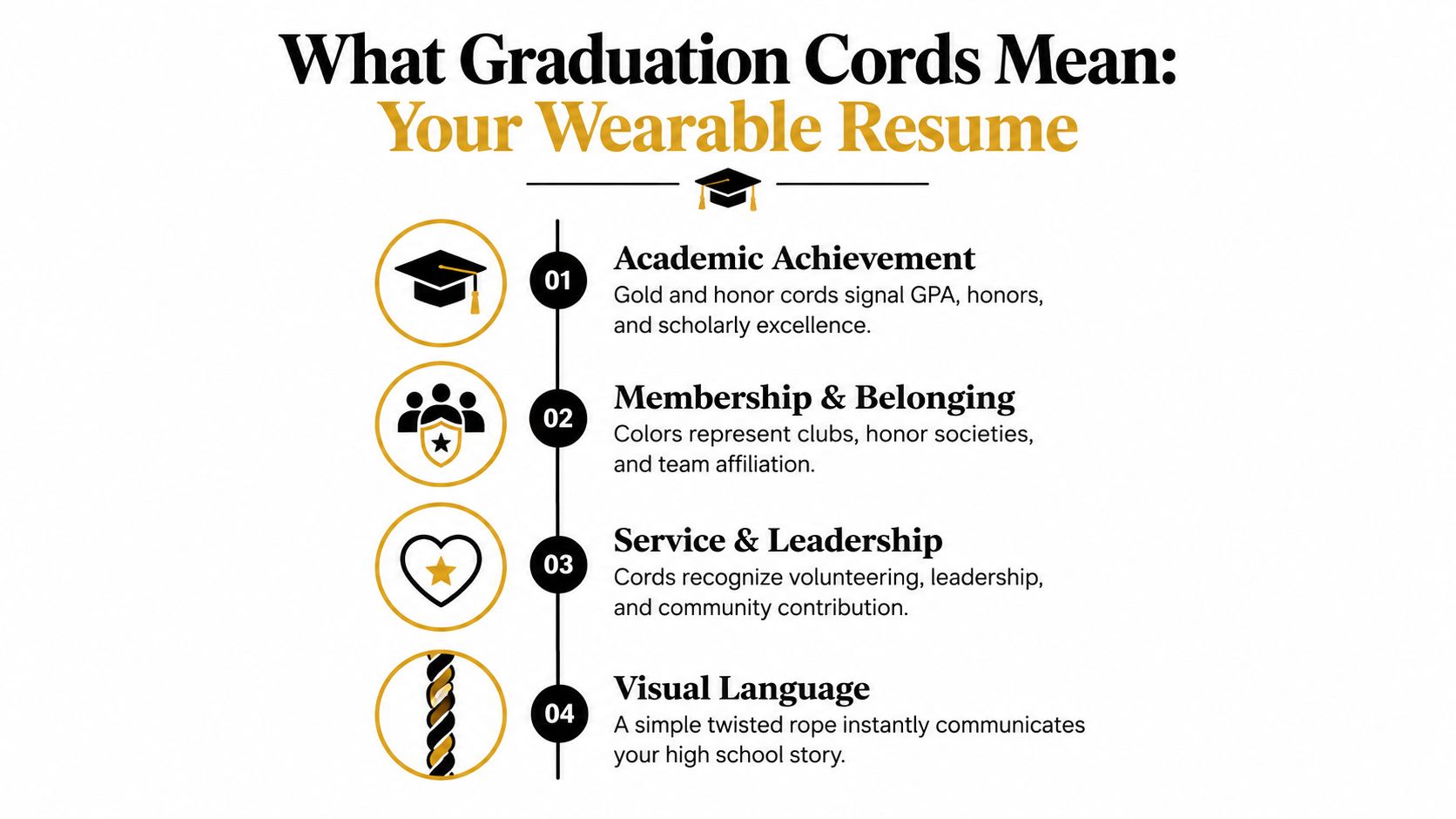
A wearable resume for graduation day
The easiest way to understand high school graduation cords is to think of them as a wearable resume. A transcript gives the details. A cord gives the audience the headline.
A gold cord might tell the room a student earned academic distinction. Blue and gold might point to National Honor Society membership. Purple and white may identify National Technical Honor Society membership. That kind of visual language matters most in large ceremonies where schools can't stop to explain every accomplishment one by one.
How cords became part of high school graduation
High school graduation cords feel traditional, but the modern cord tradition is relatively recent in American school ceremonies. One historical account places the origin of modern senior cords at Purdue University in 1904, and notes that the style had spread to other Indiana colleges and high schools by 1912. The same account says the style peaked from the late 1950s through the mid-1960s, with the greatest variety appearing in the late 1960s and early 1970s (history of senior cords from the Indiana State Museum).
That history matters because it explains why cords feel both formal and flexible. They started as a visible marker and gradually became a structured recognition system.
Why schools kept them
Schools adopted cords because they solved a practical problem. As graduation ceremonies grew, schools needed a fast way to show honors and affiliations at scale. Today, cords are commonly used for academic honors and society membership, and color systems identify many different student organizations. A compiled list of honor-society cords includes more than 15 named honor societies with unique cord colors, showing how institutionalized this practice has become across disciplines (overview of honor cords and society colors).
In a crowded commencement line, a cord says in one glance what would otherwise take a paragraph to explain.
Cords are different from tassels and stoles. A tassel belongs on the cap. A stole is a wider fabric panel. A cord is the slim braided piece used for recognition and affiliation.
High School Graduation Cord Colors and What They Mean
Color is often where people start, and it's also where mistakes happen. Families often assume every gold cord means the same thing everywhere. It doesn't. Schools borrow from common traditions, but local policy decides the final meaning.
The safest way to read cord colors
Start with the general meaning, then verify the school's version. One high-school-focused guide says gold cords may represent a cumulative unweighted GPA of 3.75 to 4.0 or membership in the National Honor Society, while red cords may correspond to GPA 3.5 to 3.74 and extracurricular involvement. The same guide notes broader patterns used across schools, such as royal blue for leadership or community service, white for arts and humanities, green for medicine or environmental studies, silver for public speaking or service, and purple for law or fine arts (high school graduation cord color guide).
National organizations add another layer. The National Honor Society commonly uses blue and gold cords. The National Technical Honor Society commonly uses purple and white cords.
For more examples of how schools and programs interpret these shades, see this honor cord color guide and meanings.
Common High School Graduation Cord Colors and Meanings
| Cord Color | Common Meaning | Typical Use Case |
|---|---|---|
| Gold | High academic achievement or honors | GPA-based honors, scholastic distinction |
| Blue and Gold | National Honor Society | Recognized NHS members |
| Purple and White | National Technical Honor Society | Career and technical honor recognition |
| Red | Academic recognition or involvement | Mid-to-high honors bands, activities |
| Royal Blue | Leadership or community service | Student leadership, service-based awards |
| White | Arts and humanities | Fine arts, language, or humanities programs |
| Green | Medicine or environmental studies | Pathway or field-specific recognition |
| Silver | Public speaking or service | Speech, leadership, or community roles |
| Purple | Law or fine arts | Discipline-linked recognition |
Single cords, double cords, and mixed colors
A single-color cord usually signals one category. A double-color or intertwined cord often points to a specific group, society, or school-defined recognition. That's why two students can both wear gold, while a third wears gold twisted with another color for a different reason.
Quick check: If the school hasn't published a color chart, ask for the exact wording used in the graduation approval list, not just “what color should I buy?”
That one question prevents the most common ordering error, which is buying the right color in the wrong format.
How to Wear High School Graduation Cords Correctly
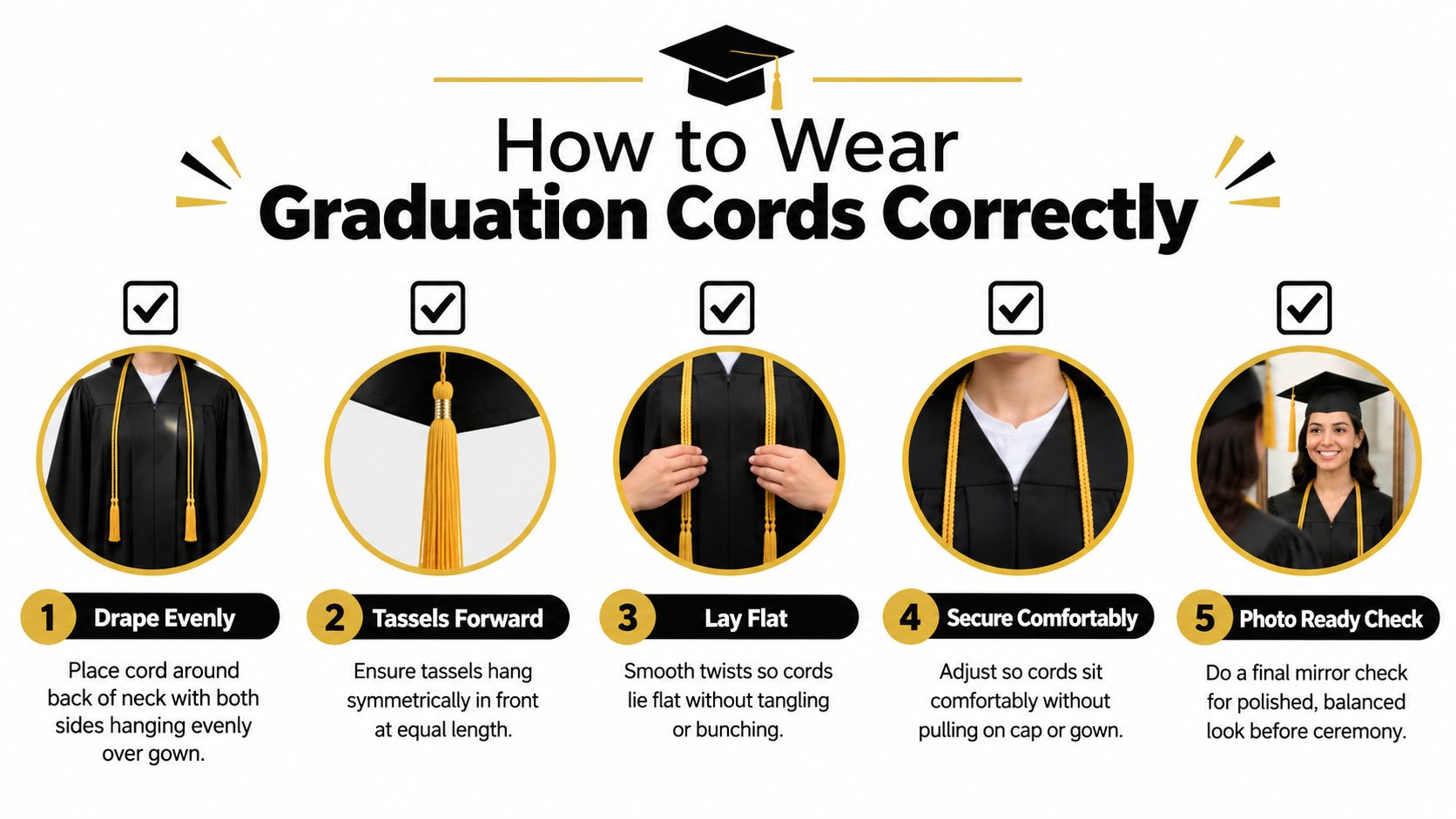
Wearing cords correctly is mostly about balance. If they're even, flat, and comfortable, they look polished in photos and stay in place during the walk. If they're twisted, stacked carelessly, or bunched under a stole, they can distract from the rest of the regalia.
Basic placement
Place the cord around the back of your neck so both sides hang down the front of the gown. The tassel ends should fall evenly. Smooth any twists before you line up.
If you're wearing more than one cord, lay them together so they drape naturally instead of crossing over each other. Thin, neat layering looks intentional. A tangled bundle doesn't.
Wearing cords with other regalia
Stoles are wider and should sit flat against the gown first. Cords usually rest on top so their colors stay visible. Medals should hang without trapping the cords underneath.
This visual guide can help if you're unsure about the order of your regalia pieces: how to wear graduation regalia.
A short demo also makes this easier to picture:
When school rules matter more than etiquette
The biggest mistake isn't usually how a cord sits. It's wearing one that wasn't approved. Spokane Public Schools states that only SPS-approved academic cords and medals may be worn at graduation, and it also states that caps may not be decorated or adorned for the ceremony (Spokane Public Schools approved graduation honors and regalia).
That means “Can I wear it?” is often a policy question, not a fashion question.
A good pre-ceremony check looks like this:
- Mirror check: Make sure both sides are even and the tassels hang cleanly.
- Movement check: Walk a few steps and sit down once. If the cord catches, reset it.
- Approval check: If you added anything after rehearsal, confirm it's allowed before ceremony day.
Materials Quality and Personalization Options for Graduation Cords
Not all cords hang the same way. Some look rich and clean in photos. Others twist tightly, fray early, or feel too flimsy against the gown collar. That difference usually comes down to braid quality, finish, and how the cord is put together.

What quality looks like
A well-made cord should drape without fighting you. The typical honor cord proportions described earlier help with that. Length in the 60 to 70 inch range and a width around 1/4 inch usually give enough presence to show clearly without feeling heavy at the neckline, while 4-inch tassels create a finished look in front-facing photos (as noted in the earlier sizing source).
Watch for these signs when comparing products:
- Even braid: The twist should look consistent from end to end.
- Clean tassels: Ends should look full and tidy, not sparse or frayed.
- Solid color definition: School colors should read clearly from a few feet away.
- Comfortable weight: The cord should stay in place without pulling at the gown collar.
Personalization choices that actually matter
Personalization isn't only about adding flair. It's often about matching the school's recognition system correctly. Some schools use a single-color cord for academic honors. Others assign double-color combinations for societies, pathways, or themed awards.
That's where product choice becomes practical. A family may need a basic single cord, a double honor cord, or a custom combination that matches school branding. Personalized graduation cords are useful when a school, homeschool group, or organization wants a specific color pairing rather than a generic off-the-shelf match.
One option in this space is the high school custom honor cord category from Graduation Cap and Gown, which includes double graduation honor cords for school-specific color combinations. That kind of product is helpful when a recognition program needs a defined pair of colors rather than a single standard cord.
Better personalization starts with one question: are you matching a meaning, or just matching a color?
If you're ordering for a group, ask for the official award name and the approved color format in writing before selecting the cord style.
Ordering Care and School Rules for High School Graduation Cords
The smoothest graduation cord orders happen when three decisions line up early: eligibility, approval, and product format. Most last-minute problems come from skipping one of those steps.
Check eligibility before you shop
Some schools tie cords to documented requirements, not just general recognition. At Akins Early College High School, students can earn an approved community service cord only after completing 100 approved and documented hours of community service, and student organizations must get pins approved by the campus graduation committee before the stated deadline (Akins graduation cords and medals guidance).
Other schools require sustained involvement and good standing. Harrison County Schools says a club may present a graduating senior with a cord only if the student participated in the club for at least two years of high school, with at least one of those years being senior year, had no disciplinary action in senior year, and had names submitted to the principal for approval (Harrison County Schools honorary cords information).
Ask the policy questions families forget
Rules vary more than people expect. One independent guide notes that students may earn multiple cords if they qualify in each category, and that most schools have grievance or appeal processes. The same guide points out how wide the variation can be, including examples of one school agreement allowing up to seven cords plus one cultural item, while another high school capped approved cords at eleven and tied violations to discipline (guide to getting graduation cords in high school).
That means these are the right questions to ask your school:
- How many cords are allowed?
- Does every cord have to be school-issued or school-approved?
- Are cultural items, identity stoles, or language recognitions handled separately?
- What is the appeal process if a student believes they qualified but was denied?
Store them well and keep records
Once approved cords are ordered, keep them simple and protected. Hang them, lay them flat, or place them in a clean bag so they don't knot before ceremony day. After graduation, many families store cords with the gown, diploma cover, or photos because they become part of the student's story, not just the outfit.
Save the approval email, the honor-society notice, or the service verification form until after commencement. If a question comes up late, paperwork settles it faster than memory does.
If your school is balancing recognition with cultural expression, remember that cords now sit inside a broader discussion about fairness, identity, and visible honors at graduation. Local policies can be generous, narrow, or still changing, so the safest path is always to confirm the written rule before ordering.
If you're sorting through honor cords, stoles, medals, or matching school colors, Graduation Cap and Gown offers product collections for individual students, families, and schools that need graduation regalia in specific formats. It's a practical place to compare cord styles, color combinations, and related accessories once you've confirmed what your school allows.