

The graduation gown is hanging in the closet, the ceremony date is getting close, and your senior may have just asked, “Which honor cord am I supposed to wear?” At rehearsal, most students will look nearly identical in their caps and gowns. The braided cords across their shoulders are often the clearest visible signs of academic achievement, service, leadership, or school involvement.
The confusing part is that high school honor cords don't have one universal color system. A gold cord can represent one honor at one school and a different distinction at another. Some cords are awarded by the school, while others may be purchased by students who belong to an approved organization. The safest approach is to learn what your school recognizes before ordering anything.
What High School Honor Cords Actually Are
As seniors take their seats, the black gowns create a nearly uniform row. Then the details become visible. One student wears a gold cord over the shoulders, another has two contrasting strands, and a third wears a cord alongside a stole or medal. Those cords help families and faculty recognize accomplishments that might otherwise be invisible beneath identical graduation attire.
A high school honor cord is a woven or twisted rope, commonly made from two strands, with tasseled ends. Students drape it over the graduation gown so the strands hang down on both sides of the chest. The cord may identify academic honors, membership in an honor society, service, leadership, athletics, arts, or another school-approved achievement.
Honor cords belong to a larger academic-regalia system that can include stoles, pins, medals, sashes, tassels, hoods, and diploma accessories. The guide to academic regalia can help families distinguish these pieces before graduation morning.
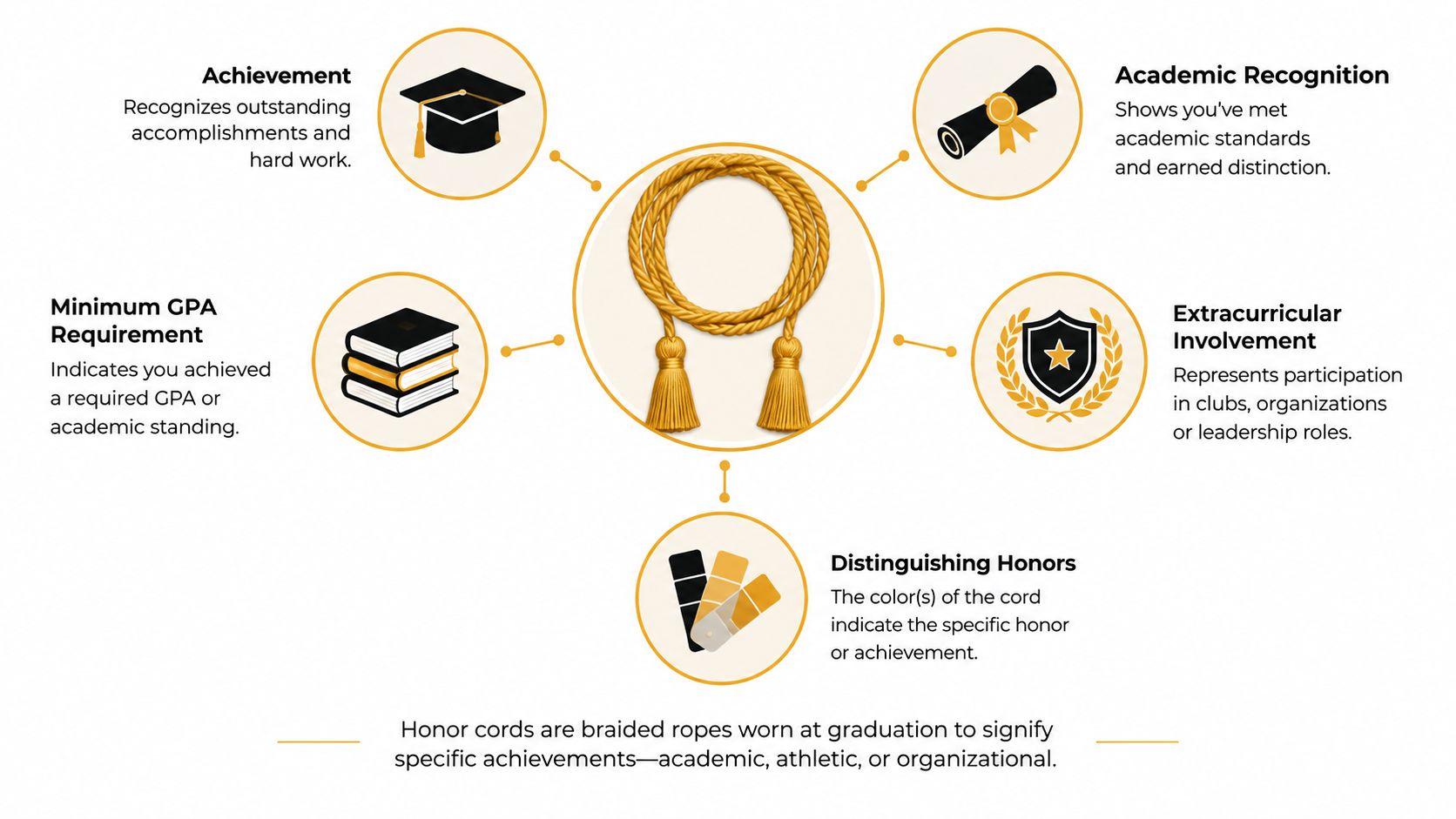
School-issued and student-purchased cords
A school-issued cord normally comes through the registrar, counseling office, department, graduation coordinator, or recognized society. The school verifies eligibility and tells students whether the cord will be distributed at an awards event, rehearsal, or commencement check-in.
A student-purchased cord may be connected to club membership, an outside organization, or a personal purchase that the school permits. Buying a cord doesn't automatically make it an official honor. Some schools allow only approved regalia, while others publish a broader list of acceptable cords.
Cord length often falls in the 60-to-72-inch range, allowing the cord to hang evenly on both sides of the gown. Many schools also limit how many cords a student may wear. That limit keeps the regalia readable from the stage and prevents cords from covering stoles, medals, or the school emblem.
Practical rule: A cord should represent a documented distinction that your school recognizes, not simply a color you like.
Historically, honor cords connect to medieval European academic and clerical dress. The modern academic-dress system in the United States was standardized in 1895–1896, helping establish the visual language later used to distinguish achievement in schools and universities. Today, institutions commonly reserve cords for students such as valedictorians, salutatorians, Dean's List students, and Latin-honors graduates, although high schools may use them for many other categories as well. This history of graduation cords explains how that symbolism developed.
Common Honor Cord Colors and What They Mean
A senior may arrive at rehearsal wearing a gold cord, while a classmate has blue, black, or rainbow cords. The colors can look like a shared code, but high schools do not follow one national chart. Treat the list below as a comparison guide, then check your school's written policy before deciding what a cord represents.
Academic honors and societies
Gold commonly marks outstanding academic achievement, including summa cum laude recognition. Blue and gold may identify a valedictorian, while blue often signals National Honor Society membership. Red and white can be assigned to an academic-excellence program.
Other colors point to a subject, career pathway, or activity. Lavender may represent humanities, drab may identify law enforcement or business, green may connect with medicine or biology, and pink may be used for music or choir. These meanings vary because schools and organizations create their own recognition systems. A color works like a label on a file. It has meaning only within the system that assigned it.
Service, leadership, and special recognition
Maroon can identify varsity letter winners, black may represent student government, and a rainbow cord may recognize diversity or LGBTQ participation. Silver is sometimes used for students with a 4.0 record, while white may identify graduation marshals.
These colors cannot be exchanged automatically between schools. One district may use black for academic honors, reserve blue for service, or approve a rainbow cord for another recognition. Review the graduation packet, student handbook, or official color chart before placing an order. The overview of rainbow graduation cords provides additional context for a category whose meaning can depend on school policy.
| Cord Color | Typical Meaning | Honor Type | School Variation Note |
|---|---|---|---|
| Gold | Summa cum laude or outstanding academic achievement | Academic | Confirm whether the school uses gold for a GPA honor, diploma, or top-ranked graduates |
| Blue and gold | Valedictorian | Academic rank | Some schools use a different combination or reserve it for another distinction |
| Blue | National Honor Society | Organization | Membership requirements and cord approval vary |
| Red and white | Academic excellence program | Academic program | The exact program may differ by school |
| Lavender | Humanities | Subject area | Not every school awards department cords |
| Drab | Law enforcement or business | Career pathway | CTE and pathway colors are locally assigned |
| Green | Medicine or biology | Subject or pathway | May represent environmental studies or another program |
| Pink | Music or choir | Arts | Choir and band programs may use different colors |
| Maroon | Varsity letter winners | Athletics | Athletic recognition may require a separate school award |
| Black | Student government | Leadership | Some schools use black for academic or other honors |
| Rainbow | Diversity or LGBTQ recognition | Inclusion | Participation and approval rules differ |
| Silver | 4.0 students | Academic achievement | The school may use a different threshold or color |
| White | Graduation marshals | Ceremony role | Marshals may receive a cord, stole, or another designation |
Use the chart to compare possible meanings side by side with your school's policy. Your school's published policy takes priority over any general guide.
Eligibility and How Schools Decide Who Earns a Cord
Families often assume that every school uses the same GPA cutoff. Published policies show otherwise. One school may use a cumulative GPA, another may use weighted grades, and a third may award cords for rank, membership, or athletics rather than GPA alone.
Three documented policies
Chippewa Valley High School provides a straightforward academic-honors example. Students must meet the school's minimum standards by February 10 of senior year, and the published cumulative-GPA threshold is 3.0 for a cord or sash. Chippewa Valley's academic-honors policy shows why deadlines matter as much as grades.
Caledonia High School uses Latin-honors bands after the first semester of grade 12. Summa Cum Laude receives a gold cord for a 4.0000+ cumulative GPA, Magna Cum Laude receives silver for 3.5000–3.9999, and Cum Laude receives bronze for 3.3300–3.4999. Caledonia's graduation-honors page spells out both the colors and the GPA ranges.
Bishop Verot High School uses weighted GPA at the end of the seventh semester and specifies no rounding up. Its stated cutoffs are 4.5000+ for Summa Cum Laude with a gold cord, 4.0000–4.4999 for Magna Cum Laude with a silver cord, and 3.5000–3.9999 for Cum Laude with a black cord. Bishop Verot's cord information is a useful reminder that even the meaning of “academic cord” can depend on the grading method.
| Policy Element | Chippewa Valley High School | Caledonia High School | Bishop Verot High School |
|---|---|---|---|
| Main basis | Cumulative GPA and minimum standards | Cumulative GPA and Latin honors | Weighted GPA |
| Published threshold | 3.0 | 4.0000+, 3.5000–3.9999, or 3.3300–3.4999 | 4.5000+, 4.0000–4.4999, or 3.5000–3.9999 |
| Color assignments | Cord or sash policy | Gold, silver, or bronze | Gold, silver, or black |
| Timing | Standards met by February 10 of senior year | After first semester of grade 12 | End of seventh semester |
| Rounding language | Follow the school's stated standards | Follow the published bands | No rounding up |
Independent graduation guidance commonly places Latin-honors thresholds around 3.5 for Cum Laude, 3.7 for Magna Cum Laude, and 3.9 for Summa Cum Laude, but those figures aren't national requirements. This Latin-honors guidance reinforces the central point: eligibility follows institutional rules.
Ask the counseling office how it handles transfer credits, mid-year recalculations, incomplete grades, and appeals. Then save the student handbook and graduation packet. The guide to different types of graduation cords can help you identify categories, but it can't replace your school's decision.
How to Wear and Layer Cords With Your Cap and Gown
A properly worn cord should look balanced before you enter the auditorium. Start with the cord behind your neck, then bring both strands forward so they fall evenly over the gown. The tassel, knot, or charm should rest at or just below the bottom of the V-neck collar.
Five steps for a clean arrangement
- Drape the cord: Place the midpoint at the back of your neck. Don't let the cord sit on only one shoulder.
- Balance the strands: Check that both ends reach to a similar point on the front of the gown.
- Set the center detail: Position the knot, tassel, or charm at or just below the bottom of the V-neck.
- Layer carefully: If you have multiple cords, follow your school's order. When no order is provided, keep the arrangement neat and avoid hiding a medal or stole.
- Adjust the cap: Make sure the mortarboard sits level and doesn't cover the cords or slide forward.
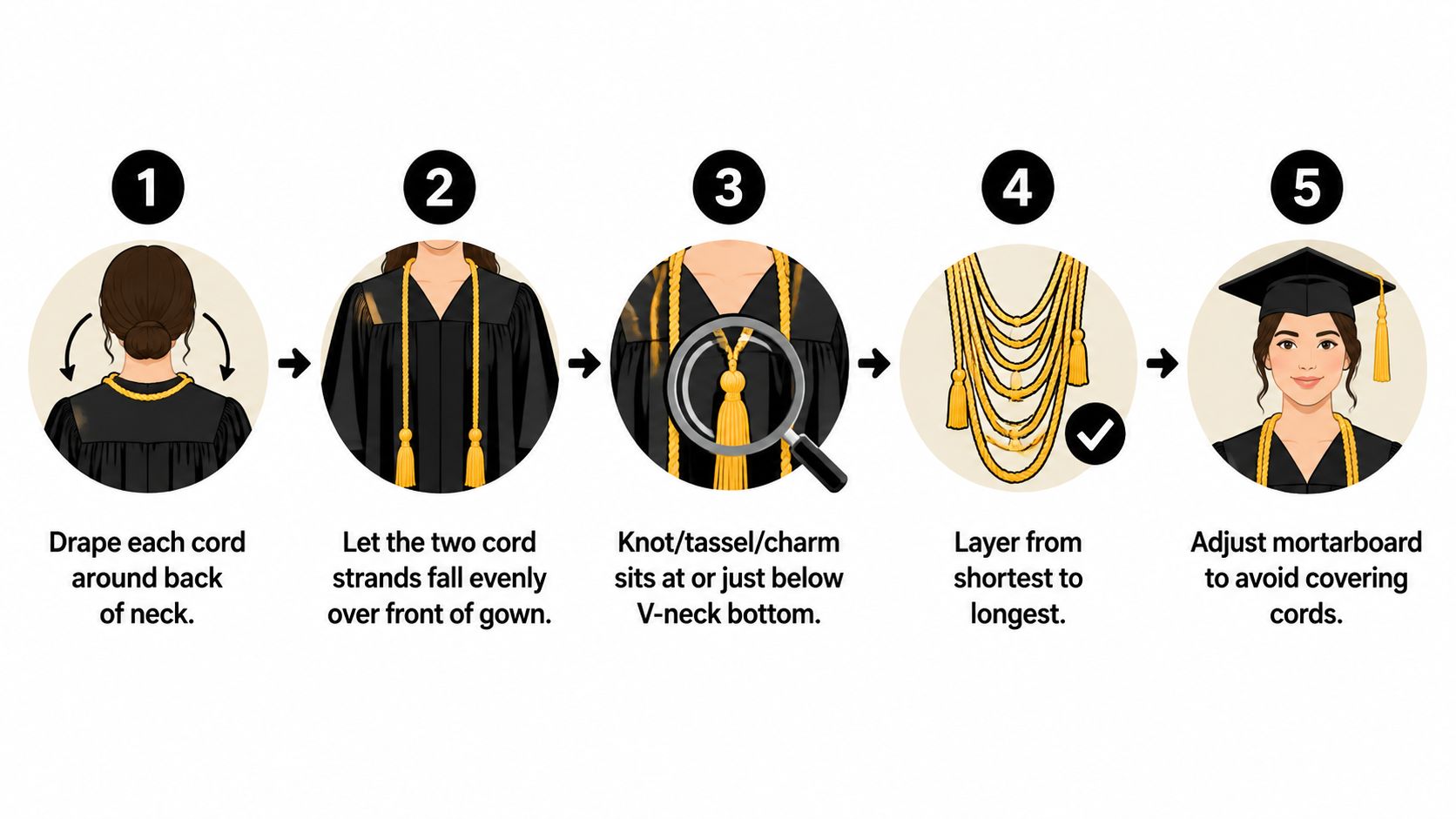
Schools sometimes specify which cord goes on top. National-honor colors such as gold or maroon may be placed on the outermost layer, with school-specific colors underneath, but that order isn't universal. Follow the coordinator's instructions if they differ.
Don't tie several cords together. A hidden graduation pin or small safety pin under the stole can keep multiple cords aligned without creating a bulky knot. Test the arrangement at home, then remove every pin before returning a rental gown.
Cap, fabric, and ceremony details
Some schools instruct students to move the cap tassel from one side to the other at a specific moment. If your school gives no special instruction, ask the coordinator which side should face the diploma hand or ceremonial position. Keep the cap level rather than tilting it forward, since a forward tilt can obscure your face and push against the cords.
A polyester gown may arrive wrinkled. Use a garment steamer and keep the nozzle moving. An iron can press shiny marks into synthetic fabric, especially when the heat is too high. For a complete visual guide, see how to wear graduation regalia.
Ordering Cords and What to Check Before You Buy
Ordering is easiest when you treat it like a verification task, not a color-shopping exercise. The school may provide a vendor, distribute qualifying cords at no charge, or prohibit outside regalia. Check the rules before comparing products.
The pre-checkout list
- Confirm the exact color: Use the school's named color or official color code. A screen image may not match the finished fabric.
- Confirm the length: Cord lengths commonly fall between 60 and 72 inches, but the school or vendor may recommend a particular size for the gown.
- Confirm the strand style: Ask whether the honor requires a single cord, double-strand cord, metallic trim, or a specific charm.
- Confirm the delivery date: Graduation demand is seasonal, with buying activity concentrated around spring ceremonies. Order before the school's stated cutoff, not after the last rehearsal.
- Confirm outside-vendor approval: Some schools accept approved outside suppliers, while others require a school-issued product.
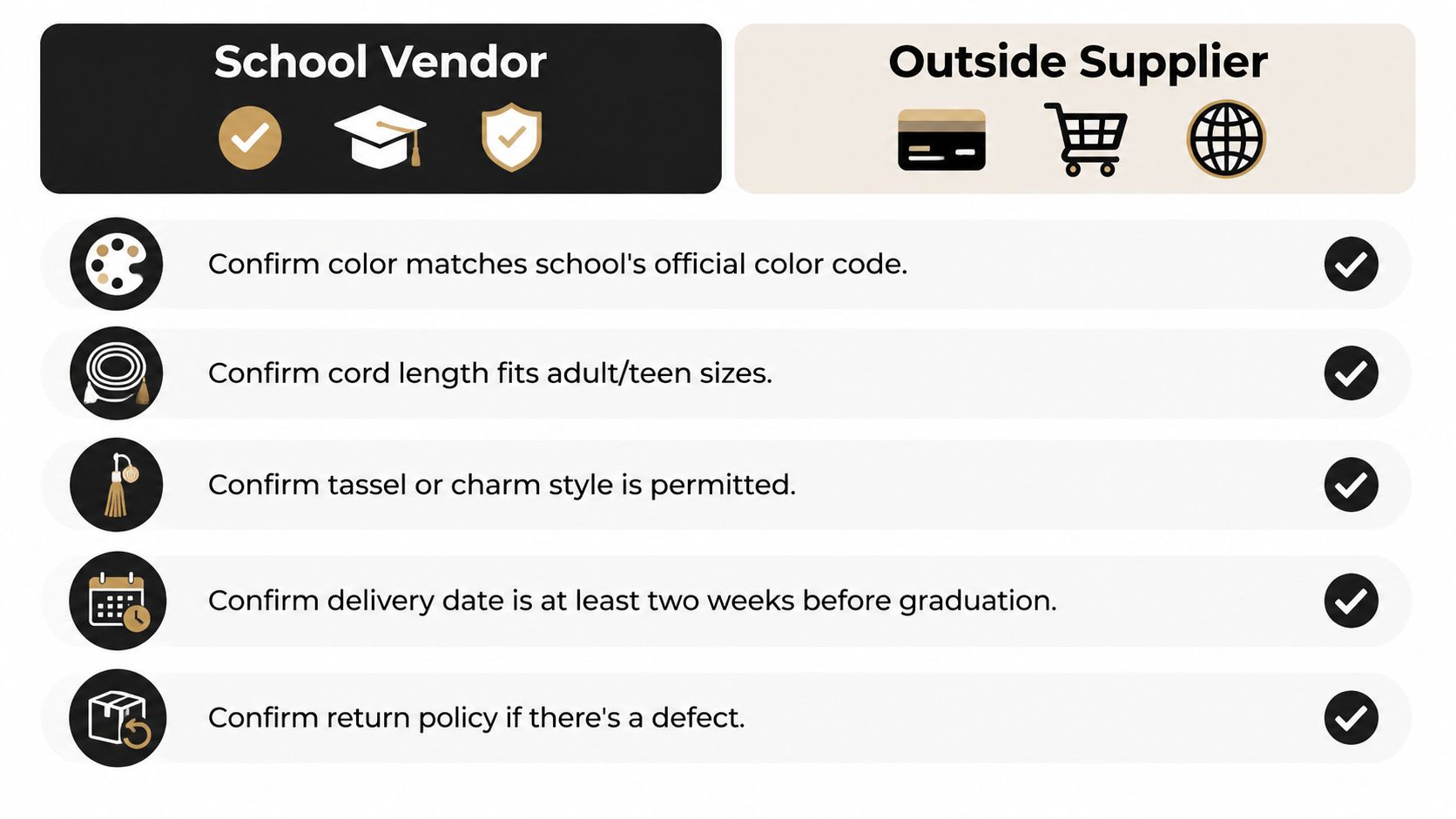
The final two weeks of April can create a timing trap for families whose ceremonies occur in spring. Demand often rises sharply before graduation, and rush production or expedited shipping may become necessary. A recent niche-market estimate places Amazon U.S. graduation-cord demand at about $193K per year, with 738K annual searches and a 283.2% increase over the last 90 days, while demand peaks from April through June. These figures come from Flapen's graduation-cord market tracking, and they point to seasonal purchasing rather than steady year-round demand.
Compare the complete purchase
A bundle containing a cord, stole, and tassel may make sense if you need several pieces and the school permits them. A separate cord is usually more practical when your gown and stole are already supplied. Some schools bundle an academic cord with a qualifying stole at no charge, so ask before paying out of pocket.
Save the school's vendor PDF or take a screenshot of the approved color and style. Keep the confirmation with your order details, and read the return policy in case the cord arrives damaged or the school changes your eligibility.
What Honor Cords Typically Cost
The price depends on construction, finish, and what comes with the cord. A basic single cord may cost about $9 to $18, while a double-strand or metallic-trim cord may fall around $14 to $25. A bundle that includes a stole may range from about $25 to $45.
These ranges are planning estimates, not guarantees. A custom dye match can cost more than a standard color. Full metallic braiding, a personalized charm or seal, and rush production can also raise the final price.
Three practical buying tiers
| Cord Type | Typical Price | Best For |
|---|---|---|
| School-issued | May be included or supplied through the school | A senior whose school distributes qualifying cords |
| Standard online single | About $9 to $18 | A graduating senior who needs one common color |
| Double-strand or metallic | About $14 to $25 | A chapter officer or student whose honor requires a more distinctive cord |
| Cord and stole bundle | About $25 to $45 | A family purchasing multiple approved regalia pieces |
| Premium custom | Varies beyond standard ranges | A parent ordering a keepsake-quality cord with custom details |
Families should first ask whether one academic honors cord is included for qualifying students. Paying for a replacement or duplicate cord may be unnecessary if the school already provides one.
A standard cord is appropriate for basic ceremony use. A custom finish may make sense when the cord represents a long-term organization, a family keepsake, or a formal recognition program. Since the cord is worn for a single ceremony but may be stored for years, decide whether you're buying for the stage, the photographs, or the memory box.
Key Takeaways for Graduation Day
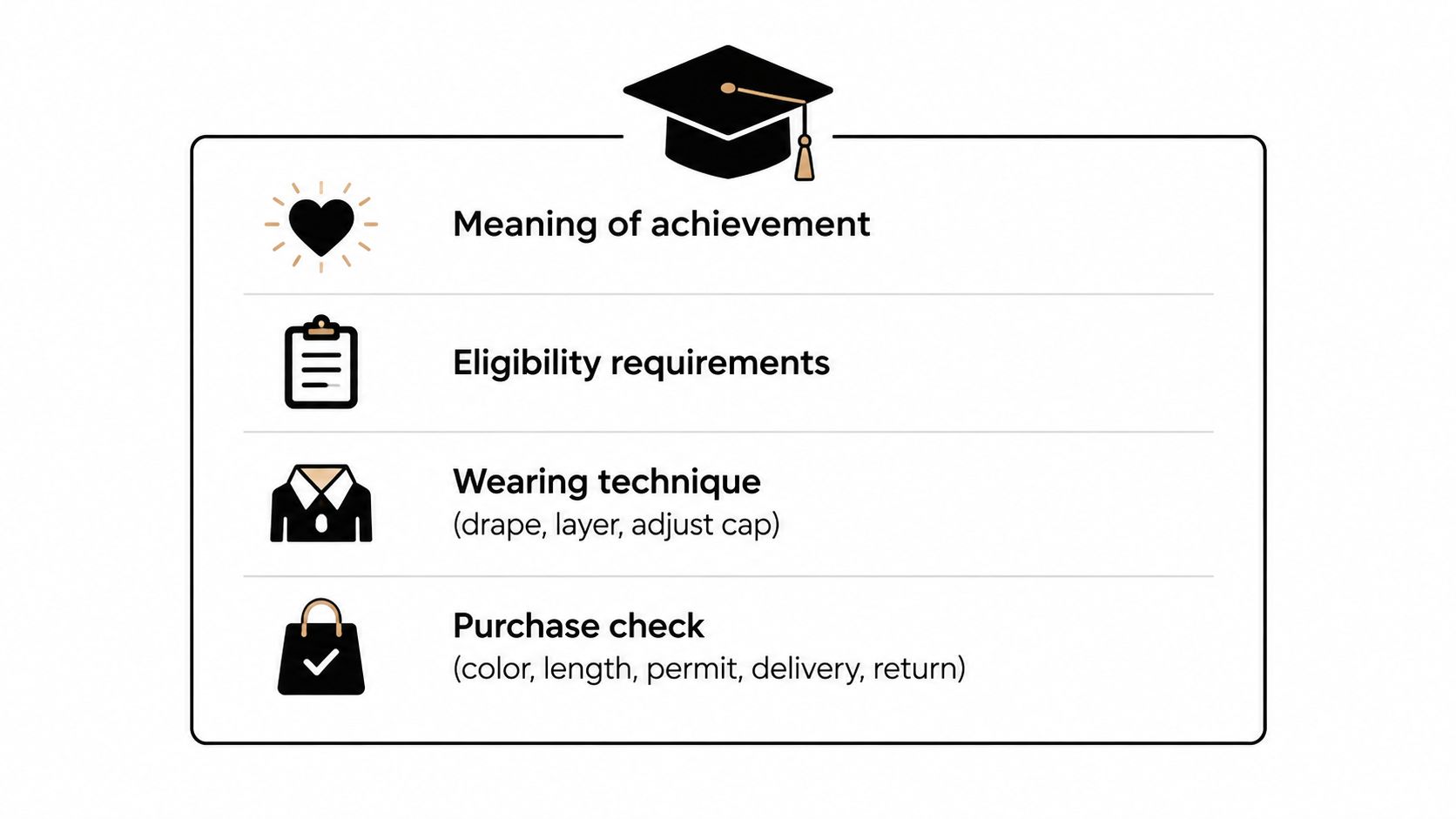
Honor cords are symbols of verified achievement, not general fashion accessories. Every cord should correspond to an honor, membership, role, or accomplishment that the school has approved and documented.
Use this short checklist before graduation:
- Meaning: Identify exactly what each cord represents.
- Eligibility: Confirm the GPA cutoff, grading method, deadline, and any membership requirement.
- Color: Treat common conventions as clues, not guarantees. Gold and white may signal academic honors, blue may identify service or an honor society, red may represent leadership, and purple may connect with music, but local rules control.
- Purchase: Verify the approved vendor, color, length, strand style, delivery date, and return policy.
- Wear: Drape the cord over both shoulders, balance the ends, place the center detail near the V-neck, and keep cords beneath stoles when your school directs that arrangement.
- Ceremony: Untangle everything before lineup, check the cap position, and remove pins before returning rental regalia.
Budget carefully. Single cords may start around $5 to $10, double cords or honor bundles may run around $15 to $30, and premium or custom options can exceed $40. Because these figures differ from the more detailed ranges above, use your school's vendor quote and the product listing as the final price reference.
Graduation is also a moment to recognize the people who helped a senior reach the finish line. If you're writing a note for a graduate, Fiore's guide to what to write in a grad card offers ideas for making the message personal without repeating a generic congratulations.
Graduation Cap and Gown offers high school honor cords, including double graduation honor cords, along with approved regalia accessories such as stoles, tassels, medals, and diploma covers. Visit Graduation Cap and Gown to compare colors and styles, verify fit and delivery options, and order the pieces your school permits for commencement.