

Graduation honor cords are so much more than just a colorful accessory for your gown; they're a visual language. Each color tells a story about your academic journey, turning a simple rope into a testament to your hard work and accomplishments. Whether you need a single cord or a double honor cord, the meaning behind each one adds a rich layer of tradition to your big day.
Whether it signifies top academic honors or a specific major, the meaning behind each cord adds a rich layer of tradition to your big day.
A Quick Guide to Graduation Cord Colors
When you step onto that commencement stage, the vibrant cords draped over your gown are a personal tapestry of your achievements. They're not just for decoration; they're part of a long-standing tradition in academic regalia, communicating your unique successes to everyone in the room without you having to say a single word.
Understanding what the different honor cord colors mean helps decode this rich tradition. Whether you're a graduate getting ready for your ceremony or a proud family member in the audience, knowing what each hue signifies adds a deeper layer of appreciation to the whole event.
The system is surprisingly detailed, with specific colors assigned to different fields of study, honor societies, and levels of academic distinction.
What Do Different Colors Represent?
The symbolism behind graduation cord colors is fairly standardized across the country, though you'll find slight variations from one school to the next. Generally, certain colors are reserved for specific achievements or academic disciplines, creating a visual language that ensures every accomplishment is publicly recognized and celebrated.
You can group most cord meanings into a few key categories:
- Academic Honors: Gold is the undisputed champion here. It's universally recognized as the symbol for high academic achievement, like graduating summa cum laude, magna cum laude, or cum laude.
- Field of Study: Specific colors are often tied directly to a graduate's major. For example, you'll frequently see light blue on education majors, while green often represents degrees in medicine or environmental science.
- Honor Societies: Prestigious organizations like the National Honor Society have their own signature colors—often gold or a combination like blue and gold—to identify their members at a glance.
This is just a quick look at some of the most common meanings you'll encounter.
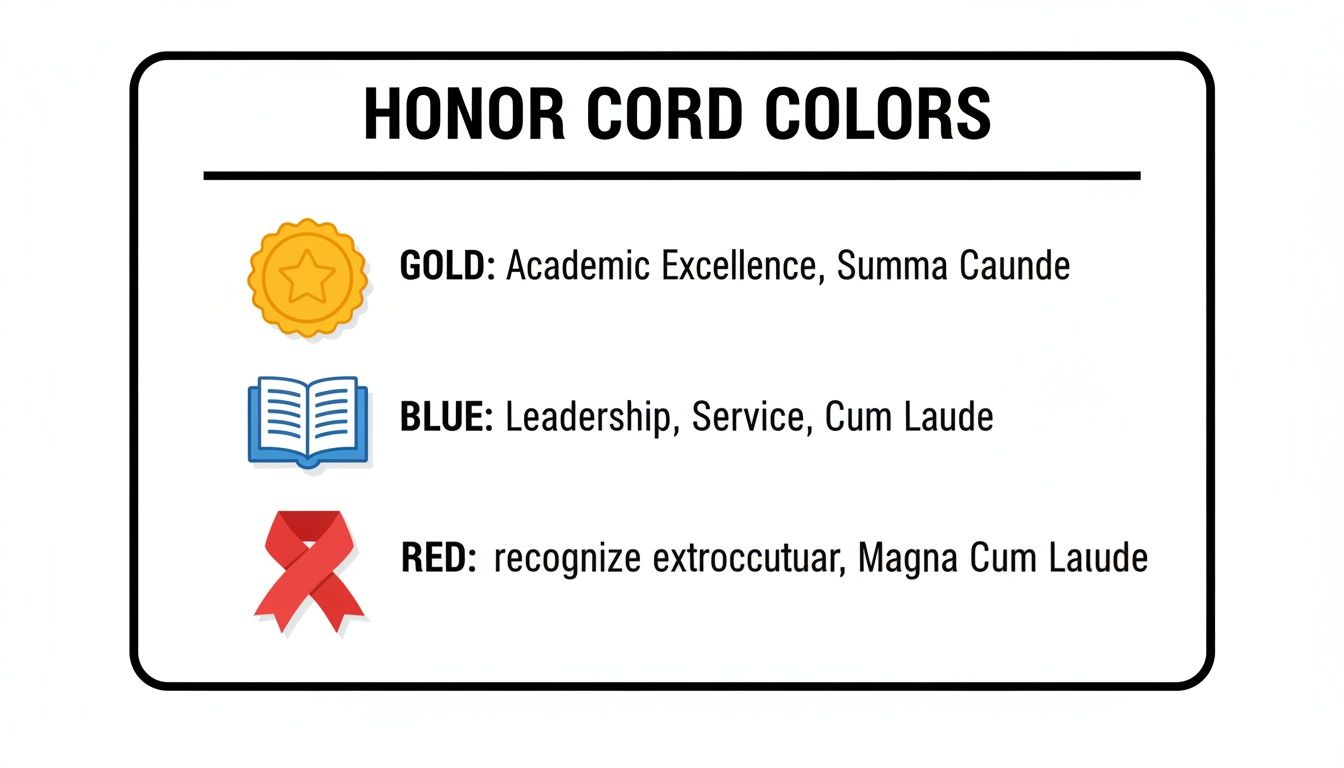
As you can see, colors like gold, blue, and red each carry significant weight, representing everything from top academic performance and leadership to passion and community service.
This system transforms the graduation ceremony from a sea of identical gowns into a vibrant display of individual and collective achievement, celebrating every student's unique path. For a much more detailed breakdown, you can learn more about the complete graduation rope color meaning in our dedicated guide.
The Story Behind Your Honor Cords
So, why do graduates wear those colorful ropes? Think of honor cords like medals on a military uniform—each one tells a story of dedication and success. These seemingly simple accessories are a core part of a tradition that turns your graduation gown into a personal testament to your hard work.
Understanding the story behind them adds a much deeper layer of meaning to your commencement day.
The whole tradition of academic regalia, including cords, actually dates back centuries. Every single element is symbolic, designed to publicly recognize a student's achievements. Cords, in particular, are a vibrant and immediate way to showcase specific accomplishments that might otherwise go unnoticed in a huge ceremony. They are the visual proof of all those late-night study sessions, challenging projects, and unwavering commitment.

Different Achievements, Different Cords
Not all cords are created equal, and the honor cords color meaning almost always depends on the type of achievement it represents. It’s pretty common for a graduate to wear several cords, with each one signifying a distinct chapter of their academic story.
These honors generally fall into three main buckets:
-
Institutional Honors: These are the big ones, awarded directly by the university or college for overall academic excellence. The most common are the Latin honors—cum laude, magna cum laude, and summa cum laude—which are almost universally represented by a gold honor cord.
-
Departmental Recognition: Lots of academic departments award cords to their own graduates. The color often corresponds to the specific field of study, following guidelines from associations like the American Council on Education. For example, engineering is typically represented by orange, while nursing is often apricot.
-
Honor Society Membership: Cords are also the primary way for national and international honor societies to recognize their members. Organizations like Phi Beta Kappa (often light blue and pink) or the National Honor Society (gold) have specific colors that members wear with pride.
Understanding these distinctions clarifies why one student might wear a single gold cord while another displays a collection of different colored ropes. Each cord is a badge of honor, representing a unique and hard-earned accomplishment on the path to graduation.
The Symbolism in Your Regalia
Ultimately, each honor cord you wear contributes to the broader narrative of your academic journey. From the cap and gown to the tassel and hood, every piece of graduation attire is steeped in symbolism, connecting you to generations of scholars who came before.
Knowing the story behind your cords transforms them from simple decorations into meaningful keepsakes. They are a celebration of your unique path, showcasing the specific knowledge you gained and the communities you joined along the way.
To explore this topic further, you can learn more about the significance of what is academic regalia in our detailed article. This context helps you appreciate every single piece you wear on your special day.
The Spectrum of Achievement: A Detailed Color Guide
While the whole tradition of academic regalia is packed with symbolism, for many graduates, the real story is in the colors of the honor cords they wear. Each color acts as a chapter in your academic story, representing your field of study, your level of achievement, and your membership in distinguished societies.
Think of it like a painter's palette. Every color is carefully chosen to represent a specific idea—only here, the ideas are your accomplishments. This guide will walk you through the most common colors you’ll see at commencement, helping you decode the unique meaning behind each one.
The Most Common Honor Cord Colors Explained
Walk into any graduation ceremony and you'll notice a few colors that pop up again and again. These are the heavy hitters of the honor cord world, carrying meanings that are widely understood across most schools. They usually signify broad categories of achievement or popular fields of study, making them instantly recognizable.
- Gold Honor Cords: This is the undisputed symbol of high academic achievement. Gold cords almost always represent honors like summa cum laude, magna cum laude, and cum laude. They're also the signature color for many of the most prestigious national honor societies.
- Royal Blue Honor Cords: Often tied to leadership, community service, and trustworthiness. This deep blue can also represent philosophy or political science, highlighting a graduate's dedication to big ideas and civic engagement.
- Red Honor Cords: A color of passion, courage, and strength. Red is frequently used to denote studies in journalism, public health, or theology. It's a bold statement about a graduate's commitment to their chosen path.
- White Honor Cords: Symbolizing purity, new beginnings, and possibility. White is commonly associated with the humanities, arts, and social sciences, reflecting a broad and foundational understanding of human culture and society.
Each of these colors tells a powerful story. A graduate wearing a gold cord is immediately recognized for their academic prowess, while someone with a red cord might be celebrated for their dedication to public service through journalism. This visual language makes every achievement visible.
The Significance of Gold in Graduation
Gold honor cords stand out as the most iconic symbol in graduation regalia, universally representing top-tier academic excellence across high schools, colleges, and universities worldwide. This isn't a new trend; it dates back to traditions formalized in 1896 by U.S. colleges adopting a uniform academic dress code.
Today, gold cords are awarded to students hitting specific GPA milestones—like a 3.5 cumulative GPA for freshmen in Phi Eta Sigma. Gold is the top choice for honor societies; the National Honor Society uses gold cords, and surveys of over 10,000 U.S. high school graduations show about 15-20% of honor graduates donning them. Prestigious groups like Alpha Omicron Pi sorority, Beta Club, and the Spanish National Honor Society all select gold, symbolizing prosperity, wisdom, and compassion.
To see how one university breaks it down, you can discover more insights about cord colors and meanings at Frostburg State University.
A Deeper Dive into Disciplinary Colors
Beyond the most common hues, a wider spectrum of colors represents specific academic disciplines. These standardized colors help identify graduates from various fields of study, creating a vibrant display of the university's diverse academic community. Understanding these detailed meanings adds another layer of appreciation to the ceremony.
Here's a breakdown of colors often tied to specific majors:
- Green: This color is strongly linked to the life sciences. It's frequently worn by graduates in medicine, environmental studies, and agriculture.
- Orange: Representing innovation and technical skill, orange is the traditional color for engineering graduates.
- Light Blue: Almost universally, light blue signifies a degree in education, honoring those who will shape future generations.
- Purple: Often associated with law, urban planning, and architecture, purple denotes ambition, creativity, and justice.
- Silver: Similar to gold, silver can represent high honors, but it's also tied to fields like veterinary science, physics, and oratory or public speaking.
These colors are not just arbitrary choices. They are part of a long-standing academic tradition that visually organizes and celebrates the wide range of knowledge represented at commencement.
Detailed Guide to Honor Cord Color Meanings and Associations
To really appreciate the stories being told at graduation, it helps to have a quick reference. The colors you see aren't just decorative; they are a visual language rooted in academic history. This table breaks down what each hue typically represents, connecting colors to specific fields of study and the societies that honor them.
| Color | Primary Meaning | Associated Fields or Honors | Example Societies or Uses |
|---|---|---|---|
| Gold | Excellence, High Achievement | Summa, Magna, Cum Laude honors, top GPA | National Honor Society (NHS), Alpha Lambda Delta |
| Royal Blue | Leadership, Philosophy | Political Science, Justice Studies, Philosophy | Pi Sigma Alpha (Political Science), Leadership Programs |
| Red | Passion, Public Service | Journalism, Public Health, Music, Theology | Spanish National Honor Society, Mu Alpha Theta (Math) |
| White | Arts, New Beginnings | Humanities, Arts, English, Social Sciences | Sigma Tau Delta (English), General Arts Honors |
| Green | Life Sciences, Health | Medicine, Environmental Science, Agriculture | Beta Beta Beta (Biology), Pre-Med clubs |
| Orange | Engineering, Innovation | All Engineering Disciplines (Civil, Mechanical, etc.) | Tau Beta Pi (Engineering) |
| Light Blue | Education | Elementary Education, Secondary Education, Administration | Kappa Delta Pi (Education) |
| Purple | Law, Justice, Dignity | Law, Urban Planning, Architecture, Theology | Phi Alpha Delta (Law), Student Government |
| Silver | Oratory, Science | Public Speaking, Physics, Veterinary Science | Lambda Pi Eta (Communication), general academic honors |
| Yellow (Lemon) | Library Science | Library and Information Science | Beta Phi Mu (Library Science) |
| Pink | Music | Music Performance, Music Education | Pi Kappa Lambda (Music) |
| Brown | Fine Arts | Fine Arts, Drama, Architecture | General Arts programs, departmental honors |
This chart is a great starting point, but remember that individual schools can have their own unique traditions. Always check your institution's specific guidelines to be sure!
Whether you're interested in the vibrant passion of a red honor cord or the scholarly dedication of a blue one, each has a unique story to tell. For a closer look at one of the most powerful colors on the stage, you can check out our guide on the red honor cord and what it represents. This helps you appreciate the full spectrum of achievement on display.
How to Wear Your Honor Cords with Pride
You've put in the work and earned those honor cords. Now, let's make sure you wear them with the pride they deserve on the big day. Getting it right is a small detail, but it makes a huge difference in looking polished and professional in all those graduation photos you'll be taking. It's about displaying your hard-earned honors with the dignity they've earned.
First things first, you need to be sure about which cords you're actually eligible to wear. The best way to do this is to go straight to the source: your school. Your academic advisor, the registrar's office, or the specific honor society chapter you joined are the people to ask. They'll give you the official list of honors you've earned and which cords go with them.

Can You Wear More Than One Honor Cord?
This is one of the most common questions graduates have, and the answer is a big, enthusiastic yes! Most universities and high schools absolutely encourage students to wear every single honor cord they have rightfully earned. Each cord represents a different accomplishment, and wearing them all together tells the complete story of your academic journey.
Think of it this way: if you won several different medals, you wouldn't be asked to pick just one to wear. Your honor cords work the same way—they're distinct symbols of your various achievements. Layering them is standard practice and adds a ton of visual prestige to your graduation attire.
Wearing multiple cords is not just acceptable; it's a celebration of your diverse successes. From departmental honors to society memberships and high GPA distinctions, each cord adds a layer to your academic narrative.
The only trick is to arrange them neatly so that every cord is visible without looking like a tangled mess. When layered correctly, every honor—whether it's for leadership, academic excellence, or community service—gets its moment to shine.
A Simple Guide to Wearing Your Cords
Wearing your honor cords is incredibly straightforward. A few simple steps will ensure they hang perfectly over your graduation gown, creating a look that's both neat and distinguished.
Here’s a quick step-by-step guide to get it right:
- Start with Your Gown: Before adding any accessories, make sure your graduation gown is on and fully zipped up. This creates a stable base for your cords and stoles to rest on.
- Find the Center: Grab your honor cord and find the midpoint where it's knotted together. This is the key to making sure it hangs evenly.
- Drape Around Your Neck: Place the cord around the back of your neck, letting the center knot rest comfortably. The two ends with the tassels should fall forward over your shoulders and down the front of your gown.
- Adjust for Evenness: Take a look in a mirror and adjust the cords so both tassels are hanging at the same length on either side of your gown’s zipper. They should hang straight down your front, parallel to each other.
If you’re rocking multiple cords, just layer them one by one. Place the first cord as described, then repeat the process with the next, adjusting them so they sit neatly together without tangling. Many students find it helpful to use a small safety pin at the back of the neck to keep the cords secure and perfectly in place throughout the ceremony.
Beyond Single Colors: Custom and Combined Cords
While a single-color cord tells a clear story, graduation regalia gets even more interesting when you see cords with multiple, intertwined colors. These combined cords add a rich, new layer to the honor cords color meaning, painting a more complex and specialized picture of a graduate's time at school. They're a vibrant testament to a student’s multifaceted journey.
These multi-color cords aren't just for show; they carry very specific significance. Think of them as a way to visually represent two or more achievements at once. A solid cord might represent your major, but a combined cord can signify a double major, a minor, or membership in an honor society that uses two distinct colors.

The Meaning of Intertwined Cords
When you spot a graduate wearing a cord with two or three colors braided together, it almost always symbolizes a unique intersection of their accomplishments. These combinations are far from random—they're chosen to send very specific messages about the student’s academic path.
Here are a few common reasons for combined cords:
- Interdisciplinary Achievements: A student who majored in both business (often represented by a drab color) and law (purple) might wear a combined cord to represent their dual focus.
- University Colors: Many schools offer cords in their official colors to graduates who have shown exceptional school spirit, leadership, or service to the university community.
- Honor Society Colors: Prestigious organizations frequently use two colors to distinguish their members. For example, a blue and gold honor cord often signifies membership in societies that value both knowledge (blue) and high achievement (gold).
This practice allows for a more detailed and personal story, showcasing a graduate’s unique blend of skills and passions.
Every cord tells a unique story, and combined cords tell a story of connection—linking different fields of study, celebrating institutional pride, or honoring membership in a distinguished community. They show that a student's achievements are often greater than the sum of their parts.
Specialty Cords for Unique Student Groups
Beyond academics, many schools now offer custom cords to recognize and celebrate the diverse backgrounds and experiences of their student body. These specialty cords shine a light on personal journeys and identities, making sure that every student’s path to graduation is honored. It's a powerful shift toward a more inclusive commencement.
These cords often recognize specific communities and accomplishments that are a huge part of a student’s university experience.
Examples of Custom Cords:
- First-Generation Cords: Many universities now award a special cord to students who are the first in their family to graduate from college, celebrating their perseverance and groundbreaking achievement.
- Student Veteran Cords: A red, white, and blue cord is commonly used to honor student veterans, recognizing their service to the country and their dedication to finishing their education.
- Cultural Organization Cords: Cords representing specific cultural or heritage groups allow students to celebrate their identity and community on graduation day.
These custom cords reinforce the idea that every graduate's story is valuable. Whether you are looking for a classic combination to represent your school or society, you can explore beautiful options like our purple and gold two-color honor cord to find the perfect match for your achievements. This ensures your regalia is a true reflection of your personal journey.
Your Questions About Honor Cords, Answered
Even after getting the rundown on color meanings, a few practical questions always seem to pop up as the big day gets closer. Here are some quick, clear answers to the most common things students and their families ask, so you can wear your honors proudly and without any last-minute stress.
Think of this as your graduation day cheat sheet. We'll cover everything from layering your cords to figuring out where they come from.
Can I Wear More Than One Honor Cord?
Absolutely! This is one of the top questions graduates have, and the answer is almost always a resounding yes. Most schools don’t just allow it—they encourage you to wear every single cord you've earned. After all, each one represents a unique piece of your academic journey.
Just layer them neatly around your neck so every color is visible. Think of it as displaying all the medals you’ve won; each one tells a part of your story, and together they create a full picture of your hard work and dedication.
Where Do I Get My Honor Cords?
This depends on the specific honor. Some cords, especially those for university-wide honors like cum laude, are often given out directly by your school's registrar or your academic department. In the same way, honor society chapters typically provide their own signature cords to new members.
However, it's also very common for students to need to purchase their own. In these cases, finding a reliable supplier is key to making sure you get a high-quality cord with the right colors that match your school's ceremony standards. We offer a wide selection of single honor cords to meet any need.
Key Takeaway: Your first step should always be to check with your school or honor society. If you do need to buy your own, pick a trusted vendor that specializes in academic regalia to guarantee you get the real deal for your big day.
What's the Difference Between an Honor Cord and a Stole?
While you wear both to show off an achievement, honor cords and stoles have different roles. Understanding the distinction helps you read the visual language of graduation day.
- Honor Cords: These are the thin, twisted ropes, usually with tassels on the ends. Cords tend to represent specific, granular achievements, like a high GPA, membership in a particular honor society, or finishing a special academic program.
- Stoles: These are the much wider sashes that drape over your shoulders. Graduation stoles often signify broader affiliations or major leadership roles, like being student government president, a member of a fraternity or sorority, or celebrating your cultural identity.
In short, think of cords for individual academic milestones and stoles for broader leadership roles or group affiliations.
How Should I Care for My Honor Cord After Graduation?
Your honor cord is more than just an accessory for your gown; it's a valuable keepsake representing years of hard work. Taking good care of it will ensure it stays a cherished reminder of your success for a long time. The main thing is to store it out of direct sunlight, which can make the fabric fade over the years.
Many graduates choose to display their cords in a shadow box along with their tassel, diploma, and a graduation photo. It’s a beautiful way to honor your academic journey and keep all your mementos safe and well-preserved.
At Graduation Cap and Gown, we know that every single detail of your ceremony matters. From finding the perfect honor cord to matching your school's exact colors, we offer the largest online selection of high-quality regalia to make your day perfect. Explore our collection and find everything you need for a memorable graduation.
Shop for your graduation essentials at Graduation Cap and Gown