

Put the tam on last, seat it level and centered about 1 inch above the eyebrows or ears, and keep the tassel on the left for doctoral dress unless your commencement program says otherwise. The school's fit and ceremony instructions take priority over any general positioning rule.
You're probably standing beside a zipped garment bag, with a hood you haven't quite figured out and a tam that looks different from the graduation cap you remember. The immediate temptation is to copy a photograph. Don't make that your starting point: a convincing photo can still show the wrong headwear or tassel position for your program.
Learning how to wear a tam starts with checking what you're authorized to wear. Once that's settled, the fitting should leave you free to walk, greet faculty, and cross the stage without reaching for your headwear.
Check Your Program's Tam Rules Before You Dress
A tam is primarily doctoral headwear. Bachelor's candidates generally wear the square mortarboard, while master's candidates should choose a tam only when their program permits it. A soft velvet crown isn't an upgrade you can substitute because you prefer its appearance.
The UAB explanation of academic regalia describes the shared framework established by the 1895 Intercollegiate Code of Academic Costume and identifies Georgia Tech's six-sided navy velvet tam with a gold tassel and MIT's eight-sided silver-gray tam with a cardinal-red tassel. That common tradition doesn't make every university's outfit interchangeable. The school still sets the details.
Tam spec examples by school and degree
The examples below distinguish named institutional specifications from choices that require program approval. Syracuse University's regalia etiquette guidance identifies its doctoral headwear as an eight-sided tam with a gold tassel; Purdue University Northwest's specification is a black eight-sided tam with a black tassel.
| School or case | Degree | Tam sides | Velvet color | Tassel color |
|---|---|---|---|---|
| Georgia Tech | Doctoral | 6 | Navy | Gold |
| MIT | Doctoral | 8 | Silver-gray | Cardinal red |
| Purdue University Northwest | Doctoral | 8 | Black | Black |
| Syracuse University | Doctoral | 8 | Confirm with commencement office | Gold |
| General policy, where permitted | Master's | 4 | Program-prescribed color | Program-prescribed color |
| General policy | Bachelor's | None (mortarboard) | n/a | n/a |
The table isn't a shopping menu. A doctoral candidate shouldn't select another institution's color combination, and a master's candidate shouldn't assume permission from the existence of a master's tam option.
If you're sorting out the relationship between the cap, gown, and hood, the academic regalia guide explains how those pieces form the complete outfit.
Check the program before buying
- Confirm your degree level. Use your commencement registration record, not the wording on an old invitation or a photograph from another department.
- Find the regalia policy. Open the commencement program or academic regalia page and look for requirements specific to your degree.
- Record the specifications. Write down the side count, velvet color, and tassel color before choosing headwear.
Practical rule: Match the school's specification, not the most familiar graduation photograph.
If the program is silent, contact the commencement office. A direct question about the required tam usually resolves the issue faster than buying something and hoping it passes inspection.
How to Fit a Tam in Three Stages
A tam that feels right over a t-shirt can sit differently once the gown collar and hood are in place. Fit the whole outfit together and judge the headwear last.
The Grad Store doctoral regalia fitting guide recommends the gown, hood, then tam sequence, with the tam band approximately 1 inch above the eyebrows or ears according to the institution's fit standard. Treat that measurement as a starting point. Your school's instructions control the final position.
The dressing order is straightforward.
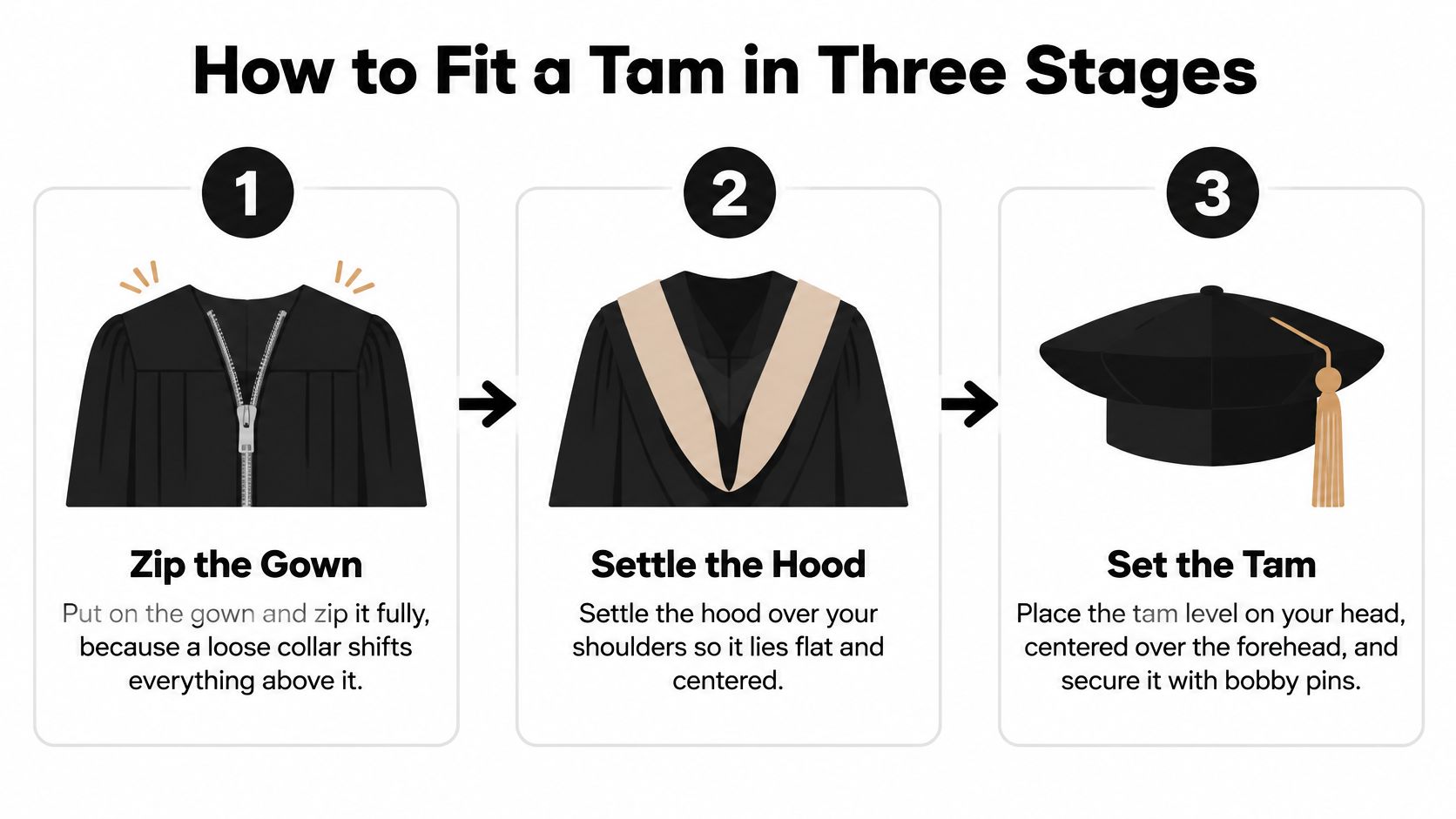
Build the outfit from the gown upward
- Put on the gown and zip it fully. Smooth the shoulders and check that the collar lies flat. A loose or uneven neckline makes the hood and headwear harder to judge.
- Settle the hood according to the ceremony instructions, keeping it flat and centered over your shoulders. If your school reserves hood placement for faculty on stage, carry it as directed instead of putting it on early.
- Place the tam last. Lower it onto your head with the band centered and the crown level. A backward, beret-style push throws the whole fit off.
- Seat the band at the institution's stated height. Keep your eyebrows and face visible. If you are pulling the front down to hold the tam in place, the size is probably wrong.
- Position any fastening strap toward the back and adjust it until the band holds without pressing. Secure feels firm through a turn of the head and light enough to forget.
- Run the mirror check. Look for a horizontal tam, an evenly hanging gown, and a hood whose lining and velvet border remain visible. Ask someone to inspect the back, which you cannot assess reliably from the front.
- Move before you commit. Stand, sit, step onto a stair, and walk across the room without touching the tam. Movement exposes a loose fit that a still photograph can hide.
Judge comfort and stability together
Shoulder pulling or bunching at the neck is a gown problem, and it throws off your read of the tam. The graduation cap and gown size chart helps separate a gown-sizing problem from a headwear problem before you adjust anything on your head.
Programs differ on the exact tam position, which is why a universal rule about tilt can mislead. Where the school's guidance specifies a placement, that stated position governs the fit.
For comparison, Pandemonium Millinery discusses a casual tam as a warmer alternative to knit caps. That resource concerns everyday headwear, and it gives no grounds for styling an academic tam loosely or asymmetrically.
A successful fit stays comfortable through walking, hooding, and stage movement without repeated adjustment.
Judge the band first. Once it holds, the velvet crown settles on its own.
Fixing a Tam That Tilts, Slips or Pinches
A tam that slides while you walk usually needs a fit adjustment, not a dramatic change in angle. Most problems start with sizing, fitting order, or an unchecked fastening strap.
The Mount Grace Bible University commencement instructions place the adjustment tab at the back, prohibit wearing the tam to the side or rear, and note that bobby pins or clips may be needed. They also specify attachment of the tassel to the top button and placement on the left after the degree is conferred. Those are that institution's rules, not a replacement for yours.
Tam symptoms, causes and fixes
| Symptom | Likely cause | Fix |
|---|---|---|
| Tam sits too far back | Pushed back during hooding or placed without a check | Re-seat level and check in the mirror, keeping within the school's stated position |
| Tam slides off while walking | Loose fit or slick hair | Tighten the fastening strap; add discreet pins only if ceremony rules allow |
| Tam sits sideways | Placed without a front-on mirror check | Lift off, re-center on the crown, and run the walk test again |
| Tam pinches or causes a headache | Fastening strap pulled too tight | Loosen the strap, re-seat the band, and check whether the size is suitable |
| Tam keeps falling forward | Too large for the head | Resolve sizing with the school well before the ceremony |
| Tam shifts after hooding | Tam was placed before the hood | Follow the fitting order of gown, hood, then tam, unless hooding happens on stage |
| Tassel hangs in the face | Tassel not fixed to the top button | Reattach it to the top button and confirm the side in the program |
| Tassel comes loose | Attachment not checked before the procession | Re-check the attachment in line-up and carry a spare pin in your pocket |
Don't use pins to disguise a painfully tight band. They can help prevent slipping, but they won't correct pressure around the forehead or temples.
Likewise, pulling the front lower may temporarily stop movement while creating another problem: the tam obscures your face and tips when you look down. Lift it off and correct the fit rather than repeatedly nudging it.
Separate advance fixes from day-of fixes
Sizing problems need attention days ahead. Contact the commencement office if issued headwear doesn't fit, and allow time to obtain the correct size rather than relying on an improvised alteration.
Re-seating the tam or correcting the tassel attachment should take under a minute on the day. If you're repeatedly rebuilding the fit in line-up, pause and ask a commencement marshal for help before moving.
Test any fix during a 20-minute wear before the ceremony. A strap that feels acceptable immediately may become uncomfortable when you leave it in place.
Where the Tassel Goes for Each Degree
For graduate and doctoral regalia, the default is the wearer's left, the heart side, throughout the ceremony. The University of Missouri academic regalia policy places graduate and doctoral tassels on the left. The familiar tassel-moving ritual generally belongs to bachelor's ceremonies, so doctoral candidates shouldn't automatically copy it.
Use your own left when checking placement, not the left side of a photograph. A mirrored phone preview can make an otherwise correct arrangement look reversed.
This image shows the tassel falling beside the face rather than across it.

Follow the program's side and timing
Some schools specify placement on the left only after conferral. Others designate a temple attachment. Follow both the timing and the attachment instructions; don't rotate a fixed tassel merely because nearby graduates move theirs.
Prepare before entering the procession:
- Identify the degree. Check the ceremony category under which you're graduating.
- Confirm the side count. Compare the issued tam with the program's specification.
- Inspect the attachment. Establish whether the tassel is pre-attached or needs securing.
- Set the position. Arrange it exactly as directed before you join the line.
Avoid the familiar mistakes
- Borrowing the undergraduate rule. Don't assume doctoral dress uses the same movement ritual.
- Rotating a fixed tassel. Leave a designated attachment in its intended position.
- Wearing the tam off-center. Correct the headwear rather than pulling the tassel to compensate.
- Assuming all tams match. Verify the required shape instead of copying another graduate.
The graduation cap tassel placement guide is useful when comparing cap conventions across degree levels.
The printed commencement program beats a general guide, including an otherwise sensible default.
Keeping the Tam Secure From Line-Up to Stage
Say you're in the doctoral line-up, someone has just settled your hood, and you feel the tam shift. You have about thirty seconds before the marshal starts moving your group. Stop handling the crown, ask the person beside you to check the band, and correct the position before the procession begins.
Make that final check while you're still standing still.

Prepare for the actual ceremony conditions
Before leaving home, check whether the ceremony permits pins or clips. If it does, secure the band discreetly to your hair without forcing a pin through the visible velvet crown. Practice with the hairstyle you'll wear, since a high bun or smooth finish can change where the band rests.
Avoid heavy hair products that leave the contact area slick. For an outdoor ceremony, test whether the tam stays secure when you turn your head into a breeze. In a warm hall, keep the band comfortable rather than tightening it preemptively against possible slipping.
A long procession may mean wearing the tam for an hour before your stage moment. Plan for sustained comfort, and finish adjustments before joining the moving line rather than trying to manage them while carrying a hood or program.
The guide to putting on a graduation cap offers additional preparation help, but don't transfer a mortarboard's front-point orientation to a rounded tam.
Use the video alongside your school's written instructions.
Keep your hands available on stage
For faculty hooding, follow the marshal's cue and let the faculty member position the hood. Don't grab the tam unless staff direct you to remove it. Keep a hand available for the handshake, and avoid tugging at the tassel during photographs.
Pack a small day-of kit:
- Spare pin. Keep it in a gown pocket if accessories are permitted.
- Mirror or phone camera. Check the front before line-up.
- Untangled tassel. Free it from the hood and gown before moving.
- Removal instructions. Take the tam off only when the ceremony directs.
The tam should be stable enough that you can leave it alone once the procession begins.
Confirm Your Tam Specs Before You Order
Ordering the wrong tam usually means reordering on a deadline. Copy the school's requirements into an order note before you shop, and write down the following:
- Degree level and sides. Faculty doctoral tams come in 4, 6, and 8 sided versions, and a program that allows a master's tam usually specifies the 4 sided shape. Record the exact approved shape rather than guessing from a photo.
- Velvet color. Use the school's wording, not your interpretation of a photograph.
- Tassel details. Note the color, type, and whether it comes pre-attached. If the tassel carries a year date drop, the drop can be removed and reapplied at home, so a date charm alone is no reason to reject an otherwise correct tassel.
- Complete outfit. Stage dress typically means the gown, hood, and the cap for your degree level, with tams for doctoral candidates and mortarboards for most bachelor's and master's candidates. Your program's written rules have the final say, so confirm what your ceremony requires for stage participation.
Match the specification, not just the product image
Graduation Cap and Gown's tams are made from black velvet fabric, with a poof top similar to a beefeater-style cap, and generally carry a gold bullion tassel rather than one in school colors. Jumbo bullion tassels, noticeably thicker than standard, are made specifically for college tams. If your program expects school-color silk instead, that difference belongs in your order note before checkout.
The Find Your University feature helps shoppers match school colors. Treat it as a starting filter; the commencement office's written requirements still control what you may wear.
Once the outfit is settled, organizers planning the celebration can browse graduation celebration attractions separately from the regalia checklist.
Write the school's exact side count, velvet color, and tassel color on the order before checkout.
Graduation Cap and Gown offers individual tams, tassels, gowns, and hoods, along with complete doctoral regalia packages. Visit Graduation Cap and Gown with your school's specifications ready to select the pieces you need for a secure, ceremony-ready fit.