

Wearing your academic hood is more than just the final touch to your graduation outfit—it’s a symbolic act that caps off years of hard work. But let's be honest, in the chaotic moments before the ceremony, figuring out how to get that thing on correctly can be surprisingly stressful. Knowing the proper way to wear your hood is essential for looking your best on graduation day.
Getting it right is simpler than it looks. The basic idea is to drape the hood over your head with the velvet side up, secure it at the front so it doesn't slide around, and let the rest hang down your back, perfectly displaying the colors of your degree and university. This guide provides a detailed walkthrough on how to wear academic hood properly.
Your Guide to Wearing an Academic Hood Correctly

That moment you receive your academic hood is a huge milestone, but figuring out how to put it on in a crowded hallway can feel like a puzzle. This guide on how to wear an academic hood is here to remove all the guesswork.
We'll walk you through the simple process of draping your hood so it sits comfortably and displays your achievements flawlessly for the ceremony, photos, and all the proud family members in the audience. After all, your hood is more than just fabric; it’s a wearable diploma that tells the story of your degree, your field of study, and your alma mater.
The Story Woven Into Your Hood
Every piece of your academic regalia tells a part of your story. The gown shows your degree level, the cap marks you as a scholar, but the hood is easily the most descriptive piece of the entire outfit. It instantly communicates three key things:
- Your Degree Level: The length of the hood itself indicates your academic achievement.
- Your Field of Study: The color of the velvet trim corresponds to your specific discipline.
- Your University: The satin lining proudly features the official colors of your institution.
This tradition is deeply rooted in academic history, ensuring that your accomplishments are instantly recognizable to faculty, family, and peers. Properly wearing your regalia is a way of honoring this long-standing heritage.
Did you know that the academic hood's length is strictly tied to your degree level? This tradition dates back to the 1895 Intercollegiate Code of Academic Costume, which has shaped over 95% of U.S. graduations today. Bachelor's hoods measure exactly 3 feet, master's are 3.5 feet, and doctoral hoods are a full 4 feet long—numbers etched into regalia standards by the American Council of Education's 1959 revisions.
To help you get familiar with the anatomy of your hood, here’s a quick breakdown of its key components before we get into how to wear it.
Quick Guide to Academic Hood Components
Understand the parts of your academic hood at a glance. This summary breaks down what each component signifies before we dive into how to wear it.
| Hood Component | What It Represents | Key Feature |
|---|---|---|
| Shell | The base fabric of the hood. | Typically made of black fabric to match the academic gown. |
| Velvet Trim | Your specific field of study. | The color corresponds to your degree (e.g., Light Blue for Education). |
| Satin Lining | Your degree-granting university. | Features the official school colors, often in a chevron or divided pattern. |
| Cord/Loop | A small loop for fastening. | Located at the front "V" of the hood to secure it to your gown or shirt. |
Knowing what each part means transforms your regalia from a simple uniform into a personal story of your academic journey.
As experts in academic regalia, we at Graduation Cap and Gown ensure our bachelor's, master's, and doctoral packages are designed for a perfect fit, and you can use our 'Find Your University' feature to get an exact color match. For a broader overview, you might be interested in our guide on how to wear graduation regalia, which covers all the essential components.
Understanding the Colors and Fabrics of Your Hood
Before you even think about putting it on, take a second to really look at your academic hood. It’s not just a piece of fabric; it’s a story about your entire academic journey, told in three distinct parts: the velvet trim, the satin lining, and the black shell. Each piece works together, turning a simple garment into a powerful symbol of everything you’ve accomplished.
The first thing you’ll notice is the velvet trim, that bold band of color signifying your field of study. When you wear your hood correctly, this is the color everyone sees. It's part of a precise system, established way back in 1895, that now includes over 20 official colors representing different disciplines in more than 90% of ceremonies. Arts and Humanities get white, Sciences are represented by golden yellow, and Law is a deep, rich purple. This standard makes your specialty instantly recognizable in a sea of graduates.
Reading the Story in Your Regalia
Next, there's the vibrant satin lining. This is the most personal part of your hood because it proudly displays your university's official colors. You'll often see a chevron pattern here, which is a clever way to feature multiple school colors and forge a direct link to your alma mater.
Finally, the black shell fabric provides the classic, formal backdrop for all that brilliant color. It's designed to match your gown, creating a unified and distinguished look that really lets the velvet and satin pop.
Understanding this symbolism is key. It transforms your regalia from a required uniform into a deeply personal statement of achievement that you have earned the right to wear.
Knowing what these elements mean makes the experience of putting on your hood that much more powerful. Every color and fabric has a purpose, collectively telling the story of your hard-earned degree.
Decoding Your Discipline
That velvet color code is a fascinating tradition connecting you to generations of scholars in your field. While there are dozens of specific shades, some of the most common ones you'll see at any commencement ceremony include:
- Arts, Letters, Humanities: Brilliant White
- Education: Light Blue
- Science: Golden Yellow
- Medicine: Kelly Green
- Law: Purple
- Business/Commerce: Drab (a tan or khaki color)
- Fine Arts: Brown
- Nursing: Apricot
These colors are standardized, making it easy for anyone from any institution to recognize your academic discipline at a glance. If you want to dive deeper into the specific hues for advanced degrees, our detailed guide on the meaning behind doctoral hood colors is a great place to start. This knowledge not only enriches your own graduation day but connects you to a rich academic heritage.
The Proper Method for Draping and Fastening
Alright, now that you know the story behind your hood's colors and fabrics, it's time to actually put it on. This is the moment where the gown and hood come together, creating the full picture of your academic journey. Nailing the draping and fastening isn't just about looking sharp—it's about making sure you’re comfortable during a long ceremony. The proper way to wear your hood starts with these steps.
Start by unfolding the hood completely and holding it out in front of you. You’ll want the soft, plush velvet side facing up, since this is the part that will frame your face and sit on your shoulders. Go ahead and place it over your head, letting the V-shaped point settle at the front of your neck, almost like you'd wear a scarf before wrapping it.
The high-quality construction of our Doctoral Regalia and Master's Regalia really helps here, ensuring the fabric drapes smoothly without any awkward bunching. A well-made hood just sits better, making the next steps a whole lot easier.
Securing the Hood for a Comfortable Fit
One of the biggest complaints you hear from graduates is that their hood is pulling or feels like it’s choking them. Good news: this is completely avoidable. Look at the front V-point of your hood and you'll find a small fabric loop or cord. That little thing is your anchor.
To use it, just fasten this loop to a button on your dress shirt or blouse. If you're not wearing a button-up, you can secure it to an internal button on your gown or even use a small safety pin to attach it to the gown's zipper placket. This simple move is a game-changer. It shifts the hood's weight from your neck to your shoulders, giving you stability and, most importantly, comfort.
Expert Tip: Seriously, don't skip this step! Anchoring the front loop is the single most important part of wearing your academic hood correctly. It keeps the V-shape from digging into your throat and prevents the whole thing from slipping around.
This tiny detail is what separates a polished, professional look from a sloppy one. Once it's secured, let the rest of the hood hang down your back. Make sure it's centered and lying as flat as possible against your shoulder blades. It’s always a little easier with a friend, family member, or faculty marshal lending a hand—a common and welcome sight at any graduation.
This diagram breaks down the core components you'll be handling as you get your hood situated.
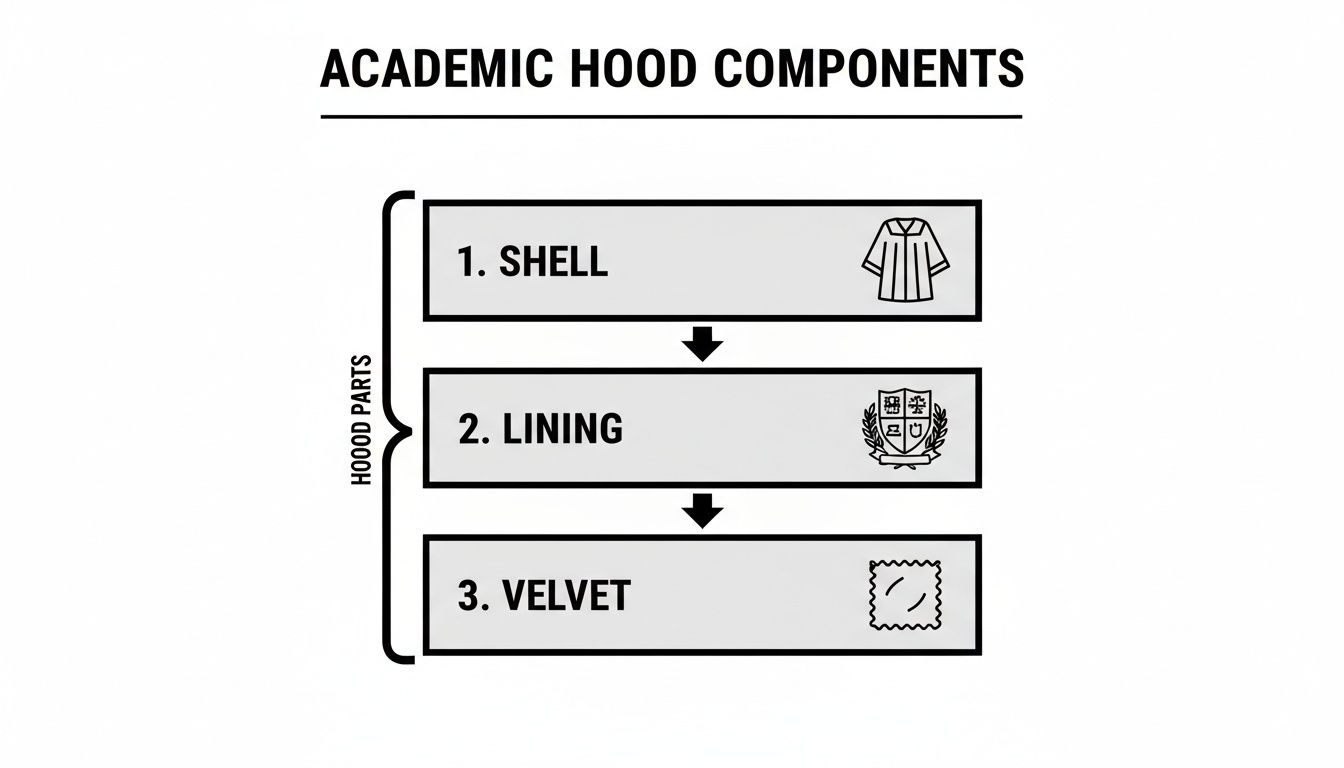
As you can see, the shell provides the structure, the velvet trim shows off your field of study, and the lining flashes your school colors with pride.
The Importance of Proper Fastening
Secure fastening completely changed how graduates wear an academic hood after the 1959 code tweaks, when back cords became standard to fight the slippage that plagued 60% of early ceremonies. These small but mighty features now prevent fit issues for 99% of the more than 2 million annual U.S. graduates. A proven technique is to partially unzip your gown, loop the neck cord over an inner button before zipping up, drape the hood over your shoulders with the tapered front at your throat, and ensure the velvet is facing up and out. This method avoids that awful neck rub, a detail praised in 85% of regalia reviews.
Once your hood is securely draped and fastened, you’re almost there. The final step is that satisfying flip that reveals your university’s colors—a process we’ll cover in the next section. Mastering this draping technique, along with knowing how to put on your graduation cap correctly, will have you looking and feeling your absolute best on your big day.
Revealing Your Colors With The Final Flip

This is it—the final touch that makes your academic regalia truly complete. It’s also the one detail countless graduates miss in the pre-ceremony excitement. After all the careful draping and fastening, your hood is probably still showing mostly black fabric on your back.
But the whole point is that vibrant satin lining—the part with your university's official colors—which is meant to be seen and celebrated. The final step in how to wear your academic hood is to display these colors.
The fix is a simple, elegant move often called "the flip." This small adjustment turns the back of the hood inside out, revealing that beautiful splash of satin color. While you can try to reach behind you and do it yourself, the best way to get it perfect is to ask a friend, family member, or faculty marshal for a quick hand.
This ensures the colors are displayed evenly and symmetrically, creating a polished look for photos and your walk across the stage. It’s the finishing touch that truly showcases your school pride.
Executing the Perfect Hood Flip
Here’s exactly how to perform the final flip. The person helping you should stand directly behind you to get a clear view of how the hood is lying against your back.
First, they’ll need to locate the velvet trim at the back of your shoulders. They should grasp the bottom edge of this velvet band and gently pull it outward and upward, flipping it over itself.
This single, fluid motion will cause the satin lining to unfold and cascade down your back, creating a bold, beautiful display of color against the black shell of the hood.
This isn't just about aesthetics; it's a symbolic reveal. The flip is the moment your academic regalia goes from a formal garment to a personal statement, proudly displaying your connection to your alma mater.
Keeping Your Colors in Place
To make sure your beautifully displayed colors don't come undone during the ceremony, many academic hoods include a small, discreet security feature on the back. Take a look for a thin cord and a small button located where the velvet trim and the lining meet.
Once the hood is flipped, this cord can be looped around the button to hold the fold securely in place. It's an expert touch that guarantees you will look perfectly polished and proud from the moment you take your seat to the final tassel turn.
This final presentation beautifully complements other key pieces of your regalia, like any custom graduation stoles you may be wearing to signify special achievements.
Getting this last detail right makes a huge difference. It’s a small action that honors tradition and makes your regalia look exactly as it was designed. Understanding these finer points, such as the meaning behind your graduation tassel color, adds depth and significance to your big day.
Common Hood Mistakes and How to Avoid Them
It’s completely understandable. In the chaos and excitement right before the ceremony, it’s easy to make a small mistake with your academic hood. We’ve seen it all—from backward hoods to hidden colors—but the good news is that every common pitfall is incredibly easy to fix. Knowing what to watch out for will ensure you look and feel your best when wearing academic regalia.
One of the most frequent complaints we hear is that the hood feels like it’s choking the wearer. This happens when the V-neck front pulls right up against your throat. The solution is literally built into your regalia. Look for the small cord loop on the front of the hood; its entire job is to anchor the hood to a shirt button or an internal button on your gown. Use it!
Another classic blunder is letting that beautiful velvet trim get twisted or tucked under. The velvet border is designed to lie flat against your shoulders and frame your face, so you want it fully visible. Just before you head into the ceremony, ask a friend to do a quick check and make sure it’s lying perfectly flat.
Keeping Your Regalia Picture-Perfect
Wrinkles are the ultimate enemy of a polished graduation look, and hoods are especially prone to them because of the delicate velvet and satin. A crumpled hood can really stand out in photos that you'll be looking at for a lifetime.
Pro Tip: Gently steam your hood the day before commencement. Never iron it, as direct heat can easily ruin the fabric. Once it's steamed, the best way to get it to the ceremony wrinkle-free is in one of our protective garment bags.
The Backward Blunder and the Color Catastrophe
Believe it or not, it’s surprisingly common to see hoods worn completely backward, with the long, colorful tail hanging down the front instead of the back. This is almost always the result of a last-minute rush to get ready.
- The Fix: Always remember this simple rule: the "V" goes in the front, and the long, draped part hangs down your back. A quick peek in a mirror or a thumbs-up from a friend is all you need to avoid this awkward mistake.
Just as common is forgetting to "turn out" the back of the hood to show off your university's colors. This single step is what displays your school pride. If you skip it, the back of your regalia will just be a solid black panel, hiding the vibrant satin lining that tells your story.
These simple checks will make sure you look confident and distinguished. And one last thing—make sure any honor cords or medals are placed over your hood, not trapped underneath it. Proper placement ensures every element of your hard-earned regalia is visible, creating a look that’s both celebratory and correct.
Answering Your Academic Hood Questions
Even after you've mastered the draping, fastening, and final flip, a few nagging questions always seem to pop up right before the big day. Getting these last-minute details sorted out ahead of time is the key to feeling completely confident when you walk across that stage.
Think of it this way: your regalia is a language, and every detail communicates something specific. Understanding those nuances helps you wear your hood with the pride it deserves. Let’s clear up a few of the most common questions on how to wear academic hood correctly.
Masters vs. Doctoral Hoods Explained
One of the first things people ask is how to tell a master's hood from a doctoral one. At a glance, they look pretty similar, but the differences are in the details—specifically, the size and shape, which signify the level of academic achievement.
- A master's hood is a distinguished three and a half feet long.
- A doctoral hood is longer, measuring a full four feet, and features wider velvet trim. It also has broad panels on the back that give it a much fuller, more pronounced look.
These specifications are baked into the academic code, making sure each degree has its own unique regalia. You can really see the difference when you compare our dedicated Master's Regalia with our premium Doctoral Regalia packages.
Keeping Your Hood Wrinkle-Free
Nothing ruins a great graduation photo faster than a wrinkled hood. That mix of delicate velvet and satin can be a bit tricky, but keeping your hood looking sharp is easier than you think.
Your best bet is to hang it up the moment it arrives. Just letting it hang for a few days will allow most of the creases from shipping to relax and fall out naturally. For any stubborn wrinkles that remain, a handheld steamer on a low setting is your best friend. The day before the ceremony, just gently steam the fabric to release any last creases.
Whatever you do, do not iron your hood. The direct, high heat from an iron will almost certainly damage or even melt the delicate velvet and satin fibers. When it's time to head to commencement, a garment bag is the perfect way to protect it.
Taking just a few minutes to care for your hood makes all the difference. Your regalia should reflect the incredible pride and effort you put into earning your degree.
Do Bachelor's Graduates Wear Hoods?
This is a big one, because traditions can vary from one school to another. In the United States, academic hoods are almost always reserved for graduates earning master's and doctoral degrees. They are a symbol of advanced, specialized study that goes beyond the undergraduate level.
However, some universities have their own unique traditions and may actually include a hood as part of the bachelor's regalia. Because of this, it is absolutely essential to check your specific institution's guidelines. You can usually find these rules in the commencement information your school sends out.
If you’re not sure about your university’s requirements for colors, styles, or specific components, our "Find Your University" tool is a great resource for getting an exact match. It's the easiest way to make sure you show up on graduation day with the right attire, ready to celebrate without any wardrobe worries.
For a seamless and memorable graduation day, trust Graduation Cap and Gown for all your regalia needs. With the largest online selection and a lowest-price guarantee, we make it easy to find the perfect cap, gown, hood, and accessories for your ceremony. Explore our complete collection at https://www.graduationcapandgown.com.