

Knowing how to wear your graduation hood correctly is simpler than it looks. You drape it over your head with the velvet side up, letting the V-shape rest at your throat. But the real magic happens when a friend helps you flip the satin lining out over the velvet trim on your back. That’s the moment the university colors are revealed, showcasing your huge accomplishment.
Understanding Your Academic Hood Before You Wear It
Your academic hood is so much more than a piece of fabric you drape over your shoulders. It's a vibrant symbol of your hard work, your dedication, and the specific knowledge you've spent years gaining. Every single element, from its length to its colors, tells a story about your academic journey. Understanding these parts is the first step to wearing your regalia with the confidence and pride you've earned.
This tradition has deep roots, starting way back in medieval universities. Today, it follows a standardized system called the Intercollegiate Code of Academic Costume, which was first established in 1895. This code ensures that academic regalia is consistent and meaningful, no matter the institution.
At its core, your hood communicates three key things:
- The Level of Your Degree: The length and shape of the hood distinguish between bachelor's, master's, and doctoral degrees. Doctoral hoods are the longest and most elaborate, which makes sense—they reflect the highest level of academic achievement.
- Your Field of Study: The color of the velvet trim corresponds to your specific academic discipline. For instance, light blue signifies Education, golden yellow represents Science, and dark blue indicates Philosophy (for a Ph.D.).
- Your Alma Mater: The colorful satin lining tucked inside the hood proudly displays the official colors of the university that granted your degree.
This system turns your regalia into a visual resume, one that’s instantly recognizable to academics and faculty all over the world.
The Anatomy of an Academic Hood
Before you can figure out how to wear a graduation hood the right way, you need to know what you’re looking at. It might seem like a confusing jumble of velvet and satin at first, but it’s pretty simple once you break it down.
The main parts are the shell (the black fabric body), the velvet trim that lines the outer edge, and the satin lining on the inside. At the front of the hood, you’ll find a small loop. This little detail is crucial—it’s designed to secure the hood to your gown or a shirt button, keeping it from sliding backward during the ceremony.
Our complete guide on wearing graduation regalia offers even more details on how to coordinate all your academic attire perfectly.
To make it even clearer, here’s a quick breakdown of what you'll find on hoods for each degree level. This table will help you spot the differences in your own regalia or understand what your peers are wearing on the big day.
Academic Hood Components at a Glance
| Hood Type | Typical Length | Velvet Trim Width | Key Features and Symbolism |
|---|---|---|---|
| Bachelor's | 3 feet | 2 inches | The simplest design, often with a pointed shape. Symbolizes the foundational level of higher education. |
| Master's | 3.5 feet | 3 inches | Longer than a bachelor's hood, featuring a wider velvet trim. The hood has a distinctive oblong shape at the bottom. |
| Doctoral | 4 feet | 5 inches | The longest and most elaborate hood, with wide velvet panels and a fuller shape. Signifies the pinnacle of academic achievement. |
As you can see, the regalia becomes more distinguished as the degree level increases, reflecting the deeper commitment and expertise required.
Why Correctly Wearing Your Hood Matters
Properly displaying your hood is a sign of respect for the academic traditions it represents. It also ensures you look polished and distinguished in photos and during the ceremony itself.
The global importance of this tradition is clear. The market for tailored academic hoods, valued at $0.5 billion in 2025, is projected to more than double to $1.1 billion by 2033. This growth highlights just how significant this symbolic garment is for millions of graduates worldwide. With nearly 2 million bachelor's degrees awarded in the U.S. alone in a recent year, the demand for high-quality, accurately designed regalia is immense. To learn more about these market trends, you can explore the full report on tailored academic hoods.
The academic hood is not merely an accessory; it is the visual culmination of your degree. Each color and fold represents countless hours of study, research, and commitment. Wearing it correctly is the final act of honoring that journey.
By understanding what your hood signifies—from its rich history to the specific meaning of its colors—you are better prepared to wear it with the distinction it deserves on your special day.
A Practical Guide to Draping Your Graduation Hood
Getting your academic hood to sit just right is the key to that polished, distinguished look on your big day. It might seem a little awkward at first, but once you get the hang of it, the process is surprisingly simple. Think of it less like a strict set of rules and more about finding a comfortable, balanced drape.
First things first, get your hood out of the box and let it breathe for a bit. If you’ve ordered one of our high-quality academic hoods, you'll see it’s designed to hang naturally. A gentle shake should loosen up any folds from shipping. It’s also a huge help to have a friend, family member, or even a mirror handy so you can see what’s going on behind you.
The Initial Draping Process
Start by holding the hood out in front of you with the rich velvet side facing up. The narrower, V-shaped part should be pointing away from you, ready to go over your head.
Now, lift the hood and drape it over your head, letting it settle onto your shoulders right on top of your gown. The front "V" should rest smoothly against your throat or upper chest—it shouldn't feel tight or constricting at all. This initial placement is the foundation for getting everything else perfect.
This quick flowchart shows the different hood lengths you’ll see, which helps visualize your specific regalia.
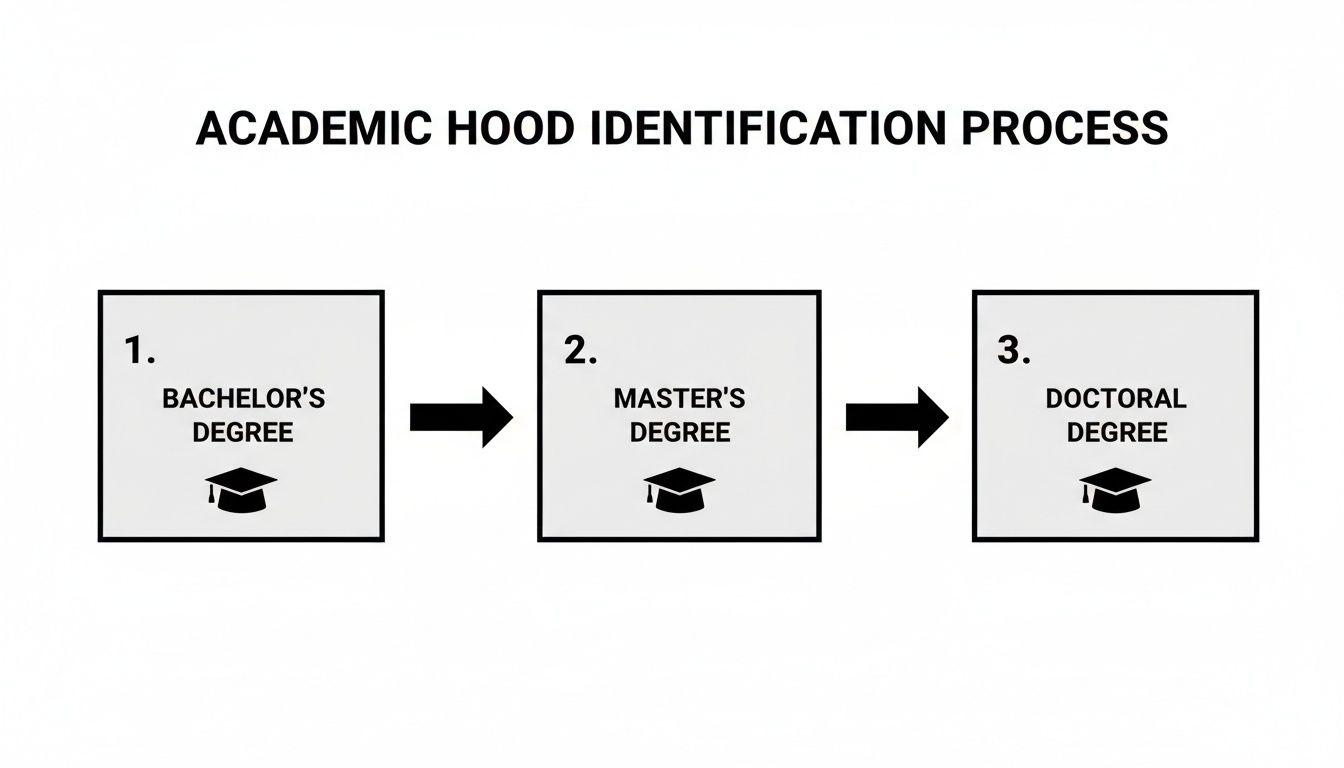
As you can see, the length is a direct giveaway of the academic degree, with the doctoral hood being the longest and most impressive of the three.
Securing the Hood for Stability
One of the biggest complaints from graduates is the hood slipping backward and creating a choking feeling. There’s a simple trick to prevent this: the front loop. Right at the point of the 'V' on the front of your hood, you’ll find a small fabric cord.
This little loop is your anchor. Here are the best ways to use it:
- Button It Down: If you're wearing a button-down shirt under your gown, just slip the cord around the top button. This is the most foolproof method.
- Pin It in Place: No buttons? No problem. A small safety pin is your best friend. Just pin the loop discreetly to the fabric of your gown underneath.
- The Gown's Hidden Loop: Some higher-end gowns, especially doctoral regalia, actually come with a small cord sewn into the inner neckline for this exact purpose.
This small anchor point is the absolute secret to wearing your graduation hood comfortably for hours. It stops the weight of the hood from pulling backward, making sure it stays perfectly in place through the entire ceremony.
Getting the Position Just Right
Once it's anchored, make a few small adjustments. The hood should rest evenly across both shoulders, and the velvet trim should frame your neck without bunching up. The goal is a clean, symmetrical drape that feels completely balanced.
Take a second to move around a little. Turn your head, shrug your shoulders—how does it feel? If it pulls or feels awkward, a tiny adjustment to the anchor point or how it sits on your shoulders will usually fix it. Our hoods are made with premium materials to provide a balanced drape, which makes this part of the process much easier. With the hood secure, you're ready for the final, most visually stunning step: revealing the colors.
Flipping the Colors for a Picture-Perfect Finish
You’ve got the hood draped and anchored—the hard part is over. Now for the fun part, the final flourish that brings your entire academic regalia to life. This is the moment you reveal those vibrant university colors for everyone to see.
Honestly, this last adjustment is where an extra pair of hands makes all the difference. While you can do it yourself with some creative arm-twisting, having a friend or a ceremony marshal help you is much, much easier. The goal is to turn the colorful satin lining inside-out, letting it drape down your back in a brilliant cascade that contrasts perfectly with the hood's black shell.

This final step is what transforms your hood from a simple black drape into a powerful symbol of who you are and where you came from. It’s a small detail that makes a huge impact, especially in photos.
The Art of the Color Flip
To nail the color flip, have your helper stand directly behind you. Their job is to gently turn the satin lining outward so it folds over the velvet trim running along the edge.
Here’s a simple way to guide them:
- Find the Velvet Trim: Tell them to locate the velvet edge at the highest point on your back, just below your neck.
- Grasp and Turn: They should pinch the edge of the hood, holding both the velvet and the satin lining together.
- Roll it Outward: From there, they just need to gently flip or roll the satin lining out so it drapes over the top of the velvet.
The idea is to reveal as much of the colorful satin as you can without completely hiding the velvet trim. This creates a beautiful layered effect, showcasing both your degree field (the velvet) and your university (the satin).
Achieving a Smooth and Symmetrical Look
The key here is to keep things smooth and symmetrical. Once the colors are flipped, the satin should lie flat against your back without any awkward bunches or twists. Your helper can just run their hand down the length of the hood to smooth out any wrinkles and make sure it drapes evenly.
This is especially important for master's and doctoral hoods, since their longer, wider design means there's more fabric to manage. You’re aiming for a clean, elegant line of color flowing right down the center of your back.
A correctly flipped hood is the defining feature of academic regalia. It’s the visual punch that celebrates both your specific field of study and your institutional pride, making your achievement instantly recognizable.
For doctoral graduates, whose regalia is the most complex, this flip needs extra attention. Many doctoral hoods have wide panels and chevrons that signify specific achievements, and it’s crucial to make sure those elements are fully visible and lying flat. To really appreciate the symbolism, check out our guide on the meaning behind doctoral hood colors.
Ultimately, getting the perfect color flip is about creating that picture-perfect finish. It’s the final touch that ensures your hood looks exactly as it was intended—as a proud, vibrant display of your incredible academic accomplishment. Taking a moment to get this detail right will make all the difference on the big day.
How to Wear Your Hood for Different Degrees
Not all academic hoods are created equal. The way you adjust your hood depends heavily on the degree you've earned, because a doctoral hood is a fundamentally different garment than one for a master's or bachelor's degree. Getting that polished, dignified look means understanding the unique quirks of your specific hood.
Each degree level comes with its own hood length and width, which completely changes how it drapes over your gown. Bachelor’s hoods are the shortest and simplest, master’s hoods are a bit longer and fuller, and doctoral hoods are the most elaborate of all—a clear visual statement of the highest academic achievement.
Fine-Tuning a Master’s Hood
For those earning a master's degree, the game is all about achieving elegance and symmetry. Your hood is typically 3.5 feet long with a three-inch velvet trim, and once you have it draped and secured, the main goal is nailing that perfect color flip we talked about earlier.
The trick is to create a clean, continuous line of your university's colors all the way down your back. A common mistake is flipping the satin lining unevenly, which just creates a bunched or twisted mess. You want to turn the lining out smoothly over the velvet trim, starting from just behind your shoulders and extending down the full length of the hood. You can learn more about perfecting this look in our detailed guide to graduation regalia for master's degrees.
Positioning a Doctoral Hood for Distinction
A doctoral hood is a much more substantial piece of regalia. It measures a full four feet long, features a five-inch velvet trim, and has wide, bell-shaped panels. Its sheer size and weight mean it requires more careful positioning to keep it from twisting or hanging crookedly throughout the ceremony.
The biggest challenge with a doctoral hood is managing its longer tail and broader panels. Here are a few tips I've picked up over the years to get it just right:
- Center the Cowl: The cowl, which is the part that drapes over your back, absolutely has to be centered. If it's even slightly off-balance, the whole hood will start pulling to one side.
- Keep the Panels Flat: After you flip the colors, take a moment to smooth out the wide velvet panels so they lie flat against the satin lining. This is what showcases the full breadth and symbolism of your hood.
- Do a Twist-Check: Because it's so long, the tail of a doctoral hood can easily get twisted. It's a good idea to have a friend check that it’s hanging straight down your back without any turns in the fabric.
A perfectly positioned doctoral hood just radiates authority and achievement. Its symmetrical drape and flat panels are crucial for showcasing the three gold chevrons that often signify the pinnacle of academic success.
Notes on the Bachelor's Hood
While it's less common, some universities do use hoods for bachelor's degrees. These are the simplest to manage, measuring only three feet long with a two-inch velvet trim. The draping and color-flipping process is the same as for a master's hood, but its shorter length makes it much less likely to twist or become unbalanced.
The global graduation gown and cap market is projected to reach $3.3 billion by 2032, which really speaks to the enduring importance of these traditions. This growth highlights why knowing how to wear your hood properly is more than just ceremony etiquette; it connects you to a worldwide community of scholars. In fact, statistics show that improper hood placement affects 25-30% of graduates—a simple mistake that can detract from an otherwise flawless look. Our Find Your University tool helps you avoid this by matching the exact colors for over 1,500 schools, ensuring your regalia is perfect. You can find more details in the HTF Market Reports on the graduation gown and cap industry.
Common Hood Mishaps and How to Fix Them
On a day filled with excitement, photos, and a million handshakes, it’s easy for your academic hood to go a little rogue. Don't worry—most of the issues are incredibly common and simple to fix on the fly. Think of this as your personal troubleshooting guide for making sure your regalia looks flawless from the moment you march in until the final cap toss.
Knowing how to wear a graduation hood correctly is really about knowing how to spot and solve these little problems before they become a distraction. A quick adjustment can be the difference between looking polished and feeling flustered.

The Slipping Hood Problem
One of the most persistent issues is the hood sliding backward, creating an uncomfortable pulling sensation right at your throat. It's a distraction you definitely don't need while waiting to hear your name called.
This almost always happens for one simple reason: the front loop isn't secured. That little cord at the 'V' of your hood is your anchor. To fix it instantly, just slip the loop over a button on your shirt. If you're not wearing a button-up, a small safety pin attached discreetly to the inside of your gown will work just as well, keeping everything perfectly in place.
When the Colors Look Bunched or Twisted
Another common sight is a hood with the satin colors all twisted up instead of lying flat. This completely hides the beautiful display of your university’s colors and can make your whole outfit look messy.
The solution here is a simple "pinch and flip." Grab a friend, have them stand behind you, and gently smooth out the satin lining so it drapes evenly over the velvet trim. If it’s still not lying flat, they can pinch the top edge near your shoulders and give it a slight lift and shake to let the fabric settle naturally.
A correctly draped hood should display an uninterrupted cascade of color down your back. If you see black fabric breaking through the satin lining, it just needs a quick adjustment to smooth it out for that picture-perfect finish.
Of course, investing in high-quality regalia from the start helps prevent many of these issues. Our academic hoods are designed for a balanced drape, and the premium fabric is less prone to excessive wrinkling—a quality backed by over 10,000 positive reviews.
This quick reference table can help you diagnose and solve any last-minute wardrobe malfunctions.
Hood Wearing Troubleshooting Quick Fixes
Even with the best prep, things can shift around. This table is your go-to guide for identifying and fixing the most common hood problems in seconds.
| Common Problem | How It Looks | Quick Solution |
|---|---|---|
| The Choker Effect | The hood keeps sliding back, pulling tight against your throat. | Secure the front loop to a shirt button or use a small safety pin to attach it directly to your gown. |
| Twisted Colors | The satin lining is bunched up or shows patches of the black shell. | Ask a friend to re-flip the colors, smoothing the satin lining flat from your shoulders down your back. |
| Off-Center Draping | The hood is heavier on one shoulder and hangs crookedly. | Stand straight and have someone adjust the hood so it's perfectly centered on your shoulders before the ceremony begins. |
| Backward Hood | The velvet trim is on the inside, and the "tail" is in front. | Take the hood off completely and put it back on with the velvet side facing up and the V-shape pointing away from you. |
By keeping these quick fixes in mind, you can confidently tackle any regalia mishaps and focus on what truly matters—celebrating your incredible achievement.
Taking Care of Your Hood Before and After the Ceremony
Your academic hood is more than just part of the uniform; it’s a powerful symbol of your accomplishment and a keepsake you’ll want to treasure for years. To make sure it looks perfect on the big day and stays pristine afterward, a little care goes a long way.
When you first receive your hood, take it out of the packaging and hang it up immediately. Find a spot with plenty of vertical space, like the back of a tall door, to let any wrinkles from shipping naturally fall out.
Pre-Ceremony Prep
For any stubborn creases, a gentle steaming is your best friend. Just hold a handheld steamer a few inches away from the fabric and keep it moving. This works like a charm on both the shell and the satin lining.
Crucial Tip: Whatever you do, never apply a hot iron directly to the velvet trim of your hood. High heat will crush, melt, or scorch the delicate fibers, permanently ruining its plush texture. Steaming is always the safer, more effective way to get your regalia picture-perfect.
Getting your regalia to the ceremony is another key step. Simply tossing it in a bag is a recipe for new wrinkles. We highly recommend using one of our protective garment bags. It’s a simple way to keep your entire outfit—gown, hood, and cap—clean, dry, and ready for your walk across the stage.
After the Ceremony: Storage and Keepsakes
Once the celebration is over, your hood transforms from academic attire into a cherished memento. To preserve it for the long haul, start by getting it professionally dry-cleaned, especially if it picked up any dirt or spills during the festivities.
For storage, find a cool, dry place away from direct sunlight, which can cause the vibrant satin colors to fade over time. A breathable garment bag is perfect, as it protects from dust while preventing the moisture buildup that can lead to mildew. You can even display it next to one of our custom diploma frames to create a beautiful tribute to your achievement. For more ideas, check out our guide on what to do with your graduation gown after the ceremony.
This focus on proper care is becoming even more important as the academic apparel industry shifts toward sustainability. The market for eco-friendly gowns and hoods is projected to grow from $0.84 billion in 2025 to $1.9 billion by 2032. This trend is fueled by a demand for materials like recycled polyester, which 35% of millennials prefer. Our own sustainable options use 40% less water in production and are designed to last, making proper care an even smarter investment. You can read the full report on sustainable academic manufacturing to learn more about this growing movement.
Your Graduation Hood Questions, Answered
Even when you think you've got it all figured out, a few last-minute questions about your graduation hood can pop up on the big day. Don't worry, it happens to everyone. Let's run through some quick answers to the most common snags so you can feel completely confident in your regalia.
What Do the Different Colors on My Hood Actually Mean?
Think of your hood as a wearable diploma that tells your academic story at a glance. The colors are a code, and once you know it, it's easy to read.
The velvet trim, that plush band of color on the outside, represents your specific field of study. You'll see golden yellow for Science, light blue for Education, and so on. The satin lining on the inside? Those are your university's official colors, proudly displaying where you earned that degree.
This two-part color system instantly tells academics everywhere the story of what you studied and where you studied it, making your accomplishments recognizable from across the room.
How Do I Keep My Hood from Choking Me or Falling Off?
This is easily the number one problem graduates face, but the fix is surprisingly simple. Look for a small fabric loop at the front point of the hood's "V." It’s designed specifically to hook onto a button on your shirt or blouse.
No button in the right place? No problem. A small safety pin, used to discreetly attach that loop to your gown, works just as well. This one step is crucial—it anchors the whole thing, preventing it from sliding backward and uncomfortably pulling on your neck all day.
What Am I Supposed to Do During an On-Stage Hooding Ceremony?
If you're part of a formal hooding ceremony, which is especially common for doctoral candidates, the process is straightforward. You'll typically carry your hood draped over your arm as you walk onto the stage.
Once you reach the front, you'll hand it to a dean or your faculty advisor, who will then place it over your head for you. Your only job is to stand still and let them do the official draping. You can always make small adjustments for comfort once you're back in your seat.
For all your graduation needs, from a single academic hood to a complete regalia package, trust Graduation Cap and Gown to provide high-quality attire that honors your achievement. Find your perfect fit at https://www.graduationcapandgown.com.