

You've opened a graduation shopping page, found a red cap and gown, and paused over the color choices. Your school uses red, but does that mean your entire gown should be red? Or are you supposed to order a black gown with a red tassel, hood lining, or stole?
That hesitation is useful. Red isn't a universal graduation code, and a matching set isn't automatically the correct set. Before you choose a shade or package, start with what your school requires for your degree and ceremony.
What Red Means in Cap and Gown Regalia
At commencement, a sea of black gowns can make a row of scarlet robes look as though it belongs to another ceremony. The difference may be deliberate. Academic clothing can distinguish rank and institutional tradition, not just create a coordinated photograph.
The contrast is easy to recognize in a graduation crowd.

Why scarlet became significant
Academic dress developed from clothing worn in medieval European universities. Robes helped scholars stay warm in unheated buildings and identified them as members of the university community. Red later became especially associated with advanced academic standing.
The Burgon Society's history of academic dress documents scarlet, purple, or red closed robes for doctors of theology and canon law around 1250–1350. That history also records Pope Benedict XII's 1334 grant of a scarlet gown or hood to those doctors at the University of Paris, followed by scarlet doctoral dress at Oxford and Cambridge on certain ceremonial days by 1500.
Those examples explain why red academic clothing can carry a sense of rank rather than reflect personal preference alone. A fully red gown may belong to a tradition quite different from a red accessory worn over black.
Think of red as a possible rank insignia, not a complete description of the outfit.
Read the whole garment
The comparison to a uniform is helpful. An insignia tells you something, but you still need to examine the garment and its other identifying details.
For a buyer, that means separating several questions:
- Meaning: Does red identify academic rank, institutional tradition, or an approved accessory?
- Placement: Is red required on the gown body, or only on a particular part?
- Construction: Does the garment have the correct sleeves, panels, and accompanying headwear?
- Approval: Does the school's written specification match the item you're considering?
You don't need to become an expert in medieval clothing to order correctly. You need to understand why a red cap and gown can be more than a color swap, then identify which features your own ceremony requires.
Why Red Signals Different Things at Different Schools
The institution decides how its colors work together. A red item can reflect a school's identity, an academic discipline, or a local rule about who wears a particular garment. Treating those meanings as interchangeable is where buyers can go wrong.
A useful introduction to the vocabulary is our guide to what academic regalia includes. Once you can name each piece, you can ask a much more useful question than whether red is allowed.
These categories provide a starting point.
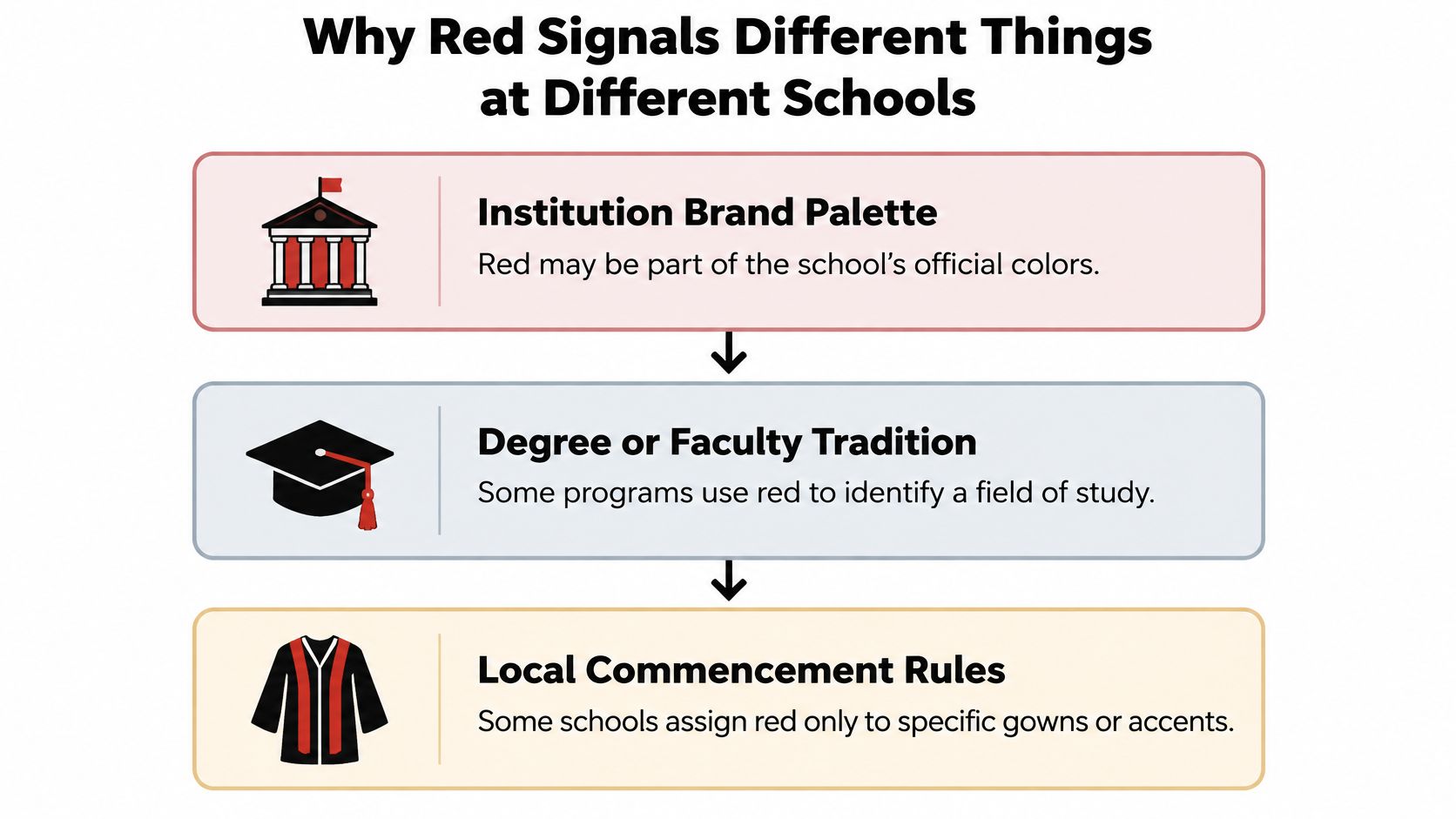
Separate school identity from academic meaning
An institutional palette identifies the university. A discipline color identifies a field of study. An honor or cultural designation needs its own explanation and approval rather than an assumption based on either of those systems.
Stanford offers a clear worked example. Its doctoral robes are red and black, while the hood lining identifies the degree-granting institution and the velvet edging identifies the academic discipline. Its listed discipline colors include crimson for communication and journalism and scarlet for theology, according to Stanford's regalia guidance.
Notice the distinction: the doctoral robe's red fabric and a hood's crimson edging aren't necessarily answering the same question. One belongs to the university's doctoral outfit; the other communicates a field.
That's why a photograph of another graduate isn't enough to establish your requirements. Even a visually similar outfit may represent a different institution or qualification.
Apply a simple meaning filter
Before adding a red item to your order, ask:
- Is this a school color? Look for the institution's required placement and shade, not just its general branding.
- Is this discipline trim? Confirm the named field and the specific part of the garment where that color belongs.
- Is this a degree marker? Check whether the item is intended for your academic level rather than another group.
If the item is described as cultural, honorary, or organizational, ask a separate question: who authorizes it for this ceremony? Don't force that accessory into a degree-color explanation.
A practical buying note might read “approved red gown body” or “approved scarlet hood trim.” That wording is much safer than writing “red regalia,” because it records both the color and its job.
How Red Changes Across Degree Levels
A bachelor's gown and a doctoral gown differ in pattern, not only in length. Degree level sets the sleeve shape, the amount of velvet, and the places where red is even allowed to appear.
The University of Pennsylvania describes bachelor's gowns with pointed sleeves, master's gowns with oblong sleeves, and doctoral gowns with bell-shaped sleeves plus velvet on the front and sleeves. Its explanation of commencement traditions also shows that a university may use institution-specific doctoral dress rather than standard black.
Treat degree level like the dress code category on an invitation. If the event is formal, the wrong cut still looks wrong even in the right color.
Use one campus page as wording, not as a template
The University of Nebraska–Lincoln's academic regalia policy is a useful example of how a school writes requirements, but its details belong to that campus. Use it to learn the vocabulary: robe, sleeve, velvet, hood, tassel, stole. Then return to your own school's instructions for the actual rule.
| Degree level | Construction cue from the Penn example | What to verify about red |
|---|---|---|
| Bachelor's | Pointed sleeves | Whether red is approved on the gown body or only on removable items |
| Master's | Oblong sleeves | Whether red names the institution, the field, or the degree level |
| Doctoral | Bell-shaped sleeves with velvet on the front and sleeves | Whether red belongs in the robe, the velvet areas, or the hood components |
Same red, different job. A crimson edge can mean a field at one ceremony, while a scarlet panel can be part of a university's doctoral dress at another.
Lock the level before the color
Search results labeled “red graduation gown” often mix high school, bachelor's, master's, doctoral, and faculty styles. Filter by qualification first. Then compare sleeve shape and velvet placement against the written rule.
A solid red gown fails if the requirement is a black gown with defined red accents. A black gown with added red accessories also fails if the rule calls for red built into the sleeve or panels. Graduation Cap and Gown sells regalia for doctoral, master's, bachelor's, high school, and pre-K/kindergarten levels, and as a third-party vendor it does not keep specific regalia rules on file, so bring the confirmed requirement before ordering.
Check the listing language against four details: degree level, sleeve or panel construction, attached versus removable pieces, and the exact part allowed to be red. Borrowed regalia needs the same check, because a gown can look close in a photo while belonging to another level.
Matching Red Gowns, Hoods, Tassels, and Stoles
Treat your graduation outfit like a coordinated jacket, lining, and pocket square. The pieces belong together, but they don't all have to follow the same color rule.
The University of Miami's honors and regalia guide illustrates the distinction: scarlet is the traditional velvet color for divinity, while the hood lining identifies the degree-granting institution. School-specific piping and linings can also combine red with other colors.
Work from the gown outward
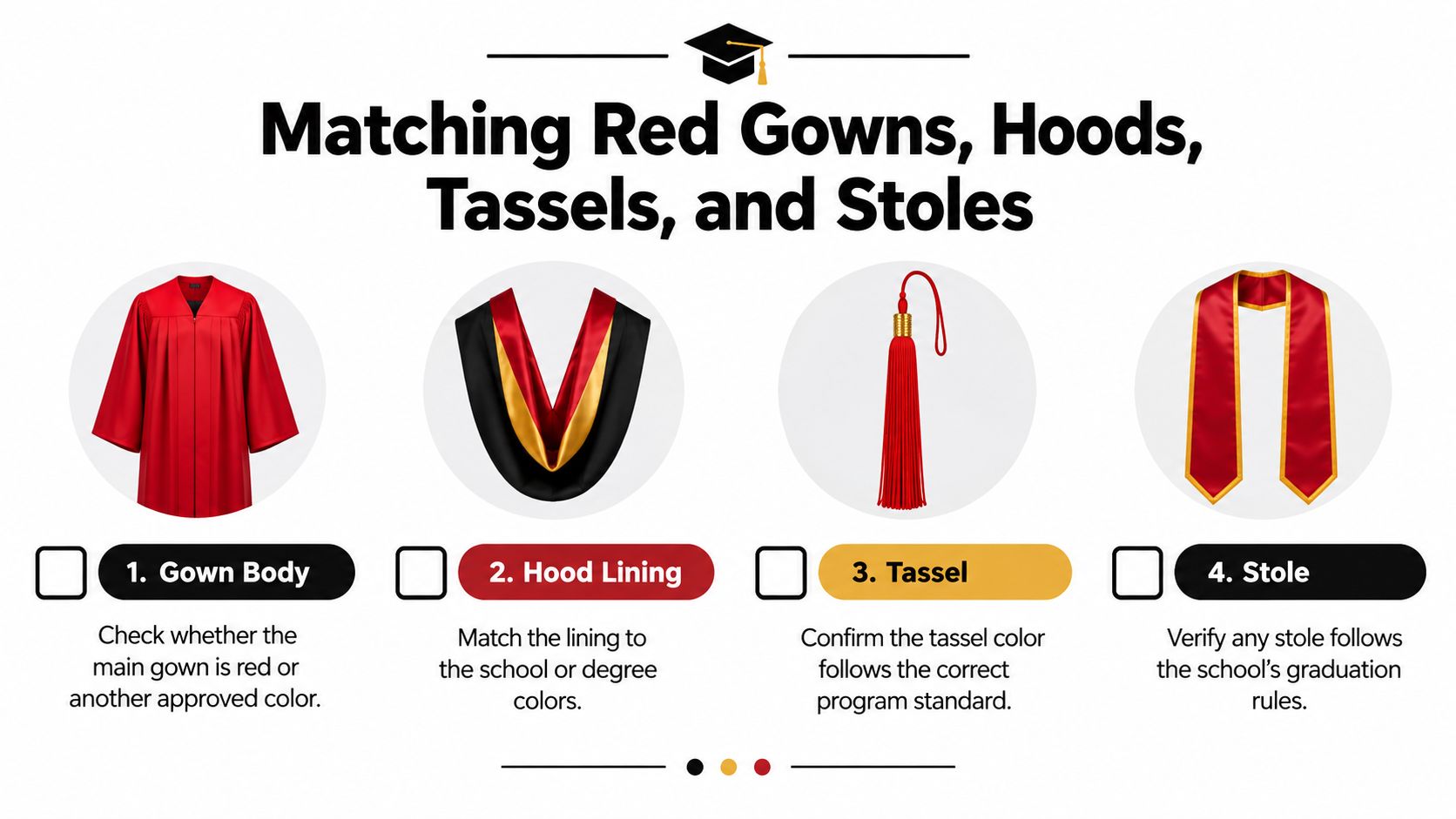
Start with the gown body. Establish whether the main garment must be red, black, or another approved color. Don't choose accessories to justify a gown that doesn't meet the basic requirement.
Next, examine the hood lining and hood trim separately. Ask which institution's colors belong inside the hood and which academic field belongs on the velvet edge. A product described with red in its name still needs to match the complete specification.
The tassel deserves its own check. Don't assume it should repeat the gown color or the hood edging. Record the school's required tassel color independently.
Use this visual checklist to keep the components separate.
Keep recognition accessories separate
A stole or honor cord isn't a substitute for a required hood. If you're considering an optional accessory, ask whether it's permitted and what organization or achievement it represents.
For a group planning an approved embroidered stole, satin ceremony accessories from Custom Mark provide a resource for considering that separate accessory. Settle the school's approval and design requirements before choosing embroidery or colors.
We recommend checking with your school for which colors to select for honor cords. Your major alone shouldn't be the basis for that choice.
Our explanation of graduation hood colors can help you organize the terminology when discussing your order.
Before checkout, complete this component list:
- Gown: Confirm the body color, degree style, and required sewn-in details.
- Hood: Record lining colors separately from velvet trim.
- Tassel: Match the stated program or ceremony requirement.
- Stole: Verify permission, wording, and any organizational specifications.
- Honor cords: Obtain the school's color instructions rather than choosing by appearance.
Keep those answers beside the product listing. If a package doesn't explain a component clearly, resolve the missing detail before ordering instead of assuming every red piece should match.
Ceremony Rules to Check Before You Buy
Your university's logo may be red. Its athletic teams may wear red. Neither fact establishes that a red graduation gown is acceptable.
The University of Arkansas for Medical Sciences makes this distinction especially clear. Its policy permits regalia from any vendor only when the garments satisfy its stated requirements.
A school-color assumption can produce the wrong order
Under the UAMS regalia policy, the gown must be black. The tassel must be black or the appropriate college color, and master's and doctoral hoods must match the degree and carry the institution's crimson-and-white lining. Doctoral candidates use tams, while other degree candidates use mortarboards.
A shopper who focused only on crimson could therefore choose the wrong gown. The institution uses that color, but assigns it to a specific component.
This is why official requirements should outrank search results, social media photographs, and general explanations of academic symbolism. Those materials can help you understand regalia, but they don't approve your purchase.
Confirm the policy first, then shop.
Find an authoritative answer
Look for the current commencement announcement, registrar's instructions, or academic regalia policy. If they disagree, ask the office responsible for your ceremony to clarify which instructions apply.
A useful message includes your degree, program, and ceremony, followed by specific questions:
- Gown approval: Is a fully red gown required or permitted?
- Headwear: Does this degree require a mortarboard, tam, or another specified style?
- Accessories: Which items are mandatory, optional, or restricted?
- Vendor choice: May students purchase from a third-party retailer if the specifications match?
We serve individuals and schools as a third-party vendor, and we don't keep any specific school regalia information on file. You must obtain those details before ordering.
Our guide to how to wear graduation regalia can help with assembling the approved pieces. Wearing guidance, however, doesn't replace the institution's purchasing requirements.
Keep a copy of the final instructions with your order notes. If you're coordinating a group, distribute that same confirmed specification to everyone rather than asking each graduate to interpret “school colors” independently.
Choosing the Right Size and Fabric
Once the approved outfit is clear, focus on how it fits. Buying regalia is closer to buying a uniform than choosing a fashion piece: the goal is the correct silhouette and a consistent appearance.
A fitting check should consider the complete outfit, not just the gown hanging from your shoulders.

Use the chart rather than your usual clothing size
We provide size, color, and fabric guides. Start with the graduation cap and gown size chart, then follow the measurement instructions for the garment you're considering.
Don't substitute your usual shirt or dress size for the measurements requested. If a listing leaves you uncertain about fit, identify the exact uncertainty before finalizing your selection, such as length, sleeve construction, or room through the body.
For color and fabric, we also offer product samples. Use a sample to compare the red fabric with the school's approved reference and assess its feel in person, rather than relying only on a screen image.
Check the outfit in ordinary movements
When you can try on the garments, sit, stand, and walk in them with your planned ceremony clothing. Check whether the neckline and shoulders allow the accompanying pieces to sit as intended.
Use the video as an additional visual reference while reviewing your regalia.
A manageable sizing routine keeps the decisions together:
- Gather: Have the school's specification, a measuring tool, and the relevant chart ready.
- Measure: Record what the chart requests instead of estimating from everyday clothing.
- Compare: Check the correct garment category and review the fabric guidance.
- Verify: Compare an available sample with the approved color reference.
- Record: Save the selected size, fabric, and color beside your component list.
For a group order, share the measurement method as well as the chart. Asking everyone for a familiar clothing size can leave the coordinator comparing answers that were gathered in different ways.
Your Next Step to Ordering Red Regalia
A useful order begins with a finished specification, not a cart full of red items. You should be able to explain what each selected piece is for and which requirement it meets.
Keep a compact order sheet beside you:
- School rules: Save the current instructions and any clarification from the ceremony office.
- Red placement: Mark exactly which pieces or details need red.
- Degree requirements: Identify the appropriate garment construction and headwear.
- Fit and fabric: Record the chosen size, material, and approved shade.
- Package contents: Compare what's included with what you need.
Choose a package only after checking its contents
Our red options include the Doctor of Education Hood - Red & Golden Yellow, rated 4.8 out of 5 by 13 customers, and customizable bachelor's degree cap, gown, tassel, and hood packages. Treat those as options to compare with your requirements, not as automatic matches based on the product name.
Available product colors include Antique Gold, Apricot, Black, Brown, Burgundy, Emerald Green, Gold, Green, Hunter Green, Kelly Green, Kente, Light Blue, Maroon, Navy Blue, Orange, Pink, Purple, Rainbow, Red, Royal Blue, Silver, Teal, Turquoise, and White. Select the specified color rather than substituting a nearby shade because it looks similar.
Make the final comparison deliberately
Read your order sheet against the selected options before submitting payment. Pay particular attention to items that are easy to overlook, such as a hood's lining or an accessory included in a package.
We provide secure ordering alongside size and fabric guides, but the school's requirements remain your reference for choosing correctly. If an essential detail is unresolved, pause the purchase and get that answer first.
The best next step isn't to find the brightest red or the most coordinated set. It's to choose regalia that accurately represents your degree, follows your ceremony's rules, and fits the way it should.
Graduation Cap and Gown offers red regalia options, customizable bachelor's packages, and individual pieces for building your approved graduation outfit. Visit Graduation Cap and Gown with your school's requirements in hand, then use our size, color, and fabric guides to select the right pieces before ordering.