

You're zipped into your gown, the procession is close, and a classmate hands you a pin for an organization that helped carry you through school. The obvious question is where to attach it. The less obvious, more important question is whether your university allows it at all.
If pins are permitted, the safest default is the upper chest or lapel area of the gown, positioned so the pin stays visible without crowding the hood, stole, or cords. But the school's commencement policy comes first. Academic regalia is a coordinated system, not a blank canvas, and a pin should complement its official pieces rather than compete with them.
The Pin Placement Decision Most Graduates Get Wrong
A pin looks small in your hand. On a gown already carrying a hood, stole, or honor cords, it can land in the middle of a crowded patch of fabric. That's why the question of where to put pins on a graduation gown isn't just about choosing left or right. It's about finding a permitted location that doesn't hide the details the school expects graduates to wear.
The safest general placement is on the gown's upper chest or lapel, below the shoulder seam and away from the neckline. Attach the pin through the gown fabric only, not through the hood or stole. Put on the gown and arrange all approved regalia before deciding where the pin belongs. University guidance generally treats pins and medallions as optional accessories added after those main pieces are arranged, and Kansas State University says adornments must be approved by the university. That means there's no universal pin location that overrides local policy. (Kansas State University's regalia guidelines)
The rule that matters most: Your commencement office's policy outranks general etiquette. If it prohibits pins, don't attach one to the gown.
The hierarchy has a purpose. The hood identifies degree level and discipline, while stoles and cords may represent approved honors or organizations. A pin is an additional recognition, so it should stay small and clear of those established elements. If you're also dressing in traditional Scottish attire, a separate kilt pin placement guide can help with that garment, but its conventions don't determine how your university gown should be decorated.
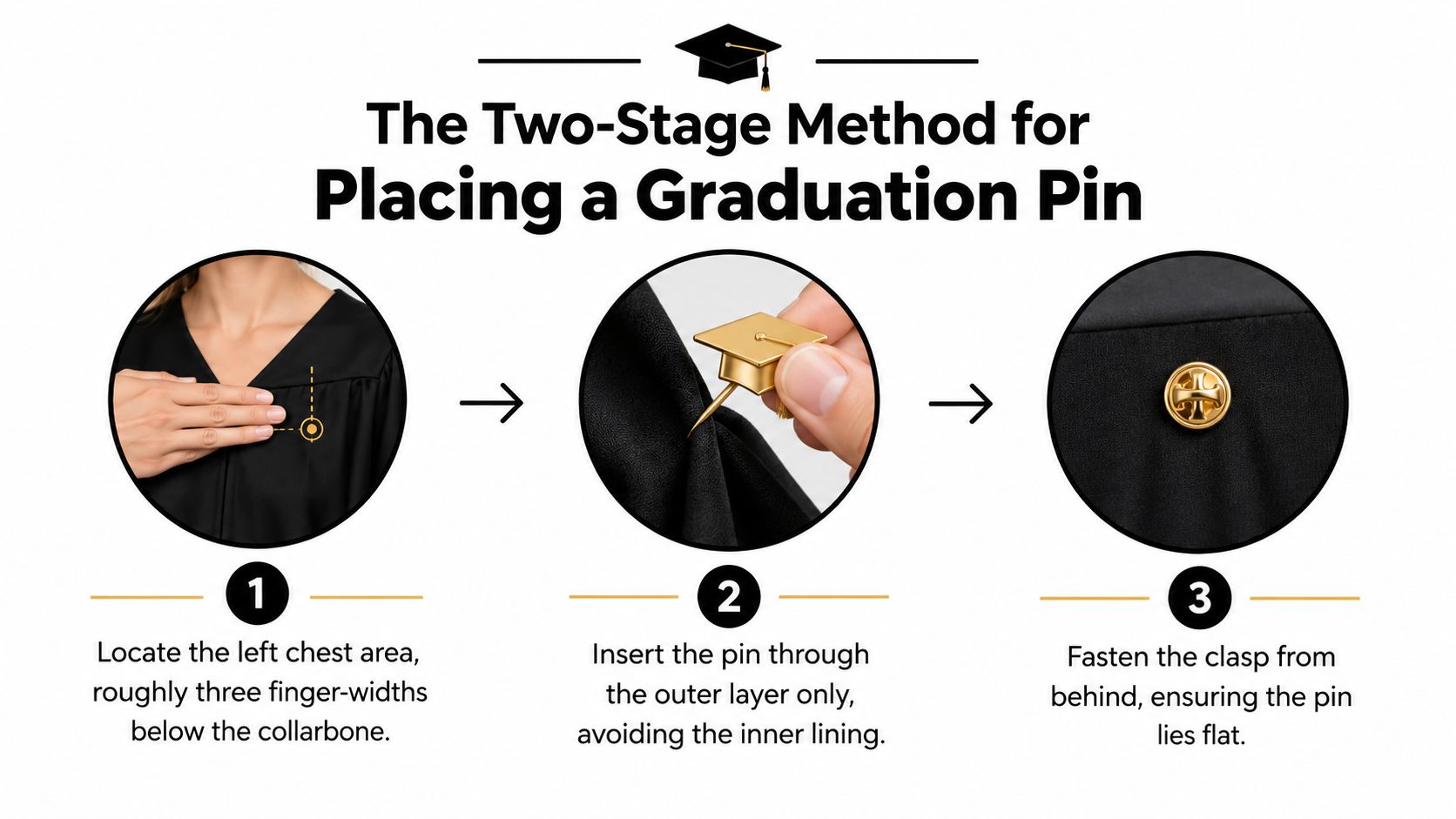
The Two-Stage Method for Placing a Graduation Pin
Graduates often reach for the pin before checking the rules or arranging the rest of their regalia. That's how pins end up over a hood, through a seam, or removed by staff at the entrance. Use a two-stage method instead: confirm permission, then choose and attach the location.
Stage one: Confirm the rules
Check your school's commencement or registrar page for its policy on pins, medallions, and other adornments. Look for restrictions on who may wear them, which organizations may supply them, and whether approval is required. Kansas State University notes that cords and stoles can represent academic honors or officially recognized organizations, while adornments need university approval. Utah State University describes a pin as an emblem normally worn on the gown's lapel area, but also subjects university-issued adornments to approval procedures. Those examples make the practical point: a lapel is a common placement, not permission by itself. (Utah State University's adornment guidelines)
Stage two: Fit the pin to the arranged regalia
Put on the gown, then add the hood, cords, and stole you're permitted to wear. Find a clear spot on the upper chest or lapel, away from the zipper, shoulder seam, dense stitching, hood, and stole edges. Use a removable clip to mark the position, take off the gown, and fasten the pin through the gown fabric only. This avoids repeatedly puncturing lightweight material while you adjust the placement.
Put the gown back on and check the pin in a mirror. Sit down, stand up, and walk a little. If the pin snags, pulls the fabric, or disappears under another layer, move it before the procession.
The video below demonstrates pin placement and fastening mechanics.
How Bachelor, Master, and Doctoral Regalia Change the Pin Zone
The more regalia you wear, the less room you have for personal adornments. A bachelor's gown often leaves a relatively clear upper chest, though a stole can occupy that area. A master's graduate must keep the pin clear of the hood's neckline and any stole. Doctoral regalia adds more visual detail, so a pin needs to be particularly discreet.
| Degree level | Placement consideration |
|---|---|
| Bachelor's | Use the open upper chest or lapel, clear of any stole or cords. |
| Master's | Keep the pin away from the hood's neckline and the stole's path across the chest. |
| Doctoral | Choose a small, flat pin that doesn't compete with the gown's velvet panels or other trim. |
The point isn't to decorate every available patch of fabric. Academic dress has standardized elements that communicate academic information. The Intercollegiate Code of Academic Costume, adopted on March 16, 1895, standardized major features such as gown cut, degree colors, and disciplinary symbolism, not a universal system for personal pins. The American Council on Education revised the code in 1932 and 1959, with later clarifications including dark blue for the PhD degree. (A history of academic regalia from Penn)
For a bachelor's graduate, the main issue is usually whether a pin crowds a stole or honor cords. For a master's graduate, leave the collar and hood clear so the hood sits naturally. Doctoral graduates should be even more restrained: a pin that overlaps velvet trim or pulls at a decorated front panel makes the whole outfit look unsettled.
Before pinning anything, arrange the academic hood correctly and see where its edges fall. This guide to wearing the academic hood can help you check the fit. If the hood's neckline and the upper chest are already crowded, choose another school-approved location or skip the pin.
Layering Pins with Cords and Stoles the Right Way
When you're wearing several pieces, order and balance matter more than forcing everything into one spot. Arrange the gown and hood first, then let the cords and stole fall naturally. Add a pin only after those layers are sitting correctly.
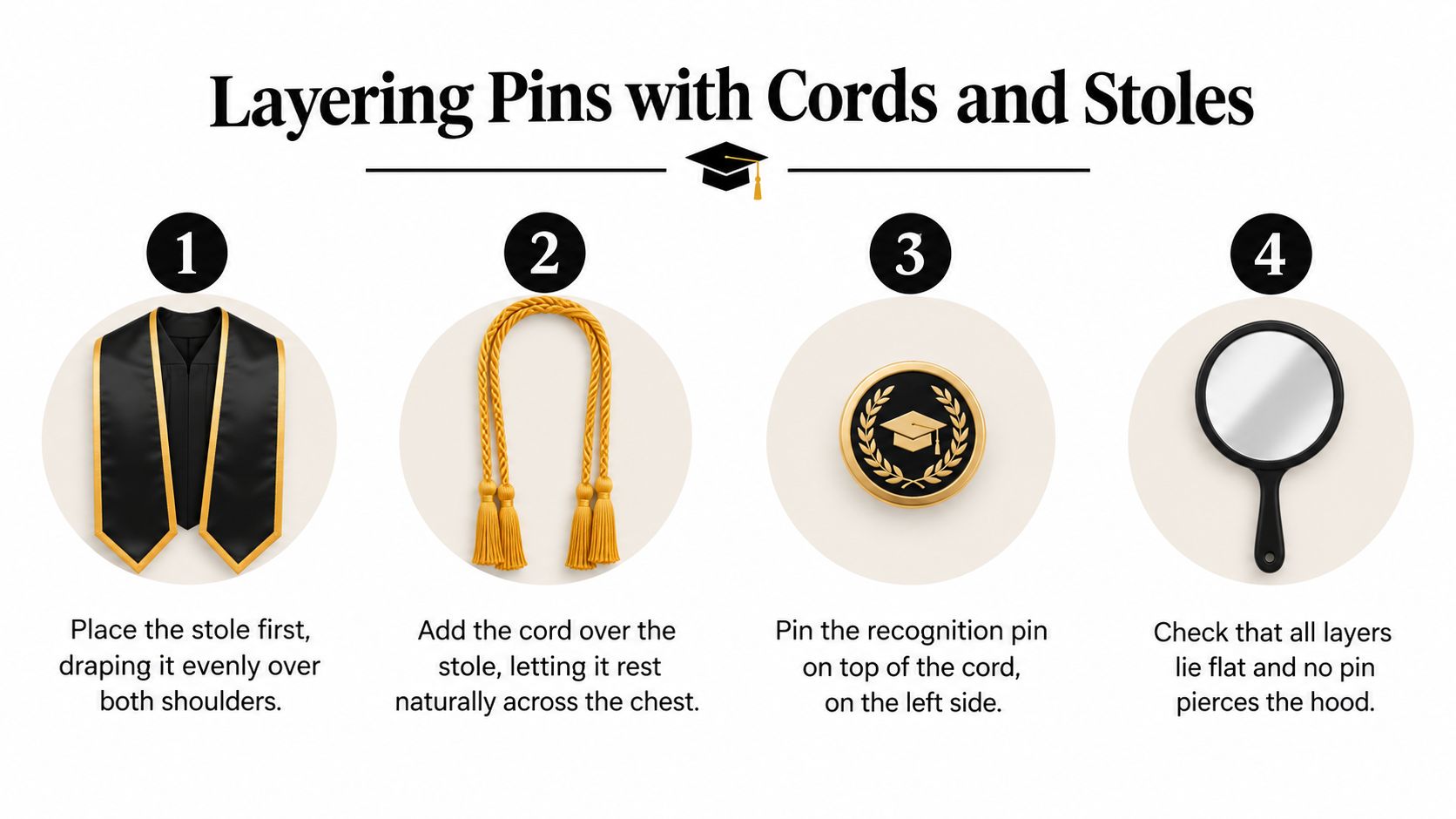
Center each cord's midpoint behind your neck so its ends hang evenly at the front. Then place the cords over the gown and position them under or alongside the stole according to your school's instructions. Kansas State University specifies that its bachelor's honor cords attach at the wearer's left shoulder. Johnson & Wales advises centering the cord behind the neck and, if a stole slips, pinning the stole to the gown rather than modifying the cord. (Kansas State University's guidance on wearing regalia)
Keep the accessories intact
Don't pin through a braided cord, tassel, hood binding, or satin stole edge. A puncture can distort the accessory or leave a visible pull mark. If a stole keeps slipping, secure the stole to the gown only if your university permits that approach. A quick comparison of the cord ends will reveal a twisted cord or off-center neck loop before it shows in photographs.
A small recognition pin should sit on a clear patch of gown, not force the cords or stole out of place. If the front is already crowded, take one approved item off rather than stacking accessories until none of them lies flat. Some universities limit the number or combination of adornments, so check the policy before treating every earned piece as automatically wearable.
If you're sorting out the cord arrangement, this guide to graduation honor cords offers another useful reference. Your school's approved layering order still takes priority.
When the Best Pin Location Is Not the Lapel
The lapel is a sensible default, not a rule for every graduate. A pin should be visible only when visibility doesn't create a safety, accessibility, or policy problem. If a pin could catch on a wheelchair or walker, interfere with a religious garment, press uncomfortably against the collarbone, or crowd culturally significant regalia, don't force it onto the chest.
Ask the commencement or accessibility office about an approved alternative. The right answer may be a different location, a different attachment method, or wearing another approved item that represents the same achievement. If the pin's message could be interpreted as political or advocacy-related, ask about the school's rules before attaching it. Don't assume a personal emblem is treated the same as an organization-issued recognition pin.
University rules differ sharply. The University of Baltimore permits pins and doesn't limit their number, while the University of Providence prohibits them unless they're specifically approved. Utah State describes a pin as usually worn on the lapel, but that guidance doesn't create a universal placement rule. (The University of Baltimore's commencement attire policy)
Don't make an accommodation decision at the lineup. A short message to the registrar or commencement office can settle whether a different position or attachment is acceptable.
Cultural and identity stoles can already occupy the chest, and the garment or accessory may carry meaning that matters more than making a pin visible. If you're choosing between different stole styles, this overview of types of graduation stoles can help you think through the layers. The final placement should work for your body, your regalia, and your school's requirements.
Pinning Mechanics and Troubleshooting Common Mistakes
A permitted pin can still damage a gown if it's attached carelessly. Avoid the zipper line, seams, dense stitching, and hood fabric. Don't use the mortarboard as a substitute for the gown's chest area: cap decorations may follow separate rules, and the pin can catch or obstruct someone's view.

Choose a lightweight pin with a secure fastening that lies flat against the gown. A heavy medallion can pull on lightweight fabric; if the material sags when you attach it, choose a lighter item or another approved way to display the recognition. After fastening the pin, give it a gentle tug to check that it stays put. Don't yank it, and don't keep puncturing the same spot while trying to make it sit perfectly.
What to do if the pin is rejected
The University of Scranton permits ceremonial pins only when they're university-issued or university-sanctioned and meet its standards. Its cap-decoration rules separately require decorations to stay on top of the mortarboard, lie flat, avoid obstructing others' views, and not interfere with participation. (The University of Scranton's commencement attire guidance)
If a marshal or commencement staff member tells you to remove a pin, comply rather than arguing in the procession line. Ask whether an approved alternative is available. You might be able to display the recognition on an approved stole, or wear a cord that represents the same honor, but don't transfer the pin to another piece of regalia without permission.
The same goes for pins prohibited outright. Leave the gown undecorated and follow the school's rules. A pin isn't worth risking your participation or damaging borrowed regalia.
Your Pre-Ceremony Pin and Regalia Routine
The best placement is the one you've checked in advance, attached securely, and tested with every approved layer in place. Academic regalia's standardized pieces already carry meaning, so a pin should add a personal or organizational note without obscuring the hood, stole, or cords.
Run through this routine before ceremony day:
- Check the policy. Read the commencement or registrar guidance for pins, medallions, and adornments. If the rule isn't clear, contact the office and keep its reply.
- Arrange your pieces. Lay out the gown, hood, cords, stole, and pin in dressing order. Put on the gown and add your approved layers before choosing a pin spot.
- Mark before attaching. Use a removable clip to identify a clear location on the upper chest or lapel. Take off the gown before fastening the pin through the gown fabric.
- Test the finished look. Put everything back on and check in a mirror. Sit, stand, and walk to make sure the pin doesn't snag, droop, or block the gown's front closure.
If the pin doesn't sit cleanly, remove it and reassess. Don't keep puncturing a gown to make a crowded placement work. For a fuller dressing sequence, consult this guide to how to wear graduation regalia.
Accessories are easiest to coordinate when you choose pieces that fit the gown and follow the school's rules. Graduation Cap and Gown offers honor cords, custom stoles, medals, and other academic regalia accessories, alongside caps, gowns, and hoods. When you're ready to put your approved graduation look together, visit Graduation Cap and Gown.
Choose your pin only after the commencement office confirms it's allowed, then arrange the full regalia before attaching it. That simple order keeps the gown intact and the ceremony focused on your achievement.