

For most US university ceremonies, the cap is black; a white cap is right only when the school's written commencement instructions permit or require it. Don't buy a white cap for graduation just because your degree uses white as an academic color.
The popular advice to choose a cap by its symbolism skips the most important detail: the cap, gown, hood and tassel can follow different color rules. A photograph of another graduate isn't permission to copy their outfit. Get the school's rule in writing, then choose the shade, finish and fit.
Where a White Cap Is Allowed and Where It Is Not
Start with the black-mortarboard default at US universities. The Intercollegiate Code guidance summarized by Lamar University specifies a black mortarboard for bachelor's and master's graduates, while white primarily identifies arts, letters and humanities through academic-color elements rather than the cap itself.
That distinction matters before you spend anything. A white tassel or white hood trim doesn't authorize a white mortarboard, and a retailer's product photograph doesn't override commencement instructions.
When a white cap is usually allowed
| Ceremony or situation | White cap usually allowed? | What to confirm |
|---|---|---|
| Bachelor's or master's ceremony at a US university | No, black mortarboard is the standard | The commencement guide's cap color rule |
| Doctoral ceremony at a US university | Usually no; black regalia and a black cap or tam are common requirements | Whether nontraditional colors are explicitly permitted |
| School-specific uniform that includes white | Yes, when the school specifies it | Whether the requirement covers the cap alone or the full set |
| Preschool or kindergarten ceremony | Often yes; matching white sets are sold for this use | The ceremony dress code |
| High school or themed ceremony | Possible with school permission | Written approval before ordering |
| Cultural or religious adornment on the cap | Only under the applicable policy or legal protection | Advance approval, deadlines and whether the cap can be modified |
The University of Northern Iowa's cap-and-gown guidelines make the distinction concrete: bachelor's and master's candidates wear a black mortarboard, doctoral candidates wear a black keeper tam, and tassel color follows the graduate's primary academic college. Doctoral students shouldn't assume that a standard square cap is acceptable, whatever its color.
For a school-specific white uniform, read the actual garment names. A requirement for a white gown might cover the gown alone, or the school might expect a coordinated set. Those are different orders.
Permission comes before styling
High-school, preschool and themed ceremonies can use their own coordinated colors. Parents and coordinators should work from the ceremony organizer's current instructions rather than images from a previous class.
If white isn't permitted, keep the required black cap. Ask whether white belongs on an approved tassel, hood or stole instead, without replacing accessories that already have prescribed colors.
Practical rule: Choose the required garment first. Express your preferences only within the options the school allows.
Our guide to wearing graduation regalia can help you identify the separate pieces before ordering. Your first action, though, is simpler: find the commencement guide and confirm the cap rule before buying anything.
Confirm the Cap Rule and Where White Appears
"Is white okay?" is the wrong question to send a registrar. A yes could mean the gown, the hood or a stole while your mortarboard is still expected to be black. Send the commencement office a precise checklist instead, and ask for the answer in writing.
- Garment coverage: Does the color instruction apply to the cap alone, or also to the gown, hood, stole and tassel?
- Permission status: Is a white cap permitted, required or merely tolerated? Ask for the written rule.
- Approval requirements: Do decorations or cultural items need approval, and what is the submission deadline?
- Tassel protocol: Which side should the tassel start on, and will graduates receive an instruction to move it?
Forward the exact wording of the reply to whoever places the order. A paraphrased "white is fine" loses which garment the rule covers.
White identifies a field, not necessarily a cap
The 1895 academic-dress code assigned white to arts, letters and humanities, connecting that convention to the white fur traditionally used on Bachelor of Arts hoods at Oxford and Cambridge, according to Montana State University's regalia information. Science received golden yellow, law purple and medicine green under that same system.
Those assignments live on academic-color details such as the hood and tassel, while the base garments follow the institution's uniform. The University of New Orleans dress guidelines show both rules running in parallel: black caps and gowns for bachelor's, master's and doctoral graduates, with white assigned to anthropology, light blue to arts teaching, golden yellow to biological sciences and orange to civil engineering. A biology graduate there wears golden yellow on the hood and a black cap on the head.
A coordinated white outfit is a separate choice, and it appears most often at school-organized children's ceremonies.

Questions to settle before ordering
Can you wear a white cap if the school only specifies a white gown? Not automatically. Follow the exact instruction and ask whether the school intends a matching cap or a different cap color.
Is white an honor color? No universal rule makes a white cap an honors designation. White has an established disciplinary meaning, while an institution may assign its own recognition colors to approved accessories.
Contact your school directly to ask which graduation apparel colors it is currently using, because schools can change their colors yearly. Check with the school before selecting honor cord colors, and get the answer early enough to exchange the order if the shade is wrong.
Keep the reply with your order details, especially if you are buying for a group. Before choosing a white cap for graduation, identify which garment carries the field color and which garment must follow the school's base uniform.
Choosing a White Cap That Fits and Matches Your Gown
Buy the cap for the band, not the square. A mortarboard's flat top is rigid, so a band that pinches when it arrives will pinch on ceremony day no matter how well the white matches your gown.
Treat the school's written rule as a pre-purchase checklist. The gown, hood and tassel each carry their own color instruction, and the cap's white is a separate line item, so confirm the cap on its own before you order.
- Mortarboard: A stiff, flat square cap with a centered tassel. The rigid top means all of the comfort lives in the headband.
- Fit: Measure your head just above the eyebrows and ears, then compare that measurement with the cap's listed size. Color tells you nothing about sizing.
- Level: Worn correctly, the square sits parallel to the floor with the front point centered over your forehead.
- Secure: Tip your head forward, then turn side to side. The cap should stay put, and the band should leave no mark after a few minutes of wear.
- Match: Compare the cap's listed finish and white shade name with the gown's, not just the word "white" in the title.
The construction and history of the traditional mortarboard are described in Valdosta State University's commencement history guidance. Once the cap arrives, wear it at home before ceremony day. A top that rotates or a band that loosens during this test will only get worse across a long ceremony.
Use this checklist when comparing a cap with its gown.

Match the finish before chasing a brighter white
For children's ceremonies, our Child Matte White Graduation Cap & Gown - Preschool & Kindergarten is listed in a Matte finish, while the Child Shiny White Graduation Cap & Gown - Preschool & Kindergarten is listed in a Shiny finish. Each product page is where you confirm the color name, the cap's sizing description, and the available tassel options before ordering. Our broader material choices include Shiny, Matte, Deluxe, Eco-Friendly, Satin and Classic.
Choose the cap's sheen to match the gown's. A shiny cap above a matte gown can look mismatched even when both are labeled white, so match the finish name on each product page rather than relying on the word "white" alone.
Before paying, consult our graduation cap and gown size chart and website fabric guide. Confirm the permitted color, the gown measurements, the cap's sizing description and the finish name. A cap described as one size does not mean the gown is one size.
If you're also organizing casual headwear for a celebration outside commencement, Merchandise's custom caps provide a separate resource for that purpose. Keep casual event headwear separate from the school's academic-regalia requirements.
How to Wear a White Cap Correctly on Ceremony Day
Dress with the ceremony instructions beside you, not with a generic photograph as your guide. Cap color doesn't determine tassel placement, and you shouldn't copy another graduate whose degree or event follows a different protocol.
The visual below highlights the guide-first approach and the Arizona State University example.
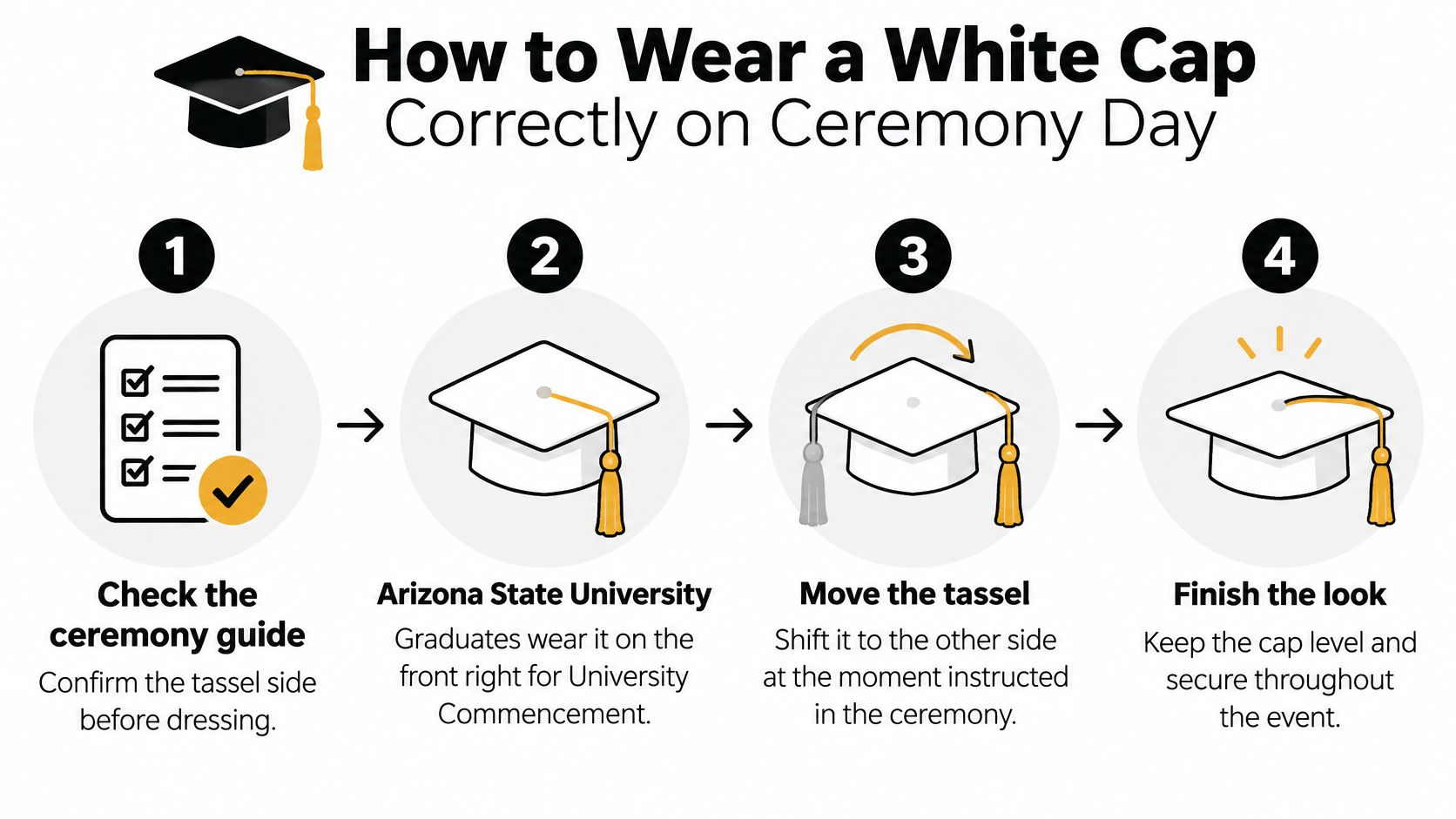
Follow a deliberate dressing routine
- Check the ceremony guide. Confirm the tassel side before dressing. Arizona State University directs graduates to begin on the front right for University Commencement, move the tassel to the front left when the president confers degrees, and leave it left for later events; the University of West Alabama instead directs graduates to wear it on the left.
- Center the front point. Place the cap flat on your head, with the point over the middle of your forehead. A sideways position makes the whole outfit look crooked in photographs.
- Set the band comfortably. Adjust it if the design permits, or reseat it so it contacts your head without pinching. A loose band lets the square rotate, while an overly tight fit becomes distracting during the ceremony.
- Arrange your hair for stability. Test the cap with the hairstyle you'll wear, and use discreet hairpins through the fabric band if appropriate. Don't force pins through the stiff top.
- Position the tassel and inspect decorations. Move the tassel only at the moment instructed in your ceremony. Check that it hangs freely and that nothing pulls the top out of alignment.
- Finish the look. Keep the cap level and secure throughout the event. Look in a mirror from the front and side before the processional to confirm that the top is parallel to the floor.
For another visual reference while dressing, use the demonstration below.
Our graduation cap wearing guide offers additional positioning guidance. Families coordinating their own celebration outfits can use Raccoon Transfers' graduation shirt ideas for families, while keeping the graduate's regulated outfit separate.
Final check: point centered, top level, band comfortable, tassel on the required side. A quick glance and gentle head turn should reveal any slipping before you join the line.
Decorating a White Cap Within School Rules
A decorated white cap is still a color decision first. Approval for paint, gems or lettering does not make an off-white or ivory cap acceptable, and it never overrides the separate rules for gown, hood or tassel. The University of West Alabama's regalia guidance limits decoration to the flat top; other published university policies use the same boundary idea and warn against interfering with tassel attachment, so measure your own cap and follow your school's written rule rather than copying a limit from somewhere else.
Decoration limits on a graduation cap
| Decoration element | Common rule | Example from published policy |
|---|---|---|
| Placement | Flat top surface only | University of West Alabama |
| Size | Keep the design inside the mortarboard's edges | Published university regalia policies |
| Tassel and center | Must not block tassel attachment or the center button | Published university regalia policies |
| Lights or sound devices | Often restricted; confirm before buying supplies | Institution's current decoration policy |
| Content | Check bans on profanity, hate speech and weapons references | Institution's conduct and commencement rules |
| Custom designs | Treat as subject to approval, with a deadline | Institution's own policy |
Trace the top onto paper before you buy anything. Keep decorations off the underside, leave the center button free, and spread lightweight materials evenly so the cap still sits level. If the rule mentions bright designs, flashing elements, amplified sound or prohibited messages, apply it to supplies as well as finished artwork.
Cultural and religious expression needs a separate check
Do not force cultural or religious items through the craft rules. District and campus policies can treat tribal regalia, headwear and adornments differently from ordinary cap decoration, as this school board policy example shows. Ask for written confirmation of the approval path, the deadline and whether an item may replace, modify or sit beside the mortarboard without affecting participation.
Pre-purchase checklist: exact white shade and finish; allowed surface; size boundary; tassel and center-button clearance; banned content; lights or sound rules; approval deadline; cultural or religious accommodation; and the email or form to carry on ceremony day.
After the written rule is clear, use our graduation cap decorating guide to plan the layout inside those limits.
Caring for and Storing Your White Cap
White makes dirt, makeup, adhesive residue and handling marks more noticeable than black. Keep the top clean from the start rather than planning an aggressive cleaning session immediately before commencement.
Use gentle spot care
- Handle with clean hands. Hold the cap by its band and the edge of the top rather than pressing your palms onto the square. This reduces the transfer of skin oils and cosmetics.
- Lift fresh marks gently. Use a dry, clean cloth to blot makeup or food residue without rubbing it farther into the fabric. Fresh marks are easier to address before they settle.
- Spot-clean cautiously. Test a lightly damp white cloth on an inconspicuous area, then dab the mark without soaking the board. Let the cap air-dry away from direct heat, which can distort its stiff structure.
- Remove adhesive slowly. Ease away loose residue without scraping or pulling the fabric surface. Don't use strong solvents or saturate the cap to dissolve stubborn glue.
- Store without pressure. Keep the cap flat in a clean protective space or its own breathable garment bag. Don't stack books, shoes or other garments on the square, because crushing can leave creases.
Store the white cap separately from a colored gown until ceremony day to reduce the risk of color transfer.
If the cap includes manufacturer care instructions, follow those over a general cleaning method. Never machine-wash or immerse a stiff mortarboard unless its care label expressly permits it.
Graduation Cap and Gown offers white children's cap-and-gown sets, academic regalia and accessories for ceremonies from preschool through university. Visit Graduation Cap and Gown with your school's written requirements in hand, then use our size, color and fabric guides to choose the correct outfit before ordering.