

You've found the gown, confirmed the ceremony date, and may already be planning the family photographs. Then one practical question appears: what should you look for in a Filipino graduation stole? The right choice needs to do more than display Philippine colors. It should fit the gown, respect academic protocols, and communicate the part of Filipino heritage you want to carry across the stage.
The Cultural and Academic Significance of the Stole
A black gown can make every graduate look formally similar. A Filipino graduation stole changes that visual language immediately. Draped across the shoulders, it can identify Filipino heritage, acknowledge family and community, and make academic achievement visible in a way that feels personal rather than generic.
That cultural meaning matters especially for graduates whose education connects several places and generations. A flag-style stole may express national identity, while a more detailed design can recognize language, regional roots, or ancestral knowledge. In either case, the stole becomes part of the graduate's story, not merely an accessory selected for color.
The academic role also deserves attention. Filipino graduation stoles are used as a distinct layer of academic regalia in some Philippine university systems. Mindanao State University-Iligan Institute of Technology's 2015 graduation guidelines require a “stole/langkit” for undergraduate candidates and a hood for graduate students, which shows that the stole can be institutionally recognized rather than treated as decoration. The same guideline says the stole must be securely pinned on both shoulders and worn throughout the ceremonies, giving it a formal place in commencement protocol. You can review the graduation stole meaning and ceremonial context before choosing a design.
A tradition shaped by institutions
Academic regalia isn't identical at every school. Some universities may permit cultural stoles as an additional layer, while others may specify how they should be worn or whether they can accompany hoods, cords, and medals. That makes the commencement handbook, registrar, department, or graduation coordinator the first authority to consult.
The history of Filipino regalia also includes formal changes. Bukidnon State University approved a campus regalia redesign in March of the previous year, with the new design set to debut with the Class of 2024 during the university's centennial founding anniversary. The example shows that regalia can evolve through official governance and milestone occasions, rather than remaining fixed forever.
Why selection affects the ceremony
A stole that's too short may sit awkwardly on the chest. One that's too wide can hide the gown's neckline or crowd other recognition pieces. A design with meaningful motifs also deserves enough space for those symbols to remain visible in photographs.
Ceremony rule: Treat the stole as part of formal regalia. Check your institution's instructions before you personalize, layer, or pin it.
The most respectful choice combines institutional compliance, secure fit, and honest cultural representation. A Philippine flag sash may be exactly right for one graduate. Another may prefer Baybayin, Cordillera-inspired elements, or a regional textile reference that reflects a more specific family history.
Decoding Symbols and Indigenous Design Patterns
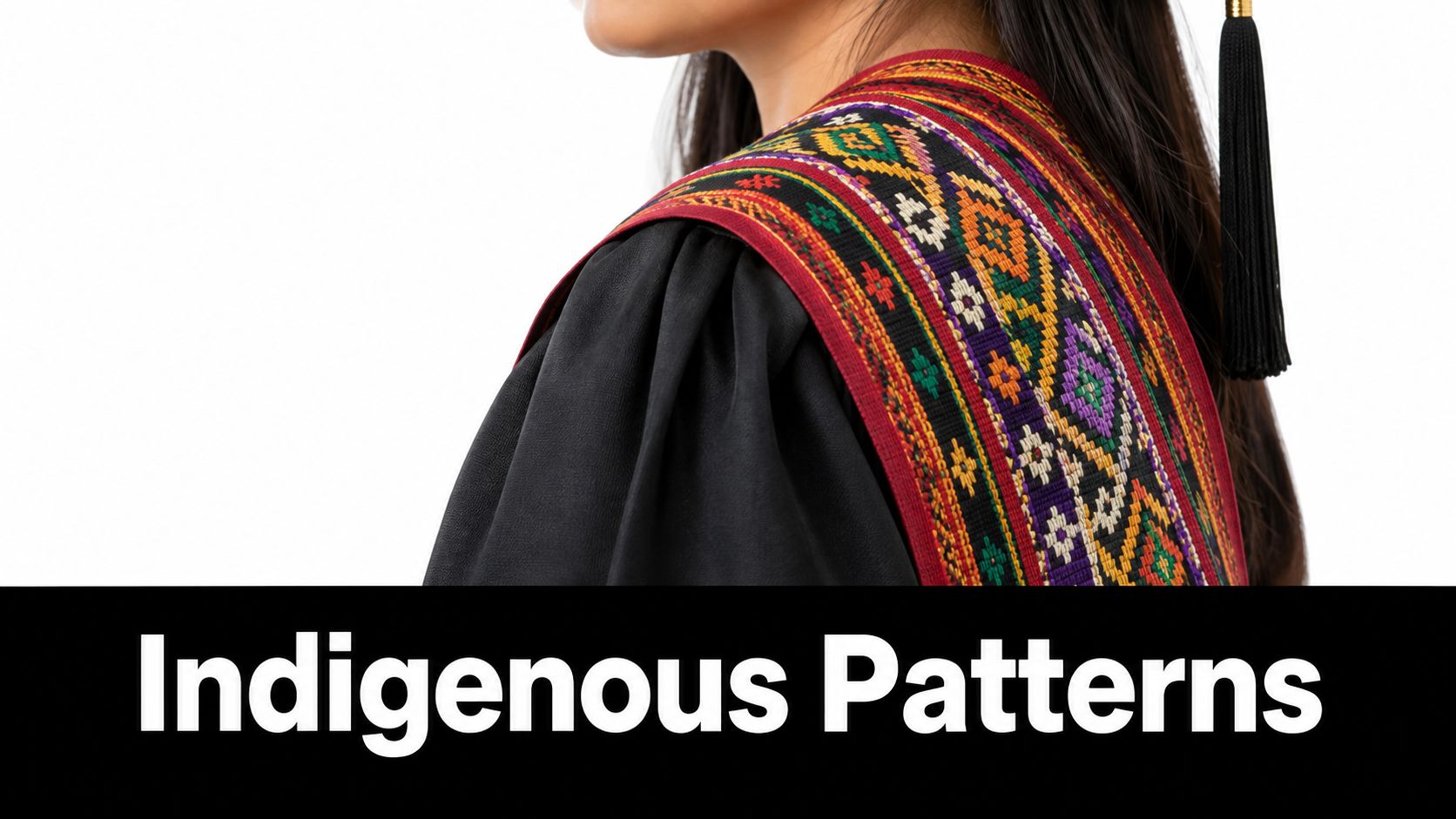
A Filipino stole can communicate broad national identity, but it can also tell a more particular heritage story. The difference rests in the design language. A Philippine flag motif is immediately recognizable and publicly legible. Baybayin text, indigenous patterns, and regional references invite a more focused conversation about language and ancestry.
Flag imagery and national identity
The standard Philippines-themed stole usually prioritizes national belonging. Red, blue, white, the sun, and stars create a visual connection to the country and make the stole easy to understand at a busy commencement ceremony. This option suits graduates who want their regalia to make a clear statement of Filipino pride without pointing to a specific region or language tradition.
That simplicity isn't a weakness. A clean flag design can leave room for a name, school, degree, or organization detail. It can also work well for diaspora graduates who want to honor Filipino identity in an international academic setting.
Baybayin and the language of knowledge
Baybayin introduces a different layer of meaning. One design description connects Baybayin with “karunungan,” meaning wisdom, and pairs it with Cordillera-inspired stars to connect graduation with ancestral knowledge. This is a stronger heritage narrative than a product that uses flag colors alone, because it links academic learning with cultural memory. The graduation stole collection featuring Baybayin and heritage-focused designs provides an example of this approach.
Baybayin should be selected carefully. Confirm the intended spelling and meaning with a reliable cultural or language resource, especially if the text will be embroidered permanently. Decorative characters shouldn't be treated as interchangeable artwork when they represent a meaningful writing tradition.
Indigenous patterns and regional identity
Indigenous-inspired weaving patterns can signal a connection to a family, community, or region, but they shouldn't be used without thought. A pattern described as Cordillera-inspired may evoke ancestral knowledge and mountain-region heritage. Other textile references may carry different histories, meanings, or ownership concerns.
Ask yourself three questions before ordering:
- What am I representing? Decide whether the stole is about Filipino nationality, a specific regional background, language revival, or family heritage.
- Do I understand the reference? Learn what the motif or textile tradition signifies instead of choosing it only because the colors look attractive.
- Will the design remain readable? Crowding multiple symbols can weaken each message and make the stole difficult to read in photographs.
A flag stole and a heritage-pattern stole don't compete. They serve different purposes. If you want a broader explanation of cultural regalia symbolism, the guide to Kente stoles and their meaning can help you compare how cultural textiles communicate identity without treating every tradition as interchangeable.
Matching Stole Dimensions to Your Degree Level
A beautiful stole loses its impact if it hangs unevenly over the gown. Length affects where the ends fall, how clearly the design appears in photographs, and whether the stole competes with a master's or doctoral hood.
Product specifications in the Philippine graduation sash market provide concrete reference points. One listing gives an approximate length of 72 inches and a width of 4.5 inches, while another notes that 31 to 33 inches is commonly used for elementary and high school graduations and 33 to 36 inches for college and university ceremonies. See the Philippine graduation sash sizing reference when comparing product measurements.
Start with the education level
Use the measurement table as a starting point, then compare it with your school's instructions and the shape of your gown.
| Education Level | Recommended Length (Per Side) | Total Length | Best For |
|---|---|---|---|
| Elementary | 31 to 33 inches | 62 to 66 inches | Shorter gowns and younger graduates |
| High school | 31 to 33 inches | 62 to 66 inches | Standard secondary-school ceremonies |
| College or university | 33 to 36 inches | 66 to 72 inches | Bachelor's, master's, and university gowns |
The table reflects common market guidance, not a universal institutional rule. Listings also use other formats, so check whether a seller describes the length per side or as the stole's full end-to-end measurement. Confusing those two descriptions is one of the easiest ways to order the wrong size.
Fit the stole to the gown
For a bachelor's gown, a college-length stole generally provides enough drape for the flag or embroidery to remain visible on the chest. Master's and doctoral gowns require more attention because the hood adds another layer around the neck and shoulders. Don't assume the stole should cover or replace the hood. In many ceremonies, the hood remains an academic marker and the cultural stole is worn as an additional layer, but your university's rules take priority.
Honor cords and medals create another fit issue. A stole should lie flat rather than twist beneath multiple accessories. Put on the gown, hood if applicable, and stole during a trial fitting. Adjust the placement while standing and sitting, since a length that looks balanced upright may shift when you move.
Fit check: Measure from the shoulder area down the front, then compare that result with the seller's stated per-side length. Don't order from the total length alone.
For school-specific guidance, consult a graduation cap and gown size chart. A short fitting session before commencement can prevent last-minute pinning, hidden artwork, or uneven ends.
Choosing Materials and Customization Options
Material controls how a Filipino graduation stole looks, moves, and withstands a long ceremony. Satin has a smooth surface and a noticeable sheen, which helps a cultural design stand out against many matte gowns. Polyester satin is also practical for buyers who want a stole that can be stored as a keepsake after commencement.
Independent product specifications commonly list 100% polyester for Filipino flag-style stoles, along with hydrophobic quick-drying behavior and stain resistance. These properties can help the sash handle moisture and incidental marks during a crowded ceremony, while the satin finish supports a clean drape. Review the Philippines graduation stole material specifications if fabric performance is part of your decision.
Compare construction details
A fully lined stole usually presents a more structured appearance than a single layer of fabric. Arrow-pointed ends create a defined finish and help the sash look intentional in front-facing photographs. These details matter most when the stole includes printed artwork, embroidery, or multiple color blocks that need to remain aligned.
A practical comparison looks like this:
- Polyester satin: Smooth, durable, quick-drying, and suited to a polished ceremonial drape.
- Fully lined construction: Adds body and helps the stole sit evenly over the gown.
- Arrow-pointed ends: Creates a formal visual finish and keeps the lower edge from looking blunt.
- Printed flag artwork: Offers an immediate national design statement.
- Embroidery: Adds texture and can support names, school identity, or heritage text.
Balance personalization with symbolism
Customization works best when every addition has a clear role. A graduate may add a name, degree, school colors, organization, or carefully verified Baybayin text. Too many elements can hide the flag or make an indigenous motif difficult to recognize.
The custom graduation stole options can help you compare personalization approaches. Before approving a design, check text spelling, logo permissions, color contrast, and the position of every element while the stole is fully laid out.
School colors can complement the Philippine flag, but they may also compete with it. Use one visual priority. If cultural identity is the main message, keep personalization restrained. If the stole recognizes a Filipino student organization, use the organization's colors and name in a way that supports rather than overwhelms the heritage design.
Styling Your Stole and Caring for the Fabric
A properly fitted stole still needs careful placement. Start by finding the center back, place it at the nape of your neck, and let both sides fall evenly over the gown. Smooth the fabric from the shoulders downward so the artwork faces forward and the ends remain parallel.
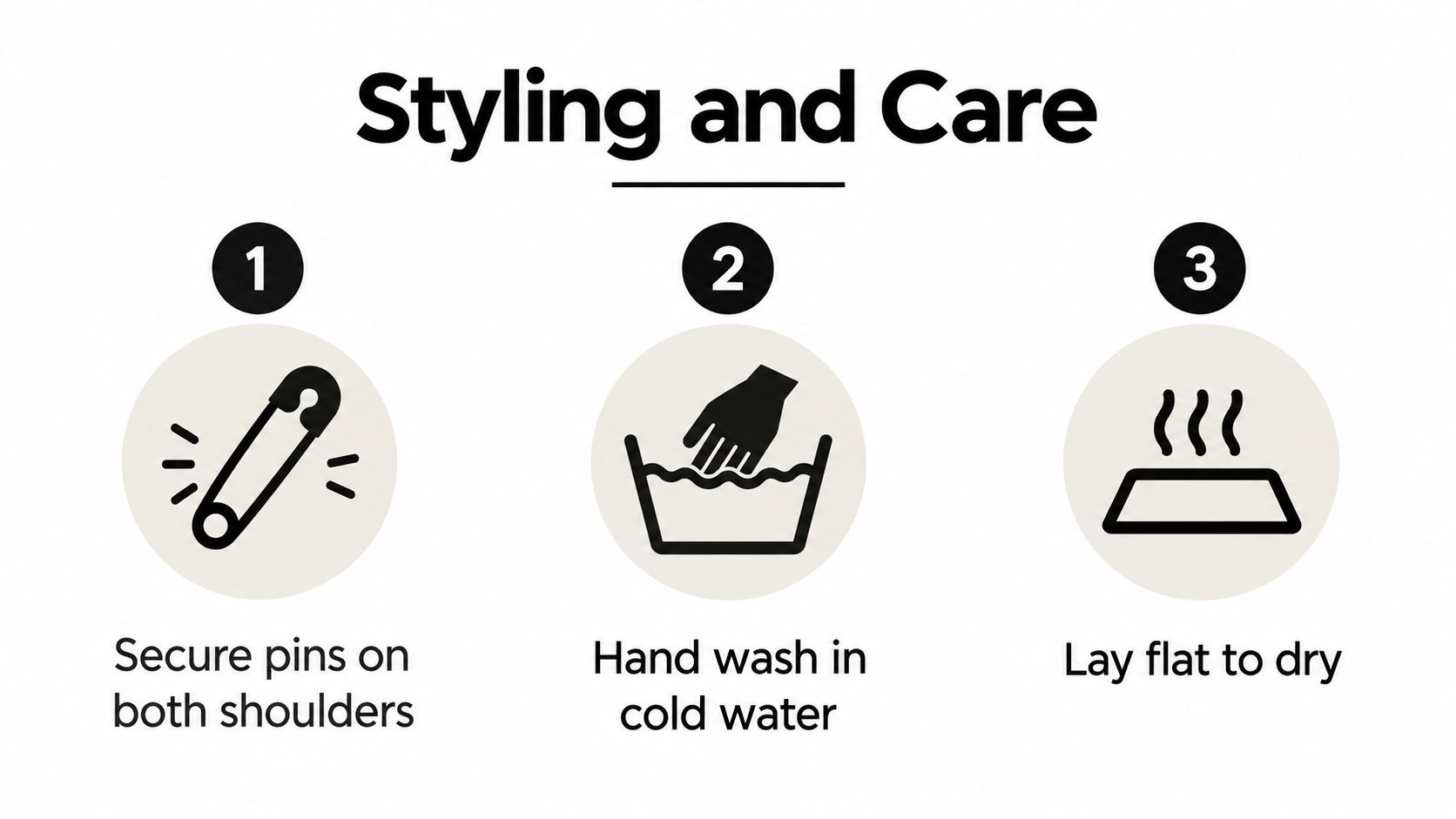
Mindanao State University-Iligan Institute of Technology's graduation guidance says the stole should be securely pinned on both shoulders and worn throughout the ceremonies. That instruction reflects a practical concern as well as a ceremonial one. A pinned stole stays in position during seating, procession, stage walking, and photographs.
Wear the layers in the right order
Try on the complete outfit before commencement. Put on the gown first, then the academic hood if your degree requires one, followed by the Filipino stole and any cords or medals according to your institution's directions. Some schools may specify a different order, particularly for doctoral regalia, so follow their protocol when it differs.
Use small, discreet pins from the underside of the gown or stole. Place them near the upper shoulder areas, where they can stabilize the sash without distracting from the design. Avoid pinning through prominent embroidery, printed flag details, or delicate decorative work.
Before the ceremony: Stand in front of a mirror and check shoulder symmetry, visible artwork, hood placement, cord position, and the length of both ends.
Remove wrinkles without harming the surface
Satin can arrive with shipping creases. Hang the stole in a clean place and use gentle steam rather than pressing a hot iron directly against the fabric. Keep heat away from printed designs and embroidered surfaces unless the care label gives specific permission.
For washing, follow the seller's care instructions. If hand washing is allowed, use cold water and avoid aggressive rubbing. Lay the stole flat to dry, then store it away from direct sunlight, dust, and moisture. Folding it tightly for long periods can create stubborn creases, so a loose, protected storage method is preferable.
A garment bag or archival-style box can help preserve the stole after graduation. Keep any pins, cords, and accessories separate so metal parts don't snag the satin. The stole should remain a keepsake of the ceremony, not become a damaged item packed away without protection.
The styling demonstration below can help you visualize secure placement before the event.
Ordering Logistics and Cultural Etiquette
Shopping for a Filipino graduation stole involves two separate decisions. First, you need a product that can arrive in the correct size and construction. Second, you need a design that represents Filipino heritage with care rather than using cultural details as surface decoration.
Listings show Filipino and Philippines-themed stoles in several market sizes, including approximately 40 inches, 72 inches, and 84 inches, and some describe their products as being “in compliance with most academic institutions' size guidelines.” Review the Filipino graduation stole product options carefully, especially the measurement definitions, personalization terms, and delivery information. A stated length may describe one side, the full stole, or a product-specific format.
Order with a verification checklist
Before placing an order, confirm:
- Ceremony rules: Ask the university, department, or coordinator whether cultural stoles are allowed and how they should be layered.
- Measurements: Compare the product's width and length with your gown, hood, and degree level.
- Artwork: Request a clear preview if the stole includes names, logos, Baybayin, or indigenous-inspired patterns.
- Color matching: Compare the stole with the official gown and school colors, preferably using a university color-matching tool or approved regalia guide.
- Delivery timing: Check production and shipping estimates, then leave a buffer for corrections or exchanges rather than ordering at the last possible moment.
A fabric cut to size guide can also clarify how sellers describe dimensions, especially when you're comparing a finished stole with fabric measurements. This is useful for coordinators ordering for a group, since inconsistent interpretations can lead to mismatched lengths.
Represent heritage with care
A Philippine flag design makes a broad and recognizable statement of national identity. Baybayin can emphasize language and knowledge, while Cordillera-inspired stars or indigenous weaving references may point toward ancestral and regional heritage. Choose the message you can explain and support, and don't claim a regional connection that isn't yours.
Cultural respect also means avoiding a crowded design assembled from unrelated motifs. If you're unsure about a symbol, consult a knowledgeable Filipino cultural organization, family member, or heritage practitioner before approving it. A thoughtful stole doesn't need every possible reference. It needs a coherent one.
Graduation Cap and Gown offers Philippine flag, embroidered Philippines, and mixed USA and Philippines stoles, along with custom regalia and sizing resources for graduates and coordinators. Visit Graduation Cap and Gown to compare a Filipino graduation stole with your gown, hood, and other ceremony pieces, then order with enough time for fit and design checks.