

You're probably standing in front of a mirror right now with your gown on, stole in hand, and one very specific question in your head. If I order a white cord, will it mean what I think it means at my school?
That's the right question. White graduation cords aren't a universal symbol you can decode from a generic color chart. They're part of a school's own commencement language, and that language changes from campus to campus. The safest way to shop for graduation cords white is to treat the choice like a verification process, not a style decision.
What White Graduation Cords Represent
A senior checks the ceremony instructions, sees “white cord,” and assumes the color provides the answer. It does not. A white cord may mark Latin honors, an honors program, a society, a research fellowship, or another distinction approved by the institution. The school's rule, rather than a general color chart, determines what you may wear.

Academic regalia developed from clothing used by European universities in the 12th century, when gowns helped scholars stay warm. U.S. institutions later formalized academic costume through a national intercollegiate code adopted in 1895, as described in the history of academic regalia at USC Aiken. Cords became an additional visual signal. At a crowded ceremony, families and faculty can recognize an honor or membership without reading a transcript.
Why white causes so much confusion
White has no single campus-wide definition. One school may assign it to an honors tier, while another reserves it for a named program. A third may allow only cords distributed by an approved office or organization. The color is the visible label. Your institution supplies the definition.
The graduation cord meaning guide offers a broader explanation of how schools and organizations use cords.
Practical rule: A white cord carries meaning only when your school, honors office, registrar, or approved organization authorizes it.
The first three questions to ask
Before ordering, check three parts of the decision:
- Which institution controls your ceremony: Your college's commencement office or registrar sets the ceremony rules.
- Which recognition you earned: Confirm whether it is Latin honors, program honors, military service, society membership, or another approved distinction.
- Who issues the item: If the school distributes the cord, use that version rather than choosing a similar-looking one online.
A white cord can represent a real achievement, but the correct choice depends on the institution, the recognition you earned, and the approved cord style. Verify those three details before you click add to cart.
The Visual Language of Regalia and Where Cords Fit
Families in the audience read graduation attire the way they read insignia on a uniform. Every layer says something a little different, and cords make the most sense when you see them as one piece of that larger system.
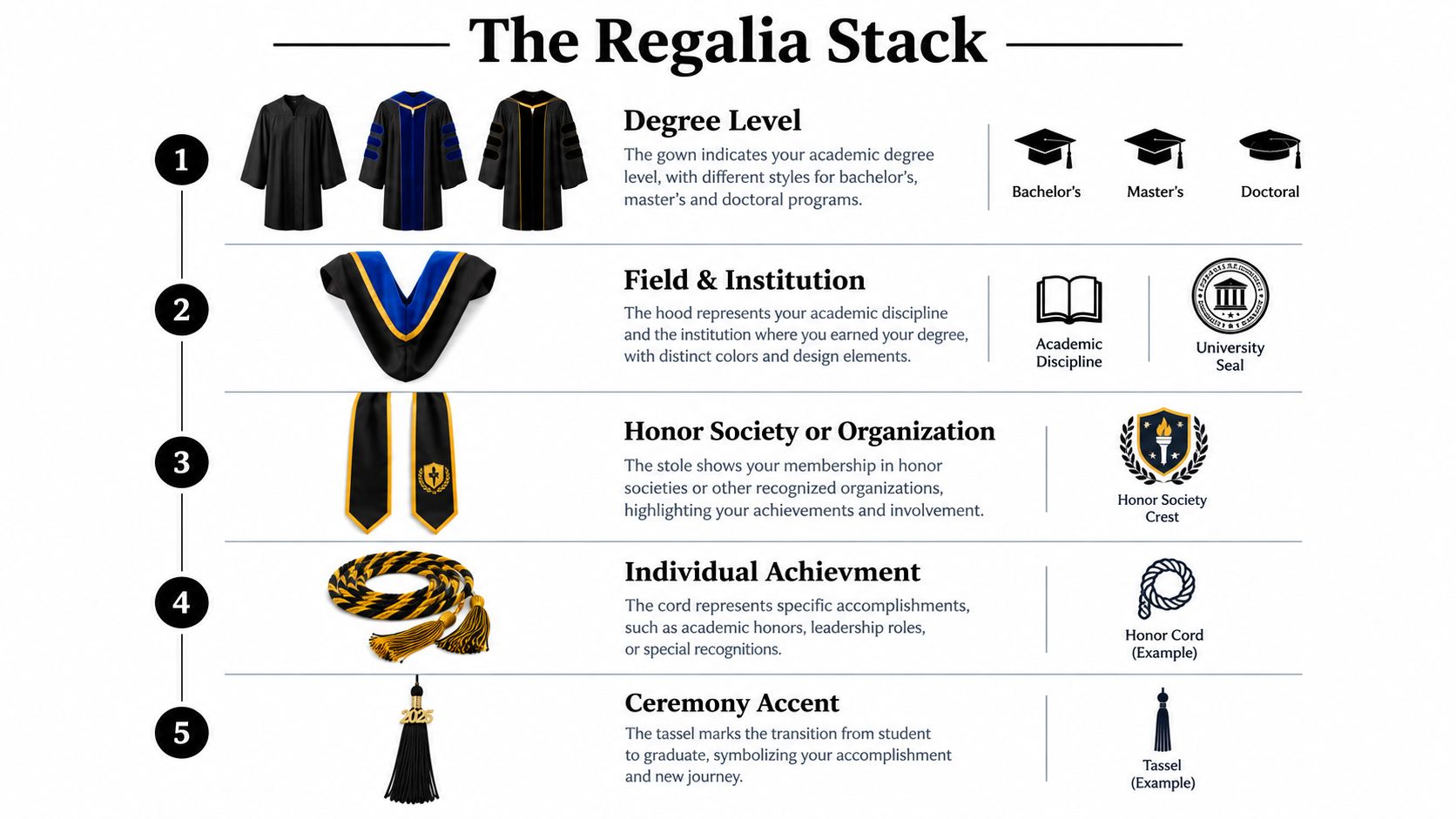
The academic regalia overview explains the major pieces well, but the short version is this. The gown usually reflects degree level. The hood often signals field and institution in traditions where hoods are used. A stole may identify an organization, heritage group, or society. A tassel is part ceremony, part academic symbolism. A cord is the compact visual marker that usually points to an individual distinction or membership.
The regalia stack
| Regalia piece | What it usually communicates | How it reads visually |
|---|---|---|
| Gown | Degree level or ceremony standard | The largest, most immediate signal |
| Hood | Field and institution | Formal academic identity |
| Stole | Organization, heritage, program, society | Broad fabric statement over the shoulders |
| Cord | Achievement or membership | Narrow, highly specific recognition |
| Tassel | Ceremony accent and degree tradition | Small but prominent in photos |
That layered structure is why a cord matters even though it's physically small. It sits front and center, framed by the gown and often resting beside or over a stole. From the audience, it works like a concise label.
Where white cords sit in photos
White cords tend to stand out sharply against a black or dark gown. In portraits, they frame the center of the chest and draw the eye toward medals, stoles, or honor pins layered nearby. If you're wearing both a stole and cords, the stole creates the broad backdrop while the cord adds the precise signal.
White cords aren't the whole story. They're the fine print everyone can still see from across the room.
That's why schools keep assigning meaning to them. They're visible, readable, and easy to distinguish when ceremonies are large and fast-moving.
How Real Schools Assign Meaning to White Cords
You are standing in line for commencement, looking at other graduates, and you notice that two students wearing white cords may not be wearing them for the same reason at all. That is the part that trips people up. Graduation cords white only make sense once you read your own school's rule the way a coordinator would, starting with the institution, then the honor threshold, then the exact color or braid style the campus assigns.
A few real examples make that decision tree easier to follow.
At Penn State Abington, white means cum laude. Blue means magna cum laude, and blue-and-white means summa cum laude. The campus also explains how it decides eligibility: honors are first calculated from cumulative GPA at the end of the previous semester, then corrected later if final grades change the result, according to Penn State Abington's regalia policy. If you attend Abington, the question is not “What do white cords usually mean?” It is “Which honor band did Abington place me in?”
At Georgia Tech, the same color starts from a different framework. A plain white cord signals honors for students with at least 3.15 GPA. Gold signals high honors at 3.35, and a white-and-gold braided cord signals highest honors at 3.55. The school also applies a 60 credit hours in residence rule and bases the classification on the GPA from the term immediately before the final enrollment term, as shown in Georgia Tech's honor cord rules. That is a good reminder that cord meaning depends on both color and local eligibility rules.
A side by side comparison
| Institution | Cum Laude | Magna Cum Laude | Summa Cum Laude | Special Notes |
|---|---|---|---|---|
| Millersville University | White | Silver | Gold | Purple for University Honors College, red for Departmental Honors |
| Penn State Abington | White | Blue | Blue-and-white | Prior-semester GPA used first, later corrections possible |
| Georgia Tech | Not labeled with Latin terms in this policy | Not labeled with Latin terms in this policy | Not labeled with Latin terms in this policy | White for honors at 3.15, gold at 3.35, white-and-gold at 3.55, plus 60 residence hours |
| Andrews University | White cord for undergraduates with 3.50 or better | Not specified in the same way | Not specified in the same way | Separate gold, blue, and white combination for students graduating with honors |
| University of Memphis | White for with distinction | Not separately color-split in that policy example | Not separately color-split in that policy example | Distinction tied to 3.25 to 4.0 GPA |
The last two rows show why students should pause before ordering a plain white cord.
At Andrews University, undergraduates with a cumulative GPA of 3.50 or better receive a white cord, while a separate gold, blue, and white combination is used for students graduating with honors. At the University of Memphis, white identifies with distinction for undergraduates in a 3.25 to 4.0 GPA range. Those examples belong to those campuses alone. They do not transfer cleanly to another school just because the color looks familiar.
That is the safest way to read white cords. Treat white as a policy line set by a specific institution, not as a universal symbol. Start with your school, confirm the threshold you cleared, then check whether the approved item is plain white, a two-color braid, or part of a larger honors combination before you order anything.
Beyond Latin Honors, Other Ways White Cords Are Used
A lot of seniors get tripped up here. They see white in a product photo and assume it must mean GPA honors, then find out their campus uses white for something else entirely. The safer approach is to read white cords the way a commencement office does. Start with the institution, then the approved category, then the exact cord style.
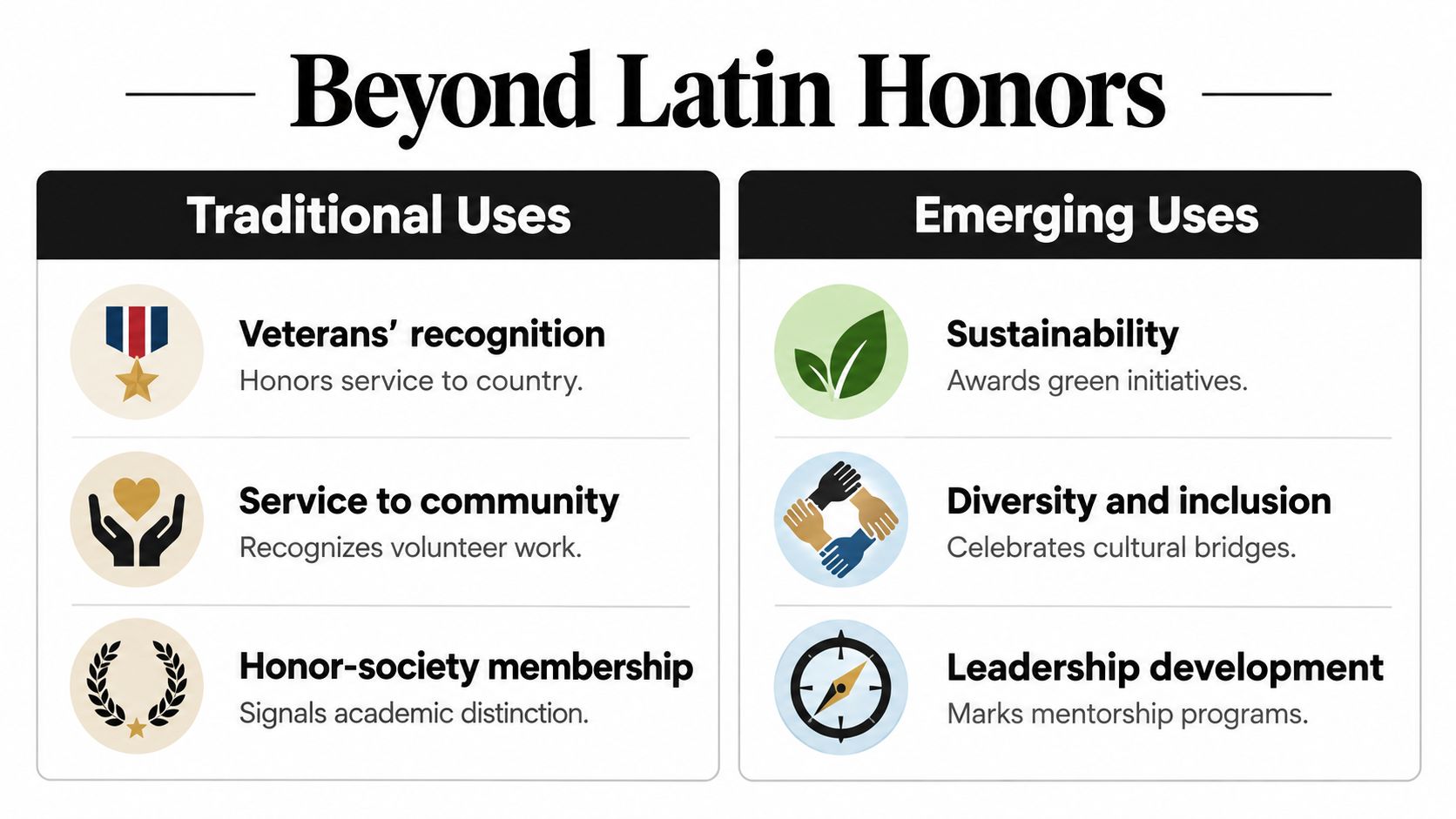
White shows up well beyond Latin honors. On some campuses, it appears in service awards, club recognition, fellowship programs, or military-related regalia. That matters because a student may be fully eligible for recognition and still order the wrong item if they focus on color alone instead of the school's approval list.
You can see that clearly in campus policies. NDSU's academic regalia guidance separates academic regalia from organization-based items and includes a red-white-blue veteran cord. In other words, white can be part of a combination that signals military recognition rather than a standalone academic honor.
A school policy can also approve both plain white and white mixed with another color, with each option meaning something different. The St. Mary's policy page discussing approved cord categories shows how institutions sort cords by approved groups and designations rather than by one universal color code. That is the part students often miss. Regalia works less like a public legend and more like a campus checklist.
| Cord style | Possible meaning in school policy |
|---|---|
| Solid white | Honors tier, honors program, fellowship, or another institutional recognition |
| White-and-gold | Higher distinction or braided honors variation |
| Blue-and-white | A top honors tier at some campuses |
| Red-white-and-blue | Military or veteran recognition at some schools |
| Red-and-white | Double honors or university honors at some institutions |
A cord's meaning comes from the issuing office or organization, not from the shopper's guess about what the colors seem to symbolize.
So if you are staring at a white cord and wondering whether it counts, use a simple decision tree. Which school are you graduating from? Which office approved the cord? Is the correct item solid white, a two-color braid, or a three-color combination? Answer those three questions before you order, and you are much less likely to show up wearing the wrong regalia.
Cord Styles, Fabrics, and How They Look on Camera
A senior can choose the correct color and still end up with a cord that twists, curls, or disappears in photographs. Once your school confirms the approved style, examine how the cord is made, how it hangs, and how it reacts to stage lighting.
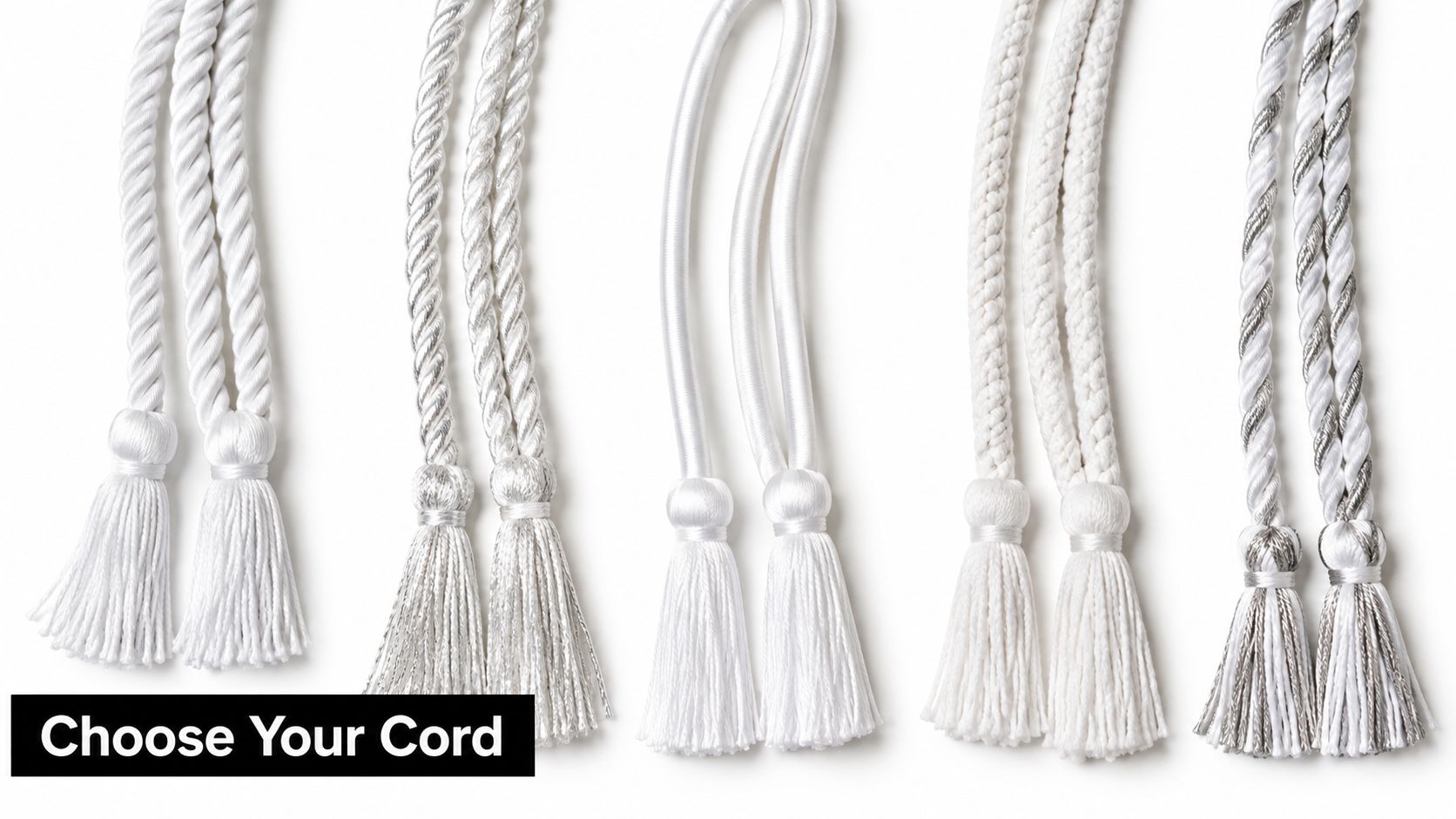
A solid white double-strand cord creates a clean, traditional appearance. A braided white-and-gold or blue-and-white cord has a more formal visual effect and may represent a distinction level named in your school's policy. The colors alone do not decide that meaning. Your institution's approved list does.
Cords also differ in surface finish. Matte cotton-blend material looks soft and understated, while a shinier finish reflects auditorium lights more strongly. That reflection can make white look crisp on camera, although it may also reveal a twist or uneven section.
What changes the look on stage
Three physical features affect how a cord appears in person and in photographs:
- Sheen: A brighter finish can reflect stage lighting and produce a clearer outline.
- Twist and braid pattern: Tight braids usually look defined, especially in two-color combinations.
- Weight and drape: The cord should hang down instead of springing outward from the gown.
The goal is a cord that keeps its shape while you walk, sit, receive your diploma, and pose for photos. A lighter cord may feel comfortable but curl more easily. A heavier one can hang straighter, provided it remains comfortable and matches the style your school permits.
For a visual comparison of how cords and stoles can appear together, consult this guide to cords and stoles before comparing products.
Fabrics and finish matter more than students expect
White exposes construction problems quickly. A thin cord may separate, curl, or hang unevenly. A well-formed cord drapes cleanly from the neck and keeps both ends visible after hugs, movement, and the diploma handoff.
White finishes also require careful control under strong light. Cobra DTF's white ink guide explains why white surfaces can be more technically demanding to make look clean and opaque, a useful comparison when judging a cord's finish.
A simple fit check
Put on the complete gown before ceremony day and test the cord:
- Center the loop at the back of your neck.
- Check both ends in a mirror for an even hang.
- Walk and sit once to see whether the cord twists beneath a stole or hood.
A cord that looks orderly in its package may behave differently with the full regalia, so let the fit check guide your final choice.
How to Wear and Layer White Cords Correctly
A white cord should sit comfortably around the neck, with the loop resting behind the collar and the tassel ends hanging straight down the front of the gown. If you're also wearing a stole, the stole usually forms the broader outer layer while the cord remains visible at the center. The important part is readability. People should be able to see both items clearly, not just a bundle of overlapping fabric and rope.
The neatest arrangement for multiple honors
If your school allows more than one cord, place the highest distinction closest to the body and the next one slightly forward so both can be seen. Keep the ends even. If one cord is longer than the other, center each separately rather than forcing them into one knot of fabric at the neckline.
A small hidden pin near the inside collar can help stop slipping during photos, hugs, and the walk across the stage. That's especially useful if you're wearing a slick stole underneath. You don't need a dramatic fix. You just need the cord to stay where it belongs.
Buy the cord your school issues when possible. If the school doesn't issue it, match the exact approved color combination and style from a reputable regalia source, not a last-minute marketplace substitute.
What students usually get wrong
- They stack cords on top of a bulky stole until the center disappears in photos.
- They assume two honors always mean two cords even when the school uses a stole, medallion, or single approved combination instead.
- They forget eligibility can change if final grades or registrar review shift the distinction level.
This is why the issuing office matters so much. A cord isn't just decoration. It's a visual claim about what the school recognizes, and it needs to match the policy, the fit, and the ceremony rules.
Where to Buy, How to Order, and Last-Minute Options
When you're ready to order, use a checklist before you add anything to the cart. That saves far more stress than trying to fix a color mistake the week of commencement.
The verification checklist
- Issuing office: Did the registrar, honors office, or society approve the cord?
- Recognition type: Is it Latin honors, program honors, veteran recognition, or an organization cord?
- Degree level: Some schools separate undergraduate honors from graduate regalia.
- Exact color combination: Solid white is not the same thing as blue-and-white, white-and-gold, or red-white-and-blue.
- Timing: Does the school calculate honors from the previous semester, final grades, or a later correction process?
If you need product categories to compare, one option is the personalized graduation cords guide, which is useful when a department, society, or program needs a defined color set rather than a random off-the-shelf cord. For shoppers looking across common combinations, it helps to compare solid white, white-and-gold, blue-and-white, and red-white-and-blue listings against your school's written policy, not just the product photo.
Reading a product page the right way
Check the product description for color order, braid style, length, tassel finish, and whether the item is a single solid color or a multi-color twist. If your school says “white-and-gold braided cord,” don't substitute a plain white cord because it's close enough. It isn't.
If you're also replacing a missing cap, hats from Dirt Cheap Headwear can be a useful comparison resource for basic commencement headwear options while you finalize the rest of your regalia.
Last-minute ordering without panic
For urgent situations, order only after you've confirmed the exact approved specification. Then choose the fastest shipping window available from the retailer you trust. If you're buying for an honors college or society, bulk ordering matters even more because every graduate should receive the same visible standard, not slightly different whites, braids, or lengths from mixed vendors.
A rushed order can still work. A wrong order, even if it arrives on time, is the bigger problem.
Care, Storage, and Lasting Keepsake Tips
White cords arrive in small packages, and that means they often need a little cleanup before ceremony day. The most common issue is minor twisting from shipping. Don't yank the strands apart. Lay the cord flat, let the twist relax naturally, and smooth it gently with your hands before hanging it overnight.
How to remove creases without damaging the cord
Use low heat and patience. If the cord has a satin-like finish, a cool iron with a pressing cloth is the safer approach. Cotton-blend cords can usually handle a bit more warmth, but they still shouldn't be pressed aggressively. If the cord includes metallic fibers or a high-sheen braid, keep heat brief and indirect so the finish doesn't flatten or scorch.
A handheld steamer can work well if you keep it moving and avoid soaking the fibers. The goal isn't to flatten the braid. It's to let the cord recover its clean drape.
How to store it after graduation
Once the ceremony is over, don't toss the cord in a drawer with your tassel and forget it. Store it flat in a garment bag, archival box, or shadow-box setup so the braid keeps its shape. White cords pick up dust and lint easily, so a closed container is better than an open shelf.
A few keepsake ideas work especially well:
- Shadow box display: Pair the cord with your stole, tassel, and diploma photo.
- Garment bag storage: Keep the cord with your gown for alumni events and graduate portraits.
- Labeled memory box: Useful if you wore multiple recognition items and want to remember which group issued each one.
Keep the packaging or a note about who issued the cord. Years later, that small record makes the keepsake much more meaningful.
The questions students ask at the very end
Can you wear a white cord from a society if your school uses white differently for another honor? Sometimes, yes. Sometimes, absolutely not. If the society is approved and the school allows organization cords, the answer may be straightforward. If the school restricts cords or reserves certain combinations for university-issued honors, you need written confirmation before wearing it.
What if your eligibility changes after final grades? That happens. Penn State Berks notes that a white cord represents cum laude, with honors based on cumulative GPA at the end of the previous semester and retroactive adjustments possible if final grades move a student to a higher honors level, according to Penn State Berks' academic distinction instructions. That means your first cord assignment may not be the final one.
Can you wear two cords together without permission? Don't assume so. Some schools distinguish sharply between academic honors, university honors, and organization cords. LSU, for example, reserves white cords for undergraduate Upper Division Honors and restricts who may wear that combination, according to LSU's academic regalia guidance. If a school distributes cords directly, follow that standard.
How do you confirm the exact color before ordering? Use the commencement office, registrar, honors office, or the approved organization page. If the school names a combination such as solid white, purple-and-white, blue-and-white, or white-and-gold, match that wording exactly. The University of Southern Indiana uses white cords for its University Honors Program, while Kansas State University uses purple-and-white cords in multiple styles for different GPA-based honor levels, according to USI's regalia policy context. Those aren't interchangeable.
The cleanest decision path is simple. First, identify the issuing authority. Second, confirm the recognition and the exact color combination. Third, verify whether the school supplies the cord or expects you to purchase it. The right white cord isn't the one that looks most familiar online. It's the one your own institution or approved organization has confirmed for your ceremony.
If you're ready to match your school's approved honor cord, stole, cap, or gown, Graduation Cap and Gown offers college, graduate, and specialty regalia options, including white and multi-color honor cords that can be checked against your institution's rules. Use your school policy first, then shop with that exact specification in hand so your cord looks right, fits correctly, and means exactly what it should on graduation day.