

You walked off the stage with a graduation diploma cover in your hands, and the sheet inside might be a blank placeholder. The final diploma often arrives weeks later, sometimes rolled in a tube, sometimes in a size that does not match the folder you already bought. That mismatch is the mistake that curls edges, crushes a raised seal, or leaves the sheet sliding around on photo day.
Color and padding are the easy choices. Fit and the chemistry of the board that touches the paper decide whether the credential still looks right in ten years. A cover that looks formal on stage can still be the wrong pocket, the wrong insert, or a plastic that sticks to ink.
Measure first, then match the insert, then pick a style for the ceremony. The steps below follow that order, with the published sizes that catch buyers off guard and the storage habits that keep the original usable after the photos are done.
Find the Exact Diploma Size Before You Buy
Diploma size follows the issuing school and the degree, not the words bachelor's or doctorate. A diploma cover sizing guide shows why a single "standard" fails. Purdue University lists undergraduate diplomas at 9 5/8 by 7 5/8 inches, while graduate and professional diplomas measure 11 by 8 1/2 inches. Pacific University prints bachelor's and master's diplomas at 8 1/2 by 11 inches, and doctoral diplomas at 12 by 16 inches. Rice University recorded diplomas printed before November 1, 2017, at 18 by 23 inches, and diplomas printed on or after that date at 17 by 23 inches.
Other schools split the same way. The Purdue commencement diploma page is one reference point, and the University of Oregon lists law diplomas at 11 by 14 inches while many of its other degrees use letter stock. Temple University's registrar specifies that undergraduate, graduate, and most professional diplomas are 8.5 by 11 inches effective April 1, 2023, while Kornberg School of Dentistry diplomas stay 11 by 14 inches.
| Institution and degree | Diploma size | What it means for the cover |
|---|---|---|
| Purdue, undergraduate | 9 5/8 x 7 5/8 in | Smaller than letter size; a letter-size cover leaves the diploma sliding |
| Purdue, graduate and professional | 11 x 8 1/2 in | Standard letter-size cover |
| Pacific University, bachelor's and master's | 8 1/2 x 11 in | Standard letter-size cover |
| Pacific University, doctoral | 12 x 16 in | Needs a larger cover |
| University of Oregon, law | 11 x 14 in | Needs a larger cover |
| Temple University, most undergraduate, graduate and professional (from April 1, 2023) | 8.5 x 11 in | Standard letter-size cover |
| Temple University, Kornberg School of Dentistry | 11 x 14 in | Needs a larger cover |
| Rice University, printed before November 1, 2017 | 18 x 23 in | Large format; confirm with the registrar |
| Rice University, printed on or after November 1, 2017 | 17 x 23 in | Large format; confirm with the registrar |
Measure before you order
We serve individuals and schools as a third-party vendor, and we do not keep specific regalia records on file. You bring the dimensions, or you confirm them with the school.
- Measure width and height with a ruler on the actual diploma, not a photo.
- Add clearance for a raised seal or heavy paper stock so the sheet is not forced into the pocket.
- Check the hold. Corner mounts, slits, and a full pocket each change how much room you need.
If you only have a PDF of the layout, you can adjust PDF paper size in Acrobat so the on-screen page matches the printed sheet before you compare it with a cover.
Practical rule: The cover should hold the measured diploma snugly, without curling the edges or letting the sheet slide.
Insert size is not the cover's exterior size. A cover is built for the diploma plus clearance. One campus order can mix formats. A University of Central Arkansas bid requested 8,000 diploma covers, 6,000 for 8.5 by 11 inch inserts and 2,000 for 11 by 14 inch inserts. Read which insert each product supports. If you later want the credential on a wall, a diploma frame that also holds a photo is a separate size decision from the ceremony folder.
Which Cover Materials Protect Your Diploma
The inside of a cover decides how the diploma ages. The leatherette, foil, or padding on the outside mostly changes how it looks in photos. A padded folder can still press acidic board against the sheet for years.
The Library of Congress preservation guidance recommends enclosures that are acid-free and lignin-free, with either neutral pH or alkaline buffering. Buffered materials typically use calcium carbonate and hold a pH of about 8 to 8.5. Lignin in wood-pulp board breaks down into acid as it ages. Buffering neutralizes acid already in the paper and slows new acid from forming.
| Material | Archival suitability | Best use |
|---|---|---|
| Acid-free, lignin-free board with calcium carbonate buffer (pH about 8 to 8.5) | Suitable for long-term keeping | Insert or mat that touches the diploma |
| Neutral-pH board | Suitable; preferred for sensitive inks or photographs | Diplomas with colored or sensitive media |
| Inert polyester sleeve | Suitable for sensitive media | Extra layer around the diploma for long-term storage |
| Ordinary paperboard or wood-pulp board | Not archival; lignin generates acid as it ages | Ceremony use only |
| PVC or adhesive contact | Not archival; can stick to or discolor the document | Avoid for storage |
Read the rows from safest to riskiest
Buffered board is the default insert or mat when the diploma should last and the inks are stable. Neutral-pH board is the better pick when colored inks or a photograph sit on the sheet, because an alkaline environment can affect some media. An inert polyester sleeve adds a barrier without adding acid.
Ordinary paperboard is fine for the hour you cross the stage. It is a poor roommate for sheepskin or modern diploma paper left in a closet. PVC and sticky linings can grab ink or leave a haze. If a product page never says acid-free or lignin-free, treat the insert as not archival and ask before you buy.
A ceremony-only cover can use standard board for the day. Any diploma you mean to keep should sit on an archival insert, mat, or sleeve, not on ordinary board or plastic.
Ask the seller one question before you pay. Does the insert that touches the diploma state acid-free and lignin-free, or is that only the outside cover?
Cover Styles and Which One Fits Your Ceremony
A cover works like a picture frame. The folder can be beautiful, but if the opening does not match the sheet, the diploma slides, bends, or sits crooked while the cameras are on. Pick the style second, after size and insert.
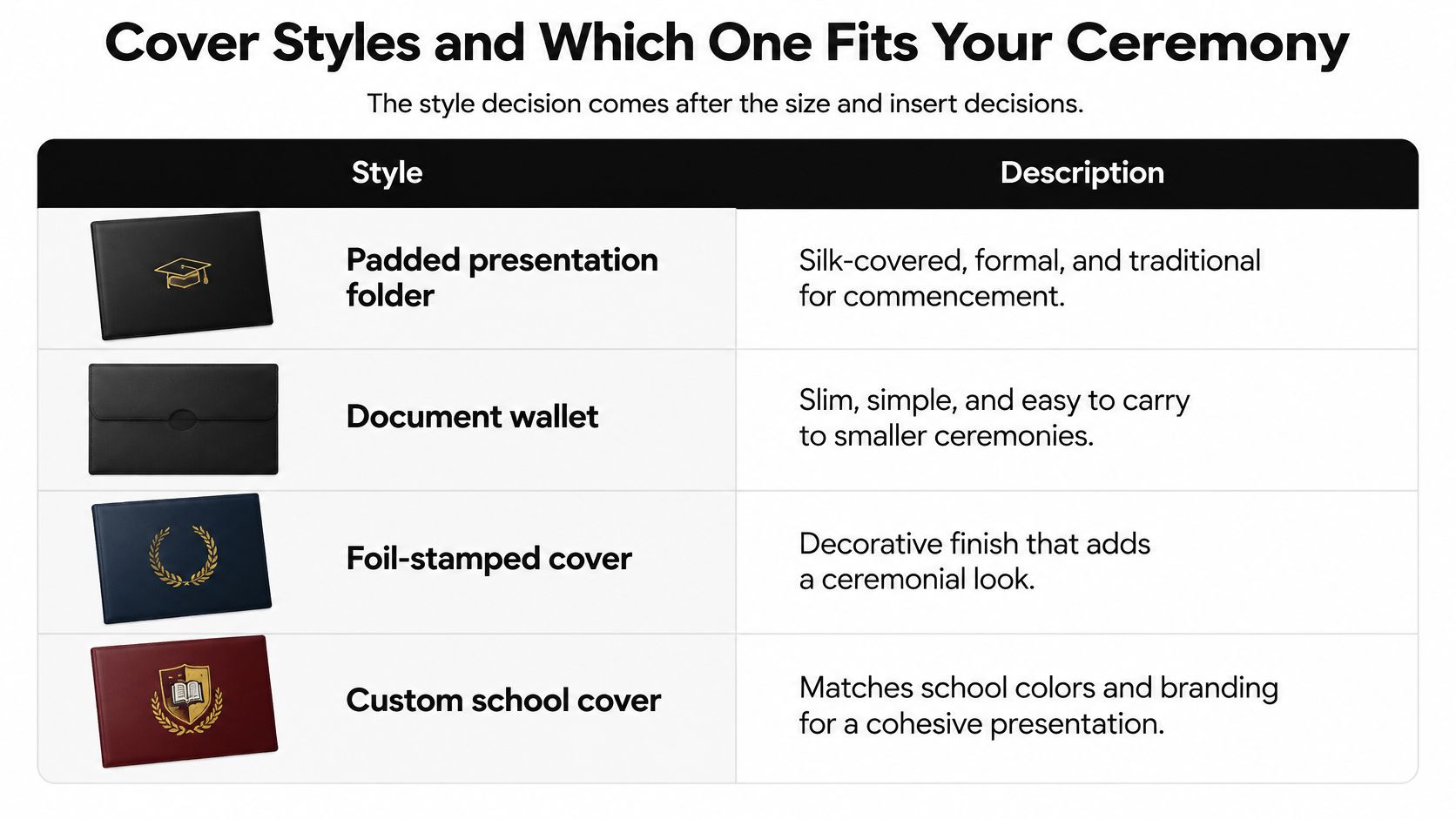
A custom diploma cover overview describes the job plainly. The folder gives you a formal object to hold, cuts down on bending while the credential is presented, and keeps the sheet enclosed afterward. Style decides how that job reads on stage, and how the cover opens in a graduate's hands.
| Style | Best use | What to check |
|---|---|---|
| Padded presentation folder | Ceremony and display | Whether the inner panel presses against the printed sheet |
| Classic leatherette book cover | Ceremony and display | Whether the board is acid-free and lignin-free |
| Horizontal leatherette cover, letter size | Ceremony with an 8 1/2 x 11 inch diploma | That the opening matches the measured sheet |
| Plain archival folder | Long-term keeping | Acid-free, lignin-free board |
Pocket type changes the fit
Three holds show up again and again, and they are not interchangeable.
- Corner mounts: Ribbons or corners grip the sheet at four points. They look open and formal, and they need the diploma to match the opening exactly.
- Slits: The edges slide into cuts in the lining. A heavy seal can catch if the slit is tight.
- Full pockets: The sheet sits inside a sleeve. This is the most enclosed option and the easiest to overstuff.
Pick the look for commencement, then confirm the hold and the board. A decorative cover over a non-archival insert is a weak choice if the diploma will live in it after the ceremony. Schools ordering one printed design for a class can start from Customize Your Graduation Diploma Cover. Families who also keep a tassel or stole often pair the folder with a cap and gown shadow box so the paper and the regalia are not crammed into one opening.
A class order magnifies small handling problems. Before you commit, watch how the cover opens, how the sheet seats into its hold, and how the lining sits against the seal.
Personalizing Your Cover With Text, Color and Ribbon
A class sponsor who approves the artwork in January cannot fix a typo in March without paying for a new run. Personalization changes production, not only the photo. Layout, imprint, and ribbon are locked before the covers are made, which is why the sequence below starts with the sheet's orientation and ends with a proof, not the other way around.
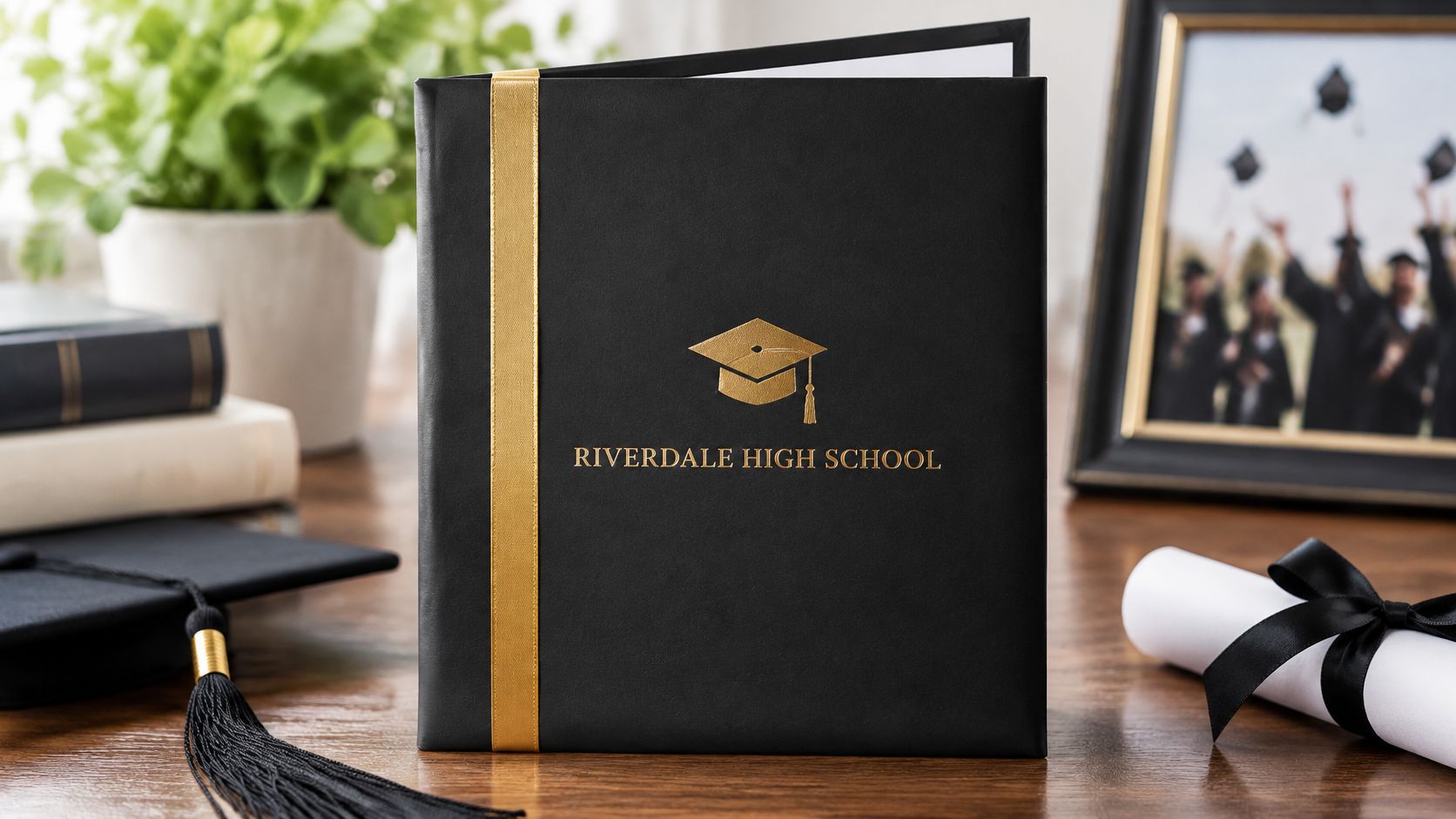
Five steps before anyone prints
- Choose layout and orientation. Horizontal letter stock is common. A doctoral sheet that is taller than it is wide needs the opening turned to match.
- Pick cover color and ribbon. School colors belong on the outside. Ribbon corners should not cover a seal.
- Confirm size against the measured diploma. Do this after color, not instead of it. A pretty cover in the wrong opening still fails.
- Choose the printed text or image. School name, degree, year, or seal artwork all have to clear the area where the sheet sits.
- Request a mockup before you approve. Email what you want to order, and a mockup of a custom stole, gown, or diploma cover can be created from that information before anything is produced.
The order rules that surprise class sponsors
Customized diploma covers require a minimum order of 8 pieces, and the design of all 8 must be exactly the same, with no variation. Email the details for a quote and an estimated delivery date. A class order that prints a different graduate name on each cover does not fit that rule. One shared design does. Printed text has to stay clear of the diploma's space, and the cover still has to clear a raised seal.
A single graduate purchasing one stock cover instead of a custom run should measure the diploma first and match it to the cover's stated opening, since a letter-size look only works if the sheet fits. If the long-term plan is a wall display rather than a folder on a shelf, browse diploma frames only after the sheet is flat and the size is confirmed.
Storing and Verifying Your Diploma After Commencement
The folder's job changes the week after commencement. It stops being a stage prop and becomes the box your original lives in. Store it like one.
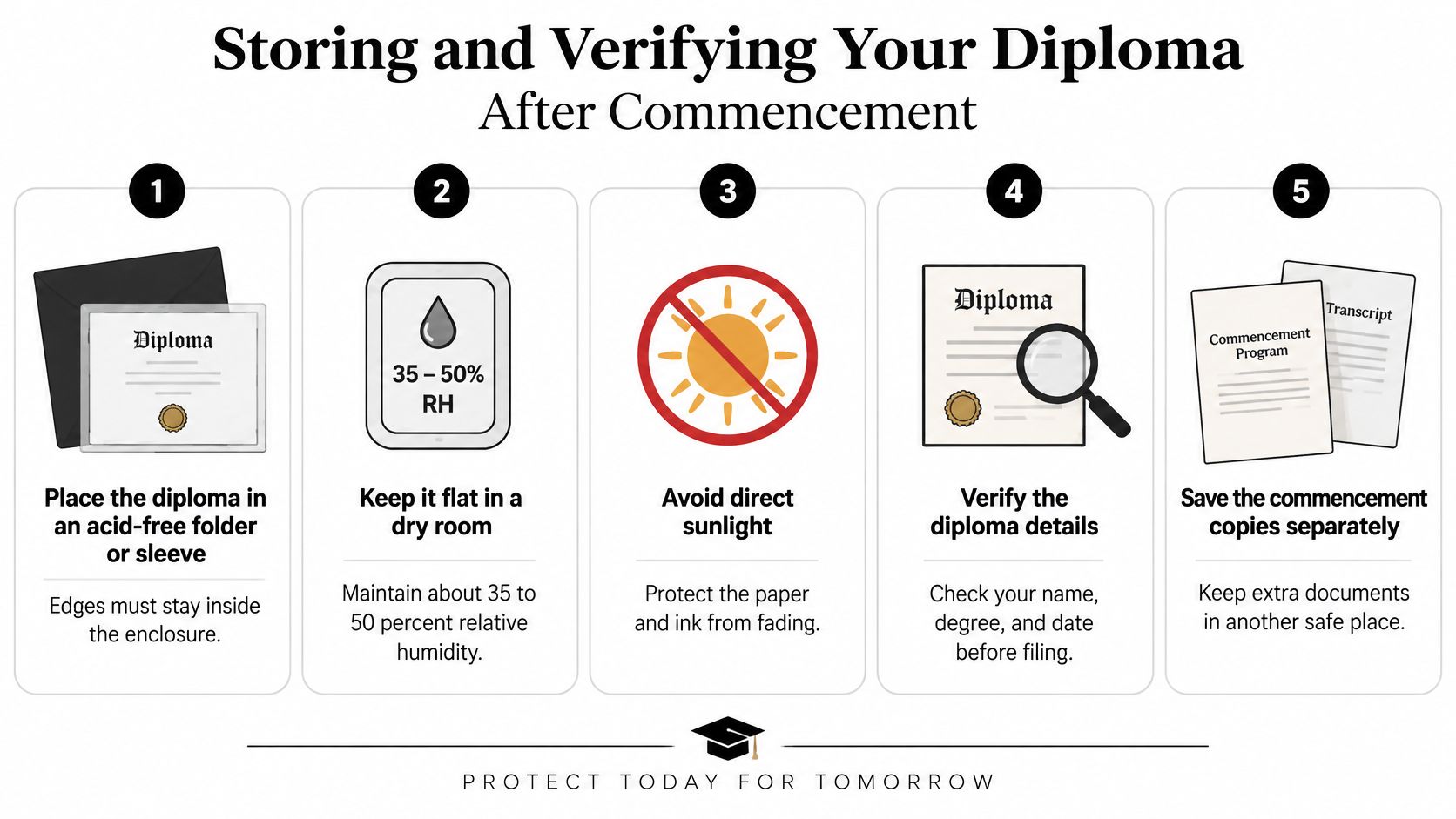
Put the sheet away so the edges survive
The National Archives holdings guidance recommends acid-free folders or envelopes large enough that no edge of the document sticks out, kept flat at roughly 35 to 50 percent relative humidity. Exposed edges bend, break, and tear, and every small break is permanent. Keep the folder away from direct light, radiators, vents, attics, and basements.
Heat damages paper as surely as damp does. Skip irons, ovens, and hot mounting of any kind.
Once a year, run this short check.
- Keep it flat. A tube curl comes back if the sheet goes back into a tight drawer.
- Store it dry. Damp basements swell paper and can make linings stick.
- Keep it out of direct light. Ink fades even when the cover looks fine.
- Check the insert. Look for discoloration or a tacky spot where the sheet meets the board.
- Store the cover with the diploma. A loose sheet in a drawer loses the protection you paid for.
Three myths that cost people the original
The first myth: a handsome cover is automatically archival. Gold lettering and leatherette describe the outside only. The insert and the board decide whether the inside is safe, so check them before trusting the folder with the original.
The second myth: the diploma has to stay inside that cover forever. Move the original into an archival sleeve and display a copy if you want one on the wall. A wood diploma frame suits the copy you are willing to show, and the original stays protected in storage either way.
The third myth: a scan on your phone counts as proof. Anyone can photograph a diploma, so a picture carries little weight on its own. As Training Journal's look at digital credentials explains, checking a physical diploma across borders can mean delays and fraud risk, while cryptographically signed credentials let an institution or employer verify origin and spot tampering.
What to keep besides the paper
Make a high-quality scan while the sheet is still flat, then ask the registrar whether the school offers an official digital credential. A phone photo or an ordinary PDF never carries the same weight as institution-backed verification.
Each record does a different job. The paper covers the ceremony, family display, immigration, licensing, and your own files. A verifiable digital record covers remote hiring and international checks. Keep both, and let the cover do what it is for: taking the handling so the sheet inside stays clean.
Confirm the Size With Your School Before You Order
The step that prevents most bad orders is a five-minute call or email to the school. The school sets the diploma format. We recommend checking with your school for the correct diploma cover color and size, or measuring the diploma yourself, because we do not keep that regalia file.
Timing trips people up. Covers are often handed out at the ceremony, while the diploma follows a separate clock. Seattle Pacific University's catalog states that graduates receive a diploma cover at commencement, and the diploma is issued later after the Registrar confirms that requirements are done and the degree is awarded. Texas Woman's University presents covers at commencement and does not mail them. You may need the folder on ceremony day and the sheet weeks later. Order from the school's published size, not from a guess based on a friend's campus.
Order in this sequence
- Get the exact size and color from the school. Write down width, height, and whether a seal sits near an edge.
- Choose the cover style for the stage, the display shelf, or both.
- Pick an archival insert if this copy is the one you intend to keep.
- Personalize only if a minimum of eight identical covers fits the group. One graduate with a unique name needs a stock cover or a design shared by the whole order.
- Place the order with time for a mockup and delivery before the ceremony date.
If a diploma is lost later, contact the school for a copy. We do not provide replacements.
Call or email the registrar this week, confirm the size, and only then place the cover order.
Graduation Cap and Gown carries diploma covers for high school through doctoral ceremonies, including letter-size leatherette folders and custom covers when a school needs one shared design. Match the insert to your measured diploma, then choose color and ribbon for the day you walk. Visit Graduation Cap and Gown to compare cover sizes and start an order with enough time before commencement.