

You're standing at a rental table, and every gown in front of you looks the same. That's normal, and it's exactly why graduation gown colors confuse first-time graduates, the gown body usually stays uniform while the meaning sits in the hood, trim, stole, or tassel. Once you know what each color layer is doing, the whole ceremony becomes much easier to read.
The short version is simple. In U.S. academic dress, black became the standard gown color under the 1895 Intercollegiate Code, while discipline colors moved to the accent pieces that surround the gown itself, such as hoods and velvet trim (academic dress in the United States). That's why one stage can look full of color without the gown body changing from person to person.
Why Most Graduation Gown Colors Stay Black
The first thing most graduates notice is how many black robes are piled together before the ceremony. That sameness is intentional. The 1895 Intercollegiate Code made black the only sanctioned color for gowns, caps, and hood shells, and that rule still explains why the black gown remains the default in many major markets today (academic dress in the United States).
Black does the quiet practical work
Black reads cleanly under bright stage lighting, which helps photos stay consistent from row to row. It also hides the little marks that happen during a long day, things like hems brushing seats and hands resting on fabric. For a commencement team, that matters because the gown has to look right on a crowded stage, in a gym, or outdoors, all without becoming distracting.
Practical rule: the less the gown body competes with the stage, the easier it is for the audience to notice the graduate, not the fabric.
Black also sends a social message
The color does more than solve photo problems. It creates a formal, equal baseline, so no student stands out because of a brighter or more expensive robe. That's why, across thousands of ceremonies, the gown itself is usually kept neutral while the visual story moves to hoods, cords, stoles, and tassels.
Some schools do break from the standard. Stanford, Columbia, and a handful of historically Black colleges and universities use school-colored robes for a more unified look, but those are the exception, not the rule. Most campuses keep the gown black and let the accents carry the identity.
A helpful resource for understanding how academic dress is structured is open font licensing explained, which shows how detailed standards can still leave room for different implementations. For a broader overview of regalia pieces and their roles, you can also look at what is academic regalia.
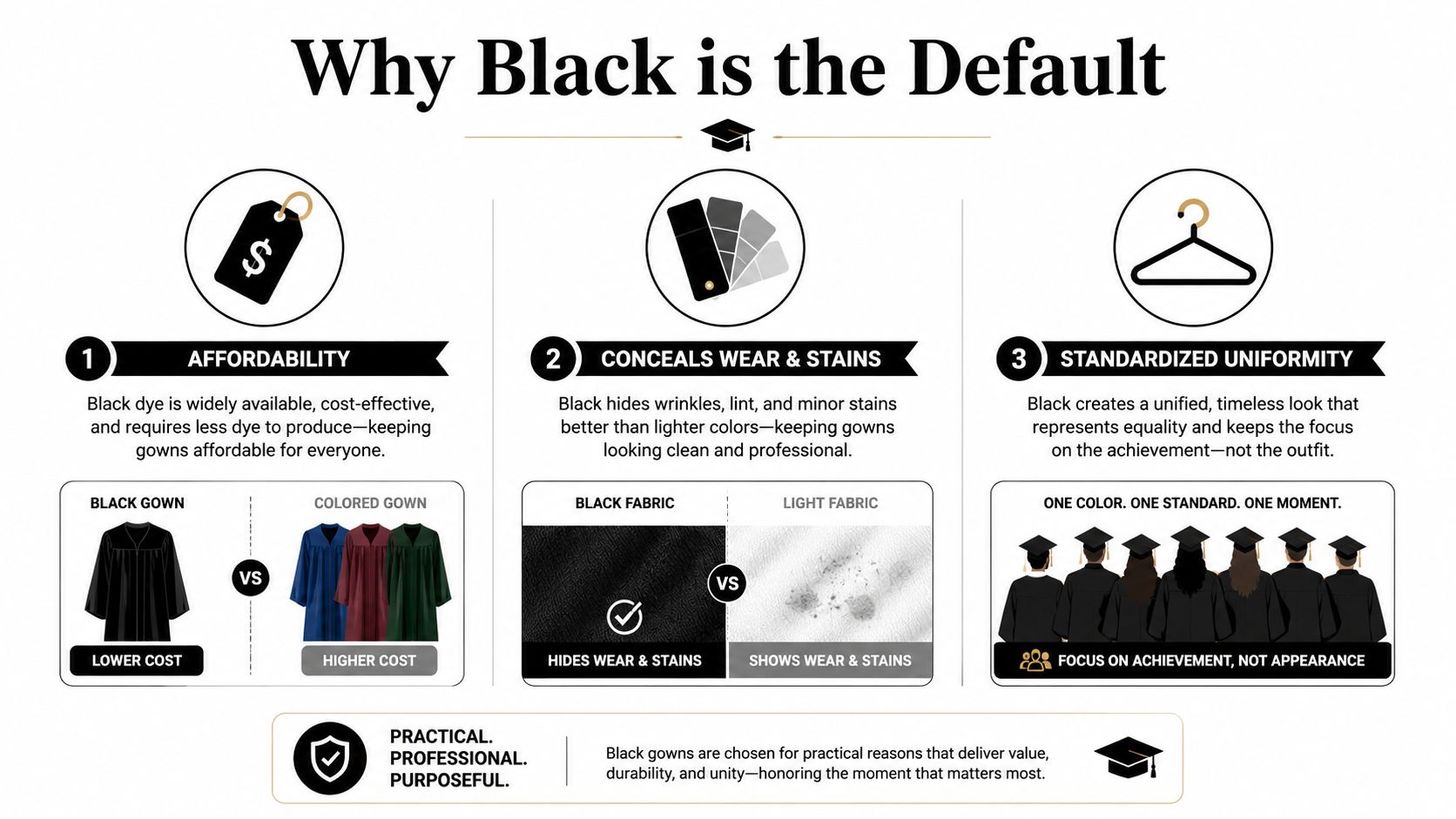
The most useful way to think about black is this, the gown is the backdrop. The color story starts elsewhere, and that's where the rules from 1895 still matter.
How the Intercollegiate Code Shaped Every Color Today
The modern system didn't appear by accident. Universities needed a way to clean up wildly inconsistent academic dress, so the American Intercollegiate Commission met and helped establish a rule set that still echoes through commencement today. The result was a common language for color, cut, and trim, even though institutions still keep room to personalize the look (academic regalia hood colors).
The code gave gowns, hoods, and trim different jobs
The code's basic idea is easy to remember. The gown stays black, while the hood velvet or border signals the field of study, and the hood lining shows the institution's colors. For master's and doctoral robes, velvet trim becomes part of the degree-level signal too, so the ensemble communicates more than just “graduate” (academic hood colors by degree).
That's why a Bachelor of Arts graduate and a Bachelor of Science graduate can wear the same black gown and still look distinct at a glance. The difference appears in the hood, where the color language identifies discipline rather than personal taste. The code is also advisory, which is why schools can layer in institutional branding without breaking the tradition.
| 1895 Intercollegiate Code at a Glance | Then | Now |
|---|---|---|
| Black gown standard | Black was the sanctioned gown color | Black still anchors most ceremonies |
| Discipline colors | Field colors were assigned to academic subjects | Hoods and trim still identify disciplines |
| Degree-level trim | Velvet and trim differentiated higher degrees | Master's and doctoral robes often show more color |
| Institutional identity | The code aimed for consistency | Schools add their own lining, seals, or accents |
The strongest practical effect is consistency. Coordinators can sort regalia more easily when field colors follow the same general logic across programs, and graduates can read the stage faster when the hood does the signaling. If you want a visual companion to that system, the guide on graduation colors and hoods shows how the hood carries most of the meaning.
A graduate doesn't need to memorize the whole code. It's enough to know that the black gown is the constant, and the rest of the outfit does the identifying.
School Color Versus Discipline Color Systems
Many first-time graduates stumble here. They anticipate one color will convey the entire narrative, but academic dress typically operates on two parallel systems simultaneously. One system indicates your graduating institution, while the other denotes the academic field being celebrated.
School identity shows up in the institution layer
School color usually lives in the gown fabric when a school customizes it, in a school-branded stole, or in the seal and lining details on the hood. That layer tells people which university, college, or program is sending the graduate across the stage. It's the visual equivalent of the school's signature.
Discipline identity lives in the hood
The discipline system usually shows up in the hood velvet border and the lining colors. A university can use black gowns across the whole ceremony and still create a strong identity through hood facings, because the field color does the heavy lifting. That's why a hood can carry a university's identity and a student's subject area at the same time.
A useful example is a University of Michigan Bachelor of Science in Engineering, where the hood lining can reflect maize and blue while the velvet border shows orange. The gown itself stays black unless the school chooses a custom robe, so the school identity and the discipline identity stay visible without fighting each other (academic regalia colors at Virginia Tech).
| School Color vs Discipline Color Systems | Where It Appears | What It Signals | Example |
|---|---|---|---|
| School system | Gown fabric, stole, hood lining, school seal | Institution or campus identity | A school-colored robe or lining |
| Discipline system | Hood velvet, hood edge, trim | Field of study | Orange for engineering, light blue for education |
| Overlap | Hood lining plus seal or accent pieces | Both institution and field | A hood that mixes school colors with a field color |
| Possible clash | A custom school robe with a discipline hood | Two visual messages at once | School branding paired with a program hood |
A discipline hood can interrupt a personal color preference, and that's normal. Academic dress is built to communicate the program, not the mood board.
If your ceremony seems visually busy, that's because two systems are working together. One tells people where you belong, and the other tells them what academic tradition you're stepping into.
Bachelor Master and Doctoral Gown Color Differences
Degree level changes the shape and trim of the robe, and that's often more important than the color of the gown shell. A bachelor's gown, a master's gown, and a doctoral gown all read differently on stage, even when the base fabric stays black. The cut tells the story before anyone gets close enough to inspect the details.
Start with the sleeves and silhouette
Bachelor's gowns usually have pointed sleeves, which makes the look simpler and cleaner. Master's gowns are longer in the sleeve and often show oblong sleeves with visible openings, so they feel more layered. Doctoral gowns are the most distinctive, with bell-shaped velvet sleeves, front panels, and velvet trim that immediately signal the highest degree level (types of graduation gowns).
Trim becomes more important as the degree rises
The higher the degree level, the more the robe uses trim to identify both status and field. That doesn't mean the gown stops being black. It means black becomes the base that lets the trim and hood colors stand out clearly. Doctoral regalia often adds a soft Tudor bonnet with colored cord, which is why doctoral graduates usually look the most colorful at commencement.
| Bachelor, Master, and Doctoral Gown Differences at a Glance | Bachelor's Gown | Master's Gown | Doctoral Gown |
|---|---|---|---|
| Sleeve shape | Pointed sleeves | Longer oblong sleeves | Bell-shaped velvet sleeves |
| Overall look | Simple and clean | Slightly fuller | Most formal and detailed |
| Trim | Minimal | More visible detail | Velvet panels and trim |
| Headwear | Mortarboard | Mortarboard | Tudor bonnet or tam, depending on the school |
The easiest way to read degree level is to look at the whole outline, not just the color. The black gown keeps the system steady, while the sleeves, panels, and trim give away the level at a glance.
Matching Your School Color Without Guesswork
A graduate in a black gown can still look completely different from one school to another. The safest approach is to start with the school, not a generic color chart. Commencement offices usually know whether the gown stays standard black, shifts to a custom school color, or pairs with a school-specific hood or stole. A quick look at the school's own commencement page tells you more than a wall of random photos ever will.
Use a short verification path
Start with the commencement office page and find the exact regalia list for your degree. Then use a Find Your University tool if the school offers one, because it usually points you to the right hood, lining, and gown style without guesswork. Alumni-association photos can help confirm how the full set looks in a real ceremony, and a registrar email clears up anything that still feels uncertain.
- Check the ceremony page first: It often lists whether the gown is standard black or school-colored.
- Match the degree level next: Bachelor's, master's, and doctoral regalia are not built the same way.
- Compare photos carefully: Alumni photos show how the fabric looks in real lighting, not just on a product page.
- Ask the registrar if needed: One direct email can prevent a wrong order.
Campus ordering can make color matching simpler and cleaner because the school already knows what it approved. A licensed vendor can also work well when the school allows outside purchases, especially if the vendor provides size, fabric, and sample guidance. Graduation Cap and Gown is one option that offers school matching tools, degree-specific regalia, and sample support for that process.
That is where fabric and product samples help. A swatch can settle the question when an online image and the actual textile seem to disagree, since a shade on a screen can look very different under indoor lighting.
Custom Stoles and Accessories That Layer Over the Gown
Some of the most meaningful color stories at commencement aren't built into the gown at all. They're layered on top. A stole, cord, or medal can add identity, honor, and recognition without changing the base regalia underneath. The trick is knowing what sits where so nothing important gets buried in the photo.

Four common layers and how they read
A first-generation graduate might add a sky-blue stole from orientation, and that color shows clearly because the stole sits over the front of the gown. A member of a Black Greek-letter organization can layer a crest stole on top of that, letting organizational identity stay visible without hiding the academic robe. A gold honors cord usually rests over the collar and chest, so it stays readable in portraits even when the graduate is moving. A Kente stole draped over a doctoral robe carries cultural significance and looks especially strong against the black base.
Layering rule: put the most important credential where the camera can still see it, then avoid stacking so many items that the gown disappears.
The order matters. Stoles usually sit over the shoulders and across the hood area, while cords rest around the neck and collar line. If a graduate wears a hood too, the accessories should be arranged so the field color still shows, because the hood remains the clearest academic identifier.
Families often ask how to give a graduate something meaningful without getting in the way of the ceremony look. A practical place to start is a graduation gift registry if you're collecting items like frames, accessories, or celebration pieces that support the day without adding confusion to regalia. The simplest accessories are often the best ones to photograph.
Ordering Timeline and Fabric Color Samples
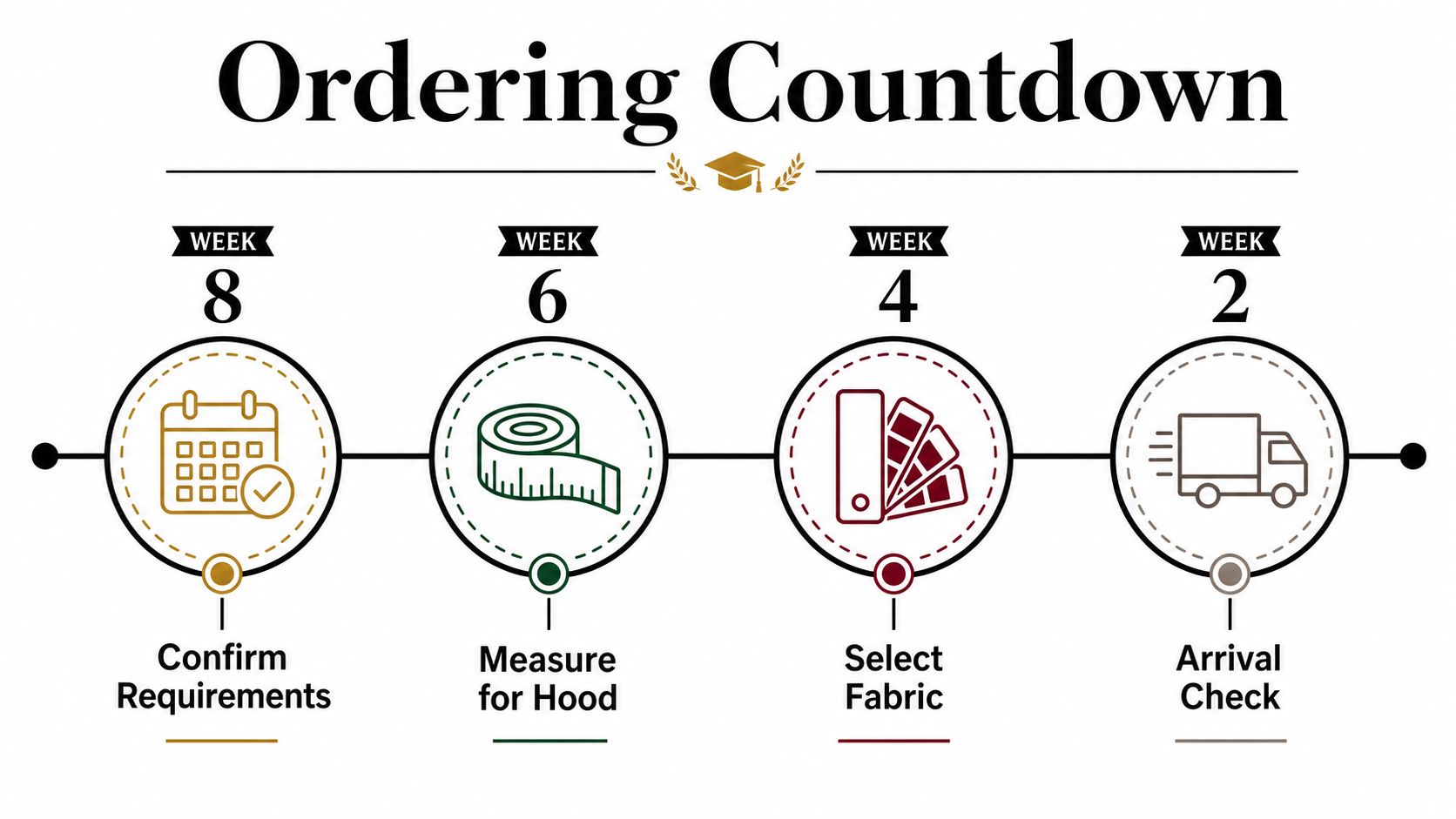
Color mistakes usually happen when orders get rushed. A safer plan starts as soon as the school confirms the regalia requirements, then leaves time to compare real fabric instead of trusting a screen image. A hood that looks teal on a monitor can read navy under stage lights, so the sample matters.
An eight-week ordering rhythm
At eight to six weeks out, confirm degree level, hood color, and gown style through the school bookstore or approved vendor. Order a fabric swatch kit at the same time, then compare the textile in daylight and indoors. If the shade still looks right in both settings, the color choice is on track.
At five to three weeks out, review the swatches, approve any custom stoles, and track the shipment. This stage catches a wrong color before it becomes a day-of problem. If something looks off, there is still room to correct it.
At two weeks to ceremony, do the final fitting, steam the gown instead of ironing it, and pack it in a breathable garment bag. That helps keep the fabric clean and the color even when the gown comes out of storage. For a sample request or a side-by-side comparison, the product samples page is a practical place to start.
A short video walkthrough can also help you see the order of the pieces before the gown arrives.
A simple last check
Hold the sample in natural light, then under indoor light. If the shade changes too much, ask for another look before you approve the order. That habit prevents most color surprises.
Common Misconceptions About Graduation Gown Colors
Three myths show up in nearly every commencement conversation, and all three make the process more confusing than it needs to be. The good news is that each one falls apart as soon as you look at how regalia works.
Myth one, graduates choose the gown color
They usually don't. The gown shell is dictated by degree level and institution, which is why most ceremonies keep the body of the robe standardized rather than personalized. The visual choice is usually in the accessories, not the main garment.
Myth two, every university uses the same discipline shades
That's not quite true either. The Intercollegiate Code gives schools a common base palette, but individual institutions can shift a hue to match branding or tradition, so two schools may use slightly different versions of the same field color. The shared system makes the colors recognizable, but not identical in every detail.
Myth three, the gown color signals the major
The major is normally communicated through the hood lining and velvet trim, not the gown body. That's why two students in different programs can wear the same black robe and still have very different academic colors on stage. If you're trying to read a ceremony correctly, look at the hood first.
| Myth vs. Reality | Myth | Reality |
|---|---|---|
| Who picks the gown color | The graduate chooses any color | The school and degree rules usually decide |
| Discipline shades | Every school uses the exact same shade | Schools may adjust the tone while following the code |
| What the gown color means | The gown shows the major | The hood and trim show the field |
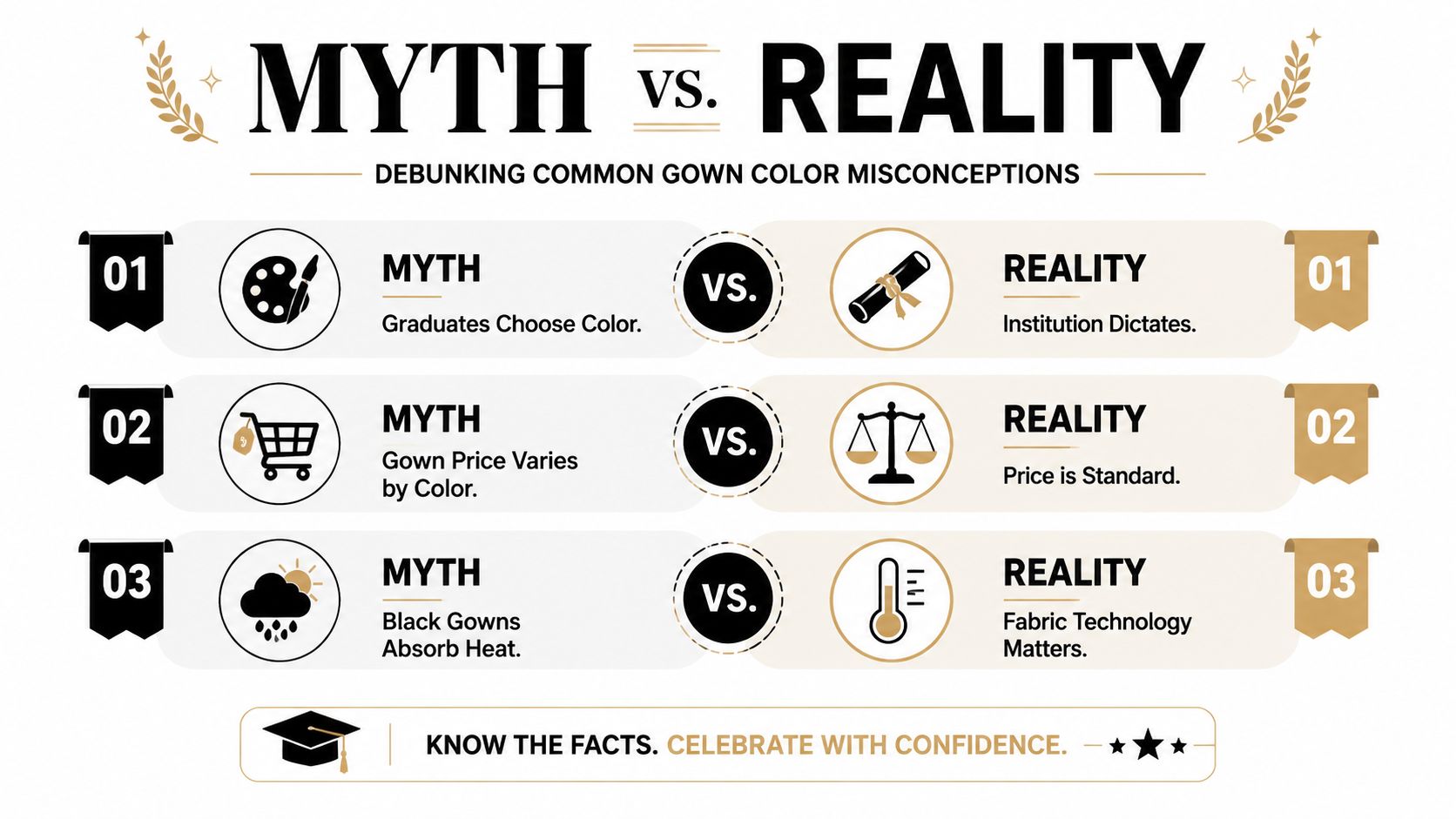
Once you separate the gown from the accents, the whole system gets easier. The robe gives you the base, the hood gives you the field, and the trim gives you the degree-level detail.
If you want help choosing regalia that matches your school colors, degree level, and ceremony rules, Graduation Cap and Gown offers school-matching tools, caps and gowns, hoods, tassels, stoles, cords, and sample support in one place. Visit Graduation Cap and Gown to compare options, check your colors, and get ready for commencement with less guesswork.