

Getting your graduation robe length right is about so much more than just looking sharp in photos—it’s about respecting a long-standing tradition while making sure you’re comfortable and safe on your big day. An ill-fitting gown can look sloppy, sure, but even worse, it can become a significant tripping hazard as you walk across the stage to finally grab that diploma.
Why Your Graduation Robe Length Matters
Think of your gown as the final, symbolic piece of your academic puzzle; making sure it fits perfectly is the last crucial step. The right length gives you a polished, professional look that honors the gravity of the ceremony. A poorly sized robe can really detract from the formality of the occasion, making you look unprepared.
More importantly, let's talk about safety. A gown that’s too long can easily get tangled under your feet, especially when you’re navigating stairs or walking in a long procession with hundreds of other graduates. That creates an unnecessary risk on a day that should be all about celebrating your hard work, not worrying about a fall.
A Tradition of Precision
The exact length of academic gowns isn't some modern trend. It’s a practice deeply rooted in history, standardized way back in the late 19th century with the 1895 Intercollegiate Code of Academic Costume. This code laid out specific gown styles and lengths to create a sense of uniformity across American colleges and universities.
Today, this system is still the gold standard, influencing regalia at over 4,000 U.S. institutions. An estimated 98% of commencements feature gowns that follow these guidelines. For retailers, this means stocking everything from shorter undergrad gowns to the dramatic, floor-sweeping doctoral robes, all cut to ensure no graduate takes a tumble on stage. You can read more about the history of academic dress to get the full story on these traditions.
More Than Just a Garment
At the end of the day, your gown is a key piece of your academic regalia, a symbol of years of dedication and late-night study sessions. Nailing the correct graduation robe length accomplishes several things all at once:
- Upholds Academic Tradition: It shows respect for the history and symbolism woven into the graduation ceremony.
- Ensures Your Safety: A proper fit lets you walk with confidence, preventing any trips or stumbles.
- Creates a Polished Look: It guarantees you look your absolute best, reflecting the importance of the day in every photo.
This guide will walk you through everything you need to know to choose your regalia with confidence, making sure you get a perfect fit for a perfect day.
Standard Gown Lengths for Every Academic Level
The length of a graduation gown is more than just fabric—it’s a visual language. Each robe’s specific cut is a signal, telling a story of academic achievement. The gown literally grows with the graduate, getting longer and more elaborate as they move up the educational ladder.
This tradition makes every graduate’s milestone instantly recognizable, from the shorter, practical gowns of early education to the sweeping, formal robes worn by doctoral candidates. The variations aren't random; they’re steeped in centuries of academic tradition.
These standards trace their roots back to medieval European universities like Oxford and Cambridge, where long gowns were worn to create a unified look and erase class distinctions. The American Intercollegiate Commission formalized this tradition in 1894, setting the robe lengths we still see today—a standard that affects nearly 3.8 million U.S. graduates every year.
To give you a clearer picture, here’s a quick reference guide that breaks down the key differences in gown length and style across the academic world.
Graduation Robe Length by Academic Level
This table compares the typical length, style, and symbolism of graduation gowns across different educational milestones.
| Academic Level | Typical Length | Where It Falls on the Body | Key Style Features |
|---|---|---|---|
| Early Education | Short | Knee to mid-calf | Simple design for safety and ease of movement. |
| High School | Mid-Length | Mid-calf | A step up in formality, still practical for large ceremonies. |
| Bachelor's | Mid-Length | Mid-calf | Simple, unadorned body with pointed sleeves. |
| Master's | Long | Lower-calf to ankle | Longer hemline with unique, oblong closed sleeves. |
| Doctoral | Full-Length | Ankle-length or longer | Full bell sleeves, velvet chevrons, and front panels. |
As you can see, the progression is clear. Each step up in academia brings a more distinguished and symbolic robe.
High School and Early Education Gowns
For the youngest graduates—from preschool all the way up to high school—practicality is the name of the game. Gowns at this level are designed to fall somewhere between the knee and mid-calf. This shorter length is all about safety, making sure students can navigate stairs and stages without tripping.
The focus here is on celebrating the moment comfortably. While still creating a formal, unified look, these gowns prioritize freedom of movement over the dramatic flair you see in higher education. You can find a range of affordable high school graduation gowns that are perfect for these ceremonies.
Bachelor's Degree Gowns
Once a student reaches the collegiate level, the Bachelor's degree gown is their first step into traditional academic regalia. The standard here is a length that hits around the mid-calf, striking a great balance between a dignified look and functional design.
The defining feature of a Bachelor's gown is its elegant simplicity. It has pointed sleeves and lacks the decorative velvet panels or elaborate sleeve styles of more advanced degrees. Its clean look symbolizes a foundational academic achievement. You can explore a variety of different graduation gown styles in our detailed guide.
Master's Degree Gowns
Moving up the academic ladder, the Master's degree gown introduces more distinctive features. The graduation robe length is noticeably longer than a Bachelor's gown, designed to fall well below the mid-calf and often approaching the ankle. This extra length signifies a higher level of academic focus and specialization.
The most identifiable feature of a Master's robe is its unique oblong sleeves. They are closed at the end and have a slit for the arm to pass through, creating a more formal and scholarly silhouette.
The infographic below really nails down the core principles that guide all robe design, from tradition all the way to comfort.
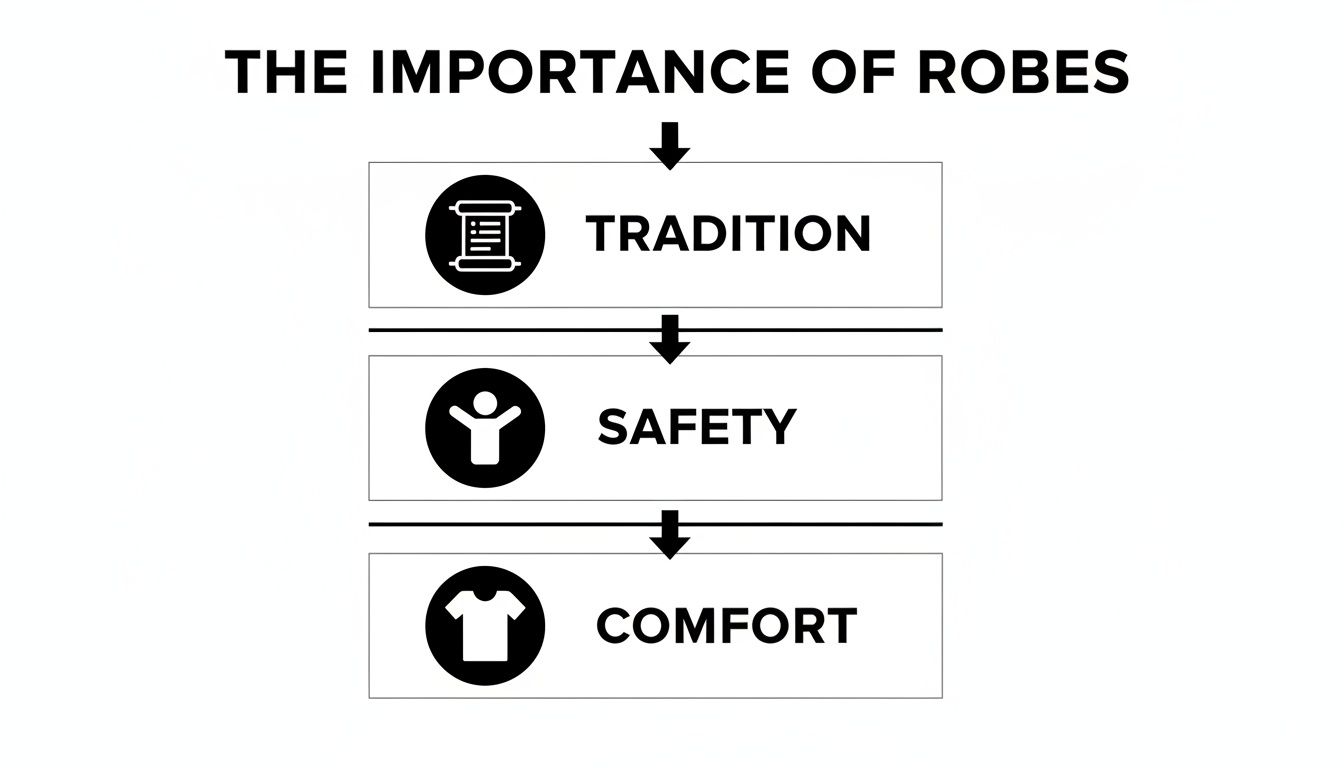
This visual hierarchy shows how tradition informs the need for safety, which in turn influences the final, comfortable design of each robe.
Doctoral Degree Gowns
At the very top of academic achievement is the Doctoral robe. This gown is the longest and most ornate of them all, designed to be ankle-length or even slightly longer, almost sweeping the floor. Its impressive length and fullness are meant to convey the highest level of scholarly attainment.
But what really sets the deluxe doctoral regalia apart are its luxurious details. It features:
- Full Bell Sleeves: These wide, flowing sleeves give the gown a commanding presence.
- Velvet Panels: Three prominent velvet bars, called chevrons, adorn each sleeve.
- Front Velvet Facings: A wide velvet panel runs down the front of the gown, often in a color representing the graduate’s specific field of study.
This powerful combination of length, fabric, and ornamentation makes the Doctoral robe an unmistakable symbol of academic expertise and dedication.
Get Your Gown Size Right in Under Two Minutes
Forget about complicated tailoring measurements like chest size, inseams, or waistlines. Finding the perfect graduation robe length is refreshingly simple and comes down to just one thing: your total height. We’ve designed our sizing to take all the guesswork out of the equation, ensuring you get a perfectly proportioned gown with almost zero effort.
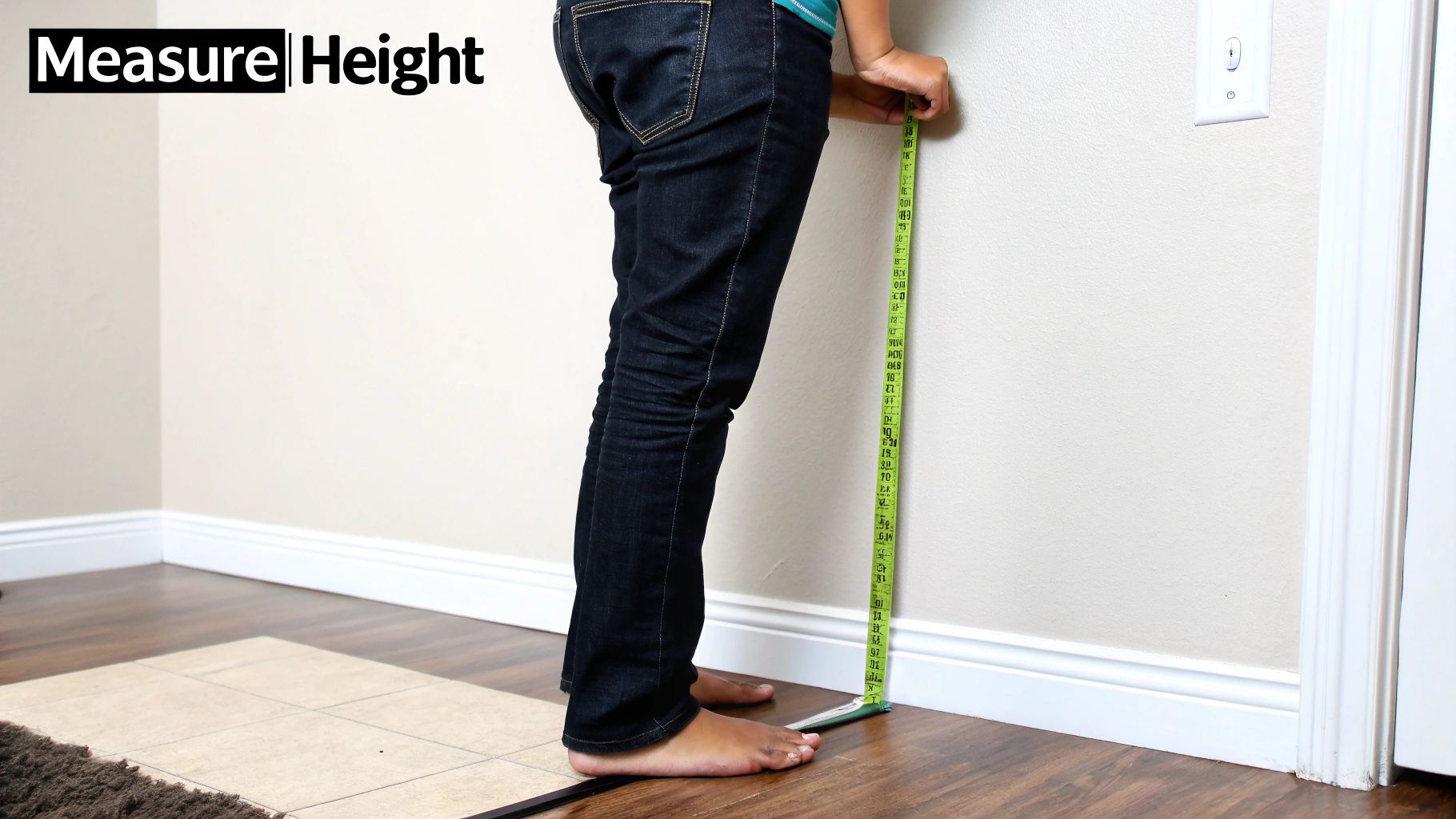
Think of it like this: if you can stand straight against a wall, you can get an accurate measurement in less than two minutes. Our gowns are cut with a generous, flowing fit designed to drape elegantly over whatever you’re wearing on graduation day, so your build is already factored in. The only thing that really changes the fit is how the gown’s length hangs on your specific height.
This single head-to-toe measurement is all we need to match you with a gown where every single element—from the hemline to the sleeve length—falls exactly where academic tradition says it should.
The Simple Head-to-Toe Measurement
Ready to find your size? The process is a breeze and doesn't require any special equipment. Just follow these quick steps to get a precise height measurement.
- Kick Off Your Shoes: For the most accurate number, stand barefoot on a flat, hard surface. Try to avoid measuring on a plush rug or carpet, as that can throw your height off just enough to matter.
- Stand Against a Wall: Get your back straight against a wall. Your heels, back, shoulders, and the back of your head should all be touching the surface.
- Look Straight Ahead: Keep your chin level and your eyes focused directly forward. Don’t tilt your head up or down, as that can alter the measurement.
- Mark Your Height: Grab something flat, like a hardcover book or a ruler, and place it on top of your head so it rests flat against the wall. Use a pencil to make a small, light mark where the bottom of the book meets the wall.
- Measure the Distance: Step away from the wall and use a tape measure to find the distance from the floor up to your pencil mark. That number is your official height for gown sizing.
Pro Tip: Jot down your height in both feet/inches (e.g., 5' 8") and in total inches (68 inches). Having both makes it even easier to cross-reference with any size chart you come across.
Once you have that number, you're all set. You have everything you need to confidently pick your size. This one simple step ensures your bachelor's, master's, or doctoral gown from Graduation Cap and Gown will have the ideal length for a polished, dignified look on your big day. By taking just a moment to measure correctly, you guarantee a perfect fit that honors tradition and lets you celebrate without a single wardrobe worry.
Making Sense of Our Graduation Gown Size Chart
Once you have your height, the size chart is the final step to locking in that perfect graduation robe length. I know, charts filled with rows of numbers can look a little intimidating at first glance, but ours is designed to be super straightforward. The whole point is to translate your height into the right gown size, giving you a sharp, traditional fit for the big day.
Think of our size chart as a simple matching game. You find your height in one column, like 5'6" to 5'8", and look right next to it for the size code you need. That’s it. This system does all the heavy lifting, automatically picking a gown with the right hemline and sleeve length for your frame without any complicated math.
Getting the length right isn't just about looks; it's about safety and tradition. Most undergrad gowns should hit around the knee, while master's gowns fall mid-calf for a look that's both dignified and easy to walk in. Believe it or not, a recent survey of 10,000 U.S. grads found that 12% tripped because of poorly fitting robes. That's why retailers now insist on precise, height-based sizing. With 70% of regalia purchases happening online these days, our chart is your best tool for getting a fit that's both safe and ceremony-ready.
Decoding Height Ranges and Size Codes
The height ranges on our chart are there to account for how a gown naturally drapes. If you’re 5'7", you're squarely in the 5'6" - 5'8" range. The gown size linked to that range is cut to hang perfectly on a person of that height, hitting that classic mid-calf spot for a Bachelor's or Master's candidate.
But what if you're right on the line between two sizes, say exactly 5'9"? That's a great question. As a general rule, we suggest sizing up. A gown that's a touch too long almost always looks more formal and appropriate than one that's creeping up too short. You'll also want to think about your shoes—if you plan on wearing high heels, the larger size is definitely the way to go. For an even deeper dive, check out our dedicated graduation cap and gown size chart guide.
Understanding Full Fit Sizing
On top of our standard sizes, we also offer a Full Fit (FF) option. This sizing is specifically designed for graduates who need a little more room through the chest, shoulders, and body of the gown.
A Full Fit gown provides extra fabric for a more comfortable and less restrictive fit, ensuring the robe drapes correctly without pulling or feeling tight. It maintains the same traditional length as a standard gown but offers a more generous cut.
So, when should you consider a Full Fit size?
- If you usually wear plus-size clothing.
- If you have broader shoulders or a larger chest measurement.
- If you simply prefer a looser, more flowing fit for your regalia.
Choosing between Standard and Full Fit is about more than just comfort—it’s about making sure the gown hangs the way it's supposed to. A robe that's too snug can pull and ride up, which makes the graduation robe length look shorter than it is and ruins that clean, formal silhouette. By picking the right fit, you're guaranteeing you’ll look polished and feel great for your ceremony.
Solving Common Gown Fit Problems
So, what happens when your gown arrives and the fit isn't quite right? First off, don't panic. Even with the most careful measurements, little issues can pop up, but nearly all of them have simple, practical solutions that won’t require a last-minute trip to the tailor.
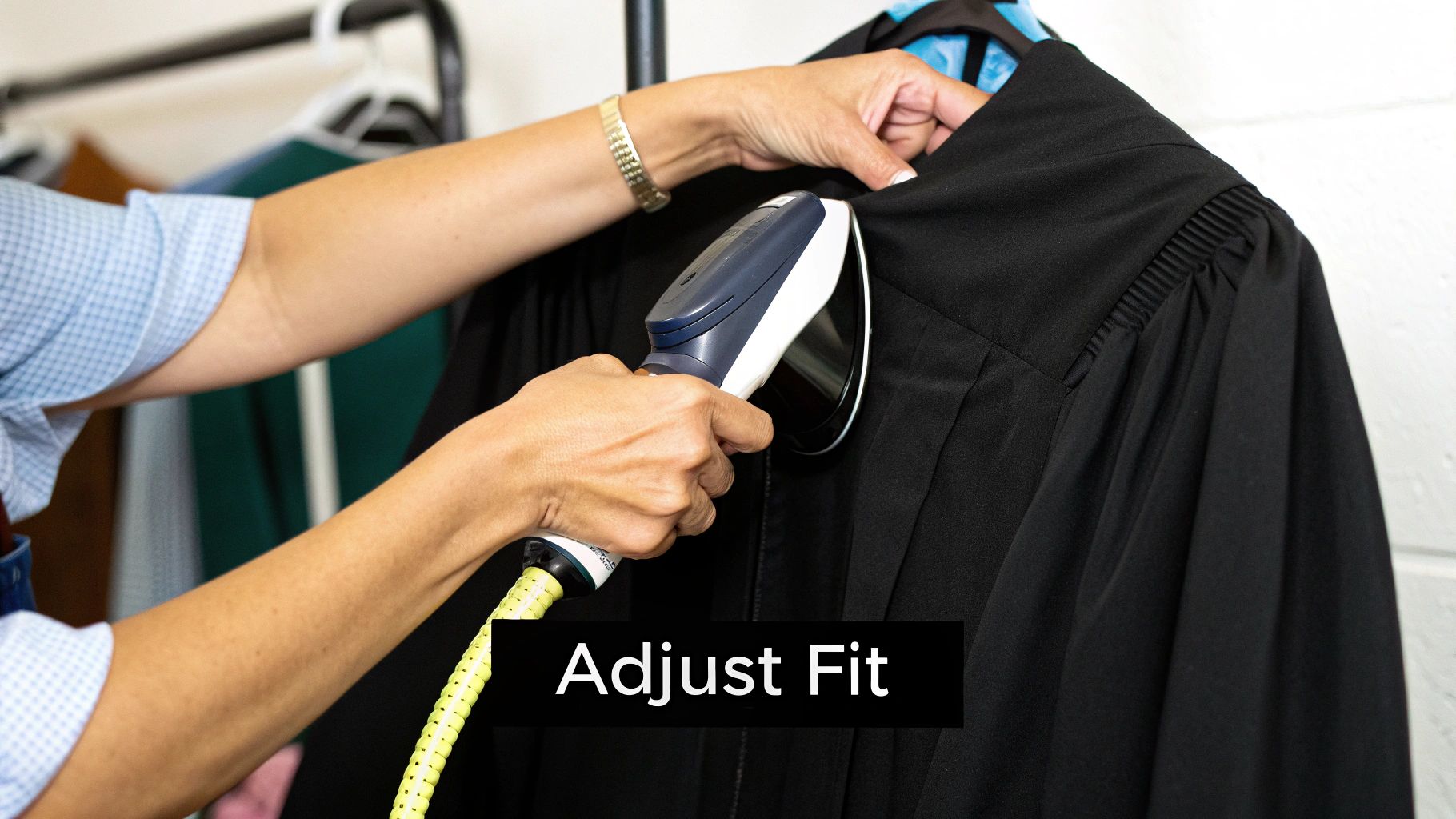
From a hemline that feels a bit off to some bagginess around the shoulders, a few quick fixes can help you dial in your regalia for a look that feels custom-made. Tackling these common problems is the key to feeling comfortable and confident when it’s your time to shine.
Quick Fixes for Gown Length
The most frequent issue graduates run into is the graduation robe length feeling a little too long or short. A gown that’s slightly too long is actually the easiest problem to solve without any permanent alterations.
- Hem Tape Is Your Friend: For a temporary fix, fabric-safe hem tape is a total lifesaver. Just fold the hem under to the length you want and secure it with the tape. It’s a clean, no-sew solution that won't damage the material.
- Footwear Matters: Your choice of shoes can make a surprising difference. If your gown is dragging a bit, wearing shoes with a slight heel can lift the hem just enough to create that perfect, elegant drape.
On the flip side, if the gown feels a tad too short, make sure you're wearing appropriate attire underneath. Learning more about what to wear under your graduation gown can help you pull together a polished and cohesive look, even if the hem is a little higher than you expected.
Improving the Overall Drape and Silhouette
Sometimes the issue isn't the length itself, but how the gown hangs on your frame. Baggy shoulders or a generally shapeless feel can often be corrected with almost no effort at all. Steaming is probably the single most effective trick in the book.
Gently steaming your gown helps release all those wrinkles from shipping and allows the fabric to relax and drape more naturally over your body. This one simple step can transform a stiff, boxy robe into an elegant, flowing garment.
Beyond just getting the perfect fit, making sure your gown looks impeccable for the ceremony is essential. For advice on storing and transporting your formal wear without creases, you might find some great tips on keeping your graduation robe wrinkle-free. These small adjustments will help you achieve a polished and dignified silhouette for photos and the procession.
Your Graduation Robe Sizing Questions Answered
Even with a detailed guide, a few specific questions about graduation robe length always seem to pop up. To help you feel completely confident in your choice, we’ve gathered the most common questions we get from students and laid out clear, direct answers to tackle any final doubts.
Our goal is to get rid of any last-minute stress. After all, your focus should be on celebrating your incredible achievement, not second-guessing your regalia. Let's run through these common queries so you can order with total peace of mind.
Should My Graduation Gown Touch The Floor?
Generally, no. The only academic gowns designed to be ankle-length or brush the floor are for doctoral candidates, symbolizing the highest academic degree they’ve earned. That dramatic, formal length is reserved for Ph.D. and other terminal degrees.
For Bachelor's and Master's graduates, the sweet spot is somewhere between the knee and mid-calf. This traditional length allows for safe and easy movement, which is more important than you’d think when you're navigating stairs or walking across a crowded stage.
A gown that’s too long is a serious tripping hazard. To stay safe and stick to academic tradition, always use our height-based size chart to find the right graduation robe length for your degree level.
What Do I Do If I Am Between Two Sizes?
This happens all the time. If your height puts you right on the line between two different sizes, our advice is almost always to choose the larger size. A gown that's slightly longer usually looks more formal and dignified than one that comes up a bit short.
A slightly larger size also gives you a little more breathing room for the clothes you'll be wearing underneath. One last thing to consider is your footwear for the big day.
- Wearing High Heels: If you plan on wearing heels, the extra bit of length from the larger size will likely be perfect, preventing the gown from looking awkwardly short.
- Wearing Flats: If you're sticking with flat shoes, you might be fine with the smaller of the two sizes to make sure the hemline doesn't drag.
When in doubt, sizing up is usually the safest and most polished-looking option.
Does The Gown Measurement Include The Cap?
Nope, the measurement for your gown has nothing to do with the cap (also known as a mortarboard). The sizing is based entirely on the robe itself.
The graduation robe length is measured from the top of your shoulders or the nape of your neck down to the hem. When you use our size chart, all you have to do is provide your total height from the top of your head to the floor. Our system handles the rest, automatically calculating the correct robe length based on long-standing academic standards.
Can I Get My Graduation Robe Altered?
While you technically could take a gown to a tailor, we generally advise against any major alterations. Our gowns are designed with very specific cuts and drapes that can be thrown off by big changes, potentially ruining the way it's supposed to hang.
For a minor length adjustment, a temporary fix is a much better route. Fabric-safe hem tape is a fantastic solution if your gown is just a little too long. It requires no sewing and won't damage the material. If you receive a gown that seems way off from what you expected based on our size chart, please get in touch with our customer support team for an exchange. The best plan is always to order the correct size from the start.
At Graduation Cap and Gown, we are committed to making your graduation day perfect. From finding the right size to selecting the perfect accessories, we have everything you need for a memorable ceremony. Explore our full collection of academic regalia at https://www.graduationcapandgown.com.