

In the 2022–23 academic year, Hispanic-Serving Institutions enrolled 64% of Latino undergraduates and accounted for 66% of Latino undergraduates earning degrees, according to the ERIC report on Hispanic-Serving Institutions. Those 602 colleges were 20% of U.S. colleges and universities, yet they enrolled 30% of all undergraduates. On that stage, a stole is a sentence in the visual language of commencement. The same serape can be required, optional, or not allowed. Check the campus rules first, then choose the design that fits family heritage and the graduate's own words.
What a Hispanic Graduation Stole Signals
Say a senior buttons a black gown and a woven sash falls in two even panels. That Hispanic graduation stole marks cultural heritage, identity, and pride beside the degree. It does not replace a hood, an honor cord, or other academic regalia, and it does not measure who graduated.
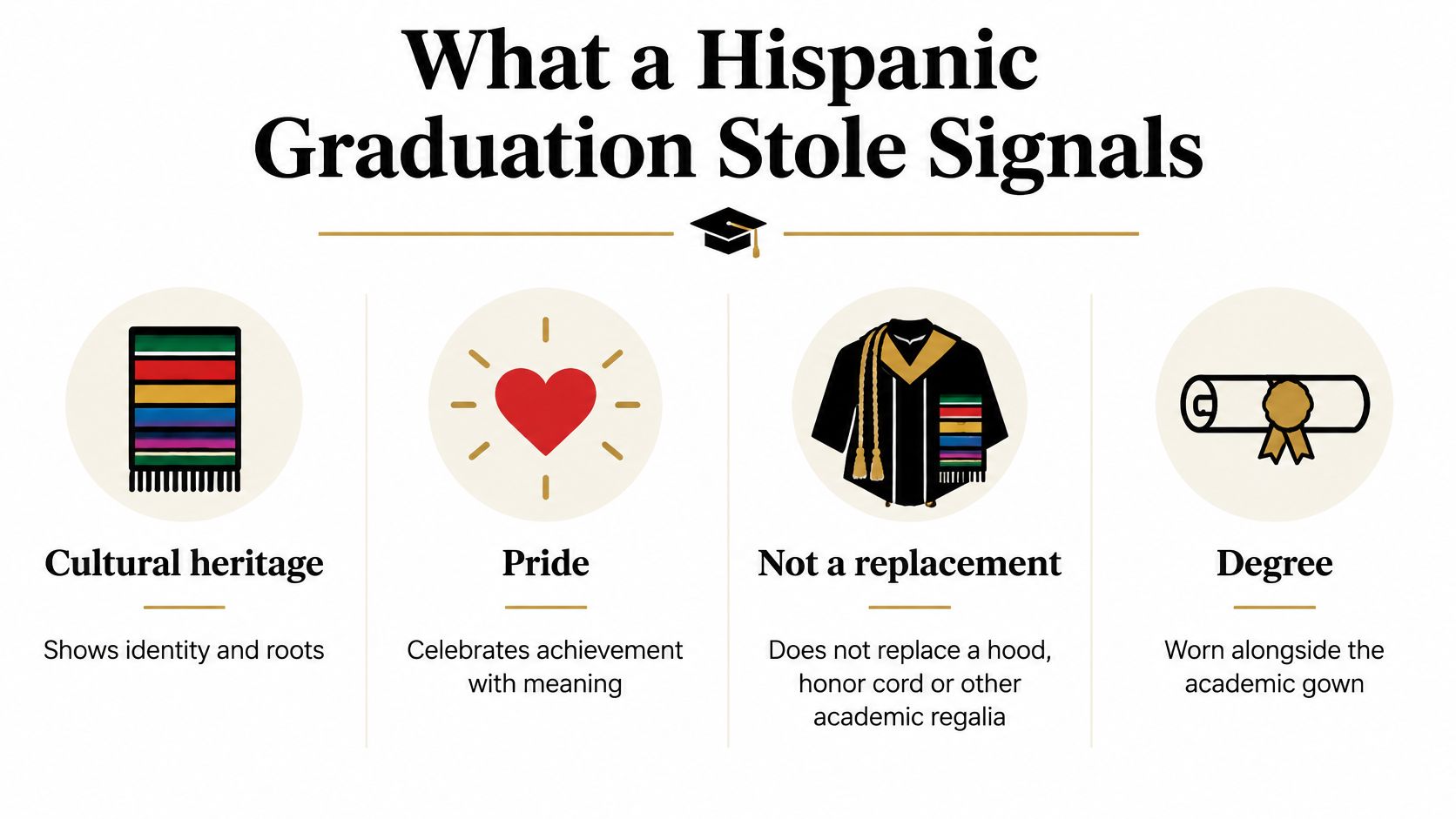
Indiana University Kokomo calls the serape-style stole a symbol of Hispanic and Latino cultural pride, resilience, and heritage. The same campus account notes that Rock Valley College ties Hispanic cultural stoles to heritage, perseverance, and community pride. A guest reads the weave as belonging. The hood and cords still carry the academic record.
A stole speaks beside the degree. It does not stand in for it.
According to the Pew Research Center, Hispanic postsecondary enrollment rose from 1.5 million students in 2000 to 3.8 million in 2019, and by 2021 about 23% of Latinos ages 25 to 29 held a bachelor's degree, up from 14% in 2010. More graduates are reaching the ceremony, so the sash is easier to see. Families sorting aid, housing, and a first diploma can use help navigating college as a first-gen student before regalia week arrives.
The decisions are practical. Which design fits the family story, whether the campus allows the sash, how it sits with the gown, and how to have it for a 2026 ceremony. Our guide to graduation stole meaning separates cultural panels from honor regalia. Campus rules, not symbolism alone, decide what can be worn.
Designs, Colors, and Wording That Fit Your Story
A Hispanic graduation stole is not one standard object. Hispanic, Latino/a, Latinx, Chicano/a, and Latine are not interchangeable labels, and no single panel speaks for every graduate. Pick by heritage and by the words the graduate uses.
Woven serape or sarape stripes are a textile many recognize. They suit a shared Latino identity without naming one country. Cal Poly Humboldt says its Latinx stole reflects textile traditions from Latin American nations, and graduating students decide the design each year.
Flag or ancestry colors name a homeland. Montana State University recognizes Latinx graduates with a sarape stole in yellow and blue, and it states that stole colors may vary according to a student's country of ancestry or origin. Students who identify as Latino, Latina, Latinx, or Hispanic receive that recognition after registering through the Student Commons. The same policy places the cost of additional regalia on the recognized student, organization, or group.
A motif carries a personal story. Elon University's 2025 ceremony used a monarch butterfly for migration, transformation, and persistence. A short bilingual phrase works when a sentence matters more than a pattern. UNC-Chapel Hill describes a sarape-style stole carrying the phrase "Soy El Futuro."

Keep one main idea per panel: stripes, or flag colors, or a short phrase, not all three. Skip another country's flag, an Indigenous motif, or a religious emblem unless that history belongs to the graduate. Humboldt makes its Latinx stole available to self-identified Latinx graduates, while Colorado allows graduates to receive cultural stoles regardless of personal identity. Inclusive campuses publish the symbol and the rule. They don't claim one universally authentic stole.
If the graduate also holds an academic honor, that is a different garment. A Pink Graduation Stole - Pink College & High School Stoles is high quality pink bridal satin with arrow pointed edges, shaped to fit all body types, each side 31 inches long and 5 inches wide, and fully lined, for honors recognition at college and high school. It is not a cultural stole. Families who want a photo keepsake at home sometimes create a personalized pet photo blanket for the same weekend. For lettering on the sash itself, start with a custom graduation stole only after the campus has approved the wording.
| Design | What it signals | Choose it when |
|---|---|---|
| Woven serape or sarape stripes | Heritage, resilience, and community pride | A shared textile should be visible without naming one country |
| Flag or ancestry colors | Country of origin or family homeland | The graduate wants a nation named, as Montana State allows colors to vary by ancestry |
| Motif such as a monarch butterfly | Migration, transformation, and persistence | The story is personal, as in Elon's 2025 ceremony |
| Bilingual phrase such as Soy El Futuro | Identity and the future in the graduate's own words | A sentence matters more than a pattern, as at UNC-Chapel Hill |
| Multicultural stole | Several racial or ethnic identities at once | One Hispanic or Latine label would be incomplete, per Northwest Missouri State |
Northwest Missouri State draws that last line on purpose. Its Hispanic/Latine stole is a serape stole and a symbol of identity, heritage, and a personal journey. Its multicultural stole represents students across Black, Hispanic/Latine, Asian, Asian-Pacific Islander, American Indian, and multiracial communities. Use the broader stole when one label would leave someone out.
Campus Rules for Wearing a Cultural Stole
The same stole can be welcomed, optional, or forbidden. Read the published rule before anyone pays for fabric.
| Campus | Who qualifies | How the stole is obtained | Deadline or limit |
|---|---|---|---|
| Cal Poly Humboldt | Self-identified Latinx graduates | Commemorative stole; not required to walk | Design chosen yearly by graduates |
| University of Colorado | Registered cultural-celebration participants, regardless of personal identity | Complimentary cultural stoles for registered students | Must register for the celebration |
| CSU Fullerton | Students registered for Nuestra Graduación | Stole presented at the celebration; skip the event and still request one for academic ceremonies | Registration required |
| Montana State University | Students identifying as Latino, Latina, Latinx, or Hispanic | Register through the Student Commons; student or group pays for extra regalia | Registration required |
| Northwest Missouri State | Hispanic or Latine cultural-stole participants | Reception attendance not required; wear at commencement or keep | Register by April 20 |
| Louisiana State University | Earned university honor or an approved regalia request | Organization submits an Academic Regalia Adornment Approval Form | Office of Academic Affairs approval at least 30 days prior |
Why the rows don't match
Humboldt treats the stole as commemorative. Colorado has offered complimentary stoles to people who register for a cultural celebration, including graduates who don't share that personal identity. Fullerton ties presentation to Nuestra Graduación, then still lets a student who skips the celebration request a stole for the academic ceremony. Montana State limits recognition to students who identify as Latino, Latina, Latinx, or Hispanic and puts the bill for extra regalia on the student, organization, or group.
Northwest Missouri State University requires students to register for the cultural stole or related reception by April 20. They don't need to attend the reception to receive or use the stole, and they may wear it at commencement or preserve it as a keepsake.
Louisiana State University is stricter. Special adornments, including stoles, ribbons, and sashes, need formal approval. Only students who have earned a university academic honor, or whose regalia request has been approved, may wear special regalia. Student organizations and institution-approved programs must submit an Academic Regalia Adornment Approval Form, and the Office of Academic Affairs must approve all adornments at least 30 days before the ceremony.
Practical rule: If the policy is silent, don't assume a decorative sash is allowed.
Three questions for the commencement office
Email these before you order.
- Is a cultural stole allowed over the gown, and does an honor cord or hood change that answer?
- Who pays, the graduate, a student group, or the campus?
- What is the last registration or approval date, including any form that must be in 30 days early?
Save the reply with the graduate's name. A coordinator, a parent, and a student organization can then work from the same yes or no.
Celebration, Registration and Family Logistics
Decide early whether the stole belongs to the cultural celebration, the academic ceremony, or both. That choice changes who must register.
Two paths, two calendars
Celebration path. Cal State Fullerton requires registration for Nuestra Graduación and for the stole presentation. A student who skips the celebration may still obtain a stole for academic ceremonies. Colorado offers complimentary stoles to registered cultural-celebration participants. If the stole is handed out only in that room, missing the event can mean missing the garment unless the office has said otherwise.
Ceremony path. Northwest Missouri State's April 20 registration covers the cultural stole or the reception, and students don't have to attend the reception to receive or use the stole. Humboldt's Latinx stole is commemorative and not required for commencement, so a graduate can walk in standard regalia and still keep the sash as a memory.
MSU Denver frames its Latina/o/x graduation as a culturally responsive experience that includes recognition of graduates and presentation of the Serape Stole. That presentation is a structured moment of belonging before the formal ceremony. Families can plan photos, seating, and travel around it. Slippery Rock University likewise distributes culture-specific stoles, including Latino stoles, through a multicultural graduation ceremony. For families planning the weekend beyond campus, milestone celebrations in Central Texas show how a community marks the day after the procession ends.
What a cohort should finish
- Preferred terms: Collect self-identification and the wording each graduate wants, such as Hispanic, Latino, Latina, Latinx, or Latine.
- One order date: Set a single stole deadline that sits before the campus approval date.
- Matching panels: Keep size and color consistent across the cohort so the group reads as one community in photos.
- Who pays: If a parent wants an extra stole, confirm the payer. Montana State places the cost of additional regalia on the student, organization, or group.
- A small buffer: Cultural events often mix undergraduates and graduate students, and headcount shifts year to year. Order a few extra panels only if the office allows it.
A working student who can't attend a Friday celebration should not lose the stole if the academic ceremony still permits it. Write that exception into the registration note so the family isn't guessing at the door.
How to Wear the Stole With Your Gown
Culture should show, and the degree should still show. Layer in this order.
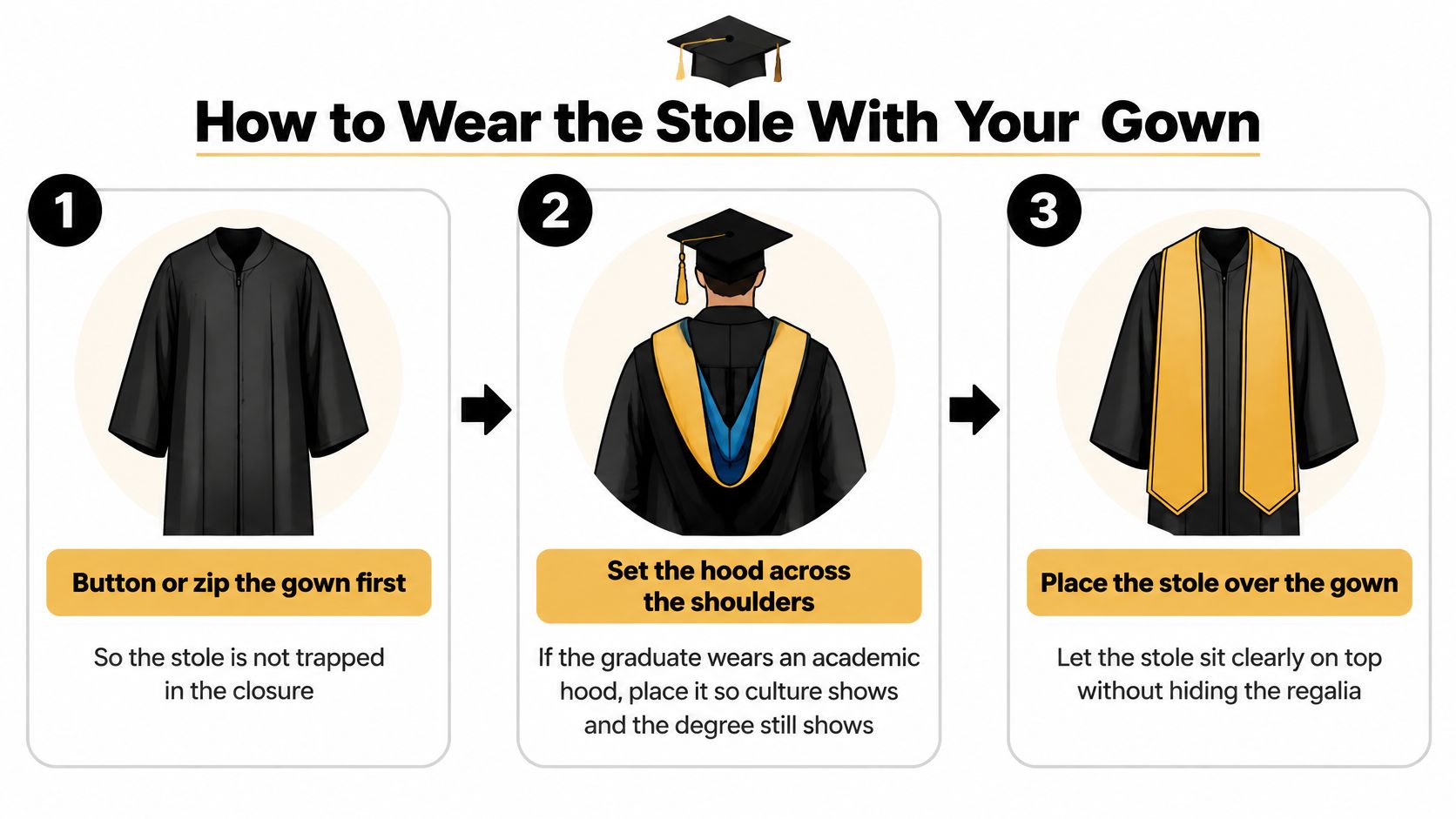
- Button or zip the gown first. If the stole goes on too early, the closure traps a panel and the pattern twists at the chest.
- Set the hood across the shoulders before the stole, when the graduate wears one. Velvet trim and the colored satin lining stay visible at the neck. The hood names the degree. The stole names the person.
- Drape the stole around the back of the neck. Keep the two front panels even, the patterned face outward, and the ends hanging straight. A twist hides stripes and turns a phrase upside down.
- Place honor cords so the knots sit at the neck and the ropes fall beside the stole panels. Don't let a cord cross a phrase or a flag. Our notes on how to wear stoles keep cords, medals, and sashes from covering one another.
- Fasten medals to the gown, not through the stole. Keep them clear of a name card. A pin through woven cloth leaves a hole in a keepsake.
- Take a waist-up photo in the lineup light. Fix anything that hides a panel, a hood lining, or the tassel.
Many schools present the stole at a cultural celebration and expect it again at official commencement. Humboldt treats its Latinx stole as commemorative and not required in order to walk. If your campus is in that group, you can still rehearse the drape for photos even when the procession doesn't require the sash.
Watch a short regalia walk-through, then practice once with the gown.
If a panel flips, a hood covers the pattern, or a cord crosses the lettering, reset it before the processional. The test is simple. A guest in the stands can see both the heritage panel and the academic colors.
Confirm the Rules Then Order Your Stole
Decide in this order, and write the campus date beside each step before you ask for a mockup.
- Ask whether the campus issues a Hispanic or Latino stole and whether registration is required. A yes from a friend isn't the same as a yes from the commencement office.
- If the school supplies it, note the exception. Fullerton still lets a student who skips the celebration obtain a stole for academic ceremonies. Humboldt treats the stole as optional keepsake regalia, not a ticket to walk.
- If the school doesn't supply it, order only after adornment rules are confirmed. Leave at least the 30 days LSU requires when a campus demands prior approval, then add shipping time. We don't keep a school's regalia rules on file, so you'll need that approval in hand before you order.
- Match the design you already chose: serape stripes, ancestry colors, a motif, or a short phrase, including Class of 2026 if the year should appear. We sell serape stoles among custom graduation stoles, and you can design and personalize a stole online. Email the wording, colors, and layout so we can create a mockup before the stole is produced. Our guide on where to buy graduation stoles is the place to start that note.
- On arrival, drape it once over the gown, hood, and cords, then pack it flat. Wear it at commencement if the school allows it. Keep it when the rules say no.
Expect a mockup approval step before production, then allow shipping time ahead of the ceremony date. The useful result is a stole the graduate was permitted to wear and that the family can still recognize in the photos.
Graduation Cap and Gown makes custom stoles you can personalize, including serape stoles and Class of 2026 stoles, so a Hispanic graduation stole can carry the pattern or phrase your campus already approved. Email your wording and colors for a mockup, then wear the stole only if the commencement office said yes. Visit Graduation Cap and Gown to design the panel that fits the graduate's own words.