

Don't let the academic hood intimidate you. It might look complicated, but putting it on is actually pretty straightforward once you get the hang of it. The whole point is to drape it so the rich velvet trim faces out and the colorful satin lining—that’s where your university colors are—is flipped out and visible from the back. A well-worn hood sits comfortably on your shoulders and is pinned to your gown in the front so it doesn’t ride up and pull at your neck during the ceremony.
Getting to Know Your Academic Hood
Before you even try to put it on, it helps to understand what you’re working with. The academic hood is easily the most symbolic piece of your graduation attire. It’s a visual story of your entire academic journey, proudly displaying your degree level, your specific field of study, and the university that granted you that hard-earned degree.
It’s far more than just a colorful accessory; it’s a critical component of your full academic regalia. To see how it fits into the complete picture with your gown and cap, you can explore our detailed guide on what academic regalia includes. Every single element, from its length to its colors, is dictated by a specific academic code, ensuring consistency from one institution to the next.
The Anatomy of an Academic Hood
Getting familiar with the different parts of the hood will make the process of putting it on a thousand times easier. Let's break down the key components you’ll want to identify before you start.
To help you get your bearings, here’s a quick rundown of the essential parts.
Academic Hood Components at a Glance
| Component | Description & Purpose | Where to Find It |
|---|---|---|
| Shell | The main body of the hood, typically made of black fabric to match your gown. | This is the largest part of the hood, forming its basic shape. |
| Velvet Trim | The colored band lining the outer edge of the shell. Its color signifies your specific field of study (e.g., golden yellow for Science, light blue for Education). | This colored velvet strip runs along the entire visible edge of the hood. |
| Satin Lining | The colorful interior fabric. These are the official colors of the university that granted your degree, displayed in a specific pattern. | Found on the inside of the hood, this part is meant to be turned out to be visible on your back. |
| Front Loop | A small cord or loop at the "V" of the hood. It’s used to fasten the hood to a button on your shirt or a pin on your gown to keep it in place. | Look for this small but crucial piece at the very front tip of the hood where it rests on your chest. |
With these parts in mind, you're ready to get started.
The length of the hood itself is also a big deal. The Intercollegiate Bureau of Academic Costume (IBC) set specific standards that are still followed today. A Bachelor's hood is 3 feet long, a Master's hood is 3.5 feet, and a Doctoral hood measures a full 4 feet in length. Each size is a clear visual marker of a higher level of academic achievement.
The goal is to wear your hood in a way that proudly and correctly displays all these symbolic elements. A properly worn hood looks elegant and feels comfortable throughout the entire commencement ceremony.
Draping Your Hood with Confidence
Putting on your academic hood for the first time can feel like trying to solve a puzzle. But don't worry, it's a straightforward process once you know the key moves. The whole point is to correctly display its three symbolic parts: the black shell, the colorful velvet trim, and the satin lining that shows off your university's colors. Let’s get you looking polished and feeling comfortable for your big day.
First, hold the hood out in front of you with the velvet side up. The narrow end—the "V" shape—should be pointing up toward your chin, with the wider, heavier part hanging down. Getting this initial orientation right is the most important step. Everything else just falls into place after that.
Now, simply place the hood over your head. Let it drape around your neck and settle on your shoulders. The velvet trim should frame your neck and hang down your chest, almost like a stole. At this point, the colorful satin lining is still hidden on the inside, but we'll get to that.
Securing the Front of Your Hood
One of the most common complaints from graduates is that the hood pulls back and feels like it’s choking them. To avoid this, you have to secure the front.
Look for a small elastic loop or cord at the point of the "V" in the front. This tiny feature is your best friend. It’s designed to be fastened to a button on your dress shirt or blouse. If your outfit doesn't have a button in the right spot, no problem. Just use a small safety pin to attach the loop to the zipper of your graduation gown. This simple move anchors the hood and takes all the pressure off your neck.
For more tips on making sure your whole outfit works together, check out our complete guide on how to wear your full graduation regalia.
The Final Flourish: Turning Out the Colors
With the hood secured, it’s time for the final, most visually striking step: revealing your university colors. This is often called "turning out the hood."
Reach behind you and find the velvet trim at the back of your hood. Gently flip this back section outward, starting from about the middle of your back. This motion will turn the satin lining to the outside, unveiling the vibrant chevron or pattern of your university’s official colors.
Wearing an academic hood correctly starts with the velvet trim facing up and outward. This trim symbolizes your field of study—over 60 disciplines have standardized colors according to the 1959 IBC code, which is used by 95% of U.S. universities. For instance, white velvet denotes arts and humanities, golden yellow is for science, and lilac represents dentistry. This trim, which is 3 inches wide on master's hoods and 5 inches on doctoral ones, is the key to getting the look right.

This infographic shows how the duration of study is reflected in the regalia. The increasing commitment for higher degrees is why the hood, in particular, becomes more elaborate and distinguished.
You might need a friend to help you get this part just right, since it’s almost impossible to see what you’re doing back there. The goal is to create a clean, symmetrical display of the colors across your back.
Pro Tip: Have someone take a quick photo of your back after you've adjusted the hood. This lets you see exactly how it looks and make any final tweaks to ensure the lining is perfectly turned out and centered before you walk into the ceremony.
Mastering the Final Fit and Adjustments
Getting your academic hood draped over your shoulders is a great start, but the real secret to a polished, professional look is in the final adjustments. These little tweaks are what separate a sloppy, uncomfortable fit from one that stays perfectly in place all day.
Without them, you're signing up for a hood that constantly slides off-center or bunches up awkwardly behind your neck. You’ve worked too hard to look anything less than perfect.
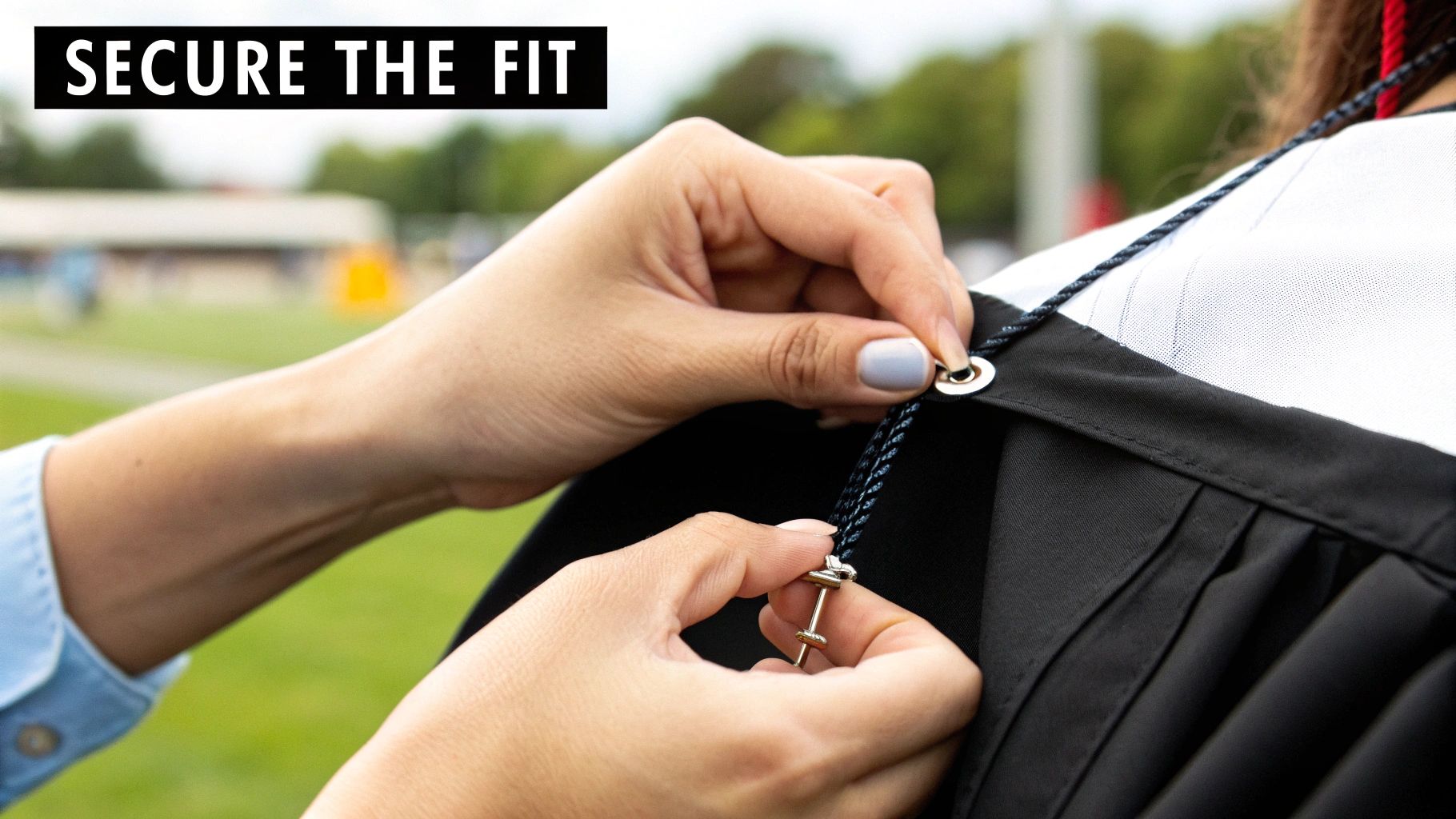
The most important, and often overlooked, feature for locking your hood in place is a small cord and button loop hidden on the back. This simple mechanism is designed to anchor the hood directly to your academic gown, preventing it from shifting as you walk, sit, and stand. A well-designed gown will have a corresponding button or a small loop stitched near the back of the collar specifically for this purpose.
Troubleshooting Common Fit Issues
Even with the hood anchored, you might run into a few common frustrations. Don't worry, they're easy to fix.
-
Hood Slides to One Side: This usually means the weight isn't distributed evenly. After you've fastened the back cord, gently pull the velvet panels on your chest downward to recenter the hood. It’s always a good idea to ask a friend to check that the satin lining is evenly displayed on your back.
-
Front Feels Too Tight: If the front V-neck is pulling against your throat, it's a sign the front loop isn't secured properly. Re-fasten the loop to a shirt button or pin it directly to your gown's zipper placket. This transfers the hood's weight off your neck and onto your shoulders where it belongs.
-
Back Bunches Up: This happens when the hood wasn't fully smoothed out before you anchored it. Just have someone lift the hood slightly, smooth the fabric down your back, and then re-secure the cord. Problem solved.
For a perfect fit right from the start, consider the premium academic gowns at Graduation Cap and Gown. Many of our gowns are designed with built-in hood loops, ensuring a seamless and secure attachment every time. You can learn more about finding the perfect fit by exploring the proper length of a graduation gown in our detailed guide.
What to Do if Your Gown Lacks a Button
So what happens if your gown doesn't have a button or loop for the hood's cord? Don't panic. This is a common issue with a very simple fix. All you need is a small, sturdy safety pin.
Simply find the cord on the back of your hood and use the safety pin to attach it to the inside yoke of your gown, right below the collar. Make sure to pin it through the fabric of the gown itself. This creates a secure anchor point that works just as well as a built-in button, keeping your hood perfectly in place.
Navigating Hooding Ceremony Traditions
For many earning a master's or doctoral degree, the hooding ceremony isn't just part of commencement—it's a deeply personal event all its own. This is the moment you transition from student to peer, a final rite of passage that deserves to be as memorable and dignified as possible.
Unlike just wearing your regalia, this ceremony involves a faculty mentor, dean, or even a family member ceremoniously placing the hood over your shoulders on stage. This powerful gesture symbolizes the academic community officially welcoming you into its ranks.
Your Role as the Graduate
When your name echoes through the hall, you'll walk toward the stage with your academic hood. The traditional way to carry it is neatly folded over your left forearm, making sure the beautiful velvet trim faces outward for everyone to see. This also keeps your right hand free for handshakes.
Once you're at the center of the stage, you’ll turn to face the audience and stand before your hooder. They'll take the hood from you, open it up, and get ready to place it over your head. Your job is simple: stand still. If your hooder is a bit shorter than you, a slight bend of the knees makes their job much easier.
Here's a key tip that's easy to forget: remove your cap just before the hood goes on. Once it's settled on your shoulders, you can put your cap back on before turning to accept your diploma.
A Guide for the Hooder
If you have the incredible honor of hooding a graduate, your goal is to make the moment feel seamless and significant. It’s a gesture packed with symbolism, and a little bit of practice ensures you honor the graduate’s hard work without any fumbling.
Here’s a proven technique to place the hood correctly without messing up the graduate’s hair or gown:
- Receive and Orient: Take the hood from the graduate and open it completely. You’ll want your hands inside the hood, with your thumbs resting on the velvet trim near the V-shaped front.
- Lift and Place: Bring the hood up and over the graduate's head, approaching from the front. Gently lower it down onto their shoulders, making sure the V-neck rests comfortably at the front without being too tight.
- Adjust the Back: Once the hood is on their shoulders, step behind the graduate. Smooth the body of the hood so it hangs straight down their back. Then, turn out the satin lining to proudly display the brilliant university colors.
Understanding the unique colors is part of the tradition. For a deeper dive, you can explore the meaning behind doctoral hood colors in our detailed article. This final touch completes the regalia, perfectly showcasing their monumental academic achievement.
Common Hood Mistakes to Avoid
Even with the best instructions, the rush and excitement of graduation day can lead to a few common regalia mishaps. Knowing how to wear an academic hood is one thing, but spotting and fixing mistakes on the fly is another. This section is your quick troubleshooting guide to make sure you look flawless from every angle.
Think of it as your defense against the dreaded "disappearing chevron" or the "bulky front drape." Honoring academic tradition is all about getting the details right, and a few seconds of adjustment can make all the difference.
The Inside-Out Hood
It happens more often than you'd think. In a hurry, you might throw your hood on completely inside-out. This mistake hides both the velvet trim and the colorful satin lining, leaving only the black shell visible from the front and back. It’s an easy slip-up when you're feeling rushed.
The fix is simple: take the hood off completely. Re-drape it over your shoulders with the velvet trim facing up and outward. You should immediately see the color of your degree field framing your neck and chest.
Forgetting to Turn Out the Colors
This is probably the most noticeable mistake. You drape and secure the hood perfectly at the front but completely forget the final flourish. The result? A flat, plain black panel hanging down your back, with your university's vibrant satin colors totally hidden from view.
To correct this, just reach behind you (or better yet, ask a friend) and find the velvet trim at the base of your neck. Gently flip this portion of the hood outward. This allows the satin lining to fold over and cascade down your back, revealing the colorful chevron that displays your school pride.
A correctly worn academic hood is a statement. This final step is crucial because it’s where you display allegiance to your alma mater. It’s the visual equivalent of shouting your school pride from the rooftops.
The Disappearing Velvet Trim
Another common issue happens when the velvet trim gets tucked under the hood's shell instead of framing it. This can make the front of your regalia look messy and unfinished, obscuring the color that represents your hard-earned field of study.
Thankfully, this is a quick adjustment. Simply pull the velvet edges out from under the shell and smooth them down over the front of your gown. Make sure the trim lies flat and is fully visible from your shoulders down to the V-point at the front.
Troubleshooting Common Hood-Wearing Issues
Let's be honest, graduation day can be a little chaotic. To help you sort things out in a hurry, we've put together a quick-glance table to help you identify and fix the most common hood mishaps. Just find the problem that matches what you're seeing and follow the simple fix.
| Common Problem | What It Looks Like | How to Fix It Quickly |
|---|---|---|
| The Inside-Out Hood | No color is visible at all—just the black shell fabric. The velvet trim is hidden. | Take the hood off and re-drape it with the velvet facing up and outward. |
| Hidden School Colors | The front looks okay, but your back is just a flat black panel. The colorful satin lining isn't showing. | Ask a friend to reach behind you and flip the back of the hood outward from the base of the neck, revealing the satin colors. |
| The Disappearing Velvet | The velvet trim on the front is tucked under, looking messy and incomplete. | Pull the velvet edges out from under the shell fabric and smooth them down so they lie flat against your gown. |
| The Choking Feeling | The front of the hood is riding up high on your neck, feeling tight and uncomfortable. | Use the cord and button on your gown to secure the hood. If that's not enough, use a safety pin to anchor it lower on the gown's zipper. |
| The Lopsided Look | The hood is hanging unevenly, with one side lower than the other. | Adjust the hood on your shoulders until the V-point in the front is centered and both sides are hanging at the same length. |
A little troubleshooting can go a long way in making sure you feel confident and comfortable.
Ensuring your regalia is worn correctly gives you peace of mind on a day that’s all about celebration. This is why we offer a lowest-price guarantee at Graduation Cap and Gown, so you can get high-quality, correctly designed regalia without any added stress.
Got Questions About Your Academic Hood? We’ve Got Answers.
To make sure you feel completely ready for the big day, we've pulled together the most common questions graduates have about wearing their academic hoods. Think of this as your go-to guide for those last-minute queries, clearing up any final confusion before you walk across that stage.
What Do All the Different Colors on an Academic Hood Mean?
The colors on your hood are far from random; they're a visual language that tells the story of your academic achievements. You'll notice two key areas of color.
First, the velvet trim running along the edge represents your specific field of study. You’ll see golden yellow for Science, pure white for Arts, and a distinguished light blue for Education, among many others. The second part is the satin lining inside the hood, which proudly displays the official colors of your university, often in a chevron or split pattern. This combination instantly communicates your degree and your alma mater to everyone in the room.
To take all the guesswork out of it, our 'Find Your University' tool at Graduation Cap and Gown makes sure you get a hood with the exact velvet and lining colors required for your specific degree and school.
How Do I Keep My Hood from Choking Me or Slipping Off?
This is easily the number one question we get, and thankfully, the solution is much simpler than you might think. The secret is the small elastic cord or loop located at the very front point of your hood's V-neck.
This little loop was specifically designed to be fastened around a shirt button or, even better, a button on your academic gown. Securing this cord is what takes all the weight off your neck, preventing that uncomfortable choking feeling. If your gown doesn’t have a button, a small safety pin attached to your gown's zipper placket works just as well. This one small adjustment is the key to making sure the hood rests comfortably on your shoulders for the entire ceremony.
Do I Wear a Hood for a Bachelor's Degree Ceremony?
While bachelor's hoods do exist, it's pretty rare for universities in the United States to require them for the graduation ceremony. The tradition of wearing a hood is generally reserved for master's and doctoral graduates, where the "hooding" itself is a significant part of the ritual acknowledging advanced academic work.
That said, you should always double-check your specific university's commencement guidelines just to be sure. If a bachelor's hood is required for your ceremony, we offer high-quality options in our Bachelors graduation packages.
How Should I Store My Academic Hood After Graduation?
Your academic hood is a valuable memento of everything you’ve accomplished, and storing it properly will keep it looking great for years. The biggest mistake is folding it up tightly, which can create permanent creases.
The best method is to hang it on a wide, supportive hanger inside a breathable garment bag to protect it from dust and environmental damage. Find a cool, dry place for it, like a closet. If the fabric gets a little wrinkled over time, never iron the velvet. Instead, use a steamer on a low heat setting, holding it several inches away from the fabric to gently release any wrinkles. This will keep your hood in pristine condition, ready for display or any future academic events.
At Graduation Cap and Gown, we know that every single detail matters on your special day. From ensuring your hood displays the perfect colors to providing the accessories that complete your look, we’re here to help you celebrate in style. Explore our full collection of academic hoods and regalia to find everything you need for a picture-perfect commencement.