

Getting your academic hood on correctly is simple once you know the key moves. Just open it up and drape it over your head, making sure the velvet side is up and the 'V' shape settles at the front of your neck.
The real secret to keeping it from sliding back is the small cord inside that 'V.' Loop it around a shirt button or pin it directly to your gown's zipper—that's what keeps it perfectly in place all ceremony long.
Understanding Your Graduation Hood
Before we get into the step-by-step, it helps to understand what you're actually working with. This single piece of regalia is steeped in history and symbolism, telling the story of your academic achievements, your field of study, and the institution that granted your degree.
It's so much more than an accessory; it's a visual record of all your hard work. You can explore the rich history and all the different components in our detailed guide on what is academic regalia.
This tradition is a huge part of commencements worldwide. In fact, the global academic regalia market, which includes essential pieces like academic graduation hoods, is expected to skyrocket to $3.8 billion by 2033. This growth is fueled by over 40 million students graduating annually in major markets, continuing a practice that dates all the way back to the 14th century at Oxford and Cambridge.
The Anatomy of a Graduation Hood
Every graduation hood is built from three main parts, and each one has its own specific meaning. Once you can spot these components, wearing the hood correctly becomes much more intuitive.
To help you visualize it, here's a quick breakdown of the key pieces that make up your academic hood.
| Anatomy of a Graduation Hood Key Components |
| :--- | :--- | :--- |
| Component | Material | What It Signifies |
| Shell | Black Fabric | Matches your graduation gown, providing a uniform base. |
| Velvet Trim | Colored Velvet | The color indicates your specific field of study (e.g., light blue for Education). |
| Satin Lining | Colored Satin | Displays the official colors of your university, showcasing your alma mater. |
Understanding these parts is the first step to wearing your hood with the confidence it deserves.
Your hood is a storyteller. The velvet trim announces your discipline to the world, while the satin lining proudly displays your alma mater's colors, connecting you to a long line of scholars who came before you.
Why Correct Placement Matters
Properly wearing your hood isn't just about looking good in photos; it's a sign of respect for academic tradition. A correctly placed hood ensures you'll be comfortable throughout the long ceremony and makes certain that your achievements are displayed just as they're intended to be.
Getting the small details right shows you appreciate the symbolism behind the ceremony. It’s a bit like learning the etiquette for other formal accessories; for another perspective, you might find a guide on how to wear a pocket watch interesting.
Now, let’s move on to the practical steps.
Securing Your Hood for a Flawless Fit
Getting your academic hood situated correctly is one of the final, most satisfying steps before walking across the stage. Commencement day can feel a bit chaotic, but this part is actually pretty straightforward once you get the hang of it.
Let's walk through the exact steps to make sure your regalia looks polished and, most importantly, stays in place.
First, hold the hood out in front of you with the velvet trim facing up. The point of the "V" shape should be pointing away from you. This is the key starting position—if the velvet is on the bottom, the whole thing is inside out.
Now, just drape the hood over your head and let it settle around your shoulders. The front V-point should rest comfortably at the base of your throat, not too high and not too low. This initial placement is the foundation for a secure, comfortable fit all day long.
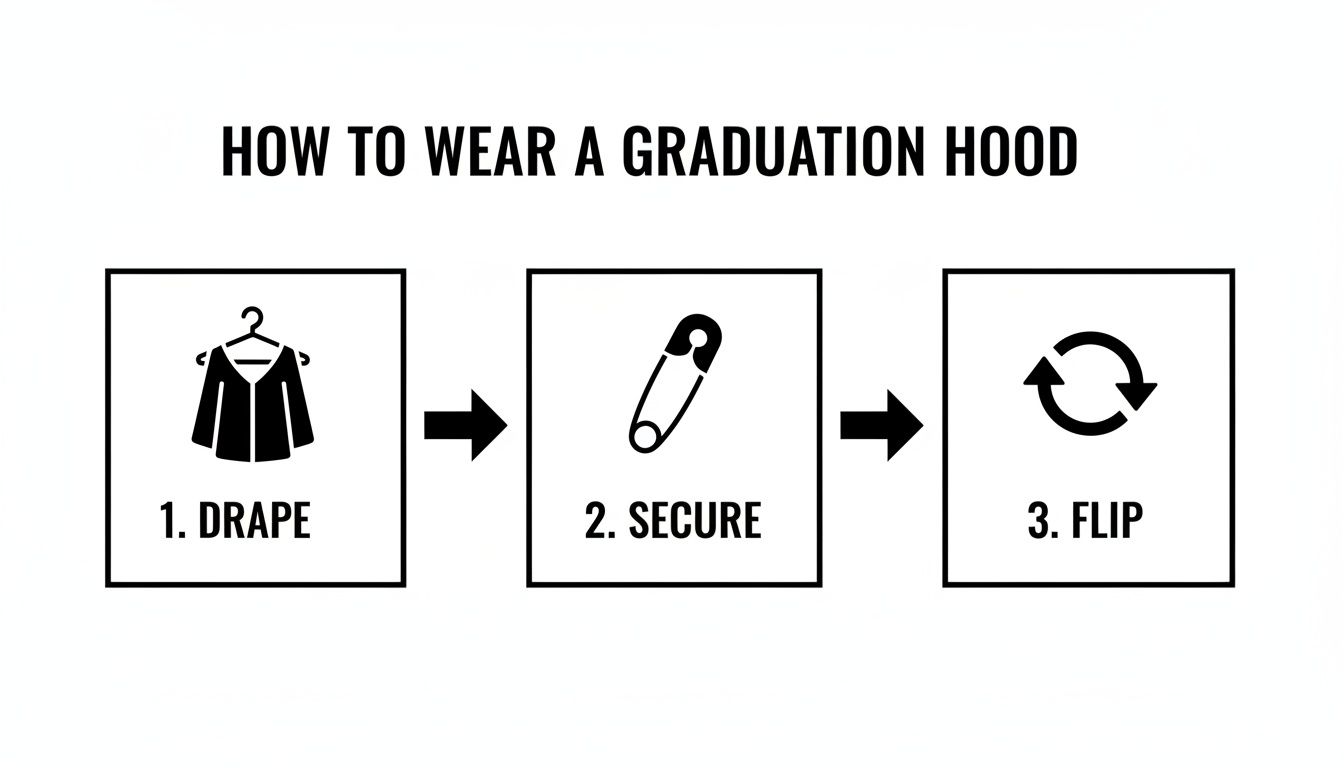
This little visual guide breaks it down into three core moves: drape, secure, and flip. That’s really all it takes to get that perfect, photo-ready look for your entire ceremony.
Keeping Your Hood in Place
Alright, this next part is the most critical step for preventing that annoying backward slide that makes the hood feel tight around your neck. Reach inside the front "V" and you'll find a small fabric loop or cord attached right at the point. This tiny detail is what anchors the entire hood.
If you happen to be wearing a button-down shirt, you're in luck. Simply loop this cord around your top button. This creates a secure connection that keeps the hood from shifting, and it makes a huge difference in both comfort and appearance.
No button? No problem. A small safety pin is your best friend here. Just pin the cord to the inside of your gown, right below the zipper pull. It’s a discreet little trick that works just as well, ensuring your hood stays put from the processional march all the way to the recessional.
A common mistake is skipping the front anchor. This almost always leads to the hood sliding back, pulling uncomfortably at your throat and hiding the beautiful velvet trim. Taking just ten seconds to secure that loop is the best way to avoid constant adjustments.
Revealing Your Academic Colors
The final touch is what really makes the hood pop. The back of the hood needs to be turned out to display the satin lining that represents your university's official colors. Since you can’t exactly see what you’re doing back there, this is where a friend or family member comes in handy.
Ask someone to reach behind you and flip the satin lining outward so it drapes over the black shell and velvet trim. They should start turning the colors out from the middle of your back, allowing that vibrant satin to cascade down. The result is that iconic, colorful look that signifies your alma mater and your degree.
For a deeper dive into what makes master's regalia unique, you can find more information in our guide on graduation regalia for a Master's degree.
Once flipped, the hood should display a beautiful spread of your school colors over the velvet border. Our Master's Hoods and Doctoral Hoods are designed to showcase these colors brilliantly, ensuring you represent your institution with pride.
Navigating the Official Hooding Ceremony
The hooding ceremony is the defining moment of any doctoral or master's commencement, a formal recognition of all those years of hard work. It's a moment steeped in tradition, and knowing the simple choreography ensures it unfolds perfectly for both you and the faculty member placing the hood.

Whether you’re the one being honored or the one doing the honoring, understanding the proper etiquette is key to a dignified, memorable experience. This is a moment you'll want to be picture-perfect.
For the Graduate: Your Moment on Stage
Your part in the ceremony starts as you approach the stage. Carry your academic hood draped neatly over your left arm. The velvet trim, which shows off your field of study, should be facing outward so it’s visible to the audience.
The point of the hood’s “V” should be aimed toward your hand, with the rest of the fabric draped back toward your elbow. This simple positioning prepares the hood for a smooth handoff to the faculty member. As you walk, maintain a poised, confident posture—you're ready for your big moment.
Once you hit your mark on stage, you’ll hand your hood to the faculty member or dean. Here’s the most important step: turn and face away from the audience. This gives the photographer the perfect shot and gives the hooder clear, easy access to place the hood.
To make it even smoother, it’s a huge help to bend slightly at the knees. This small adjustment lowers your height just enough to make placing the hood over your head a breeze, preventing any awkward reaching or fumbling with your graduation cap.
Remember, the hooding ceremony is a partnership. Your calm demeanor and correct posture are just as important as the faculty member's actions in creating a graceful and symbolic moment.
For the Faculty Member: The Honor of Hooding
As a faculty member, your role is one of immense honor. When the graduate hands you the hood, hold it so the velvet trim is facing you and the colorful satin lining is facing the graduate. You'll want to get a good grip on the V-point of the hood with both hands.
Your goal is to place the hood over the graduate's head in one fluid, confident motion. Lift it high enough to easily clear their head and graduation cap, being careful not to disrupt their hair or tam.
Once it's over their head, gently adjust the front so it sits comfortably at their collarbone and let the back drape naturally down their shoulders.
Ensuring faculty members are properly equipped makes all the difference. Our extensive collection of Doctoral and Faculty Regalia provides the high-quality attire needed to uphold this significant academic tradition.
Decoding the Different Types of Academic Hoods
Not all graduation hoods are created equal, and the differences in their design are packed with centuries of academic tradition. Getting a handle on these distinctions is key to knowing how to wear your hood correctly and making sure you've got the right regalia for your specific degree.
The variations between Bachelor's, Master's, and Doctoral hoods are subtle but significant, signaling your academic rank to everyone at the ceremony. Each type has a unique size, shape, and trim that tells a specific part of your educational story.
The Bachelor's Hood Simplicity
While they're less common, some institutions do award hoods for Bachelor's degrees. These are the simplest of the three, designed to be shorter and more streamlined. Their defining feature is a narrow velvet trim, which represents the graduate's field of study.
The Master's Hood A Step Up
The Master's hood is the one you'll see most often, and it represents a huge step in higher education. It’s visibly longer than the Bachelor's version, creating a more prominent drape down the graduate's back. The velvet band signifying the discipline is also wider, making a more pronounced statement.
The growing significance of advanced degrees is reflected in the market itself. The tailored academic hoods market is projected to hit $0.5 billion in 2025 and more than double to $1.1 billion by 2033, driven by the millions of degrees awarded annually. To learn more about this academic trend, you can explore the full market report on tailored academic hoods from HTF Market Intelligence.
The Doctoral Hood The Highest Honor
The Doctoral hood is easily the most distinct and elaborate of the bunch. As the longest and fullest, it’s designed to represent the absolute pinnacle of academic achievement. Its key features include wide velvet panels that extend down the front of the regalia and a rounded, bell-like shape at the base. This design ensures it stands out clearly.
For a complete overview of what each color on these hoods signifies, you can read our guide on the meaning behind Doctoral hood colors.
To make these differences crystal clear, here’s a simple comparison of their defining features.
Bachelor's vs Master's vs Doctoral Hoods at a Glance
This quick table breaks down the core differences between the three main types of academic hoods, helping you spot them at a glance.
| Feature | Bachelor's Hood | Master's Hood | Doctoral Hood |
|---|---|---|---|
| Length | 3 feet | 3.5 feet | 4 feet |
| Shape | Simple, pointed base | Longer, pointed base | Full, with a rounded bell shape |
| Velvet Trim | 2-inch width | 3-inch width | 5-inch width with wide front panels |
| Commonality | Less common; varies by institution | Standard for most Master's programs | Standard for all Doctoral programs |
By recognizing these key differences, you can confidently identify and select the correct hood from our Bachelor's, Master's, and Doctoral regalia packages, ensuring you arrive at your ceremony looking perfectly polished.
Common Hood Mistakes and How to Fix Them
On a hectic graduation day, it’s almost a guarantee that someone’s regalia will get a little out of place amidst all the excitement. Don't worry—most hood mishaps are incredibly common and can be sorted out with a quick adjustment. Think of this as your go-to troubleshooting guide for looking polished, from the processional march to that final photo op.

One of the biggest complaints we hear is about the hood riding up and feeling tight around the neck. This is almost always caused by an unsecured front loop. All you need to do is re-attach that little cord to a shirt button or pin it to the inside of your gown's zipper. Problem solved.
Quick Fixes for Common Problems
Another frequent issue is hidden school colors. If that vibrant satin lining isn't showing off your alma mater’s pride on your back, it just means the hood hasn't been turned out correctly. Ask a friend to reach behind you, flip the lining outward over the velvet trim, and let the colors cascade down your back.
Here are a few other quick fixes you might run into:
- Crooked Hood: If your hood is hanging lopsided, just take a second to re-center it on your shoulders. It should drape evenly down your back.
- Inside-Out Hood: Is the rich velvet trim hidden from view? Your hood is probably inside out. That beautiful velvet should always be visible and facing outward.
- Twisted Fabric: Sometimes, the back of the hood can get twisted up. A quick shake and a helping hand from a friend will smooth it out perfectly.
A well-fitting hood shouldn’t feel restrictive at all. If you find yourself constantly adjusting it, the anchor point at the front is likely the culprit. Taking ten seconds to secure it properly will save you a ton of hassle throughout the ceremony.
Preparing for a Flawless Look
Honestly, the best way to avoid any last-minute stress is to prepare your regalia ahead of time. The quality of your hood's fabric also plays a huge role in how well it drapes and stays in place. The sustainable academic gown market has seen a huge shift, with many modern hoods using recycled polyester durable enough for hundreds of wears.
It's also interesting to know that U.S. colleges standardized hood lengths after WWII. A Bachelor's hood is typically 3 feet long, while a PhD hood is 4 feet or even longer.
To avoid wrinkles and arrive looking your best, transport your entire setup in one of our high-quality garment bags. This simple step keeps every piece of your academic attire protected and ready for the big day. For more tips on managing all the different components, you might be interested in our guide on how to wear graduation regalia.
Your Graduation Hood Questions Answered
Even after you've got the basics down, a few questions always seem to pop up on commencement day. Here are some quick, clear answers to the most common things graduates wonder about their academic hoods, from what the colors mean to how to layer everything correctly.
What Do the Colors on My Graduation Hood Mean?
Think of the colors on your academic hood as a visual language telling your entire academic story. Each color has a specific purpose and is steeped in tradition.
The most noticeable color is the velvet trim, which signifies your specific field of study. You’ll see golden yellow for Science, light blue for Education, and citron for Social Work, just to name a few.
Meanwhile, the satin lining shows off your university's official colors, proudly identifying where you earned your degree. You can use our 'Find Your University' tool to make sure your hood's colors perfectly match what your school requires.
How Do I Wear Honor Cords and Stoles with My Hood?
This is where things can get a little tricky, but proper layering is key to making sure every one of your hard-earned honors is visible. The order is actually pretty logical.
Just think of building your regalia from the inside out:
- Gown First: Your graduation gown is always the foundation.
- Stoles Next: Drape any graduation stoles or sashes around your neck so they hang evenly down the front.
- Cords on Top: Your honor cords go on after the stoles, lying neatly on top.
- Hood is Final: Your academic hood is the final piece, draping over everything else.
Getting this order right ensures nothing gets hidden and gives you that polished, distinguished look for photos.
Layering your regalia correctly is a sign of respect for the academic traditions you're a part of. Getting the order right—gown, stoles, cords, then hood—guarantees a look that is both dignified and photo-ready.
How Should I Store My Graduation Hood After the Ceremony?
Your graduation hood isn't just an accessory; it's a keepsake that represents a huge life milestone. To keep it looking great for years to come, proper storage is everything.
The best method is to hang it on a wide, padded hanger inside a protective garment bag. This keeps it free from dust and, most importantly, prevents the delicate velvet from getting creased. If you need to store it flat, fold it gently and place it in a box with acid-free tissue paper to protect the fabrics from discoloration.
Do Bachelor's Degree Graduates Wear a Hood?
That’s a great question, and the answer really depends on your university. While academic hoods are a standard part of the regalia for Master's and Doctoral degrees, their use for Bachelor's degrees varies quite a bit.
Some universities give them to Bachelor's graduates to signify their entry into the academic world, while others reserve them strictly for postgraduate achievements. If your school does include them, the Bachelor's hood will be a bit shorter and simpler in design.
When in doubt, always check your official commencement guidelines. You can also browse our complete Bachelor's regalia packages to find the correct attire for your ceremony.
At Graduation Cap and Gown, we know that every detail matters on your big day. From making sure your hood has the right colors to providing the perfect fit, we're here to help you celebrate your achievement with confidence. Explore our full collection of academic regalia at https://www.graduationcapandgown.com and find everything you need for a memorable commencement.