

An Indian graduation stole is a versatile ceremonial sash that traditionally ranges from 5 inches wide and 56 inches long, serving as both a status marker and a symbol of cultural pride. Its color, fabric, and design can identify academic level, institutional affiliation, or heritage while adding a clear visual focal point to commencement attire.
You may be choosing one while your cap and gown are already hanging by the door, or comparing photographs from different universities and wondering why some graduates wear a sash, others an angavastra, and others only a gown and hood. The confusion is understandable. Academic dress combines ceremony, history, institutional policy, and personal identity in a small amount of fabric.
An Indian graduation stole can make that language easier to read. It may confirm a degree level, represent an Indian national or regional identity, or mark membership in a community. The right choice depends on the ceremony's rules as much as on the design you like.
Understanding the Indian Graduation Stole Tradition
Walk into a crowded convocation hall and you'll notice the visual code before you hear the first name. Black gowns create a common background, while colored shoulder garments move through the audience like deliberate signals. A yellow stole may identify an undergraduate, turquoise may point to postgraduate study, and red may distinguish doctoral research. The effect is practical as well as symbolic. Families can often recognize a graduate's academic stage from a distance, before the name is announced.
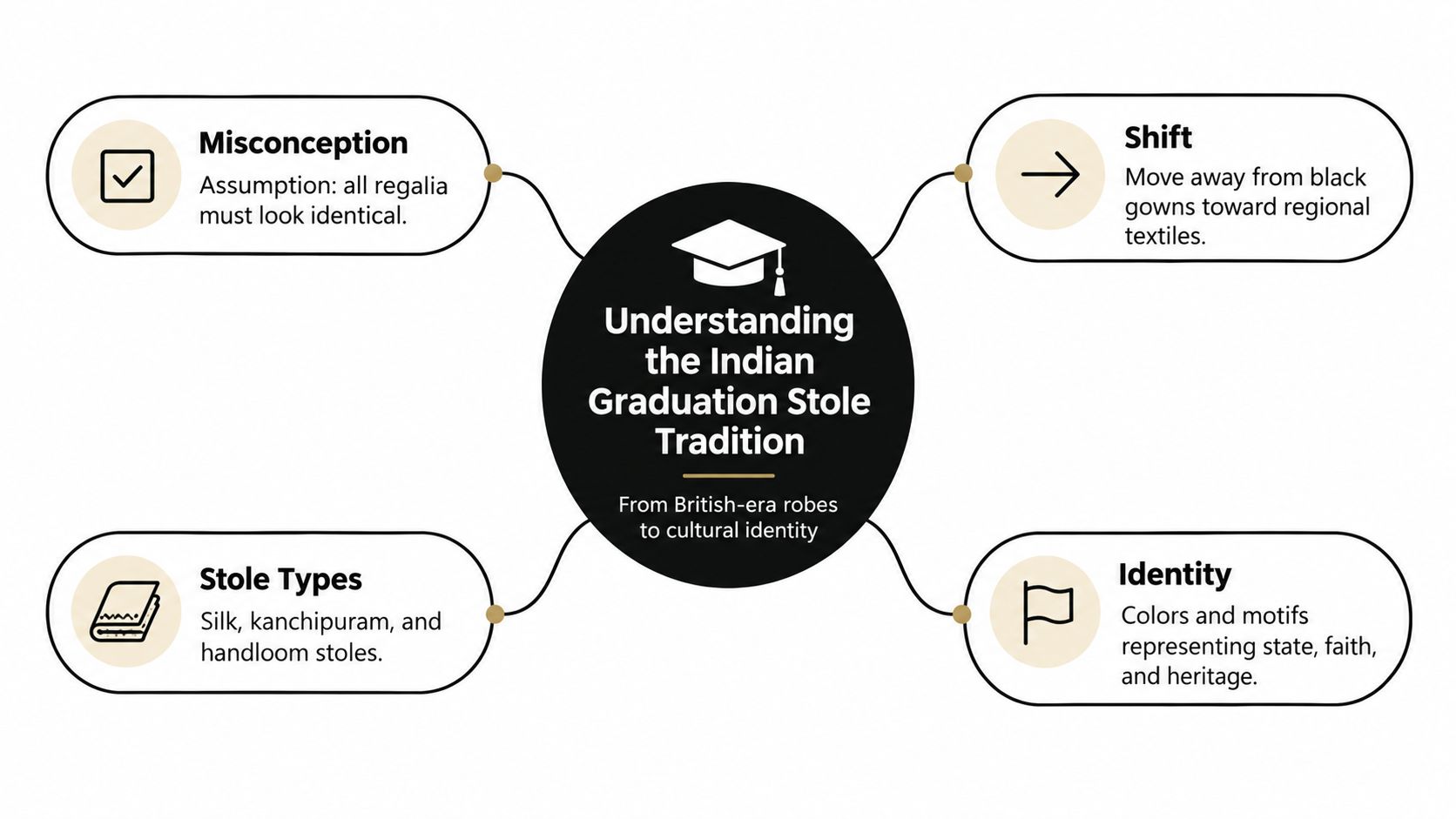
The assumption that all academic regalia must look identical doesn't fit the way Indian institutions are reshaping ceremony. Delhi University's 99th convocation in 2023 became a prominent example of this change. Reporting described a move away from standard black academic robes toward the angavastra, a stole-like garment worn across the shoulders by students and officials. The change was widely discussed because it replaced a British-era style with an Indian ceremonial alternative. Mint's coverage of the convocation dress debate connects the decision with a wider conversation about Indianizing convocation clothing at institutions including AIIMS and other central bodies.
From imported uniform to Indian visual identity
This shift isn't a matter of replacing one accessory with another. It asks universities what a formal academic milestone should look and feel like in an Indian setting. The angavastra draws on a familiar shoulder-draped form, while contemporary stoles can carry national colors, university colors, regional references, or carefully chosen motifs.
A stole therefore sits between academic uniform and cultural statement. Its position matters. Worn over the gown, it remains visible in procession photographs, on stage, and in family portraits. Its color can communicate degree level, while its design can communicate belonging.
That layered meaning has historical depth. Graduation stoles have documented roots in medieval clerical dress. One historical account connects them to garments worn by Catholic and Anglican priests, while another describes their use in the 12th century to indicate clerical rank or official position. A history of graduation stoles and sashes helps explain why a shoulder garment still carries authority in a modern ceremony.
What the stole communicates
The garment isn't automatically decorative just because it has a bright color or printed design. At a major university, it can form part of a structured visual system. At a cultural or community ceremony, it may carry a different responsibility, especially when symbols represent a family, faith, state, or heritage tradition.
Students sometimes compare an Indian stole with other identity garments, including Kente stoles and their meaning. The comparison is useful because it shows that ceremonial sashes can hold academic, cultural, and communal meanings at the same time. Before ordering, identify which message your ceremony expects the garment to convey.
The Language of Color and Rank in Regalia
At Delhi University's convocation, a family member can often identify a graduate's academic stage before hearing the degree title. The color functions like a label in a library: it helps readers understand the structure quickly, provided the institution has assigned the code consistently.
Undergraduate students wore yellow angavastras, postgraduate students wore turquoise, and PhD scholars wore red stoles, according to coverage of the university's ceremony and India's changing convocation dress. The colors distinguish academic tiers for students, officials, guests, and photographers. They also show how Indian ceremonial dress can connect older academic traditions with the practical need for a clear, modern visual system.
A practical color map
| Academic or ceremonial role | Example color | What the color can communicate |
|---|---|---|
| Undergraduate study | Yellow | Completion of foundational university study |
| Postgraduate study | Turquoise | Advanced or specialized academic work |
| Doctoral study | Red | Doctoral research and the highest degree tier in this system |
Use this table as a guide to the Delhi University example, not as a universal rule. A yellow stole at another institution might identify a discipline, honor society, or cultural group. Check the commencement handbook, department notice, or registrar's instructions before ordering or wearing a color. For a fuller explanation of what different stole colors may signal, read this guide to graduation stole meaning.
Academic regalia has never followed one worldwide color language. The University of Wisconsin Milwaukee's explanation of academic regalia explains that an Intercollegiate Code established formal design and color criteria in 1895. Earlier styles and colors did not have one standardized meaning, which helps explain why the same shade can signify different things at different ceremonies.
Academic field and affiliation
Color may identify a field as well as a degree level. Widely used regalia conventions associate white with arts and humanities, light blue with education, orange with engineering, drab with business, and dark blue with philosophy or political science, according to this guide to graduation stole colors. Depending on the university, these colors may appear on hoods, trim, cords, or stoles.
A separate stole can represent cultural heritage, Greek life, religious affiliation, community service, an international student association, or first-generation recognition. An overview of graduation sash meanings includes a black-and-gold stole for McNair Scholars and a pewter stole for honors students.
Follow the institution's required color code first. Add a personal or cultural stole only when the ceremony permits it and its message does not conflict with an official academic designation.
Materials, Sizing, and Customization Guide
A beautiful design can still look wrong if the stole is too short, too narrow, or too stiff for the gown. Start with the garment's drape, then evaluate the print, color, and personalization.
The measurements to compare
Indian academic-dress guidance commonly describes an adult stole as about 5 inches wide and 56 inches long, with custom lengths available for different wearers and ceremonies, as outlined in this guide to graduation dress in India. The broader academic-regalia market uses other conventions, including approximately 62 inches total length, a neck taper of about 4 inches, and a lower width of about 5 inches. Some suppliers also offer formats measuring 31 inches per side or 70 inches total, as shown in this university graduation stole sizing guide.
Those variations don't necessarily indicate a problem. Suppliers measure from different points, and a stole may be described by total length, length per side, or its finished shape. Compare the product's complete size chart rather than relying on the phrase “standard size.”
Use this checklist before ordering:
- Confirm the measuring method: Check whether the listed length means total end-to-end length or the length of one side.
- Check shoulder coverage: The stole should sit over the gown without crowding the neckline or hiding important hood details.
- Review the width: A width near 5 inches creates a visible ceremonial band without overwhelming the robe.
- Match the ceremony: If the university specifies a garment, use its dimensions and placement guidance first.
- Allow for the wearer: A custom length may improve the drape for a particularly tall or short graduate.
Practical rule: Measure the finished stole, not just the fabric before sewing. Tapered neck sections and stitched edges affect how the garment actually sits.
Why satin appears so often
Our India Flag Graduation Stole listing describes a fully lined bridal-satin stole with printed Indian flag imagery, arrow-pointed ends, and each side measuring 35 inches long and 5.5 inches wide. Check the product's current details and your institution's rules to confirm the design and fit you want.
That sheen has a trade-off. Satin can reveal creases, loose threads, or uneven folds more readily than a textured fabric. Inspect the seams, print alignment, neck shape, and reverse side before the ceremony.
Personalization choices
Customization may include printed text, embroidery, names, graduation details, national symbols, or institutional marks. Keep the main message legible from a normal viewing distance. A crowded stole can lose its meaning when multiple logos and phrases compete across the same surface.
For a broader look at lettering, color placement, and design decisions, this guide to custom graduation stoles is a useful reference. Ask your supplier for a proof when the stole includes a name, crest, or custom spelling. Proofing protects you from errors that won't be easy to correct after production.
Choosing Between Academic and Cultural Stoles
The central question isn't whether an academic stole or a cultural stole is more important. They answer different questions.
An academic stole usually tells the audience about achievement, field, honors, or institutional affiliation. A cultural stole tells the audience about identity, heritage, community, or national belonging. Some ceremonies allow both. Others specify one approved garment, one color system, or one arrangement over the gown.

Compare the purpose before the appearance
| Question | Academic stole | Cultural or identity stole |
|---|---|---|
| Main message | Degree level, honors, field, or organization | Heritage, nationality, faith, or community |
| Color source | University or academic code | Cultural meaning or group decision |
| Approval | Usually set by the institution | May require institutional and community approval |
| Best use | Formal recognition within the academic system | Personal and collective identity during a formal milestone |
An India flag sash can be meaningful for a student with Indian heritage, an international student connected to India, or a graduate whose family wants a visible national symbol in the ceremony. A regional handloom reference, religious motif, or family design may carry an equally personal meaning. The key is to use symbols accurately and respectfully, not merely because they look distinctive in photographs.
The same principle applies when comparing Indian and Tribal cultural regalia. Guidance on Tribal and cultural graduation supplies emphasizes that there's no universal gown color, stole design, or cord combination representing all Tribal Nations or Native students. Relevant communities or ceremony organizers should determine culturally significant colors, symbols, and designs.
A commercial supplier can reproduce a design. It can't decide whether that design represents your community correctly.
Check the rules early
Find the commencement dress code before you purchase. Look for instructions about:
- Approved garments: Determine whether the university permits personal stoles in addition to official regalia.
- Placement: Some ceremonies may require a hood, sash, or stole to remain visible in a particular position.
- Symbols: Ask whether flags, religious imagery, organization marks, or large text need approval.
- Multiple items: Confirm whether you may wear an academic stole, cultural stole, cords, medals, and hood together.
- Photography: If the ceremony has a formal portrait protocol, check which item should appear on top.
You don't have to choose between institutional belonging and cultural pride when the rules permit both. Coordinate colors and placement so each item remains readable. If the university's code is strict, wearing a cultural stole in family photographs before or after the ceremony may preserve the meaning without creating a stage-day conflict.
A short email to the registrar or commencement coordinator can prevent an uncomfortable conversation at check-in. Include a photograph or product description if the design is unusual, and request written confirmation.
Proper Draping and Styling Techniques
A stole should look intentional from the first row of the auditorium to the last family photograph. Most problems come from an uneven starting point, a twisted neck area, or fabric that hasn't been secured beneath the gown.
The centered shoulder drape
Start with the stole laid flat so you can identify its center and any tapered section. Place the center at the back of your neck, then bring both ends forward over your shoulders. Adjust the sides until they hang at equal lengths.
This is the cleanest arrangement for a formal academic look. The ends should fall down the front of the gown without crossing, while the neck section rests comfortably below the collar. Smooth the fabric with your hands, especially if the satin has been folded in transit.
The second option is a slightly more relaxed shoulder placement. Set the stole evenly behind your neck, then allow each side to follow the natural slope of your shoulders rather than pulling the fabric tightly toward the center. This keeps the front visible while reducing bunching around the neckline.
Securing the garment
Use small, discreet safety pins on the inside of the gown if the ceremony rules allow them. Pin the stole to the gown near the shoulder seam or beneath the collar area, never through a printed emblem or a visible front panel. Two secure points can help prevent shifting during a processional, handshakes, and hugs.
Avoid bulky clips. They can show through satin and may catch on the gown. If your stole includes embroidery or a heavy sewn emblem, test the balance while standing and walking before commencement morning.
Photograph check: Take a front, side, and seated photograph after dressing. A stole that looks centered while standing can shift when you sit or bend.
For a broader visual reference on arranging fabric around the body, master draping a skirt and collar offers useful principles about balance, folds, and controlled tension. The garment isn't a costume piece that should be pulled into complicated shapes. It should remain smooth, symmetrical, and easy to read.
Final stage-day check
Have a family member inspect the back of your neck and the lower ends. Confirm that the gown collar hasn't folded over the stole, that the colors face outward, and that the ends aren't tucked accidentally under the robe. Carry the stole flat or on a hanger, and put it on only after the gown is fully arranged.
Care, Maintenance, and Ordering Timeline
Custom work needs more planning than an off-the-shelf accessory. Place an order early enough to review the proof, receive the garment, check its size, and request an adjustment if the drape isn't right. Your university's ceremony date, supplier production schedule, and shipping method should determine the timeline, rather than the day you first see the product online.
For practical buying considerations, including supplier selection and delivery planning, consult this guide to where to buy graduation stoles. Keep the stole in a garment bag or loosely rolled during travel. Don't compress satin under heavy books, and don't leave it in direct sunlight for extended periods.
After the ceremony, follow the care label. Store the stole clean and completely dry, away from moisture and rough surfaces that could snag the fabric. Fold it along soft, natural lines or hang it on a padded hanger, and keep printed or embroidered areas from rubbing against zippers and metal hardware.
Graduation Cap and Gown offers an India Graduation Stole, India Flag Sash, alongside custom, international, cultural, and academic regalia accessories. Review the sizing and design options, then visit Graduation Cap and Gown to choose a stole that respects your ceremony's rules and gives your achievement a visible connection to your heritage.