

The most common advice about purple graduation caps is to match your school colors and choose a finish you like. That's incomplete. A cap can look right in photographs and still be wrong for commencement because the school requires issued attire, a particular tassel, or a different color for your degree.
Start with permission, then compare the products. Purple isn't a universal graduation color, and a product labeled for high school shouldn't be treated as university-approved regalia without confirmation.
Purple Cap Styles and Sizes at a Glance
A purple cap can differ in sheen and fit, so compare the finish and confirm sizing before ordering.
| Cap style | Finish and dimensions | Band |
|---|---|---|
| Shiny Purple High School Cap & Tassel | Shiny; mortarboard and tassel dimensions: confirm on the product page | One-size elastic |
| Matte Purple High School Cap & Tassel | Matte; mortarboard and tassel dimensions: confirm on the product page | One-size elastic |
| Purple in Deluxe, Eco-Friendly, Satin or Classic | These finish options are available; confirm purple dimensions on the product page | Confirm the purple band specifications on the product page |
Choose the finish only after school approval
The table compares finish and fit details, not ceremony eligibility. Ask your school whether it permits an independently purchased cap and whether it specifies a fabric finish. For Deluxe, Eco-Friendly, Satin or Classic options, check the individual product page for measurements and band details rather than assuming they match the high school styles.
Shiny fabric reflects more light, which can create bright highlights in photographs. Matte purple has less sheen and may appear darker beside a black gown, especially in dim light.
Check each product page to see whether a year charm is included and whether it costs extra. Confirm the required tassel color there as well; a purple cap does not guarantee a particular tassel or charm.
Before buying: A matching product photo does not confirm that a cap meets your school's requirements. Ask the commencement office about permitted colors, finishes and purchasing rules.
Check fit with the tassel attached
Use the graduation cap and gown size chart to review sizing before ordering. The elastic band is designed for one-size sizing, but the cap should stay secure without pinching or lifting when you turn your head.
Try it with the hairstyle you plan to wear. Keep the mortarboard level, attach the tassel without twisting its loop, and check that it hangs clear of the top button. If your school allows decoration, leave the tassel attachment area uncovered.
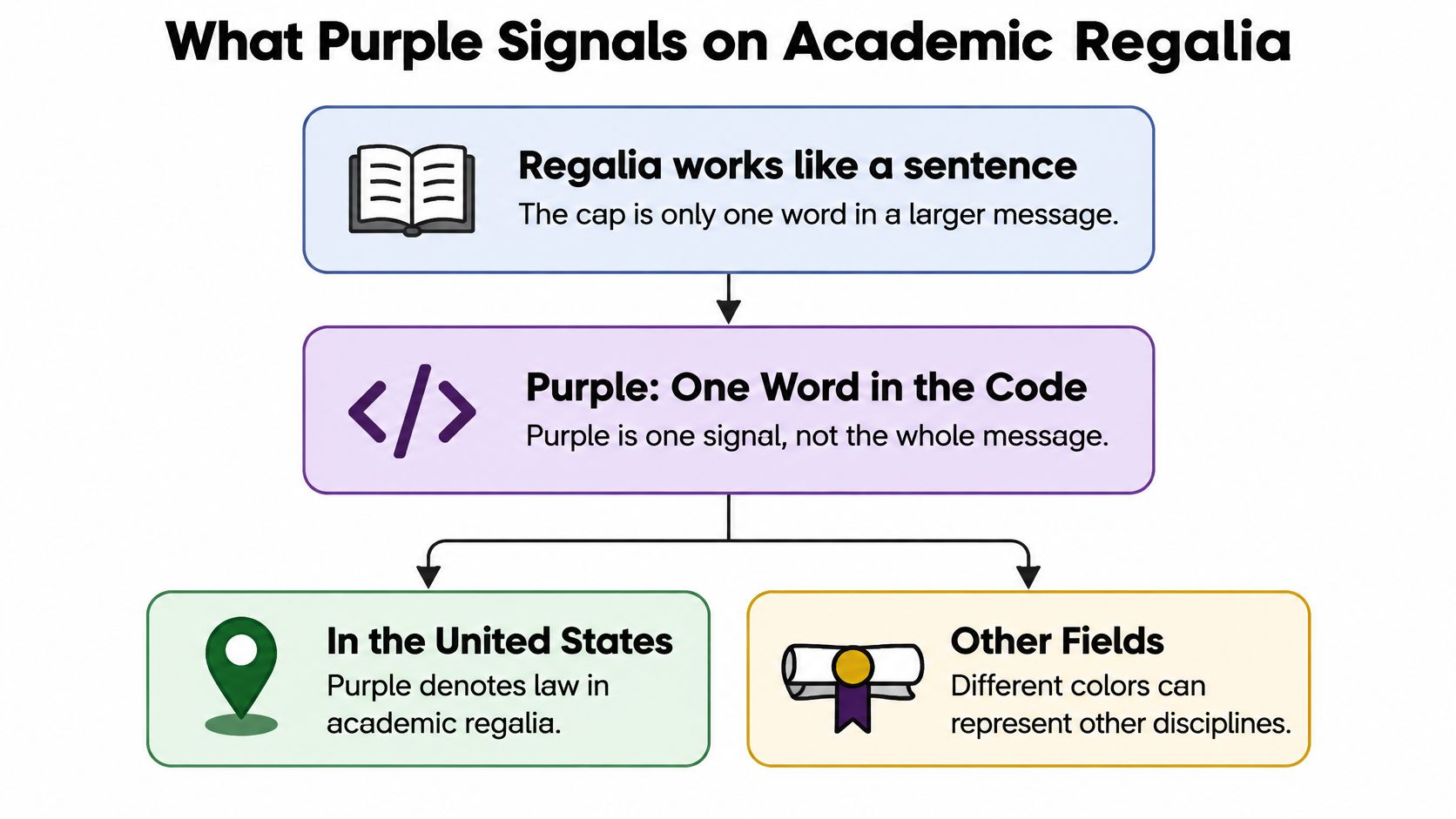
What Purple Signals on Academic Regalia
Regalia works like a sentence, and the cap is only one word. Purple contributes to the message, but you need the gown, hood, tassel, and institution's rules to understand what the graduate is wearing.
In the U.S. academic color system, purple denotes law, green denotes medicine, pink denotes music, orange denotes engineering, and golden yellow denotes science, as explained in Morgan State University's academic regalia color history. The disciplinary color commonly appears on a hood's velvet border or a doctoral gown's facing, not necessarily across the cap itself.
Read the whole outfit
A purple cap worn for law-related recognition may fit a school's academic conventions. That doesn't mean every law graduate must wear a purple cap, or that everyone wearing purple has earned a law degree.
At a high school, the same cap might match the school's branding. It could coordinate with a purple gown without identifying a subject, academic distinction, or professional qualification. The broader guide to graduation gown colors helps distinguish garment color from the meaning assigned to individual accessories.
Honors programs can use purple differently: the UC Davis history of regalia identifies purple and gold as the University of Colorado Arts and Sciences Honors Program colors. In that setting, the combination signals a program affiliation rather than law.
Institutional context remains decisive. The Victoria University explanation of graduation colors gives the University of New Mexico as an example where purple represents law and orange represents engineering.
Identify the meaning before choosing the accessory
Use this test when a school tells you to wear purple:
- Field: Does purple identify your discipline, and does it belong on the hood, facing, or tassel?
- Honors: Is it part of an approved honors-program combination?
- School brand: Is it an institutional color used across the graduating class?
These meanings can overlap, but they aren't interchangeable. An honors student shouldn't substitute a purple hood merely because their program uses purple accessories.
Purple changes how the regalia is interpreted, not the underlying cap design. A purple mortarboard is still a mortarboard; the school determines whether its color communicates something formal or just completes the ceremony's appearance.
Matching Purple Shades With Black Gowns
The hood often carries the most detailed academic information, so treat color matching as a component-level decision. A cap, hood lining, hood facing, and tassel don't necessarily need identical purple fabric to form a correct outfit.
The Hood College commencement customs guide distinguishes the academic information carried by hood design and color. For buyers, that means identifying which component must match the school's specification before trying to coordinate the entire outfit.
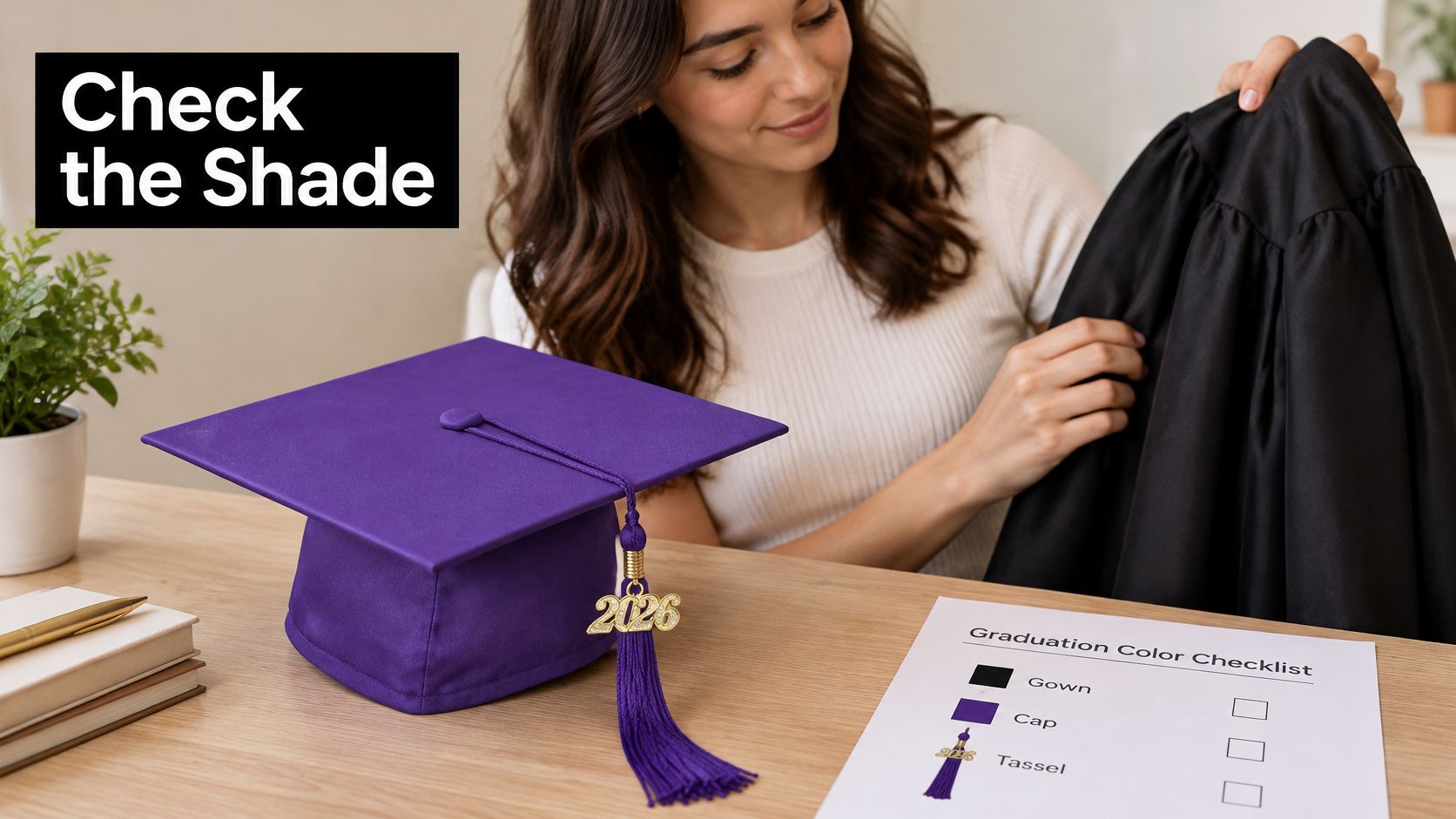
Test the shade in ceremony conditions
- Compare it with the approved swatch. Use the school's physical fabric reference when available, or its approved digital reference if that's all it provides. A screen image is useful for narrowing choices, but screen brightness and color settings can alter the apparent shade.
- View it under indoor lighting. Put the cap near the gown under lighting similar to the venue's. Warm room lights and cooler overhead lights can make the same purple look different.
- Photograph the combination. Take a picture with the cap beside the black gown, then inspect the image without adding a filter. This reveals whether the purple remains recognizable and whether the tassel or lettering is readable.
Compare deep purple with lighter violet
Say you place a deep purple cap and a lighter violet cap beside the same black gown. The deep purple may produce a restrained, nearly continuous dark silhouette, while the violet creates a more obvious color break.
Neither appearance is automatically better. If the approved school shade is deep purple, choosing violet for clearer photos would solve a photography problem by creating a regalia problem.
For permitted decoration, white or gold lettering can provide a clearer contrast against deep purple than dark lettering. Keep the official tassel color even if another color would photograph more brightly.
Judge the fabric beside the actual gown, not against a white shopping-page background.
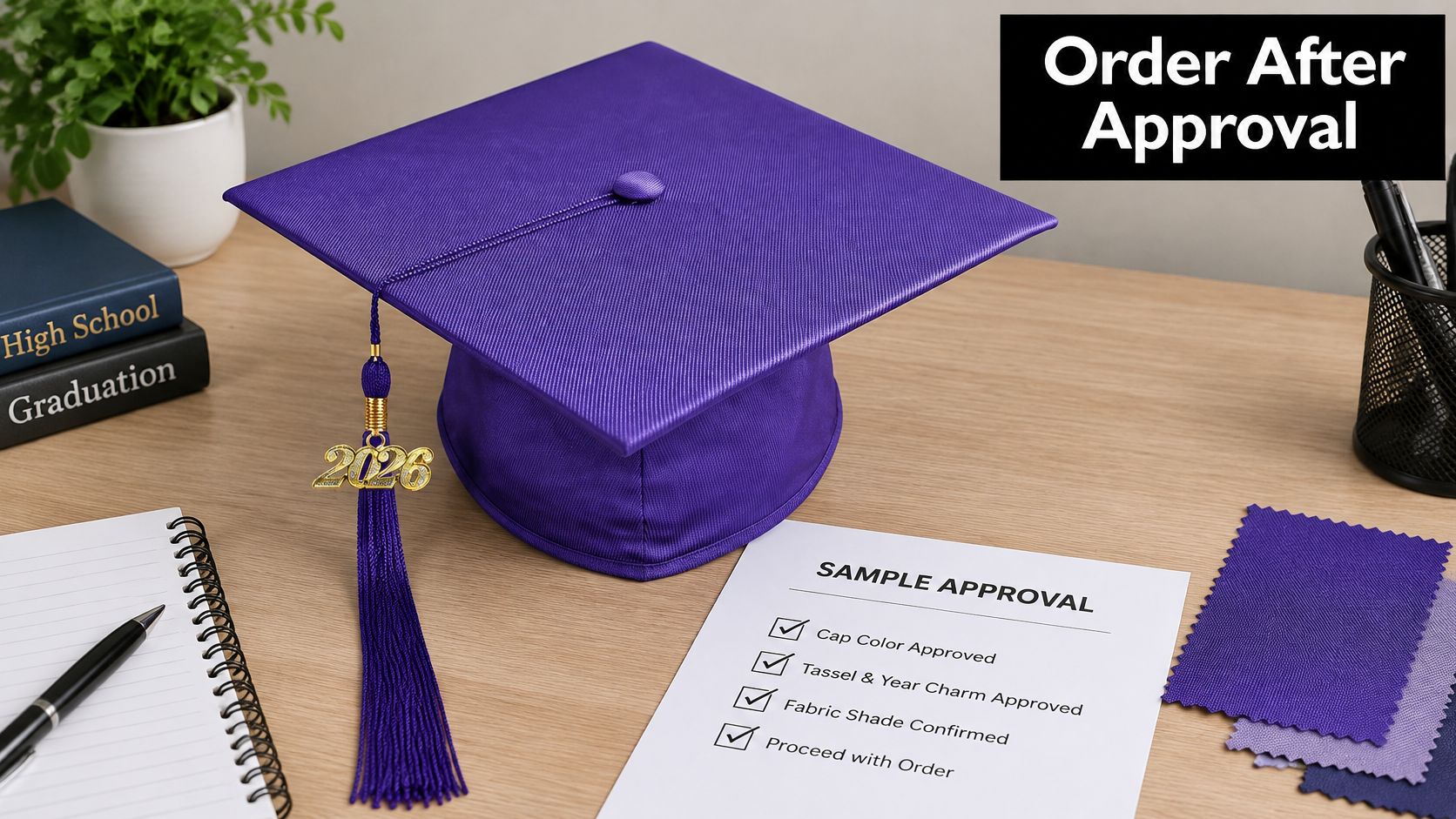
Request a physical sample when exact school-color reproduction matters. We offer product samples, which are especially useful for group orders where the organizer needs to evaluate caps and tassels together before selecting a consistent shade. Keep the approved sample with the order details so everyone is comparing against the same reference.
Checking School Rules and Personalizing Purple
A visually correct purple cap can still break commencement policy. Matching the school's shade doesn't override a requirement to wear institution-issued attire.
For example, Talladega College's commencement instructions state that students can't participate without its issued cap and gown. Creighton also permits only university-approved academic attire, so independent purchases need approval rather than an assumption that a close visual match will be accepted.
Follow the school checklist before purchasing
- Find the current commencement regalia guide. Start on the school's official website and select the information for your ceremony. Department celebrations and the main commencement may have different requirements, so check which event the guidance covers.
- Confirm the exact purple shade and its location. Ask whether purple belongs on the cap, the tassel, a hood component, or permitted decoration. Send a product photograph if the written instructions use a broad term such as school colors without identifying the garment.
- Check your degree level. High school, bachelor's, master's, and doctoral ceremonies don't use identical regalia conventions. Graduate-degree buyers should confirm the complete hood specification, not just the cap and gown color.
- Ask whether the school must issue the cap. A permitted color isn't necessarily permission to buy from a third-party retailer. If outside purchases are allowed, ask whether the school requires a particular finish, shape, or approved package.
- Get the decoration rules. Confirm whether decoration is allowed at all, then ask about height, cap-edge boundaries, wording, attachments, and tassel movement. Don't start gluing materials onto a cap while that permission is unresolved.
- Save the written answer with your order. Keep the approval email, product selection, shade reference, and ceremony information together. For a group purchase, give the same approved specification to every person handling orders.
A useful message to the commencement office is straightforward: you're considering a purple cap with a particular finish and tassel, and you want confirmation that it's acceptable for your degree and ceremony. Attach the product details and ask about any missing requirements.
Avoid asking only whether purple is allowed. That question can produce a correct but incomplete answer when the school permits purple tassels but requires black caps.
Keep the approval: Written confirmation is more useful than a remembered conversation when a coordinator needs to verify an unusual cap or accessory.
Personalize within the actual boundaries
Decoration policies differ sharply. UCF's graduate commencement guidance requires decorations to remain flat and no higher than the cap button, and it directs graduates with mobility, sensory, or communication-related needs to request accommodations.
Other institutions draw the line differently. Kansas State limits decoration to the flat top and prohibits designs extending beyond the cap perimeter, while NIACC prohibits writing or symbols on caps and permits only institution-sanctioned cords and stoles.
Those differences matter before you buy craft supplies. A design that meets a flat-top rule could still be prohibited at a ceremony that allows no cap decoration.
Use the graduation cap decorating guide for planning techniques only after establishing what your school permits. Treat a plain, unaltered cap as the default when the policy is unclear.
Design for visibility and comfort
Choose flat, lightweight materials such as thin cardstock shapes or fabric lettering. Lay out the design before attaching anything, and test a small concealed area if you're unsure how an adhesive will affect the finish.
Use these checks to keep the design practical:
- Readable lettering: Choose white or gold against deep purple rather than dark-on-dark text. Leave enough space between letters for the message to remain legible in a photograph.
- Low glare: Skip reflective foil and mirror-like pieces that can catch venue lighting.
- Clear attachment area: Keep the button exposed and the tassel's path unobstructed.
- Secure edges: Avoid loose corners, dangling ribbons, and materials that can catch on another graduate's clothing.
- Unblocked sightlines: Keep every element within the school's height and perimeter restrictions.
For photo-planning inspiration beyond cap decoration, Smartpicsuk®’s photo booth highlights from school proms can help you think about group arrangements and celebratory portraits. Keep the official ceremony outfit separate from any props or extras intended only for photographs.
Request accessibility accommodations early rather than expecting cap adjustments to solve seating, communication, or mobility needs. The commencement team can explain the arrangements available for the venue and procession.
Finish with a full wearing test. Put on the cap, attach the tassel, turn your head, and move the tassel as the ceremony requires. Ask someone seated behind you to check the view so your personalization doesn't become an obstacle for another graduate.
Accessories That Complete a Purple Look
Purple accessories and where each one fits
| Accessory | Common options | Where it fits | Check before wearing |
|---|---|---|---|
| Tassel | Solid, two-color, three-color, jumbo, Kente, LGBTQ | Matches school or degree color | Whether the school sets tassel colors |
| Stole | First generation, Kente, Greek, military, nursing, HBCU | Recognizes group, heritage or service | Whether the school allows stoles with the cap |
| Honor cord | School-approved honor or society colors | Academic honors or society membership | Whether the school approves it |
| Hood | Degree-specific velvet and satin colors | Master's and doctoral field and institution | Hood color rules for your degree level |
| Diploma cover | School-specified style or personalized cover | Presenting your diploma | Whether the school requires a specific style |
| Garment bag | Storage for the cap and gown | Transport and storage rather than ceremonial recognition | Whether the outfit can be packed without crushing the cap |

Choose accessories for the graduate's role
For a law graduate, a school-approved purple tassel may supply the appropriate accent without requiring a purple cap. Follow the institution's tassel instructions and keep the hood specification separate. The graduation tassel color meaning guide can help you identify the questions to ask before selecting a color.
For an honors student, purple and gold may identify a particular program rather than the degree discipline. Wear the approved combination in the form the program specifies, whether that's a tassel, cord, or another authorized accessory. Adding extra purple pieces doesn't make the recognition more accurate.
For a high school graduate, a purple tassel can coordinate with school colors when that choice is permitted. Once the school confirms the tassel color, the shiny cap set in the comparison table is an option for that accent; the matte set offers a different surface finish. Select the approved tassel rather than treating every available color as ceremony-ready.
Accessories can communicate more than the cap. Confirm what each item represents before combining them.
A single purple tassel is often the simplest, safest accent when it's approved, because it avoids adding unrelated recognition items. Keep diploma covers and garment bags focused on presentation and storage rather than trying to make every item part of the worn outfit. Add a stole or honor cord only when the school allows it with your cap and gown and confirms that you're entitled to wear it.
Order Your Purple Cap Set
Order only after the school approval and shade are confirmed. Choose the finish you tested beside your gown: shiny for a light-reflecting surface, or matte when the approved combination calls for a quieter appearance.
Complete the checkout check
Graduation Cap and Gown serves individuals and schools as a third-party vendor. We don't keep specific regalia information on file, so you'll need to obtain your institution's requirements before ordering.
Use our size, color, and fabric guides to confirm your selection. Don't assume that Shiny, Matte, Deluxe, Eco-Friendly, Satin, and Classic share the same construction or school approval because they're offered as material families.
- Fit: Confirm the band specification and leave room for the hairstyle you'll wear.
- Tassel: Check the selected color and make sure its loop can sit freely at the button.
- Accessories: Include only the pieces your school has authorized.
- Documentation: Keep the written approval and shade reference with the order confirmation.
Allow time for sample evaluation and questions, especially when a school or group needs a consistent appearance. For a bulk purchase, have the coordinator approve the final specification before individual orders begin.
The celebration can stay personal even when the ceremony outfit must follow strict rules. For a note to accompany a graduate's gift or photographs, Mail This offers ideas for heartfelt messages for high school graduates.
Send us the school's written requirements with your product questions, resolve any remaining differences, then place the order.
Graduation Cap and Gown offers purple cap-and-tassel sets, academic regalia, and accessories for different graduation milestones. Visit Graduation Cap and Gown with your school's approved specifications to choose the finish, fit, and accessories that belong at your ceremony.