

You're a few weeks from commencement, scrolling through purple graduation hats and trying to decide whether to choose the shade you like or the one your school expects. The listings look similar, but a purple mortarboard, a velvet tam, and a black cap with a purple tassel aren't necessarily interchangeable. Before you add anything to your cart, you need to know what your ceremony requires and which part of the outfit is supposed to carry the color.
Why the Color of Your Graduation Hat Matters
Color is part of the regalia specification, not just a styling choice. A hat can coordinate beautifully with your gown yet still be the wrong item for your ceremony. Start with the awarding institution's requirements, then use personal preference only where those requirements leave room.
Purple doesn't have one meaning across every graduation outfit. The University of New Mexico's commencement traditions identify purple as the velvet color for law, while institutional conventions can also use purple for university identity or recognition accessories. That distinction matters because a rule about hood velvet isn't automatically a rule about the cap.
Questions to Answer Before Shopping
- What does purple represent at your ceremony? Find out whether the color identifies the institution, an academic discipline, or an approved accessory.
- Which hat style is required? Look for the actual headwear specification rather than choosing by appearance.
- Is a purple cap approved? A purple element elsewhere in the outfit doesn't establish permission to wear a purple hat.
- What needs to match? Confirm whether your cap and gown should share a shade, and whether the tassel follows a separate color rule.
Quick Reference: What Purple Can Mean at Your Ceremony
| Where Purple Appears | What It Signals | Example Source |
|---|---|---|
| Cap fabric | School identity or an approved ceremonial color | Institution's regalia instructions |
| Tassel | A discipline or another school-defined designation | Registrar's tassel chart |
| Hood velvet | An academic field | University of New Mexico's law designation |
| Hood lining | The awarding institution | Institution's hood specifications |
Treat the table as a way to ask better questions, not as permission to select any purple item. The precise placement of color is part of the answer.
For outfit coordination, consult the graduation gown colors guide alongside your school's instructions. When comparing a standalone purple graduation cap with a complete package, check each component separately. A coordinated product photo can help you assess appearance, but it can't confirm academic eligibility.
The History Behind Purple in Academic Regalia
Purple's association with academic dress developed within a much older clothing tradition. European university gowns date to approximately the 12th century, while the modern American framework was formalized through the Intercollegiate Code of Academic Costume in 1895, according to the University of New England's academic-regalia history.
The code established standardized designs and colors for degrees. Within that tradition, purple signifies law, appearing on law hood edging and potentially on doctoral velvet facings and sleeve bars. The historical explanation connects purple with royalty and government: the color recalls kings and the authority associated with law.

Purple as a Visual Language
Think of academic colors as vocabulary within a ceremonial language. The University of New England distinguishes dark blue for Philosophy, green for Medicine, light blue for Education, golden yellow for Science, white for Humanities, and purple for Law. Each color helps observers interpret a particular part of the garment.
But universities don't all speak exactly the same visual language. The University of Colorado's academic-dress guidance assigns purple to law in master's and doctoral hood velvet; the University of Lausanne assigns purple to theology. Morgan State University also recognizes purple as a possible field color for law and human ecology.
Historical perspective: Purple has a formal academic meaning, but that meaning depends on the institution and the part of the regalia carrying it.
This is why identifying someone's degree from a purple hat alone is unreliable. American institutions retained room for their own colors and ceremonial traditions, even within a standardized system.
For a first-time buyer, the useful lesson isn't to memorize every discipline color. It's to distinguish historical convention from your ceremony's specification. History explains why purple law regalia exists; your university determines whether your cap should be purple, black, or another approved color.
A purple velvet law hood and a purple school-color mortarboard can therefore both be appropriate without communicating the same thing. Their shared hue doesn't erase the difference between an academic field and an institutional identity.
Cap, Mortarboard, and Tam Styles Explained
A graduation cap is a broad product description. A mortarboard or tam tells you more about the headwear's construction. When browsing purple graduation hats, pay attention to the shape as well as the color.
The mortarboard has a rigid, square top. A doctoral tam is softer and visually distinct: Montana State University's regalia information describes doctoral candidates wearing an octagonal, velvet-like hat, typically with a gold tassel. It also notes that academics frequently wear their doctoral regalia again after graduation.
Compare the Shape Before the Shade
Purple Graduation Hat Styles at a Glance
| Style | Typical Fabric | Best For | Visual Cue |
|---|---|---|---|
| Mortarboard | Check the product's fabric specification; matte options are available | A ceremony that specifies a standard cap, including approved school-color outfits | Rigid square top |
| Doctoral tam | Velvet or velvet-like material | Doctoral ceremonies that authorize this style | Soft, often octagonal crown |
| Beefeater or soft beret | Confirm material in the listing | An institution that explicitly specifies or approves the style | Soft headwear rather than a rigid square board |
Don't treat the table as a universal degree chart. For high school, bachelor's, and master's ceremonies, confirm the required cap in the school's instructions; for a doctorate, confirm the required tam or other headwear just as carefully. Degree level narrows your search, but institutional policy completes it.
The guide to graduation tams can help you recognize the difference when product photographs use unfamiliar terminology. Check whether the listing names the headwear shape and whether the tassel is included.
Match the Product to the Ceremony
A Matte Purple High School Cap & Tassel is a different purchase from a doctoral tam. The former offers a purple mortarboard with an optional tassel-color selection and a current-year charm; choosing the tassel still requires checking your school's color rule.
A Matte Purple High School Graduation Cap and Gown package groups the cap, gown, and tassel together. A Matte Purple Bachelors Cap & Gown addresses a different graduation level, so don't select solely because both packages look purple in the thumbnail.
For beefeaters and soft berets, ask the ceremony office to identify the acceptable style before ordering. A soft silhouette shouldn't be substituted for a prescribed tam merely because the colors match.
What Each Part of the Regalia Actually Communicates
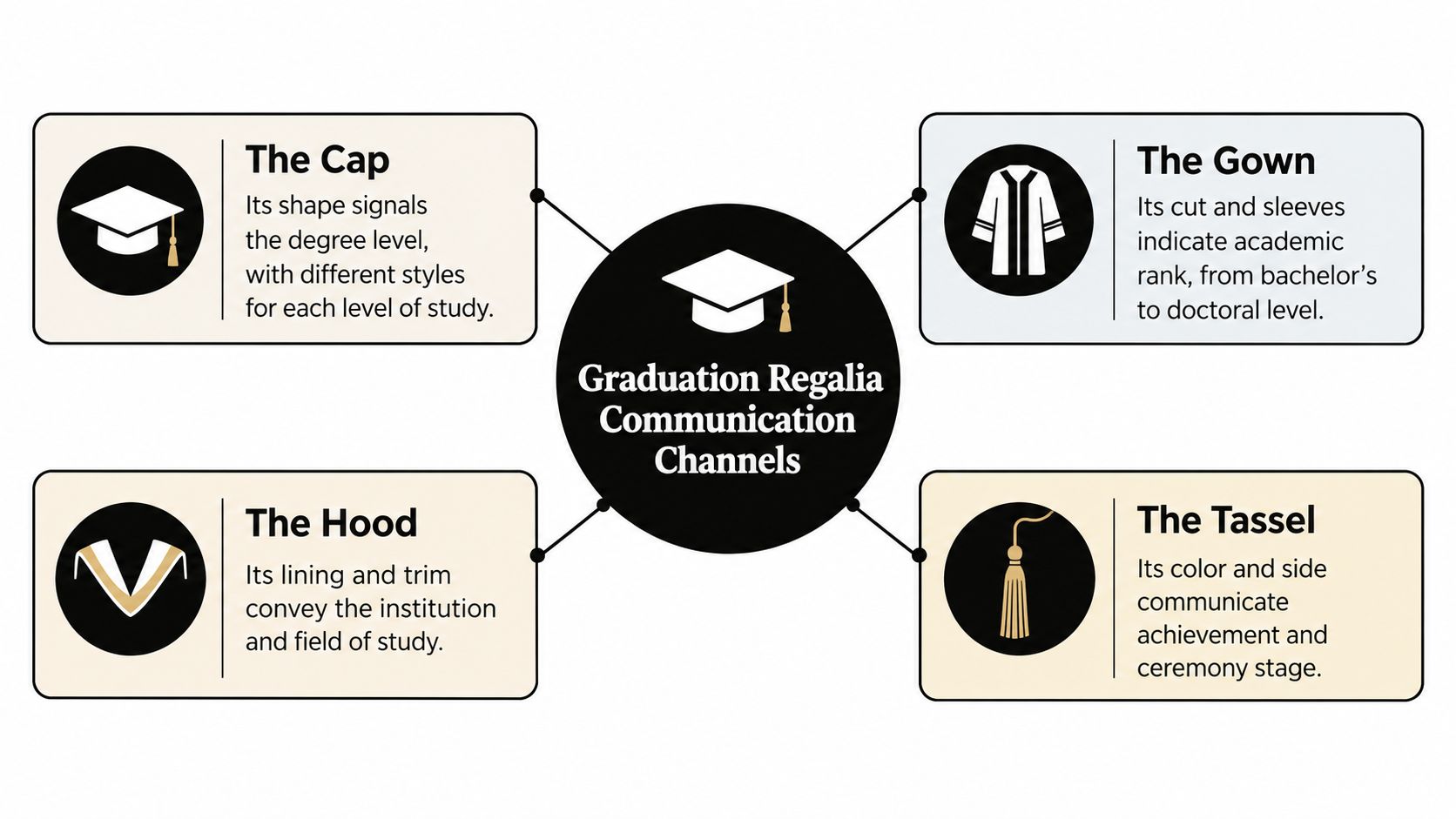
Consider an outfit with a purple tassel, purple hood velvet, and purple inside the hood. Those elements might look coordinated, but they can convey different information. Read the location of the color before interpreting its meaning.
The overview of academic regalia provides useful terminology for discussing these pieces with a registrar or supplier. Use the exact terms when asking questions: “hood lining” is more informative than “the purple part.”
Read the Outfit by Component
The cap's color may coordinate with the institution's outfit rather than identify the wearer's field. Its approved shape is a separate consideration, so neither color nor silhouette should be interpreted without ceremony context.
The tassel has its own rules. The University of South Carolina Registrar's academic-regalia guidance assigns purple to master's-level law degrees but gold to the Juris Doctor. That's a concrete reason not to assume every law graduate needs a purple tassel.
The hood's velvet edging identifies discipline. The University of Miami's regalia guide lists purple for law and specifies hood lengths of three feet for bachelor's degrees, three and a half feet for master's degrees, and four feet for doctorates. Color and length convey different information.
The hood lining identifies the awarding institution. Clemson's doctoral commencement guidance describes its registered purple lining with an orange chevron and states that it is presently the only institution with that registered combination. Purple inside that hood isn't, by itself, a law designation.
A purple tassel, purple hood edging, and purple hood lining aren't interchangeable academic labels.
Academic Units Can Set Another Pattern
Southern Methodist University's symbols and traditions explain that discipline colors can appear on mortarboard tassels, hoods, school gonfalons, and sometimes doctoral-gown chevrons. At SMU's Dedman School of Law, all degrees use purple.
For buyers, these examples establish a practical habit: describe the component, degree, and institution together. Asking for “a purple law accessory” leaves room for error; identifying the exact required piece gives the supplier something usable to verify.
The Verification Checklist Before You Click Buy
The risky assumption is that a visually convincing purple hat must be ceremony-correct. Instead, compare the listing with a written specification. If the school's instructions are incomplete, ask the commencement office or registrar before purchasing a substitute.
Save the relevant instructions with your order details. That gives you a reference if a tassel arrives in an unexpected color or a supplier asks which shade you need. For a last-minute purchase, request clarification immediately rather than relying on a generic color chart.
Build a Purchase-Ready Specification
- Confirm the ceremony and degree. Identify the awarding institution, academic unit, and graduation level. For multi-school events, keep each institution's requirements separate.
- Record the permitted headwear. Copy the required style and cap color into your shopping notes.
- Separate accessory requirements. Record the tassel, hood edging, and hood lining independently.
- Request a shade reference. Ask whether the institution provides an approved color name, physical sample, or standardized reference.
- Check fit and contents. Consult the graduation cap and gown size chart, then confirm the listing's measurements and included pieces.
- Resolve substitutions before ordering. Ask whether a different fabric, soft hat, or personalized cap is acceptable rather than assuming it is.
Bulk-order safeguard: Approve a sample against the written specification before committing to matching outfits for an entire group.
Consider Reuse Alongside Compliance
An approved purple cap may also be worth evaluating for its life after commencement. Ask about material content, durability, packaging, donation possibilities, and any take-back arrangements.
The Carmi discussion of graduation garments and sustainability notes that recycled polyester doesn't resolve disposal concerns when garments are still discarded. Its practical implication is to consider reuse alongside material claims, rather than treating “recycled” as a complete sustainability assessment.
Compare buying new with borrowing, sharing, renting, or purchasing reusable regalia where your ceremony permits those options. Don't order a noncompliant hat solely for its environmental description; choose an accepted item with a realistic plan for its next use.
Why Purple Is Harder to Match Than You Think
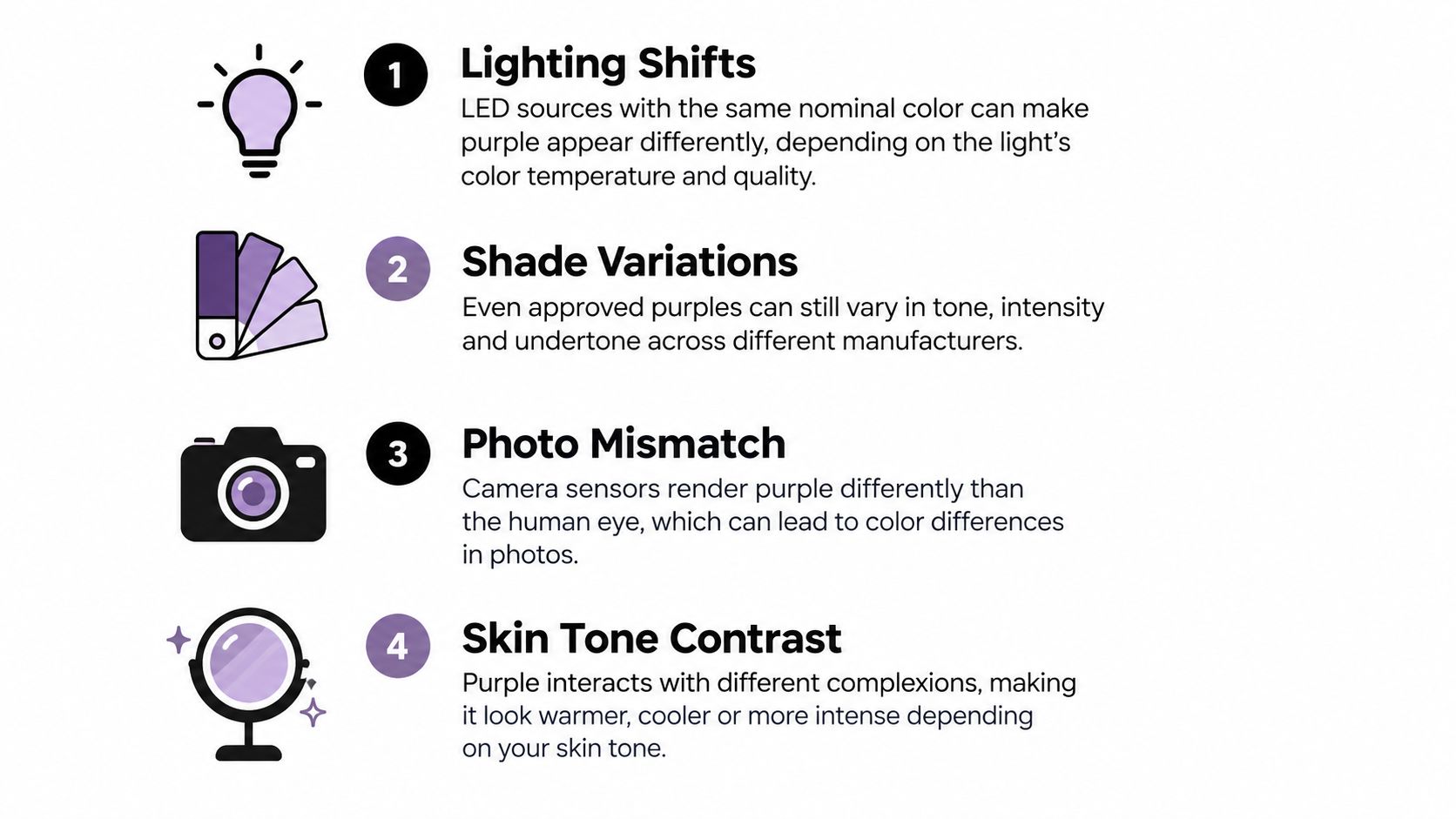
You can select the approved shade and still find that it looks different in the venue. Saturated purple is particularly sensitive to illumination. That makes color approval and color matching related but separate tasks.
Smithsonian research on textile color under LED lighting found that LED sources with the same nominal color temperature can produce substantially different perceived colors, with saturated purples among the hardest colors to render accurately. Purple combines reflected short-wavelength blue and longer-wavelength red light; changes in an LED's spectral output can alter their balance, shifting its appearance toward blue, magenta, or dull gray.
Test the Actual Outfit
An online photograph isn't enough to settle a close shade match. Obtain a physical swatch or product sample where possible, and compare it with the institution's approved reference. Place the cap beside the gown and other pieces you'll wear.
- Use representative lighting. Evaluate the purple under the commencement lighting if you can access the venue, or under several representative LED sources.
- Compare pieces together. Assess the full outfit rather than approving the cap and gown in unrelated settings.
- Keep a physical reference. Use the approved swatch or standardized color reference when discussing a mismatch with the supplier.
Prepare for Commencement Photographs
Tell the photographer that purple regalia will be prominent. Avoid relying entirely on automatic white balance, and request a test image under the ceremony lighting before formal portraits.
Photography note: Judge the garment in person and check a test photograph. Neither an attractive listing image nor a single camera preview is a complete color check.
For coordinators, make lighting review part of sample approval. A purple mortarboard that works under an office lamp may need another assessment under stage LEDs. Testing before the event gives you time to resolve questions while the supplier, venue team, and photographer can still help.
Choosing Your Purple Hat With Confidence
The strongest purchase decision combines academic correctness, fit, and an acceptable shade match. You don't need to become a regalia historian to choose well. You need a clear specification and a product listing that answers it.
Translate the school's requirements into a short buying statement, such as: “I need the approved mortarboard, the specified purple fabric, and a separately selected tassel.” For doctoral headwear, replace that statement with the institution's exact tam or other hat requirement. This turns a broad search for purple graduation hats into a focused comparison.

Choose Individual Pieces or a Complete Outfit
A standalone cap makes sense when you already have an approved gown and only need replacement headwear. A complete purple cap-and-gown package is useful when you need both pieces, provided the package matches your ceremony's requirements. Neither option removes the need to check the tassel selection.
For doctoral regalia, compare the headwear with the prescribed gown and hood rather than treating the tam as an isolated accessory. Ask the retailer to confirm the available purple shade, fabric, fit, and package contents before finalizing the order.
Make the Order Easy to Verify
- Use Find Your University. Treat the feature as a shopping aid for identifying school colors and packages, then reconcile the result with current commencement instructions.
- Check the complete order. Review every selected size, color, accessory, and included item before payment.
- Plan delivery around your deadline. Confirm current shipping choices and eligibility rather than assuming an urgent order will arrive in time.
- For group purchases, clarify terms. Ask how the lowest-price guarantee applies to your order and confirm fast-shipping options before committing.
Keep your approval email, shade reference, and order confirmation together. When the hat arrives, inspect it promptly and try it with the rest of your regalia. That final check lets you address a missing tassel, fit concern, or shade question before graduation day.
Graduation Cap and Gown offers individual caps, tassels, doctoral headwear, and complete regalia packages, including matte purple high school and bachelor's options. Visit the store with your school's specifications ready, use Find Your University to narrow your choices, and confirm the required style, shade, and delivery option before ordering.