

Does a royal blue cap and gown always mean the same thing at graduation? No. The shade can identify a school, a degree field, or a particular kind of regalia, and the right choice depends on more than color. Check your degree level, the school's current specifications, and the fit before ordering.
A gown can look right in a product photo and still fail a school's dress rules. Treat the blue as a starting point, then verify the gown, hood, trim, and accessories your ceremony requires.
Where Royal Blue Appears by Degree Level
Royal blue shows up in different places depending on the degree, and that placement changes what you need to buy. Start with the degree level, then check where your school puts the blue.
| Degree level | Where royal blue usually appears | Hood length or color carrier |
|---|---|---|
| Bachelor's | Tassel or school-specified accessories | No hood; discipline color usually on the tassel |
| Master's | Hood velvet and gown design | 3.5 feet in the UT Tyler example |
| Doctoral | Gown velvet panels, tam, and hood velvet | 4 feet in the UT Tyler example |
The UT Tyler regalia policy separates the baccalaureate mortarboard and gown from a master's gown with elongated sleeves and a 3.5-foot hood. It also describes doctoral regalia with a 4-foot hood, tam, velvet panels, and chevrons. The policy puts discipline colors on master's and doctoral hoods as velvet, while bachelor's graduates wear the discipline color on the tassel. That distinction matters more than the blue itself. A bachelor's tassel color does not tell you what hood or gown a doctoral graduate should wear.
Read the row before choosing a package
Find your degree row first. Then compare it with the school's official regalia chart, paying attention to gown design and the pieces that carry color. A royal blue bachelor's set is not a suitable replacement for a master's or doctoral package just because the school also uses royal blue. The degree-level design and accessories can differ, and the hood may carry separate information about the institution and field. Hood length changes the silhouette, and schools that specify a 3.5-foot hood may not accept a doctoral-length hood.
For a broader overview of how gowns differ across degree levels, see this guide to types of graduation gowns.
Before you shop, write down your degree level and the color placement your school lists for it. I would keep that note beside the product page while you compare, so you buy against the right row instead of choosing by shade alone.
Reading Royal Blue Across Real Commencements
What does royal blue signal on a commencement stage? It depends on where the blue sits. In traditional U.S. academic regalia, velvet trim can identify a discipline, the hood lining shows the degree-granting institution, and the gown shell can carry the school's own chosen color. Dark blue traditionally represents philosophy, including Ph.D. regalia, even when the doctoral subject is engineering, education, or another field. The Intercollegiate Code of Academic Costume overview describes that distinction and traces academic dress to medieval university traditions.

Velvet-versus-lining test: Blue on velvet trim may indicate a discipline. Blue on the gown shell or hood lining may be an institutional color. Check the school's chart to confirm which role it plays.
The same color, different dress codes
At the University of Notre Dame, royal blue is part of the doctoral gown itself. Doctoral students wear royal blue robes and tams, with royal blue velvet front panels, gold-embroidered university shields, and royal blue sleeve chevrons outlined in gold, as described in Notre Dame's account of commencement traditions. The color runs through the whole garment; the panels and chevrons are what mark it as doctoral.
San José State University takes a stricter line. Its current commencement regalia rules require students to wear the university's new royal blue regalia and prohibit older attire or garments that don't match current university colors, branding, or styling. A close-enough shade can fail at the check-in table, which is a poor place to learn your gown is a season out of date.
Royal blue also attaches to a field rather than the full gown. Southern Illinois University lists it as a tassel or hood color for bachelor's degrees in philosophy and political science in its graduate regalia guidance. At the University of Wisconsin–Milwaukee, royal blue appears for a Master of Arts in Philosophy and as velvet for the PhD, according to its commencement attire guidance. Same two words on the order form, three different pieces of fabric.
Ready-made royal blue sets exist across that same range. Graduation Cap and Gown carries royal blue alongside Antique Gold, Black, Burgundy, Emerald Green, Navy Blue, Purple, Red, and other shades in Shiny, Matte, Deluxe, Eco-Friendly, Satin, and Classic materials, and its Shiny Royal Blue High School Cap and Gown lists at $26.95, as low as $21.56 with volume pricing. Color availability and price say nothing about approval, though. Your school's chart settles that.
Then there's fit, which gets far less attention than shade. A gown that gaps at the shoulders or pools past the shoe photographs worse than a color that is one step off, and graduates using wheelchairs or crutches need a hem that clears the ground and sleeves that won't catch on wheels or grips. Check the size, color, and fabric guides before you order, not after the gown arrives.
The same blue can mark a major, a doctorate, or an institution. Your school's official regalia chart resolves which one applies to you, and fit resolves whether anyone notices the gown at all.
Confirming the Exact Royal Blue Your School Uses
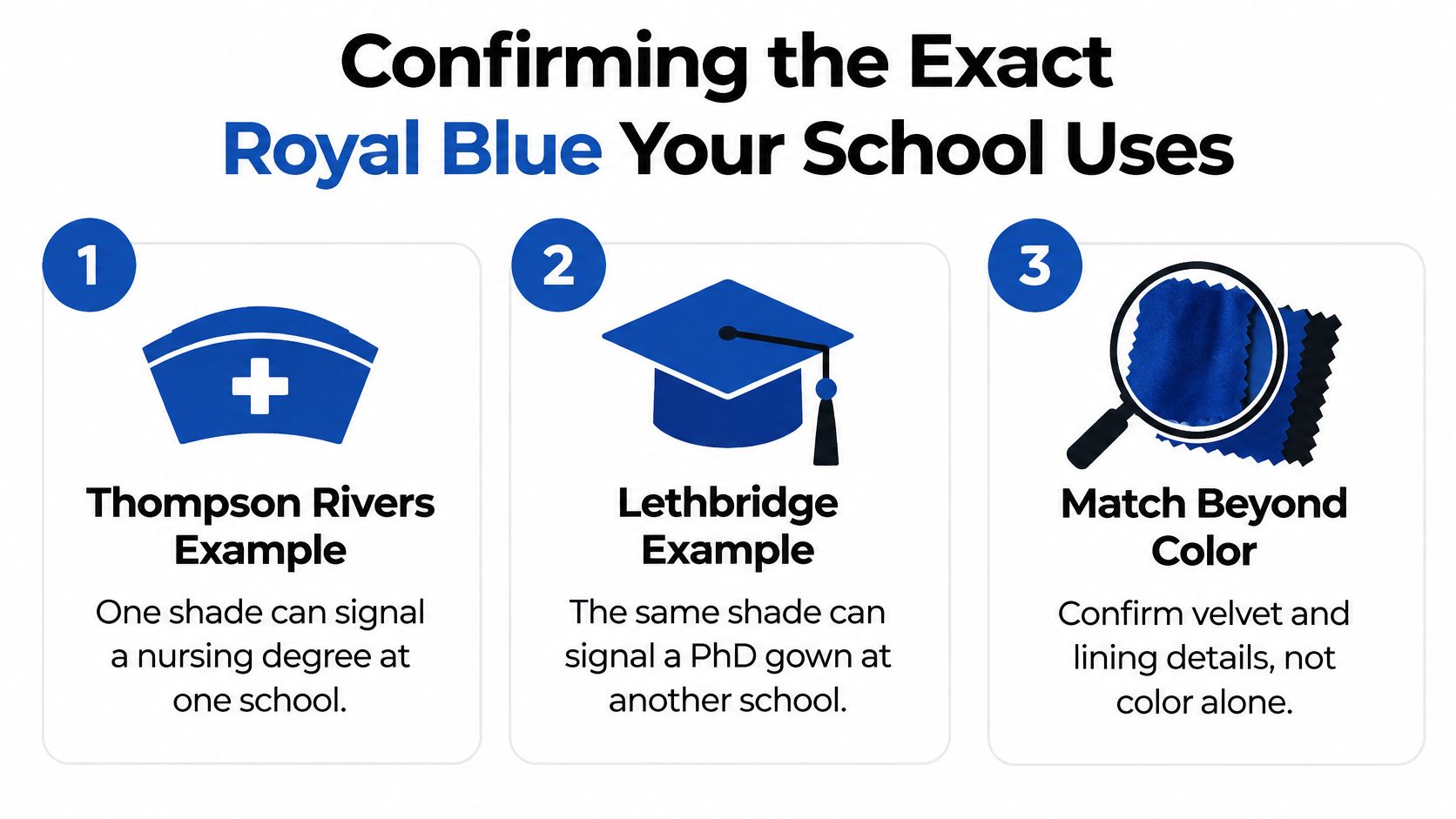
A color match can still be academically wrong. Thompson Rivers University uses royal blue for Bachelor of Science in Nursing regalia, while the University of Lethbridge specifies a royal-blue PhD gown with walden-blue velvet facings, gold piping, and a matching beefeater. These examples in the University of Lethbridge academic-dress specifications show why you need to confirm the whole outfit, not just the gown color.
Send the school a focused checklist
Email the commencement office and ask it to confirm each item that applies:
- Gown shell: Ask which official shade the school currently uses. “Royal blue” on a product listing may not match the school's approved color.
- Hood lining: Confirm the institution's colors and how they're arranged. The lining can use more than one color.
- Velvet trim: Ask for the approved discipline color and whether it belongs on your hood, gown, or both.
- Piping: Check the color and placement, especially if the school specifies contrasting edges.
- Tam or beefeater: Confirm the required doctoral headwear and whether it must match the gown.
- Tassel and honor cords: Ask for the tassel color and check with the school before choosing honor cords.
Small differences between royal blue, navy, and light blue can show up in photographs, procession lines, and group ceremonies. If the school uses a particular shade, a similar-looking blue isn't necessarily an acceptable substitute. Schools can change apparel colors from year to year, so Graduation Cap and Gown recommends contacting your school directly for its current specifications.
Graduation Cap and Gown is a third-party vendor serving both individuals and schools, and it doesn't keep specific regalia requirements on file. You'll need the school's written direction before placing an order. Its guide to graduation gown colors can help you understand color terminology, but your commencement office sets the requirements for your ceremony.
Email the checklist, get the reply in writing, and only then place your order. That written confirmation gives you a clear standard for comparing the shade, trim, and accessories.
Fabric Choices for Royal Blue Gowns
| Option | Best for | Limits |
|---|---|---|
| Shiny finish set | A crisp look under stage lights for a single ceremony | Lightweight; repeated machine washing will wear it out |
| Matte finish set | A softer look that photographs without glare | Lightweight; repeated machine washing will wear it out |
| Lightweight polyester | Quick drying, wrinkle recovery, and event-scale distribution | Usually single-use or souvenir wear; sun exposure can fade the color |
| Heavier durable textile | Doctoral regalia or repeated institutional use | Higher cost and more demanding care |
Finish changes how royal blue reads in photographs and from the stage. The Shiny Royal Blue High School Cap and Gown and the Matte Royal Blue High School Graduation Cap and Gown show the two families: one picks up light, the other absorbs it. Neither finish makes a gown acceptable where the school requires a particular shade or trim. That approval comes from the commencement office, and every fabric choice should be checked against its written direction.
Match the textile to the number of wears
Polyester is the workhorse of high-volume commencement. It resists stretching, abrasion, mildew, and shrinkage, dries fast, and holds heat-set pleats and creases. Those traits help when a school needs hundreds of gowns delivered close to ceremony day, or when a graduate is ordering late and needs a garment that travels and stores easily.
The trade-off is service life. Lightweight polyester is commonly built for one ceremony or souvenir use; repeated machine washing breaks down the finish, and long sun exposure can dull royal blue. Degree level changes the expectation here: a high school royal blue set is usually a lightweight one-day garment, while doctoral regalia is built for repeated ceremony use and closer inspection. If the gown will be worn for doctoral ceremonies, faculty events, or several seasons of institutional use, a heavier textile with professional cleaning is the more economical choice over time. That costs more up front, but repeated replacement rarely saves money.
Use lightweight polyester for a one-day ceremony. For doctoral regalia or repeated wear, choose a heavier textile, plan for professional care, and confirm the school's fabric and color requirements before ordering.
Store the gown clean and dry, out of direct sunlight, on a broad hanger. That protects the color and helps the pleats hold their shape between events.
Sizing and Fit for Every Graduate
A small, medium, or large label tells a graduate almost nothing about how a gown will hang. Regalia sizing runs on height and weight, and some university guidance covers ranges above 6 feet 10 inches and above 500 pounds, according to the Alamo Colleges commencement guidance. If your measurements sit outside a manufacturer's standard chart, that is the kind of page to read before assuming a stock size will work.
Fit is part of ceremony access, not just appearance. A gown that drags, catches on a wheelchair, or restricts arm movement can make walking, sitting, or crossing the stage harder. A loose fit is only useful if the graduate can move safely in the garment. I treat the school's chart as a floor rather than a ceiling, because the chart tells you what will be issued, not what you can move in.
Measure for the actual ceremony
Before choosing a size, gather the details that affect how the gown will work:
- Height and weight range: Use the school's sizing chart, not an everyday clothing size.
- Sleeve length: Check whether the sleeves allow comfortable movement and won't interfere with a mobility device.
- Hem length: Measure with the shoes you plan to wear. Confirm that the hem won't drag or create a tripping hazard.
- Movement: Try sitting, climbing stairs, and walking across a room in the gown if possible. Ask the school whether the hem and sleeves meet its expectations for the procession and stage.
- Cap security and comfort: Ask how to secure the cap if hair, headwear, or sensory needs make the standard fit uncomfortable.
- Heat: Consider what you'll wear underneath. Polyester can feel warm, so plan a comfortable base layer and check the venue conditions.
For help thinking through how clothing labels relate to body measurements, this overview of size labels retailers should measure offers useful context. Graduation regalia still needs to be checked against the school's own measurement guidance and the way you'll move on ceremony day.
Graduation Cap and Gown publishes size, color, and fabric guides alongside product samples, order forms, and payment options, and its graduation cap and gown size chart gives you a starting point for comparing measurements against a vendor's own range. A chart still can't tell you whether a gown will clear a particular mobility device or accommodate a sensory need.
Send your measurements and mobility or sensory questions to the school's accessibility services. They can address procession and ceremony accommodations, so the regalia you buy meets the dress rules and supports safe, comfortable movement.
Order Your Royal Blue Set Before the Deadline
Royal blue orders go wrong on timing more often than on color. A gown that arrives a week after the ceremony, or one that needs exchanging because the sleeves hang past the wrist, costs more than any upgrade you might have chosen at checkout.
Work through these in order:
- Get the school's written shade and trim specification. Ask for the gown shell, hood, velvet, piping, and tassel exactly as the school lists them for this year, not as they appeared in last year's program.
- Choose the finish and fabric around reuse. One ceremony and several years of faculty processions do not justify the same purchase. The fabric section covers how shiny and matte surfaces wear and reflect light.
- Confirm fit with the school's numbers, then check sleeve and hem. Measure in the shoes you plan to wear on stage.
- Leave a buffer for exchange. Ordering early enough to fix a wrong shade or a short gown matters more than a few dollars of difference.
A ready-made starting point is the Shiny Royal Blue High School Cap and Gown, listed at $26.95 with volume pricing as low as $21.56. Its finish is the reflective one described earlier, so the same crease and photography trade-offs apply.
The Matte Royal Blue High School Graduation Cap and Gown uses the flat surface instead, which reads darker under gym lighting and stage lights. Both are high school sets. Use them to compare price and finish, then move to institution-specific regalia if your degree level calls for a hood, a tam, or velvet trim.
Graduation Cap and Gown also sells customizable bachelor's cap, gown, tassel, and hood packages, and master's packages shipped to the customer's home. For the sequence itself, this guide to how to order a cap and gown walks through the paperwork. Whatever your degree level, the school's written specification is the document that decides the order.
Graduation Cap and Gown stocks royal blue regalia, degree-level packages, and size, color, and fabric guides for comparing options. Visit Graduation Cap and Gown once the school's requirements are in hand, then choose the set that matches both the dress code and your fit needs.