

You're standing in a crowded commencement line, adjusting your cap while your family searches the seats for your face. Then your sorority graduation stole catches the light. The Greek letters, chapter colors, and carefully chosen details make your identity visible beneath the standard gown, turning a formal academic uniform into a record of the community that helped you reach the stage.
Choosing one, however, involves more than picking a color and entering a graduation date. You'll want to understand what the stole represents, which details belong to your chapter, how fabric affects the finished look, and whether your university allows it at all. The right decision respects both sorority tradition and commencement policy.
What a Sorority Graduation Stole Actually Is
A graduate steps toward the stage, and a satin sash falls over the academic gown. Greek letters may be visible before she reaches the diploma table. That garment is a sorority graduation stole, worn over the gown to show membership, achievement, and chapter affiliation during commencement.
The stole usually uses one long strip of fabric folded across the shoulders. Its center rests at the back of the neck, with both ends hanging down the front. The shape resembles a label placed over a standard uniform, adding personal and organizational meaning without replacing the gown. Because it becomes part of the ceremony's regalia, the regalia office or student affairs administration may set rules for its size, design, and use.
A stole belongs to a different category from other graduation pieces:
- Honor stole: Recognizes an academic, leadership, cultural, or institutional distinction.
- Cord: Uses a thin braided or twisted design to represent honors, membership, or achievement.
- Sash: Often crosses from one shoulder toward the opposite hip, although sellers and schools sometimes use the terms loosely.
- Ribbon or pin: Adds a smaller mark of affiliation without the full drape of a stole.
A graduate might select a standard Greek-letter design, a chapter-specific piece, or a custom sorority stole with personal details. Newly initiated seniors may use one to mark the close of undergraduate membership. Alumnae returning for honorary recognition may choose a design that reflects an ongoing connection. Chapter expectations and university rules determine whether the design is appropriate, so personal preference is only one part of the decision.
Practical rule: Treat the stole as ceremony uniform first and keepsake second. Confirm permission before finalizing a custom design.
The National Panhellenic Conference reports 5,588,276 women initiated across its member organizations, including 367,647 undergraduate members and 136,969 new members initiated in its latest fast-facts release (National Panhellenic Conference membership facts). That institutional presence helps explain why Greek-letter stoles appear at commencements across many campuses, rather than representing one school's isolated custom. Before ordering, compare the visual options in this guide to stoles for graduation, then check your school's regalia instructions and your chapter's preferred identity details.
Why Sorority Stoles Carry Meaning at Commencement
As your name is called and your degree is conferred, a sorority stole can bring a less visible part of college life into the ceremony. Its fabric may carry founding ideals, ritual language, official colors, chapter friendships, service work, and personal milestones. What once belonged to chapter rooms and informal gatherings becomes part of a public academic moment.
Greek-letter organizations have long used mottos, colors, symbols, and rituals to express shared identity. Chapters bring those traditions into different campus communities while preserving recognizable ties to their broader organizations. That history helps explain why a stole can function as a cultural marker, rather than as decoration chosen only for appearance.
Campus reports show how widely fraternity and sorority life can be woven into undergraduate communities. One large public university reported 3,787 fraternity and sorority students, representing 18% of 20,681 undergraduates, including 2,086 Panhellenic women and an average chapter size of 231. Another reported 947 sorority members among 7,111 undergraduates, including 291 new sorority members in a single year, with an average NPC sorority chapter size of 101.11 (university fraternity and sorority life report).
Those figures provide context for the stole's public role. A student may have worn chapter letters casually, attended private rituals, or served in leadership without those experiences appearing in commencement regalia. The stole makes that history visible alongside the degree, connecting academic completion with the community that shaped the student's college years.
A keepsake, not disposable decoration
Families often photograph the stole before the ceremony. Chapter sisters may coordinate colors, compare embroidery, and preserve their pieces together after graduation. Over time, the garment can become a physical record of one undergraduate chapter and a reminder of the relationships that continue into alumnae life.
That meaning should guide the purchase. A graduate seeking only a permitted accessory may choose a simple ready-made design. A graduate treating the stole as a record of sisterhood may prefer durable fabric, approved symbols, and personalization that will still feel appropriate years later. The design should carry the story clearly, without adding so many details that the chapter identity disappears.
School rules and chapter expectations still set the boundaries. Confirm them before ordering, especially if the stole will include custom wording or organizational symbols. For more context on the traditions behind commencement accessories, read this guide to graduation stole meaning.
Chapter Colors, Greek Letters, and Personal Identity
Every sorority graduation stole carries two identity systems. The first belongs to the organization. The second belongs to the individual graduate. Separating those systems makes customization easier and helps prevent a meaningful design from becoming visually crowded.
The official chapter layer
The official layer should remain recognizable at a glance. It may include:
- Greek letters: The clearest marker of affiliation.
- Chapter colors: Use the approved palette rather than a close substitute that photographs differently.
- Crest or shield: Include it only when the chapter or national organization permits its use.
- Founding details: A founding year or formal symbol may reinforce the organization's history.
- Required typography: Some headquarters offices expect specific fonts, spacing, or letter treatment.
A chapter advisor or national organization may require a design review, especially when a crest, shield, trademarked letterform, or official emblem appears. Copyright and trademark questions aren't merely technical. A vendor may be able to produce a design, but that doesn't mean the buyer has permission to reproduce every organizational mark.
The personal story layer
Personal details can make the stole feel like yours without changing its chapter identity. Possible additions include a graduation year, major, leadership position, line name, pledge-class nickname, study-abroad flag, or affiliation with another campus community. Cross-cultural society details can also belong here when the student wants the stole to acknowledge more than one part of her experience.
A simple two-side layout often helps. Place official letters and the chapter emblem on one side, then use the other side for the graduate's year, role, or academic field. This keeps the organization prominent while giving the wearer room to tell a personal story.
Design principle: Protect the elements that identify the chapter. Personalize the space around them.
The decision about approval depends on the source of the design. A chapter-wide order typically benefits from one approved template, while an individual purchase may give the buyer more flexibility. Even then, the university's ceremony rules still control what can appear on stage. Ask both the chapter advisor and the commencement office when the design combines Greek letters with flags, seals, cultural symbols, or another organization's logo.
Materials, Finishes, and Customization Options
Fabric determines how a sorority graduation stole hangs, reflects light, feels against the gown, and accepts decoration. Medium- to high-quality satin or silk-like fabric is common because it provides a smooth drape and polished sheen. Higher-quality satin generally supports cleaner embroidery, while polyester and nylon versions make sense when durability, lower cost, or mass production matters more than a luxury hand-feel (graduation stole fabric guide).
Choose decoration after choosing the fabric. Raised embroidery suits Greek letters, chapter crests, and short formal wording because thread adds texture and visual weight. Flat printing handles fine detail and complex imagery more easily. Sewn or iron-on patches can provide a practical upgrade, but they may look less integrated than decoration produced directly on the stole.
Match the finish to the ceremony
A glossy satin design photographs brightly under stage lighting. A matte polyester surface creates a quieter appearance and can work well for a coordinated group order. Velvet adds texture but can feel heavier against a gown, while twill offers a firmer, more structured appearance. The best choice depends on whether the stole should look formal, expressive, durable, or easy to manage in large quantities.
Use the available school guidance as your baseline rather than relying on a retailer's standard dimensions. Some institutions specify stoles between 3 and 5 inches wide and 68 to 74 inches long, while also limiting decoration to no more than 12 inches on each side (commencement regalia guidelines). A retailer may list a different standard, so compare both before ordering.
| Fabric | Best Decoration Method | Look and Feel | Price Tier |
|---|---|---|---|
| Satin | Embroidery or clean lettering | Smooth, reflective, formal drape | Higher |
| Polyester or nylon | Embroidery, printing, or patches | Lightweight, durable, practical | Lower to mid-range |
| Velvet | Appliqué or restrained embroidery | Textured, rich, more substantial | Mid to higher |
| Twill | Embroidery or sewn patches | Structured, matte, sturdy | Mid-range |
For edge treatment, a merrowed hem gives the border a clean finished look. Piped trim creates stronger visual definition, while fringe feels more decorative and may suit a celebratory chapter design. If you're comparing layouts, fabrics, and decoration methods, the guide to a custom graduation stole can help you narrow the options before requesting a proof.
School Rules Every Sorority Member Should Know
The university decides whether your sorority graduation stole can appear in the ceremony. Don't assume that a design worn at another campus will be accepted at yours. Start with the academic regalia office, commencement website, or student affairs office, then look for rules covering accessory approval, colors, logos, dimensions, and the number of draped pieces.
The policies below show why a quick check matters:
- LIFE University: Administration must approve cords, stoles, pins, or other marks of distinction, and each graduate may wear one stole. If a student qualifies for more than one, she must choose one (LIFE University commencement policy).
- Shippensburg University: A stole is defined as a decorative, cloth, scarf-like garment for recognized college organizations. Students may wear one stole, and non-academic stoles require approval from the Dean of Students (Shippensburg commencement accessories policy).
- Kansas State University: Organizations seeking approved adornments must submit requests by October 1 for Fall Commencement or March 1 for Spring Commencement. The university asks for a single type of adornment rather than multiple types (Kansas State regalia guidelines).
- Louisiana State University: Stoles, ribbons, and sashes require approval from the Office of Academic Affairs at least 30 days before the ceremony, and special regalia belongs to students who earned an honor or received approval (LSU academic regalia policy).
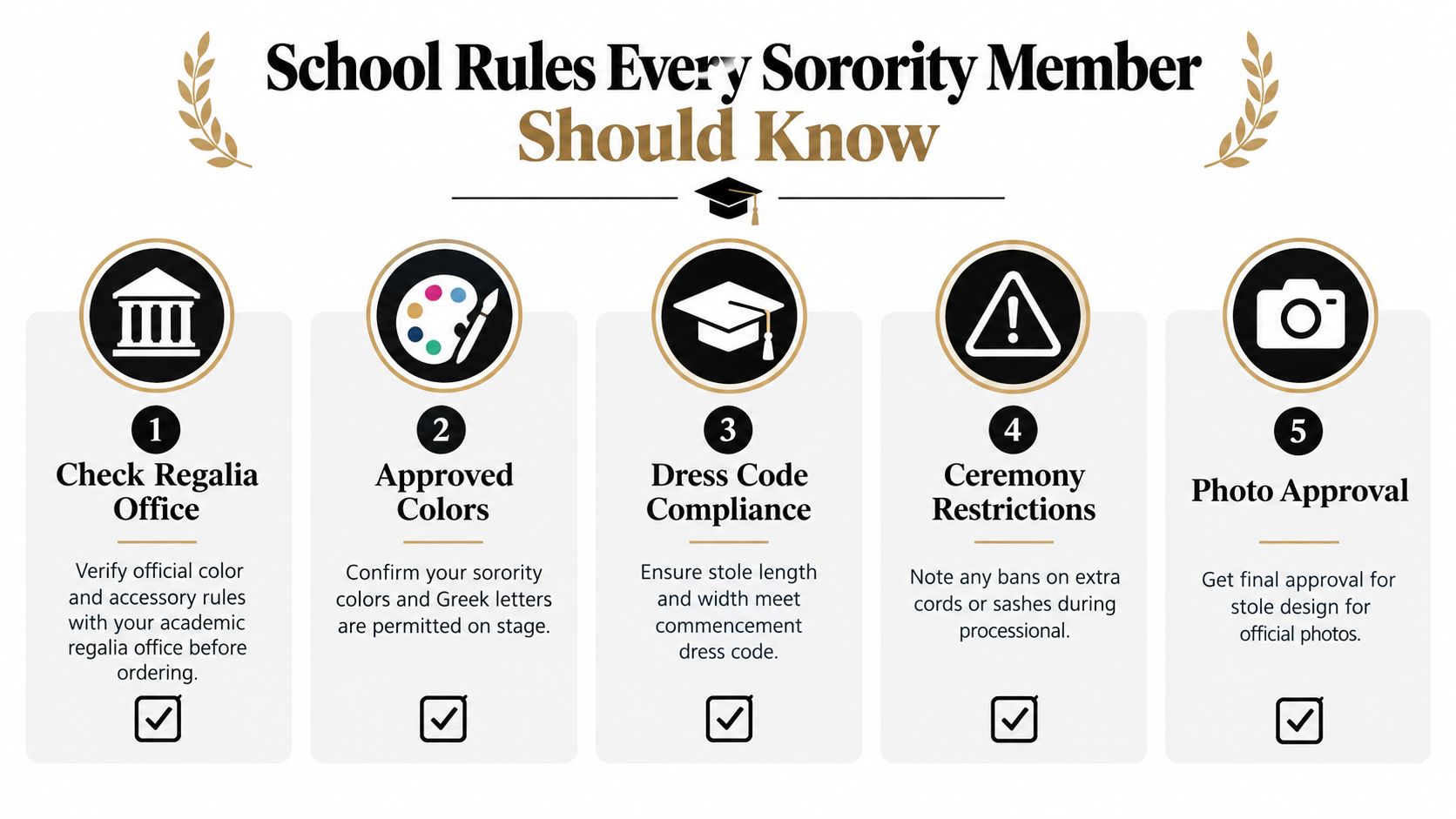
A practical approval checklist
- Check the regalia office: Find the official accessory policy before placing an order.
- Confirm colors and letters: Ask whether chapter colors, Greek letters, and crests are permitted.
- Compare dimensions: Make sure the selected width and length fit the dress code.
- Ask about combinations: Confirm whether cords, honor stoles, cultural stoles, or pins can be worn together.
- Save written approval: Keep an email, form confirmation, or approved design image for ceremony day.
Decoration can trigger a review even when the stole itself is allowed. Word count, flag imagery, university seals, outside logos, and conflicting organizational colors may cause questions. If your school uses coordinated apparel for other milestone events, resources such as a school leavers uniform polo illustrate why institutional clothing often follows specific design expectations.
How to Wear, Layer, and Care for Your Stole
Begin with the center of the stole at the back of your neck. Let both ends fall over the gown, with the Greek letters or crest facing outward and the fabric lying flat. Adjust the shoulders until the ends hang evenly, then check the result from the front and side before taking photographs.
The stole should sit over the gown collar without twisting. If your university permits additional accessories, ask which piece belongs closest to the gown. A cord may rest over the stole or beneath it, while a second cultural stole may not be allowed at all. A hood, pin, medal, or charm can also change how the fabric sits, so test the complete combination with your actual gown.
Keep the fabric in place
A discreet pin at each shoulder can prevent slipping, but place it through the gown or lining rather than through embroidered letters. A hidden tack on the gown's inner lining can provide extra stability during the processional. Avoid fastening through a crest, metallic thread, or delicate edge finish.
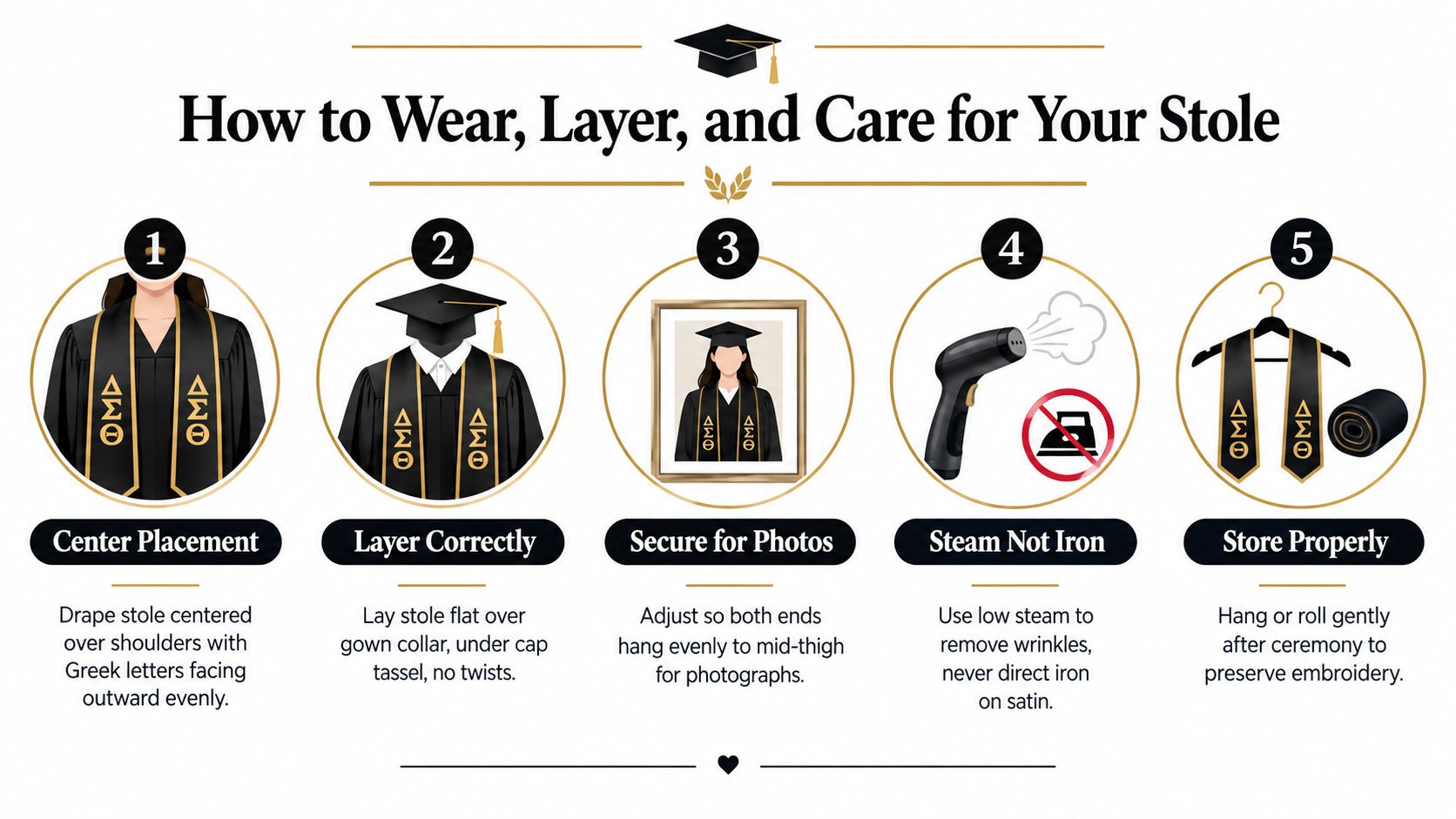
Before photographs, smooth the front panels and confirm that neither end has rotated. For wrinkles, use gentle steam rather than placing an iron directly on satin or embroidery. Steam from a short distance, let the fabric settle, and avoid soaking the decoration.
After the ceremony, store the stole flat or roll it gently around a clean support so sharp folds don't set into the fabric. Keep it away from direct sunlight, which can affect dye over time. An archival box or breathable garment bag can protect the piece as a personal keepsake, or allow a chapter to preserve it for future display.
Sizing, Ordering Timeline, and Group Purchase Tips
Measure before you browse designs. Place the measuring tape at the shoulder or back of the neck, run it down over the gown, and estimate where you want the ends to finish. Compare that measurement with the vendor's chart, allowing room for the academic robe rather than measuring only over a shirt.
A group purchase needs more coordination than an individual order because one design, one approval process, and many personal details must align. A chapter point person should collect names, sizes, Greek-letter spelling, personalization, payments, and shipping information in one shared spreadsheet. A central record prevents a correct design from being paired with the wrong graduate.
Work backward from commencement
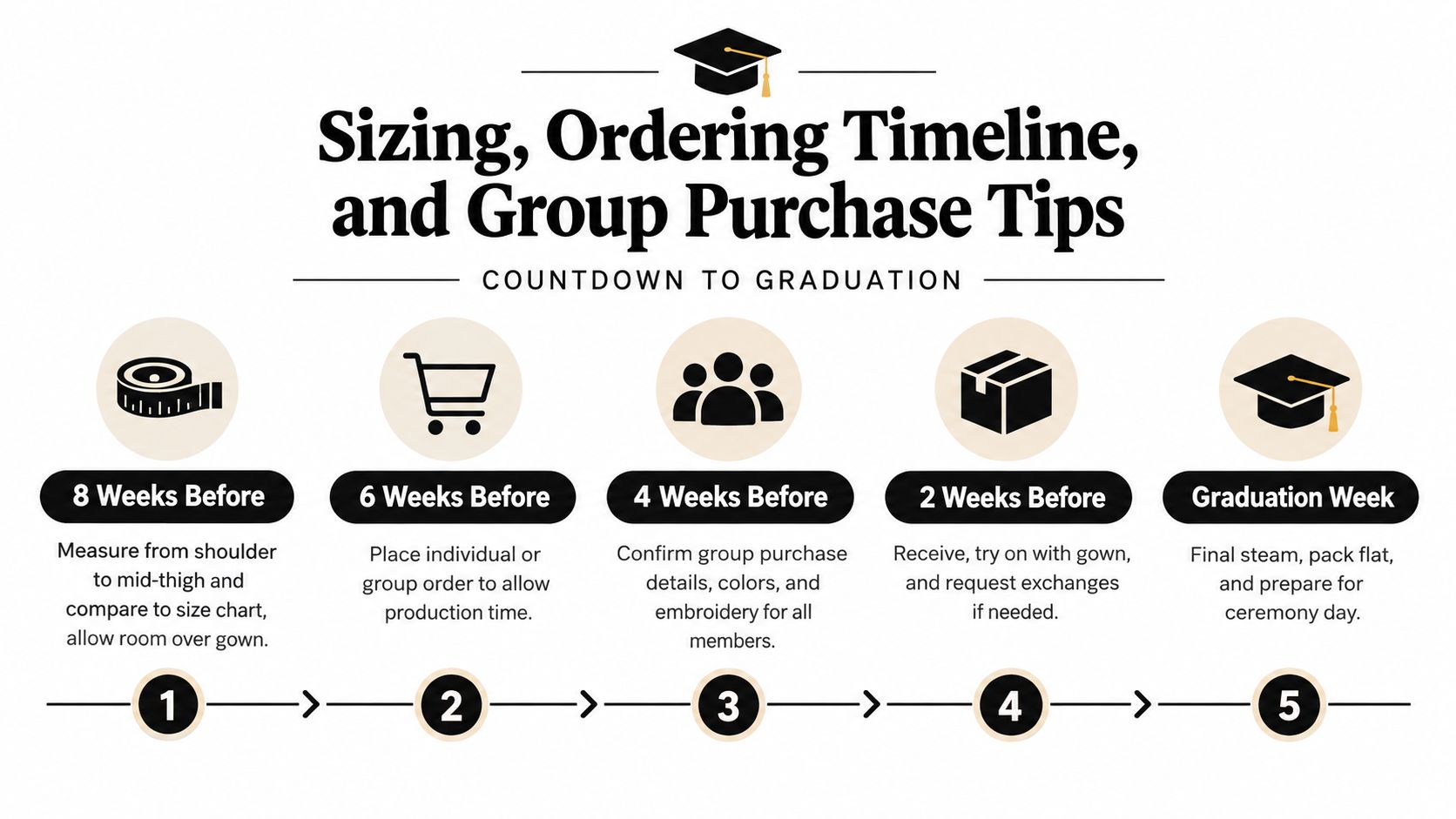
Use an eight-week countdown for an individual order, and start earlier when chapter approval or multiple proofs are involved:
- Eight weeks before: Measure with the gown in mind, review the school's policy, and choose the fabric and layout.
- Six weeks before: Submit the individual or group order after checking every spelling and color choice.
- Four weeks before: Confirm the chapter list, design proof, recipient details, and delivery address.
- Two weeks before: Receive the stoles, try them on with the full regalia, and request an exchange if necessary.
- Graduation week: Steam carefully, pack the stole flat, and prepare a discreet fastening method.
The timeline infographic follows the same practical sequence, from measuring to ceremony preparation.
For larger orders, compare production schedules and request a digital proof before approving the full batch. Bulk purchasing can simplify color matching and chapter consistency, but only if the coordinator sets a firm cutoff for names, sizes, and payments. A wholesale guide for graduation stoles can help chapter organizers evaluate group-order options.
Last-minute buyers should ask about ready-to-ship inventory and rush production, while remembering that accelerated orders may limit color matching or customization. Keep the confirmation email, inspect the package as soon as it arrives, and know what you'll wear if shipping is delayed or a piece arrives damaged.
Graduation Cap and Gown offers sorority graduation stoles, Greek-letter designs, custom graduation accessories, and group-order options for graduates coordinating chapter details. Review the available Graduation Cap and Gown collections after checking your school's rules, then choose a stole that fits your ceremony, identity, and timeline.