

You're probably here because graduation is close, your gown is handled, and one detail still feels oddly complicated: the Greek graduation stole. You know you want something that represents your fraternity or sorority well, but once you start shopping, the questions pile up fast. Which fabric looks better in photos? Does length matter? Should the letters run straight across or down the panel? And where does the stole sit if you're also wearing cords or a medal?
That confusion makes sense. A Greek stole seems simple until you have to choose one that looks right, fits your gown, follows ceremony expectations, and still feels personal. I've seen students realize only days before commencement that their stole hangs too low, bunches under a medal, or hides the very letters they wanted everyone to see.
This guide is built for that moment. It connects the meaning behind Greek stole traditions with the practical decisions that matter on commencement day. If you want a quick grounding in how regalia works overall, this overview of academic regalia basics is a helpful companion.
Introduction to the Greek Graduation Stole Tradition
The ceremony starts, the procession turns the corner, and families in the stands begin picking out their graduate before a name is ever announced. The black gowns look uniform from a distance. The stole is often the detail that changes that. Greek letters, chapter colors, and a familiar crest can make one student instantly recognizable in a sea of caps and gowns.

That moment may feel current, but it grows out of a much older campus tradition. Fraternities and sororities have shaped student identity for well over a century, and the Greek graduation stole is one of the newer ways that history shows up at commencement. The stole is not an old academic requirement in the way a gown or hood may be. It is a modern expression of Greek affiliation laid over older regalia customs. If you want a quick foundation on how those older customs work, this overview of academic regalia basics helps place the stole in the full commencement outfit.
That history matters because it clears up a common misunderstanding. Students sometimes assume every part of a Greek stole, from satin fabric to letter placement, comes from a long-set ceremony rule. In practice, many of those details come from recent design habits, campus preferences, and visibility on stage. The tradition is old in spirit and newer in format.
A good way to read the stole is as a nameplate for one part of your college life. The gown says, "I am graduating." The Greek stole adds, "I also belonged to this chapter, this service tradition, or this sisterhood or brotherhood." That is why students and chapter coordinators care so much about getting it right. A stole carries meaning, but it also has to photograph well, sit cleanly over the gown, and remain readable from the audience.
Many buying decisions go sideways. A student may choose a color that matches the chapter perfectly but disappears against the gown in photos. Another may order extra-long panels because they look dramatic online, then find they tangle with cords or hang past the point that looks balanced. Lettering creates the same problem. Large vertical Greek letters can be easy to read from the stands, while a crowded layout with a crest, year, motto, and chapter name can turn an important symbol into visual clutter.
So the tradition is not only about symbolism. It is also about judgment. The best Greek graduation stoles connect chapter history to practical commencement choices, especially fabric, length, and lettering placement. That decision framework is what many quick guides skip, even though it is usually the difference between a stole that feels meaningful and one that just feels purchased.
What a Greek Graduation Stole Is and Why It Matters
A graduate steps into line wearing the standard cap and gown, then adds one more piece across the shoulders. Suddenly the outfit says more. A Greek graduation stole is a wide satin sash that shows fraternity or sorority membership through Greek letters, crests, founding years, chapter names, and class-year details.
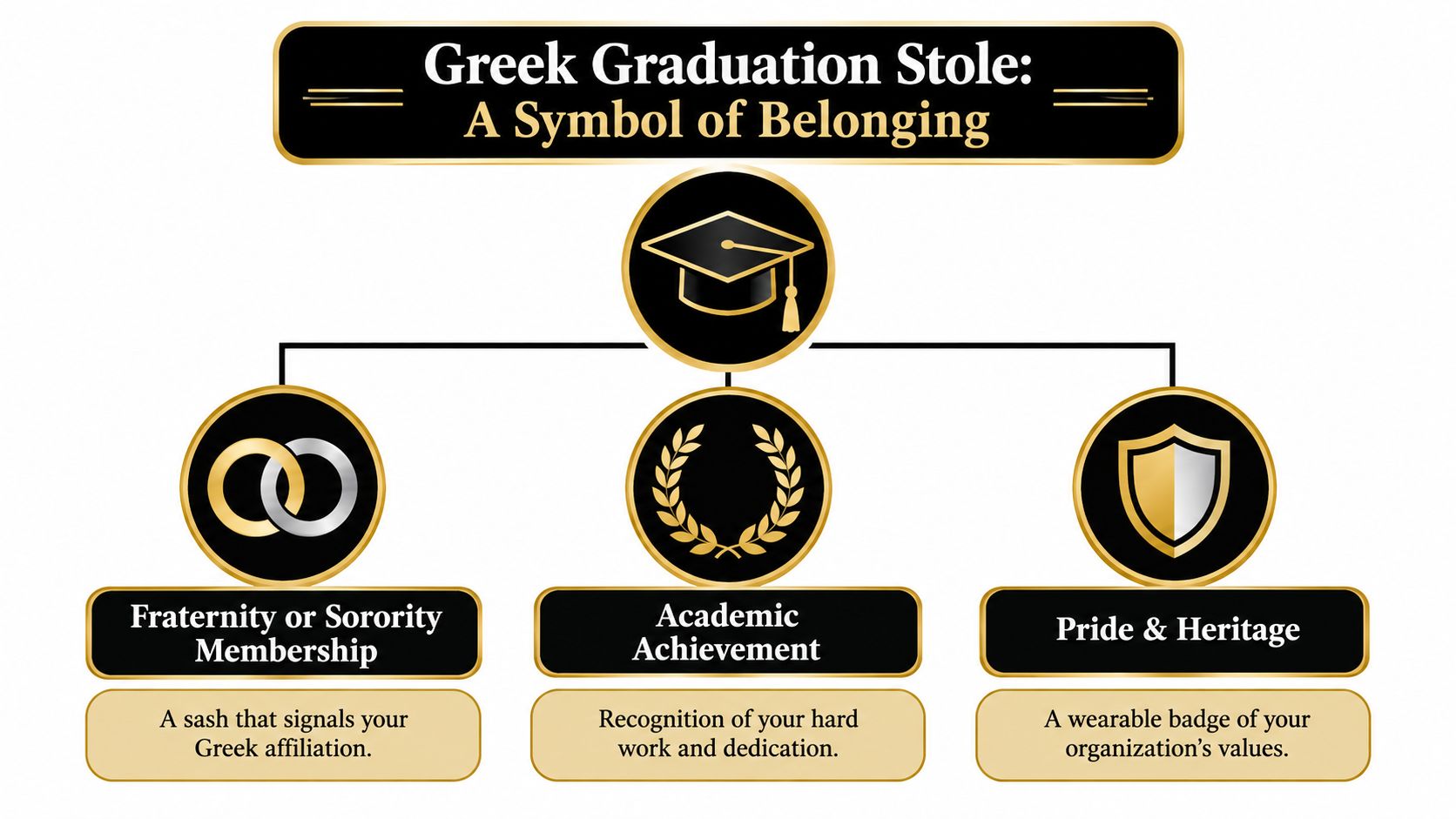
It helps to compare it with the other regalia students already know. An honor cord signals distinction. A medal signals recognition. A stole gives you a larger visual field to tell a more specific story. If cords are punctuation marks, the stole is the sentence.
That difference matters at commencement because people read regalia from far away and in a hurry. Family members spot color first. Classmates notice letters next. Photos keep whatever is clear enough to read in a split second.
What it looks like in practice
Most Greek stoles have the same basic form: one panel hanging down each side of the gown from the back of the neck. That simple shape is part of why the stole has become such a useful Greek-life symbol over the past century. As campus ceremonies became more photo-driven and more public, fraternities and sororities needed a piece that could carry identity clearly without changing the gown itself.
Students rarely question whether they want a stole. They question how to choose one that represents the chapter well and still looks balanced on stage.
A common layout puts large Greek letters high on one or both panels, with a founding year, crest, or chapter name lower down. That order works for the same reason a good campus sign works. You want the biggest message visible first, then the supporting details after.
A well-designed stole shows the chapter identity first, then lets smaller details support it.
For students comparing chapter styles, this guide to a sorority graduation stole can help clarify common design choices.
Why it matters beyond decoration
The stole matters because it ties two timelines together. One timeline is old. Greek-letter organizations have used colors, symbols, mottos, and insignia for generations to mark belonging and shared history. The other timeline is modern. Commencement today is photographed from every angle, viewed from the stands, and shared online within hours.
The stole sits right at that intersection. It carries chapter heritage, but it also has to work in real ceremony conditions. That is why etiquette and sizing decisions matter so much. A chapter may value a crest, but if the crest is too small to read from the audience, the symbol loses some of its public meaning. A student may love a long stole online, but if it hangs too low against the gown, the overall look can feel awkward instead of dignified.
In other words, the stole is symbolic clothing with a practical job.
How it differs from other stoles
Students often mix up Greek stoles with other recognition stoles because they all drape in a similar way. The clearest way to sort them is by what they are meant to represent.
- Greek stole: Shows fraternity or sorority affiliation and chapter identity.
- Honor stole: Marks academic achievement or institutional recognition.
- Cultural or identity stole: Represents heritage, community, or shared background.
Some graduates wear more than one stole if campus policy allows it. In that case, the goal is simple: each item should remain visible, readable, and respectful of the ceremony.
Materials Colors and Customization Options Explained
A Greek stole has to do two jobs at once. It should honor a tradition that reaches back through decades of chapter history, and it should still look clear and balanced under a modern graduation gown, in stage photos, and from family seating across the arena.
That is why material, color, and customization choices matter so much. They shape how the stole hangs, how the letters read, and whether the design feels dignified instead of crowded.
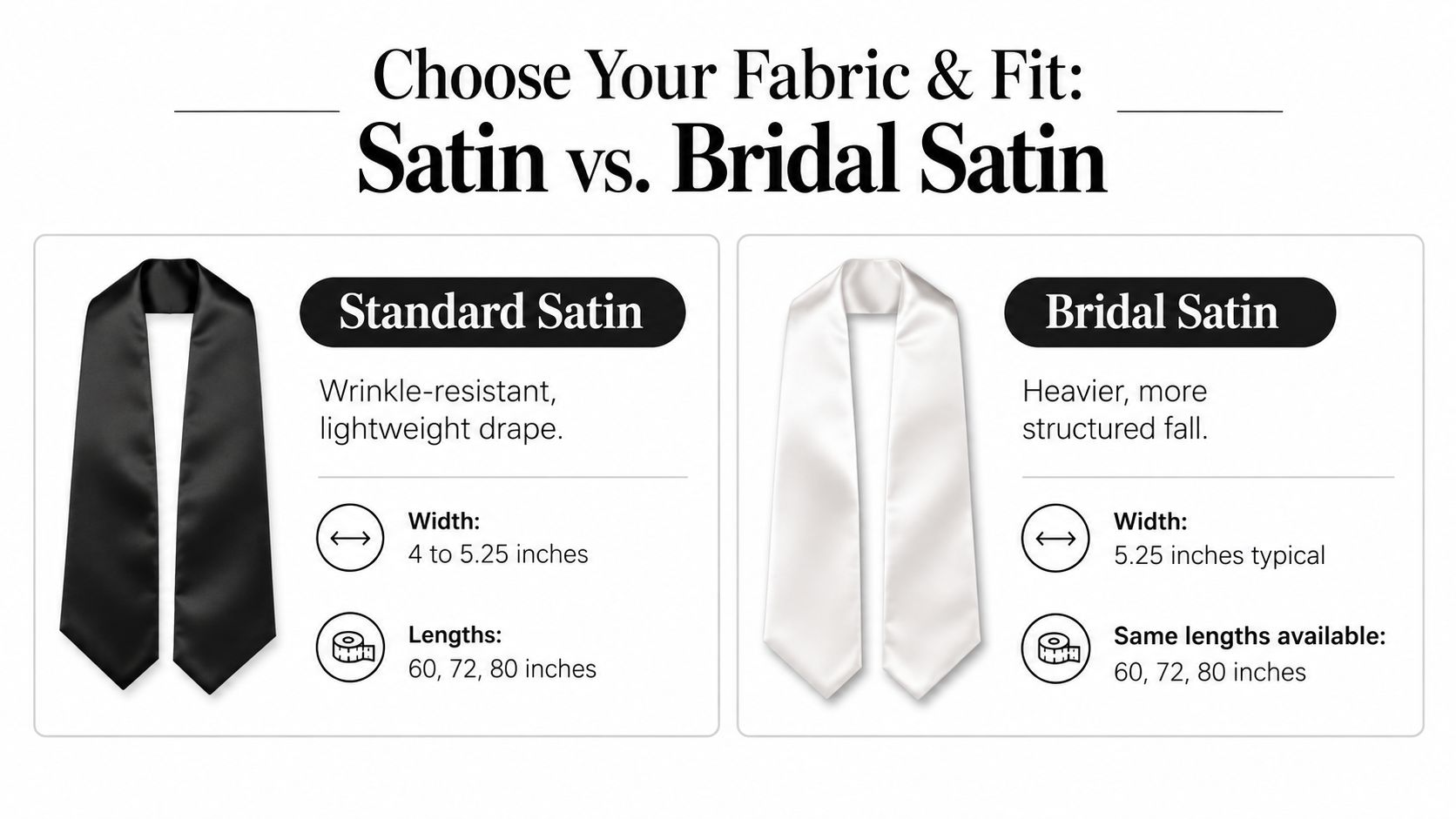
Most Greek graduation stoles are made in satin or bridal satin. The easiest way to separate them is by drape. Standard satin is lighter and tends to move more as you walk. Bridal satin has more body, so the front panels usually stay flatter and look a bit more formal.
Fabric and fit details that affect the look
Fabric choice affects visibility more than many students expect. A soft satin stole can look great in a product photo, then shift inward as you turn for a handshake or hug a family member after the ceremony. A firmer bridal satin stole usually resists that movement better.
Sizing matters for the same reason. According to this product guidance on Greek stole sizing and construction, common Greek stole lengths include 60, 72, and 80 inches, with widths around 4 to 5.25 inches. In practice, longer lengths often help the panels stay visible below the gown neckline and keep the design from disappearing into folds.
A simple way to picture it is this: the stole works like a sign hanging on fabric. If the sign is too short, too narrow, or too floppy, the message gets harder to read.
Color choice is part history, part ceremony logic
Color usually starts with official fraternity or sorority identity. That part is traditional. A chapter with established colors is carrying forward a visual system that members have recognized for generations.
But commencement adds a practical layer. Some color combinations look strong in chapter branding and weak on a black or navy gown. Light gold on white, for example, can lose contrast in bright sunlight. Deep red, royal blue, black, and gold usually read more clearly from a distance. If a chapter uses subtle colors, adding a border, stronger thread color, or darker lettering can keep the stole recognizable without abandoning chapter tradition.
That balance between heritage and readability is where many good decisions happen.
Lettering and symbol placement need a clear order
Customization works best when the stole has one main message. For Greek regalia, that is usually the letters.
Production examples show a common pattern: 2 Greek letters are often placed horizontally, while 3 letters are commonly arranged vertically unless otherwise specified. Some designs also use 2-inch or 3-inch stitched or appliqued Greek letters with embroidery hidden inside the lining for a cleaner back panel, as shown in this Greek stole construction example.
That layout helps the eye read the stole quickly.
- Horizontal two-letter layouts usually feel centered and bold.
- Vertical three-letter layouts save space and reduce crowding on the front panel.
- Hidden interior stitching gives the reverse side a cleaner finish.
If you also want a crest, class year, line name, or chapter name, treat the design like a poster. One headline should lead. Everything else should support it. On a commencement stage, oversized secondary text can distract from the Greek letters instead of strengthening the message.
Personalization works best with a simple decision framework
Students often add too much because every detail feels meaningful. That reaction makes sense. Graduation is one of the few times chapter history, personal identity, and school ceremony all show up in one outfit.
A cleaner approach is to choose customization in this order:
- Identity first. Start with official Greek letters and chapter colors.
- Visibility second. Choose fabric and letter size based on how far away people will view the stole.
- Personal details third. Add a name, class year, or crest only if the front panels still look balanced.
That framework also helps group orders. A chapter can keep fabric, color, and main lettering consistent, then allow smaller personal details on the lower panels.
One market example in this Greek stole collection reference lists a custom printed Greek graduation stole at $31.95, which gives students a rough sense of entry-level customization pricing. If you want a broader visual reference for layout choices across stole styles, this guide to a custom graduation stole shows how fabric, lettering, and spacing affect the final look.
A good Greek stole does not need every symbol your chapter has ever used. It needs the right symbols, in the right size, on the right fabric, so your chapter story is easy to recognize in one glance.
How to Choose the Right Greek Graduation Stole for You
You are in the campus bookstore a week before commencement, holding two stole mockups that both look right for different reasons. One matches your chapter colors perfectly. The other reads better from twenty rows back and will look clearer in photos with your gown. That is the choice for many seniors.
A good decision starts by separating history, visibility, and fit. Greek-letter stoles carry more than color. They point back to a long tradition of chapter identity on campus, but they also have to work in a very modern setting where families are taking photos, schools have dress rules, and graduates of different heights may be lining up side by side.
Start with the message you want the stole to send
Ask yourself what the stole needs to do first.
If you are ordering for one person, the first job may be personal recognition. Your letters should be easy to read, and any added details should still look balanced once the stole is on your gown. If you are ordering for a chapter, the first job is usually group consistency. In that case, matching layout matters more than giving every panel extra text.
The easiest way to choose is to rank these three goals in order:
- Chapter recognition. People should identify the organization quickly.
- Photo clarity. The stole should read clearly from the audience and in pictures.
- Keepsake value. Names, class year, or a crest can make it feel more personal after graduation.
That order helps because every added detail competes for space on a narrow front panel.
Use a contrast test before you approve the design
Students often focus on the stole by itself. Commencement guests see the whole outfit at once.
Set your stole color and lettering color against the gown color, even if only with a digital mockup or printed sample. A chapter color that looks strong on a table can disappear once it sits over a black, navy, or maroon gown. The goal is the same as a good road sign. People should read it quickly without squinting.
For a wider visual reference, this guide to types of graduation stoles shows how different stole formats frame text and symbols.
Here is a simple approval check:
- Can someone read the Greek letters from several steps away?
- Does the crest still look clear when the stole hangs naturally, not just in a flat mockup?
- Does the design still look balanced if cords or a medal sit near the collar?
- Does one detail dominate so much that the rest of the stole feels crowded?
If the answer to any of those is no, simplify before you order.
Break the decision into role, ceremony, and body frame
Many students get stuck, especially if two options both seem reasonable.
Use this three-part filter instead.
| Question | What to choose for |
|---|---|
| Who is the stole for? | One graduate can prioritize personal details. A chapter order should prioritize a shared look. |
| What kind of ceremony is it? | A large arena ceremony calls for clearer lettering and stronger contrast than a small indoor recognition event. |
| How will it sit on the wearer? | Panel spacing, letter placement, and overall proportion should match the graduate's frame and gown shape. |
Notice what is missing here. You do not need to re-decide every material and size spec from scratch if you already narrowed those in Section 3. At this stage, you are choosing which option fits your actual use case best.
Use tie-breakers that match real commencement situations
If two versions still seem equal, let the ceremony decide.
A senior crossing a football stadium stage usually benefits from clearer lettering and a simpler front panel. A chapter president ordering for fifteen members usually benefits from one shared layout that still looks orderly across different heights. A graduate who cares most about saving the stole as a keepsake may prefer cleaner symbolism over squeezing in every honor, office, and date.
A useful rule is this: if a detail only makes sense when you explain it up close, it probably does not belong on the front of the stole.
Graduation Cap and Gown also offers Greek, cultural, and custom stole options alongside other commencement items, which can help students or coordinators compare layouts while planning a full regalia order.
The best Greek graduation stole usually comes from restraint, not from adding more. It should honor chapter history, look right with your gown, and read clearly in the brief moment when you cross the stage.
Styling and Etiquette for Commencement Day
The common commencement scramble happens five minutes before lineup. A graduate has the gown zipped, cords on, a medal around the neck, and then pauses with the Greek stole in both hands, unsure what should sit on top and what should stay visible in photos.

The easiest way to handle that moment is to treat the stole as the main front panel of your regalia. It carries chapter identity in a form that dates back to long-standing Greek letter traditions, but commencement etiquette today is mostly about visibility and balance. On most campuses, the stole rests over the shoulders with cords and medals arranged so the stole lettering can still be seen. A general guide to graduation stole use at this graduation stole meaning guide also notes that stoles are usually optional, which reassures students who want to honor their organization without guessing at a hidden rule.
How to place it correctly
Start at the back of the neck and center the stole so both sides fall evenly down the front of the gown. Then smooth the panels with your hands before adding anything else.
That order matters. A stole works like the face frame on a portrait. If it sits crooked, every cord, medal, and photo will make the imbalance more obvious.
If you are wearing a medal, place it after the stole is centered so the ribbon or chain sits above it without covering the letters. If you are wearing cords, let them rest naturally along the gown instead of trapping the stole underneath. The goal is a clear front view that still reads well from several rows back, not only in close-up pictures.
What looks polished on stage
Stage styling is different from mirror styling.
A stole can look perfect in a dorm room and shift the second you sit down, stand up, hug family members, or turn for photos. That is why simple layouts have lasted for generations in Greek life regalia. Older chapter symbolism may be rich and layered, but modern commencement only gives each graduate a few visible seconds.
Use this quick check before key moments:
- Before lineup: make sure both panels hang to the same point on the gown
- Before photos: turn the front panels slightly outward so Greek letters face forward
- Before walking: check that medal ribbons or cords are not tucked under one side
- After standing up: smooth the stole again because seated fabric often twists
Students often ask for a visual demo before ceremony day. This short video can help you picture how regalia layers together in motion.
What etiquette actually asks you to do
Campus etiquette usually comes down to three practical choices. Wear the stole centered, keep the chapter lettering readable, and follow any commencement office rules about approved regalia.
That is why sizing and lettering choices matter here, not only when you order. A longer stole can look graceful on a tall graduate in a large outdoor ceremony, but it can also tangle with cords if it hangs too low. A shorter or more fitted style often works better for smaller frames, crowded seating, or ceremonies where several honors must share space near the collar. In the same way, bold lettering helps on a stadium stage, while finer embroidery can suit a smaller indoor event where guests are closer.
Good etiquette is clear communication through clothing. Your stole should show chapter pride, respect the ceremony, and stay readable during the brief walk that everyone will remember.
Care Storage and Ordering Timelines That Save Stress
The stress usually starts the night before commencement. A student pulls a stole from a plastic sleeve, finds a hard fold across the chest, then notices one letter was placed the wrong way in the proof they approved too quickly. Both problems were avoidable.
Greek-letter regalia carries old chapter identity into a modern ceremony, so care and timing matter for more than appearance. A stole has to do two jobs at once. It needs to look polished in photos, and it needs to present chapter letters clearly for a short walk across the stage. That is why good planning starts with three choices early on: fabric, length, and lettering.
Care that protects satin and stitching
Satin behaves a bit like a dress shirt with a glossy finish. It shows pressure marks and fold lines faster than heavier fabrics, so rough handling leaves visible results. Direct ironing can flatten the surface or leave shine spots, especially near embroidered areas.
Use a simple care routine:
- Hang it as soon as it arrives: Time helps soft folds relax.
- Steam lightly from a safe distance: Gentle moisture is usually kinder than pressing heat directly onto the fabric.
- Keep it dry and separate: A stole should not be crammed into a pocket with cords, pins, or shoes.
- Watch the lettering and trim: Embroidery, applique edges, and metallic thread can catch on zippers or jewelry during travel.
One small habit helps a lot. Carry the stole flat or on a hanger until you dress. Most snags and creases happen in transit to the venue, not during the ceremony itself.
Ordering early gives you room to fix real problems
Ordering early is less about being extra organized and more about giving yourself a correction window. Greek life customs go back more than a century, but modern stole ordering works like any other customized regalia purchase. You pick a base fabric, choose a length that fits your gown frame, and approve lettering that needs to read clearly from a distance.
That process sounds simple until details stack up. A shiny satin can make contrast lettering pop on an outdoor stage, while a matte finish may photograph more softly indoors. A 72-inch stole often gives a more traditional drop on average-height graduates, but a 60-inch option can sit cleaner on a shorter frame or on a gown already sharing space with cords and medals. Large Greek letters are easier to read in stadium seating. Smaller script may look elegant up close but disappear from family photos.
Those are sizing and etiquette decisions, not only design preferences.
For chapter officers, the main pressure point is proof approval. Group orders can go wrong in quiet ways: the wrong shade of thread, letters facing inward, inconsistent chapter names, or mixed lengths that look uneven in line. One careful proof check protects the whole group.
A practical timeline for students and coordinators
Use this sequence like a packing list for a trip. Each step prevents a different kind of problem.
| Timing stage | What to do | Why it matters |
|---|---|---|
| Early planning | Check commencement rules for chapter stoles and confirm who is ordering | Prevents last-minute regalia conflicts |
| Selection stage | Choose fabric, length, and lettering size based on your height, gown fit, and ceremony setting | Helps the stole read clearly and hang well |
| Proof review | Verify spelling, Greek-letter orientation, colors, and any graduation year or office held | Small mistakes stand out quickly on the front panels |
| Arrival week | Unpack, inspect, and hang the stole right away | Gives you time to spot errors and relax creases |
| Travel and ceremony week | Pack it flat, keep it away from rough items, and do one light steam test if needed | Reduces snags, shine marks, and rush repairs |
If you remember one rule, make it this one. Order with enough time to choose well, not just enough time to receive the package.
A Greek graduation stole is a small piece of fabric, but it carries chapter history, public symbolism, and very practical fit decisions all at once. Treat it like part of your regalia plan, not an accessory you can figure out at the last minute.
Greek Graduation Stole FAQs for Students and Coordinators
You are in line outside the arena, your chapter is taking photos, and one stole hangs almost to the gown hem while another sits much higher on the chest. That is usually the moment students and coordinators realize a Greek stole is not just a color choice. It is part history symbol, part fit decision, and part ceremony rule.
Greek-letter organizations have been carrying visual traditions for generations, so these questions come up for good reason. A stole has to honor chapter identity and still sit correctly with a modern cap-and-gown setup.
Is one size really right for everyone
Usually, no.
A standard length works for many graduates, but not for every height or gown frame. Shorter students often prefer a shorter stole so the ends do not drop too low on the front of the gown. Taller students, or chapters that want a more traditional full-length look in photos, often prefer the longer option.
The easiest way to judge it is to treat the stole like a tie or scarf. Proportion matters. A stole that is too long can overpower a smaller frame. A stole that is too short can make lettering harder to notice from the audience.
How does a shorter stole versus a longer stole change the look
A shorter stole usually looks tidier and lighter on the gown. It keeps the eye higher, which many petite graduates like in portraits and on stage.
A longer stole creates more vertical presence. That often matches the classic commencement look people expect in chapter group photos.
If you are unsure, do a mirror test with your gown on. Look at where the ends fall, how much front panel shows, and whether the lettering sits where people can read it. The best choice is the one that fits your body and still presents your chapter clearly.
Do trim and end shape matter
They do, mainly in how polished the stole looks.
Trim works like a picture frame. It outlines the fabric and can make chapter colors read more clearly from a distance. End shape affects the final silhouette. Straight ends often look clean and formal. Pointed or angled ends can feel more decorative, depending on the design.
These details should come after the big three decisions: fabric, length, and lettering. Once those are right, trim and end shape help finish the piece.
What should coordinators confirm before a group order
Start with the questions that affect the whole line of graduates, not just one person.
- Campus approval: Confirm that organizational stoles are allowed at commencement.
- Chapter wording: Use one exact version of the chapter name, office titles, and Greek-letter orientation.
- Length choices: Decide whether the chapter wants one shared length or a split option for different heights.
- Design standards: Agree on fabric color, thread color, crest placement, and lettering style before proofs are approved.
Chapter history meets modern etiquette. A chapter may have used the same symbols for decades, but commencement still asks for visual consistency. A coordinated order should respect both.
What if I am also wearing cords, medals, or other recognition items
Test the full combination before ceremony day.
Lay out the stole, cords, medals, and gown, then put everything on in the order you will wear it. Cords should rest without twisting. Medals should not pull one stole panel inward. The Greek letters should stay visible when you move, sit, and stand for photos.
A quick dress rehearsal at home prevents the kind of small problems that look large in group pictures.
Who should make the final call on design details
For a single student, the final check usually comes down to fit and readability.
For a chapter order, one coordinator should collect member names, confirm spelling, and approve the final proof against the chapter's agreed design. Too many last-minute editors often create the exact problems chapters are trying to avoid.
Can students choose different styles within the same chapter
They can, but the chapter should decide where flexibility ends.
A good rule is this: keep the shared identity elements the same, then allow small fit-based changes if needed. For example, all members might use the same satin color, Greek letters, and crest placement, while shorter members choose a shorter length. That approach keeps the line unified without forcing every body into the same proportions.
If you're choosing a Greek graduation stole, matching it with cords, or ordering for a chapter, Graduation Cap and Gown offers Greek, custom, and specialty regalia options for common commencement needs. You can compare stole styles, review accessory options, and build a regalia set that fits both your ceremony rules and your chapter identity.